Flora of Interstate State Park, Polk County, Wisconsin
Total Page:16
File Type:pdf, Size:1020Kb
Load more
Recommended publications
-

Field Release of the Leaf-Feeding Moth, Hypena Opulenta (Christoph)
United States Department of Field release of the leaf-feeding Agriculture moth, Hypena opulenta Marketing and Regulatory (Christoph) (Lepidoptera: Programs Noctuidae), for classical Animal and Plant Health Inspection biological control of swallow- Service worts, Vincetoxicum nigrum (L.) Moench and V. rossicum (Kleopow) Barbarich (Gentianales: Apocynaceae), in the contiguous United States. Final Environmental Assessment, August 2017 Field release of the leaf-feeding moth, Hypena opulenta (Christoph) (Lepidoptera: Noctuidae), for classical biological control of swallow-worts, Vincetoxicum nigrum (L.) Moench and V. rossicum (Kleopow) Barbarich (Gentianales: Apocynaceae), in the contiguous United States. Final Environmental Assessment, August 2017 Agency Contact: Colin D. Stewart, Assistant Director Pests, Pathogens, and Biocontrol Permits Plant Protection and Quarantine Animal and Plant Health Inspection Service U.S. Department of Agriculture 4700 River Rd., Unit 133 Riverdale, MD 20737 Non-Discrimination Policy The U.S. Department of Agriculture (USDA) prohibits discrimination against its customers, employees, and applicants for employment on the bases of race, color, national origin, age, disability, sex, gender identity, religion, reprisal, and where applicable, political beliefs, marital status, familial or parental status, sexual orientation, or all or part of an individual's income is derived from any public assistance program, or protected genetic information in employment or in any program or activity conducted or funded by the Department. (Not all prohibited bases will apply to all programs and/or employment activities.) To File an Employment Complaint If you wish to file an employment complaint, you must contact your agency's EEO Counselor (PDF) within 45 days of the date of the alleged discriminatory act, event, or in the case of a personnel action. -

"National List of Vascular Plant Species That Occur in Wetlands: 1996 National Summary."
Intro 1996 National List of Vascular Plant Species That Occur in Wetlands The Fish and Wildlife Service has prepared a National List of Vascular Plant Species That Occur in Wetlands: 1996 National Summary (1996 National List). The 1996 National List is a draft revision of the National List of Plant Species That Occur in Wetlands: 1988 National Summary (Reed 1988) (1988 National List). The 1996 National List is provided to encourage additional public review and comments on the draft regional wetland indicator assignments. The 1996 National List reflects a significant amount of new information that has become available since 1988 on the wetland affinity of vascular plants. This new information has resulted from the extensive use of the 1988 National List in the field by individuals involved in wetland and other resource inventories, wetland identification and delineation, and wetland research. Interim Regional Interagency Review Panel (Regional Panel) changes in indicator status as well as additions and deletions to the 1988 National List were documented in Regional supplements. The National List was originally developed as an appendix to the Classification of Wetlands and Deepwater Habitats of the United States (Cowardin et al.1979) to aid in the consistent application of this classification system for wetlands in the field.. The 1996 National List also was developed to aid in determining the presence of hydrophytic vegetation in the Clean Water Act Section 404 wetland regulatory program and in the implementation of the swampbuster provisions of the Food Security Act. While not required by law or regulation, the Fish and Wildlife Service is making the 1996 National List available for review and comment. -

Checklist of Common Native Plants the Diversity of Acadia National Park Is Refl Ected in Its Plant Life; More Than 1,100 Plant Species Are Found Here
National Park Service Acadia U.S. Department of the Interior Acadia National Park Checklist of Common Native Plants The diversity of Acadia National Park is refl ected in its plant life; more than 1,100 plant species are found here. This checklist groups the park’s most common plants into the communities where they are typically found. The plant’s growth form is indicated by “t” for trees and “s” for shrubs. To identify unfamiliar plants, consult a fi eld guide or visit the Wild Gardens of Acadia at Sieur de Monts Spring, where more than 400 plants are labeled and displayed in their habitats. All plants within Acadia National Park are protected. Please help protect the park’s fragile beauty by leaving plants in the condition that you fi nd them. Deciduous Woods ash, white t Fraxinus americana maple, mountain t Acer spicatum aspen, big-toothed t Populus grandidentata maple, red t Acer rubrum aspen, trembling t Populus tremuloides maple, striped t Acer pensylvanicum aster, large-leaved Aster macrophyllus maple, sugar t Acer saccharum beech, American t Fagus grandifolia mayfl ower, Canada Maianthemum canadense birch, paper t Betula papyrifera oak, red t Quercus rubra birch, yellow t Betula alleghaniesis pine, white t Pinus strobus blueberry, low sweet s Vaccinium angustifolium pyrola, round-leaved Pyrola americana bunchberry Cornus canadensis sarsaparilla, wild Aralia nudicaulis bush-honeysuckle s Diervilla lonicera saxifrage, early Saxifraga virginiensis cherry, pin t Prunus pensylvanica shadbush or serviceberry s,t Amelanchier spp. cherry, choke t Prunus virginiana Solomon’s seal, false Maianthemum racemosum elder, red-berried or s Sambucus racemosa ssp. -

State of New York City's Plants 2018
STATE OF NEW YORK CITY’S PLANTS 2018 Daniel Atha & Brian Boom © 2018 The New York Botanical Garden All rights reserved ISBN 978-0-89327-955-4 Center for Conservation Strategy The New York Botanical Garden 2900 Southern Boulevard Bronx, NY 10458 All photos NYBG staff Citation: Atha, D. and B. Boom. 2018. State of New York City’s Plants 2018. Center for Conservation Strategy. The New York Botanical Garden, Bronx, NY. 132 pp. STATE OF NEW YORK CITY’S PLANTS 2018 4 EXECUTIVE SUMMARY 6 INTRODUCTION 10 DOCUMENTING THE CITY’S PLANTS 10 The Flora of New York City 11 Rare Species 14 Focus on Specific Area 16 Botanical Spectacle: Summer Snow 18 CITIZEN SCIENCE 20 THREATS TO THE CITY’S PLANTS 24 NEW YORK STATE PROHIBITED AND REGULATED INVASIVE SPECIES FOUND IN NEW YORK CITY 26 LOOKING AHEAD 27 CONTRIBUTORS AND ACKNOWLEGMENTS 30 LITERATURE CITED 31 APPENDIX Checklist of the Spontaneous Vascular Plants of New York City 32 Ferns and Fern Allies 35 Gymnosperms 36 Nymphaeales and Magnoliids 37 Monocots 67 Dicots 3 EXECUTIVE SUMMARY This report, State of New York City’s Plants 2018, is the first rankings of rare, threatened, endangered, and extinct species of what is envisioned by the Center for Conservation Strategy known from New York City, and based on this compilation of The New York Botanical Garden as annual updates thirteen percent of the City’s flora is imperiled or extinct in New summarizing the status of the spontaneous plant species of the York City. five boroughs of New York City. This year’s report deals with the City’s vascular plants (ferns and fern allies, gymnosperms, We have begun the process of assessing conservation status and flowering plants), but in the future it is planned to phase in at the local level for all species. -

The 1700 Native Plants of Bucks County, PA
The 1700 Native Plants of Bucks County, PA Bucks County, PA is blessed with an enormous range of physiographic regions, soil types, and hydrological conditions. Habitats range from the diabase areas of the Upper Bucks to the coastal plains of Lower Bucks, high palisades of the Delaware River to bog remnants, pristine freshwater ponds to tidal areas. These varied conditions host a dizzying array of species, sub‐species, and naturally‐occurring varieties. Common species are regularly available from ArcheWild; many can be grown under contract. Call ArcheWild at 855‐752‐6862 or e‐mail us for more information at: contact@archewild.com Symbol Scientific Name Common Name ACGR2 Acalypha gracilens slender threeseed mercury ACRH Acalypha rhomboidea common threeseed mercury ACVI Acalypha virginica Virginia threeseed mercury ACNE2 Acer negundo boxelder ACNEN Acer negundo var. negundo boxelder ACPE Acer pensylvanicum striped maple ACRU Acer rubrum red maple ACRUR Acer rubrum var. rubrum red maple ACRUT Acer rubrum var. trilobum red maple ACSA2 Acer saccharinum silver maple ACSA3 Acer saccharum sugar maple ACSAS Acer saccharum var. saccharum sugar maple ACSP2 Acer spicatum mountain maple ACMI2 Achillea millefolium common yarrow ACPA Actaea pachypoda white baneberry ACRA7 Actaea racemosa black baneberry ACRAR Actaea racemosa var. racemosa black bugbane ADPE Adiantum pedatum northern maidenhair ADFU Adlumia fungosa allegheny vine AEFL Aesculus flava yellow buckeye AGAU3 Agalinis auriculata earleaf false foxglove AGPU5 Agalinis purpurea purple false foxglove -

Prairie Restorations, Inc. 2021 Product Availability List Plants
Prairie Restorations, Inc. 2021 Product Availability List Plants Golden Alexander Wild geranium Pasque flower Canada anemone Leadplant Harebell Wildflowers Preferred Growing Conditions Prices * Denotes northern species Soil Exposure Size Characteristics/ Common Name Scientific Name preferred habitat Dry Mesic (Medium) Wet Emergent Full Sun Sun Partial Full Shade Height Color Flower Plugs 6-Pack 4-inch Pot Pot 1 gallon Yarrow Achillea millefolium can be aggressive l l l l l 1-2.5’ W $9.00 $5.25 Sweet flag Acorus americanus wet edges & shorelines l l l l 3-5’ Y/G $9.00 $5.25 Red baneberry Actaea rubra woods l l l 2-3’ W/R $5.25 $15.00 Fragrant giant hyssop Agastache foeniculum savannas l l l l 3-5’ PU $9.00 $5.25 White snakeroot Ageratina altissima rich woods l l l 2-3’ W $9.00 Water plantain Alisma subcordatum mud flats l l l l 1-2’ W $9.00 $5.25 Meadow garlic Allium canadense wet prairies l l l 1-2’ PU $9.00 Prairie onion Allium stellatum dry hilltops l l l 1-1.5’ PK $9.00 $5.25 Wild leek Allium tricoccum woods l l l 1’ W $9.00 $5.25 Leadplant Amorpha canescens semi-woody legume l l l l 2-3’ PU $9.00 $5.25 $15.00 Pearly everlasting* Anaphalis margaritacea woods edge, meadows l l l l 1-2’ W $9.00 Canada anemone Anemone canadensis sedge meadow l l l 1-2’ W $9.00 $5.25 Thimbleweed Anemone cylindrica dry sands, savannas l l l l 1-2’ C $9.00 $5.25 Pasque flower Anemone patens outcrops & thin soils l l l 4-6” PU $9.00 $5.25 Wood anemone Anemone quinquefolia woodland groundcover l l l l 4-6” W $9.00 $5.25 Tall thimbleweed Anemone virginiana -

2019 Ecological Indicator Report
2019 CFLRP Ecological Indicator Progress Report OVERVIEW Introduction In 2011, the National Forest Foundation convened CFLRP participants to develop a set of national indicators. The resulting five indicators are economic impacts, fire risk and costs, collaboration, leveraged funds, and ecological condition. Data to support these five indicators comes from a number of sources, including the Treatment for Restoration Economic Analysis Toolkit, collaboration surveys conducted by NFF, and the Annual Reports. Projects first reported on ecological indicators in 2014. Since then, the CFLRP staff in the US Forest Service Washington Office have worked with colleagues and partners to review and update to template to make improvements while maintaining a consistent protocol to 2014. The intent of the 2019 CFLRP Ecological Indicator Progress Report is to better understand your progress in advancing ecological outcomes. It is not intended to capture everything about your monitoring activities. To aid you in filling out this report, we recommend that you read the new 2019 Guidance Document. We also recommend that you reference your past Annual Reports and your 2014 Ecological Indicator Progress Reports. For additional help, please email CFLRP@fs.fed.us. We appreciate the time and energy you dedicate to completing this progress report. This information is critical for understanding the ecological outcomes of your work, telling the national story, supporting communication and transparency, and sharing successful approaches and practices across the nation. -

Species List For: Valley View Glades NA 418 Species
Species List for: Valley View Glades NA 418 Species Jefferson County Date Participants Location NA List NA Nomination and subsequent visits Jefferson County Glade Complex NA List from Gass, Wallace, Priddy, Chmielniak, T. Smith, Ladd & Glore, Bogler, MPF Hikes 9/24/80, 10/2/80, 7/10/85, 8/8/86, 6/2/87, 1986, and 5/92 WGNSS Lists Webster Groves Nature Study Society Fieldtrip Jefferson County Glade Complex Participants WGNSS Vascular Plant List maintained by Steve Turner Species Name (Synonym) Common Name Family COFC COFW Acalypha virginica Virginia copperleaf Euphorbiaceae 2 3 Acer rubrum var. undetermined red maple Sapindaceae 5 0 Acer saccharinum silver maple Sapindaceae 2 -3 Acer saccharum var. undetermined sugar maple Sapindaceae 5 3 Achillea millefolium yarrow Asteraceae/Anthemideae 1 3 Aesculus glabra var. undetermined Ohio buckeye Sapindaceae 5 -1 Agalinis skinneriana (Gerardia) midwestern gerardia Orobanchaceae 7 5 Agalinis tenuifolia (Gerardia, A. tenuifolia var. common gerardia Orobanchaceae 4 -3 macrophylla) Ageratina altissima var. altissima (Eupatorium rugosum) white snakeroot Asteraceae/Eupatorieae 2 3 Agrimonia pubescens downy agrimony Rosaceae 4 5 Agrimonia rostellata woodland agrimony Rosaceae 4 3 Allium canadense var. mobilense wild garlic Liliaceae 7 5 Allium canadense var. undetermined wild garlic Liliaceae 2 3 Allium cernuum wild onion Liliaceae 8 5 Allium stellatum wild onion Liliaceae 6 5 * Allium vineale field garlic Liliaceae 0 3 Ambrosia artemisiifolia common ragweed Asteraceae/Heliantheae 0 3 Ambrosia bidentata lanceleaf ragweed Asteraceae/Heliantheae 0 4 Ambrosia trifida giant ragweed Asteraceae/Heliantheae 0 -1 Amelanchier arborea var. arborea downy serviceberry Rosaceae 6 3 Amorpha canescens lead plant Fabaceae/Faboideae 8 5 Amphicarpaea bracteata hog peanut Fabaceae/Faboideae 4 0 Andropogon gerardii var. -

Oklahoma Natural Heritage Inventory Plant Tracking List
OKLAHOMA NATURAL HERITAGE INVENTORY PLANT TRACKING LIST FAMILY UPDATED NAME COMMON NAME SRANK GRANK Acanthaceae Dyschoriste linearis (Torr. & A. Gray) Kuntze var. linearis polkadots S1T1 G4G5TNR Aizoaceae Sesuvium verrucosum Raf. winged sea purslane S1 G5 Alismataceae Alisma triviale Pursh northern water plantain S2 G5 Echinodorus tenellus (Mart.) Buchenau dwarf burhead SH G5? Sagittaria ambigua J.G. Sm. Kansas arrowhead S2 G2? Sagittaria cuneata E. Sheld. Wapatum arrowhead S2 G5 Amaranthaceae Amaranthus scleropoides Uline & W.L. Bray bone-bract pigweed SH G5 Chenopodium pallescens Standl. narrow-leaved goosefoot S1 G5 Guilleminea densa (Humb. & Bonpl. ex Schult.) Moq. cottonflower SNRTNR G5TNR var. aggregata Uline & W.L. Bray Guilleminea densa (Humb. & Bonpl. ex Schult.) Moq. cottonflower SNRTNR G5TNR var. densa Krascheninnikovia lanata (Pursh) A. Meeuse & A. Smit winterfat S1 G5 Suckleya suckleyana (Torr.) Rydb. poison suckleya S1 G5 Amaryllidaceae Hymenocallis liriosme (Raf.) Shinners Texas spiderlily S2 G4? Hymenocallis occidentalis (J. Le Conte) Kunth var. northern spiderlily S1T1 GNRTNR eulae (Shinners) G. Lom. Sm. & Flory Hymenocallis occidentalis (J. Le Conte) Kunth var. S1T1 GNRTNR occidentalis northern spiderlily Anacardiaceae Cotinus obovatus Raf. American smoketree S2 G4 Rhus copallinum L. var. lanceolata A. Gray prairie sumac SNAT1 G5T4T5 Rhus microphylla Engelm. ex A. Gray little-leaved sumac S1 G4G5 Apiaceae Berula erecta (Huds.) Coville wild parsnip S2 G4G5 Bowlesia incana Ruiz & Pav. hoary bowlesia SH G5 Erigenia bulbosa (Michx.) Nutt. harbinger-of-spring S1 G5 Eryngium diffusum Torr. spreading eryngo SH G4? Eryngium hookeri Walp. Hooker's eryngo S1 G3G5 Eryngium integrifolium Walter blue-flower coyotethistle S1 G5 Perideridia americana (Nutt. ex DC.) Rchb. eastern eulophus S1 G4 Ptilimnium costatum Raf. -
Floristic Quality Assessment Report
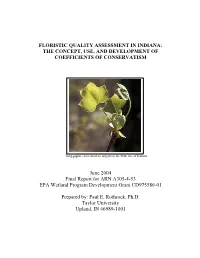
FLORISTIC QUALITY ASSESSMENT IN INDIANA: THE CONCEPT, USE, AND DEVELOPMENT OF COEFFICIENTS OF CONSERVATISM Tulip poplar (Liriodendron tulipifera) the State tree of Indiana June 2004 Final Report for ARN A305-4-53 EPA Wetland Program Development Grant CD975586-01 Prepared by: Paul E. Rothrock, Ph.D. Taylor University Upland, IN 46989-1001 Introduction Since the early nineteenth century the Indiana landscape has undergone a massive transformation (Jackson 1997). In the pre-settlement period, Indiana was an almost unbroken blanket of forests, prairies, and wetlands. Much of the land was cleared, plowed, or drained for lumber, the raising of crops, and a range of urban and industrial activities. Indiana’s native biota is now restricted to relatively small and often isolated tracts across the State. This fragmentation and reduction of the State’s biological diversity has challenged Hoosiers to look carefully at how to monitor further changes within our remnant natural communities and how to effectively conserve and even restore many of these valuable places within our State. To meet this monitoring, conservation, and restoration challenge, one needs to develop a variety of appropriate analytical tools. Ideally these techniques should be simple to learn and apply, give consistent results between different observers, and be repeatable. Floristic Assessment, which includes metrics such as the Floristic Quality Index (FQI) and Mean C values, has gained wide acceptance among environmental scientists and decision-makers, land stewards, and restoration ecologists in Indiana’s neighboring states and regions: Illinois (Taft et al. 1997), Michigan (Herman et al. 1996), Missouri (Ladd 1996), and Wisconsin (Bernthal 2003) as well as northern Ohio (Andreas 1993) and southern Ontario (Oldham et al. -

A Potential Understory Flora for Oak Savanna in Iowa
Journal of the Iowa Academy of Science: JIAS Volume 103 Number 1-2 Article 4 1996 A Potential Understory Flora for Oak Savanna in Iowa Karl T. Delong Grinnell College Craig Hooper Grinnell College Let us know how access to this document benefits ouy Copyright © Copyright 1996 by the Iowa Academy of Science, Inc. Follow this and additional works at: https://scholarworks.uni.edu/jias Part of the Anthropology Commons, Life Sciences Commons, Physical Sciences and Mathematics Commons, and the Science and Mathematics Education Commons Recommended Citation Delong, Karl T. and Hooper, Craig (1996) "A Potential Understory Flora for Oak Savanna in Iowa," Journal of the Iowa Academy of Science: JIAS, 103(1-2), 9-28. Available at: https://scholarworks.uni.edu/jias/vol103/iss1/4 This Research is brought to you for free and open access by the Iowa Academy of Science at UNI ScholarWorks. It has been accepted for inclusion in Journal of the Iowa Academy of Science: JIAS by an authorized editor of UNI ScholarWorks. For more information, please contact scholarworks@uni.edu. ]our. Iowa Acad. Sci. 103(1-2):9-28, 1996 A Potential U nderstory Flora for Oak Savanna in Iowa KARL T. DELONG and CRAIG HOOPER Department of Biology and Conard Environmental Research Area Grinnell College, Grinnell, Iowa 50112 Oak savanna occurred in Iowa until the time of settlement and then was degraded rapidly. There were no scientific studies of savan na pnor to, or after, settlement, and now no high-quality examples exist within the state. To identify those vascular plants adapted to live m the u.nderstory of savai:ina we exammed reg10nal and local flora for species that occurred in both prairie and broken woodland, and for species that occurred m both openmgs and forest. -
Lessons from an Inventory of the Ames, Iowa, Flora (1859-2000) William R
NCRPIS Publications and Papers North Central Regional Plant Introduction Station 2001 Lessons From an Inventory of the Ames, Iowa, Flora (1859-2000) William R. Norris Western New Mexico University Deborah Q. Lewis Iowa State University Mark P. Widrlechner United States Department of Agriculture, isumw@iastate.edu Jimmie D. Thompson Richard O. Pope Iowa State University Follow this and additional works at: http://lib.dr.iastate.edu/ncrpis_pubs Part of the Agricultural Science Commons, Botany Commons, and the Entomology Commons The ompc lete bibliographic information for this item can be found at http://lib.dr.iastate.edu/ ncrpis_pubs/74. For information on how to cite this item, please visit http://lib.dr.iastate.edu/ howtocite.html. This Article is brought to you for free and open access by the North Central Regional Plant Introduction Station at Iowa State University Digital Repository. It has been accepted for inclusion in NCRPIS Publications and Papers by an authorized administrator of Iowa State University Digital Repository. For more information, please contact digirep@iastate.edu. lour. Iowa Acad. Sci. 108(2):34-63, 2001 Lessons From an Inventory of the Ames, Iowa, Flora (1859-2000) WILLIAM R. NORRIS1, DEBORAH Q. LEWIS2*, MARK P. WIDRLECHNER3, JIMMIED. THOMPSON4 and RICHARD 0. POPE5 .i 1Department of Natural Sciences, Western New Mexico University, Silver City, New Mexico 88061 2Department of Botany, Iowa State University, Ames, Iowa 50011-1020 3U.S. Department of Agriculture, Agricultural Research Service, North Central Regional Plant Introduction Station, Department of Agronomy, Iowa State University, Ames, Iowa 50011-1170 419516 515 Ave., Ames, Iowa 50014 5Department of Entomology, Iowa State University, Ames, Iowa 50011-3140 A botanical survey of the vascular flora of the "planning and zoning jurisdiction" of the city of Ames, Iowa (i.e., the area within a boundary 3.2 km beyond the current city limits) was compiled from 1990 to 2000.