Aqua, International Journal of Ichthyology
Total Page:16
File Type:pdf, Size:1020Kb
Load more
Recommended publications
-

Jarvis Island NWR Final
Jarvis Island National Wildlife Refuge Comprehensive Conservation Plan FINDING OF NO SIGNIFICANT IMPACT Jarvis Island National Wildlife Refuge Comprehensive Conservation Plan Unincorporated U.S. Territory, Central Pacific Ocean The U.S. Fish and Wildlife Service (Service) has completed the Comprehensive Conservation Plan (CCP) and Environmental Assessment (EA) for Jarvis Island National Wildlife Refuge (Refuge). The CCP will guide management of the Refuge for the next 15 years. The CCP and EA describe the Service’s preferred alternative for managing the Refuge and its effects on the human environment. Decision Following comprehensive review and analysis, the Service selected Alternative B in the draft EA for implementation because it is the alternative that best meets the following criteria: Achieves the mission of the National Wildlife Refuge System. Achieves the purposes of the Refuge. Will be able to achieve the vision and goals for the Refuge. Maintains and restores the ecological integrity of the habitats and plant and animal populations at the Refuge. Addresses the important issues identified during the scoping process. Addresses the legal mandates of the Service and the Refuge. Is consistent with the scientific principles of sound wildlife management. Can be implemented within the projected fiscal and logistical management constraints associated with the Refuge’s remote location. As described in detail in the CCP and EA, implementing the selected alternative will have no significant impacts on any of the natural or cultural resources identified in the CCP and EA. Public Review The planning process incorporated a variety of public involvement techniques in developing and reviewing the CCP. This included three planning updates, meetings with partners, and public review and comment on the planning documents. -

Symphysanodon Pitondelafournaisei a New Species Of
Symphysanodon pitondelafournaisei : une nouvelle espèce de Symphysanodontidae (Perciformes) de l’île de La Réunion (France, océan Indien) par Jean-Claude QUÉRO (1), Jérôme SPITZ (2, 3) & Jean-Jacques VAYNE (4) RÉSUMÉ. - Du 8 au 11 avril 2007, à l’île de La Réunion, parmi les poissons récoltés à la surface, suite à l’arrivée de la coulée de lave de l’éruption volcanique dans l’océan, figuraient 2 exemplaires deSymphysanodon (Perciformes: Symphy- sanodontidae). Ces spécimens appartiennent à une espèce nouvelle se distinguant des espèces indopacifiques connues pour ce genre par un ensemble de caractères : 19 rayons à la nageoire caudale ; 15 rayons aux pectorales ; 48-50 écailles sur la ligne latérale ; 34-36 branchicténies sur le 1er arc branchial ; une longue anale couchée (33-38,5% LS) ; de longues pectora- les (30% LS) ; des yeux assez grands (10-11% LS). Ils sont décrits sous le nom de Symphysanodon pitondelafournaisei. ABSTRACT. - Symphysanoson pitondelafournaisei a new species of Symphysanodontidae (Perciformes) from Reunion Island. From the 8th to the 11th April 2007 at Reunion Island (Indian Ocean) some fish were collected at sea surface after the eruption of the Piton de la Fournaise. Among these are two specimens of Symphysanodon (Perciformes: Symphy- sanodontidae). This family was recently reviewed (Anderson and Springer, 2005). Ten species have been described: three from the Atlantic Ocean S. berryi Anderson, 1970; S. octoactinus Anderson, 1970 and S. mona Anderson & Springer, 2005; four from the Pacific OceanS. typus Bleeker, 1878; S. katayamai Anderson, 1970; S. maunaloae Anderson, 1970 and S. parini Anderson & Springer 2005; three from the Indian Ocean S. -

Reef Fishes of the Bird's Head Peninsula, West
Check List 5(3): 587–628, 2009. ISSN: 1809-127X LISTS OF SPECIES Reef fishes of the Bird’s Head Peninsula, West Papua, Indonesia Gerald R. Allen 1 Mark V. Erdmann 2 1 Department of Aquatic Zoology, Western Australian Museum. Locked Bag 49, Welshpool DC, Perth, Western Australia 6986. E-mail: tropical_reef@bigpond.com 2 Conservation International Indonesia Marine Program. Jl. Dr. Muwardi No. 17, Renon, Denpasar 80235 Indonesia. Abstract A checklist of shallow (to 60 m depth) reef fishes is provided for the Bird’s Head Peninsula region of West Papua, Indonesia. The area, which occupies the extreme western end of New Guinea, contains the world’s most diverse assemblage of coral reef fishes. The current checklist, which includes both historical records and recent survey results, includes 1,511 species in 451 genera and 111 families. Respective species totals for the three main coral reef areas – Raja Ampat Islands, Fakfak-Kaimana coast, and Cenderawasih Bay – are 1320, 995, and 877. In addition to its extraordinary species diversity, the region exhibits a remarkable level of endemism considering its relatively small area. A total of 26 species in 14 families are currently considered to be confined to the region. Introduction and finally a complex geologic past highlighted The region consisting of eastern Indonesia, East by shifting island arcs, oceanic plate collisions, Timor, Sabah, Philippines, Papua New Guinea, and widely fluctuating sea levels (Polhemus and the Solomon Islands is the global centre of 2007). reef fish diversity (Allen 2008). Approximately 2,460 species or 60 percent of the entire reef fish The Bird’s Head Peninsula and surrounding fauna of the Indo-West Pacific inhabits this waters has attracted the attention of naturalists and region, which is commonly referred to as the scientists ever since it was first visited by Coral Triangle (CT). -

Reef Fishes of the Bird's Head Peninsula, West Papua, Indonesia
Check List 5(3): 587–628, 2009. ISSN: 1809-127X LISTS OF SPECIES Reef fishes of the Bird’s Head Peninsula, West Papua, Indonesia Gerald R. Allen 1 Mark V. Erdmann 2 1 Department of Aquatic Zoology, Western Australian Museum. Locked Bag 49, Welshpool DC, Perth, Western Australia 6986. E-mail: tropical_reef@bigpond.com 2 Conservation International Indonesia Marine Program. Jl. Dr. Muwardi No. 17, Renon, Denpasar 80235 Indonesia. Abstract A checklist of shallow (to 60 m depth) reef fishes is provided for the Bird’s Head Peninsula region of West Papua, Indonesia. The area, which occupies the extreme western end of New Guinea, contains the world’s most diverse assemblage of coral reef fishes. The current checklist, which includes both historical records and recent survey results, includes 1,511 species in 451 genera and 111 families. Respective species totals for the three main coral reef areas – Raja Ampat Islands, Fakfak-Kaimana coast, and Cenderawasih Bay – are 1320, 995, and 877. In addition to its extraordinary species diversity, the region exhibits a remarkable level of endemism considering its relatively small area. A total of 26 species in 14 families are currently considered to be confined to the region. Introduction and finally a complex geologic past highlighted The region consisting of eastern Indonesia, East by shifting island arcs, oceanic plate collisions, Timor, Sabah, Philippines, Papua New Guinea, and widely fluctuating sea levels (Polhemus and the Solomon Islands is the global centre of 2007). reef fish diversity (Allen 2008). Approximately 2,460 species or 60 percent of the entire reef fish The Bird’s Head Peninsula and surrounding fauna of the Indo-West Pacific inhabits this waters has attracted the attention of naturalists and region, which is commonly referred to as the scientists ever since it was first visited by Coral Triangle (CT). -
Annotated Checklist of the Fish Species (Pisces) of La Réunion, Including a Red List of Threatened and Declining Species
Stuttgarter Beiträge zur Naturkunde A, Neue Serie 2: 1–168; Stuttgart, 30.IV.2009. 1 Annotated checklist of the fish species (Pisces) of La Réunion, including a Red List of threatened and declining species RONALD FR ICKE , THIE rr Y MULOCHAU , PA tr ICK DU R VILLE , PASCALE CHABANE T , Emm ANUEL TESSIE R & YVES LE T OU R NEU R Abstract An annotated checklist of the fish species of La Réunion (southwestern Indian Ocean) comprises a total of 984 species in 164 families (including 16 species which are not native). 65 species (plus 16 introduced) occur in fresh- water, with the Gobiidae as the largest freshwater fish family. 165 species (plus 16 introduced) live in transitional waters. In marine habitats, 965 species (plus two introduced) are found, with the Labridae, Serranidae and Gobiidae being the largest families; 56.7 % of these species live in shallow coral reefs, 33.7 % inside the fringing reef, 28.0 % in shallow rocky reefs, 16.8 % on sand bottoms, 14.0 % in deep reefs, 11.9 % on the reef flat, and 11.1 % in estuaries. 63 species are first records for Réunion. Zoogeographically, 65 % of the fish fauna have a widespread Indo-Pacific distribution, while only 2.6 % are Mascarene endemics, and 0.7 % Réunion endemics. The classification of the following species is changed in the present paper: Anguilla labiata (Peters, 1852) [pre- viously A. bengalensis labiata]; Microphis millepunctatus (Kaup, 1856) [previously M. brachyurus millepunctatus]; Epinephelus oceanicus (Lacepède, 1802) [previously E. fasciatus (non Forsskål in Niebuhr, 1775)]; Ostorhinchus fasciatus (White, 1790) [previously Apogon fasciatus]; Mulloidichthys auriflamma (Forsskål in Niebuhr, 1775) [previously Mulloidichthys vanicolensis (non Valenciennes in Cuvier & Valenciennes, 1831)]; Stegastes luteobrun- neus (Smith, 1960) [previously S. -

The Endemic Shore Fishes of the Hawaiian Islands, Lord Howe Island and Easter Island
49 THE ENDEMIC SHORE FISHES OF THE HAWAIIAN ISLANDS, LORD HOWiZ ISLAND AND EASTER ISLAND Par J.E. RANDALL * INTRODUCTION The author has been privileged to collect and observe fishes at the three insular localities in Oceania which have the highest percentage of endemic fishes : Hawaiian Islands, Easter Island (27” S ; 109” W) and Lord Howe Island (31° 30’ S ; 159O W) (1). At a11of these islands the most abundant shore fishes, in general, are the species unique to the islands. Before discussing these fishes, the question of what constitutes an endemic species must be considered. The islands mentioned above are all isolated peripherahy in the subtropi- cal Pacifie. Because of limited gene flow with other insular populations, many species of fishes at these islands exhibit differences. For some populations the differences are slight, and few systematists would be tempted to assign specific rank to them. Other populations have differentiated SOmarkedly (or are relies) that nearly ail workers would agree to call them species. In between these two groupings, for which there is a clear consensus, there are populations which some systematists would classify as species and others at best as subspecies. GOSLINE and BROCK (1960) for example, regard the Hawaiian variant of the convict surgeonfish Acanthurus triostegus (Linnaeus) as a species, Acanthurus sandvicensis Streets, whereas RANDALL (1956) labelled it Acanthurus Diostegus sandvicensis. GOSLINE and BROCK cari point out that they are able to sepa- rate 100 percent of the Hawaiian variant by a sickle-shaped dark mark at the pectoral base. RANDALL, on the other hand, feels that this slight color diffe- rente and broadly overlapping fin-ray Count do not constitute speciflc-level differentiation - that the Hawaiian form would freely interbreed with trioste- guselswhere in its range if it had the opportunity to do SO.Since natural’ * Bernice P. -

The Distribution of Shallow Marine Fishes of the Kimberley, Western
RECORDS OF THE WESTERN AUSTRALIAN MUSEUM 85 105–115 (2020) DOI: 10.18195/issn.0313-122x.85.2020.105-115 SUPPLEMENT The distribution of shallow marine fshes of the Kimberley, Western Australia, based on a long-term dataset and multiple methods G.I. Moore1,2 *, S.M. Morrison1 and J.W. Johnson3 1 Department of Aquatic Zoology, Western Australian Museum, Locked Bag 49, Welshpool DC, Western Australia 6986, Australia. 2 School of Biological Sciences, University of Western Australia, Nedlands, Western Australia 6907, Australia. 3 Ichthyology, Queensland Museum, PO Box 3300, South Brisbane, Queensland 4101, Australia. * Corresponding author: glenn.moore@museum.wa.gov.au ABSTRACT – The Kimberley and offshore marine waters of Western Australia are some of the least impacted environments in the world. The region is facing increasing pressure from anthropogenic stressors and there is a need to understand the baseline faunal communities. Fish surveys were conducted between 2009 and 2014, using a variety of methods, including UVC and extractive techniques. The results of these contemporary surveys were added to all known shallow water fsh records from more than 100 years of historical museum databases. We present the frst comprehensive species by site table, based on nearly 15,000 species records to summarise species presence at more than 134 unique locations across the Kimberley marine region and highlight new distributional records. This reference dataset of 1,529 species should inform managers and assist the development of representative marine protected areas. KEYWORDS: biodiversity, museum, collections, UVC, inventory INTRODUCTION Most monitoring surveys are necessarily based on carefully standardised, statistically rigorous Most tropical marine ecosystems are already methods that reduce bias. -
The Functioning of Coral Reef Communities Along Environmental Gradients
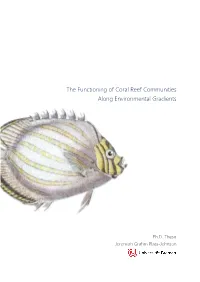
The Functioning of Coral Reef Communities Along Environmental Gradients Ph.D. Thesis Jeremiah Grahm Plass-Johnson Dissertation zur Erlangung des Doktorgrades der Natuwissenschaften der Universität Bremen, Fachbereich Biologie/Chemie. Die vorliegende Arbeit wurde in der Zeit von Juni 2012 bis Mai 2015 am Leibniz-Zentrum für marine Tropenökologie in Bremen angefertigt. Finanziert wurde die Arbeit über das Bundesministerium für Bildung und Forschung (Grant no. 03F0643A) im Rahmen des bilateralen Deutsch-Indonesischen Projekts, Science for the Protection of Indonesian Coastal Ecosystems (SPICE III). Gutachter: Prof. Dr. Kai Bischof (Erstgutachter) Prof. Dr. Matthias Wolf (Zweitgutachter) Prüfer: Prof. Dr. Claudio Richter Dr. Mirta Teichberg Weitere Mitglieder des Prüfungsausschusses Jasmin Heiden (Doktorand) Tom Vierus (Student) Datum des Promotionskolloquiums: 21. Juli 2015 Summary One of the primary challenges in ecology is to understand how environmental disturbance affects diversity and community structure, and what are the subsequent consequences on ecosystem functioning. Coral reefs are some of the most diverse ecosystems on the planet resulting in complex sets of interactions between benthic, habitat-forming constituents and mobile fish consumers. However, scleractinian corals, the primary habitat engineers, are dependent on high-light, low- nutrient water conditions and thus are highly responsive when the environment varies from this status. In Southeast Asia, an increase in human coastal populations centred around urban areas has resulted in extensive changes to the coastal environment such as degraded water quality and removal of fish consumers. This has resulted in highly varied abiotic and biotic conditions in relation with distance from the shore. Often, coral reefs closer to shore are much lower in benthic and fish diversity than those further from anthropogenic influences, with direct impacts on ecosystem functioning. -

Scientific Articles
Scientific articles Abed-Navandi, D., Dworschak, P.C. 2005. Food sources of tropical thalassinidean shrimps: a stable isotope study. Marine Ecology Progress Series 201: 159-168. Abed-Navandi, D., Koller,H., Dworschak, P.C. 2005. Nutritional ecology of thalassinidean shrimps constructing burrows with debris chambers: The distribution and use of macronutrients and micronutrients. Marine Biology Research 1: 202- 215. Acero, A.P.1985. Zoogeographical implications of the distribution of selected families of Caribbean coral reef fishes.Proc. of the Fifth International Coral Reef Congress, Tahiti, Vol. 5. Acero, A.P.1987. The chaenopsine blennies of the southwestern Caribbean (Pisces, Clinidae, Chaenopsinae). III. The genera Chaenopsis and Coralliozetus. Bol. Ecotrop. 16: 1-21. Acosta, C.A. 2001. Assessment of the functional effects of a harvest refuge on spiny lobster and queen conch popuplations at Glover’s Reef, Belize. Proceedings of Gulf and Caribbean Fishisheries Institute. 52 :212-221. Acosta, C.A. 2006. Impending trade suspensions of Caribbean queen conch under CITES: A case study on fishery impact and potential for stock recovery. Fisheries 31(12): 601-606. Acosta, C.A., Robertson, D.N. 2003. Comparative spatial geology of fished spiny lobster Panulirus argus and an unfished congener P. guttatus in an isolated marine reserve at Glover’s Reef atoll, Belize. Coral Reefs 22: 1-9. Allen, G.R., Steene, R., Allen, M. 1998. A guide to angelfishes and butterflyfishes.Odyssey Publishing/Tropical Reef Research. 250 p. Allen, G.R.1985. Butterfly and angelfishes of the world, volume 2.Mergus Publishers, Melle, Germany. Allen, G.R.1985. FAO Species Catalogue. Vol. 6. -
LABRIDAE Wrasses Are Variable in Shape, Coloration
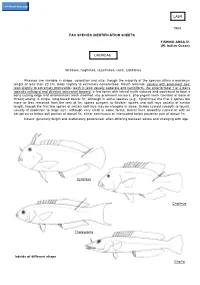
click for previous page LABR 1983 FAO SPECIES IDENTIFICATION SHEETS FISHING AREA 51 (W. Indian Ocean) LABRIDAE Wrasses, hogfishes, razorfishes, coris, tuskfishes Wrasses are variable in shape, coloration and size, though the majority of the species attain a maximum length of less than 20 cm. Body slightly to extremely compressed. Mouth terminal, usually with prominent lips; jaws slightly to extremely protrusible; teeth in jaws usually separate and caniniform, the anteriormost 1 or 2 pairs typically enlarged and directed somewhat forward; a few forms with lateral teeth reduced and coalesced to form a bony cutting edge and anteriormost teeth modified into prominent incisors; pharyngeal teeth (located at base of throat) strong. A single, long-based dorsal fin, although in some species (e.g., Xyrichthys) the first 2 spines are more or less removed from the rest of fin; spines pungent to flexible; spines and soft rays usually of similar length, though the first few spines or certain soft rays may be elongate in some. Scales cycloid (smooth to touch), usually of moderate to large size, although very small in some forms; lateral lines smoothly curved or with an abrupt curve below soft portion of dorsal fin, either continuous or interrupted below posterior part of dorsal fin. Colour: generally bright and elaborately patterened, often differing between sexes and changing with age. Xyrichtys Cheilinus Thalassoma labrids of different shape Cheilio - 2 - FAO Sheets LABRIDAE Fishing Area 51 Common in shallow to moderately shallow wates in a variety of habitats, including bare sand and rock, grass and algae-covered bottoms and coral reefs, but rare in muddy areas. -
Pacific Reef Assessment and Monitoring Program Data Report
Pacific Reef Assessment and Monitoring Program Data Report Ecological monitoring 2012–2013—reef fishes and benthic habitats of the main Hawaiian Islands, American Samoa, and Pacific Remote Island Areas A. Heenan1, P. Ayotte1, A. Gray1, K. Lino1, K. McCoy1, J. Zamzow1, and I. Williams2 1 Joint Institute for Marine and Atmospheric Research University of Hawaii at Manoa 1000 Pope Road Honolulu, HI 96822 2 Pacific Islands Fisheries Science Center National Marine Fisheries Service NOAA Inouye Regional Center 1845 Wasp Boulevard, Building 176 Honolulu, HI 96818 ______________________________________________________________ NOAA Pacific Islands Fisheries Science Center PIFSC Data Report DR-14-003 Issued 1 April 2014 This report outlines some of the coral reef monitoring surveys conducted by the National Oceanic and Atmospheric Administration (NOAA) Pacific Islands Fisheries Science Center’s Coral Reef Ecosystem Division in 2012 and 2013. This includes the following regions: American Samoa, the main Hawaiian Islands and the Pacific Remote Island Areas. 2 Acknowledgements Thanks to all those onboard the NOAA ships Hi`ialakai and Oscar Elton Sette for their logistical and field support during the 2012-2013 Pacific Reef Assessment and Monitoring Program (Pacific RAMP) research cruises and to the following divers for their assistance with data collection; Senifa Annandale, Jake Asher, Marie Ferguson, Jonatha Giddens, Louise Giuseffi, Mark Manuel, Marc Nadon, Hailey Ramey, Ben Richards, Brett Schumacher, Kosta Stamoulis and Darla White. We thank Rusty Brainard for his tireless support of Pacific RAMP and the staff of NOAA PIFSC CRED for assistance in the field and data management. This work was funded by the NOAA Coral Reef Conservation Program and the Pacific Islands Fisheries Science Center. -

Field Guide to the Snappers {Lutianidae} of the Western Atlantic
Field Guide to the Snappers {Lutianidae} of the Western Atlantic By William D. Anderson, Jr. UNITED STATES DEPART MENT OF THE INTERIOR FISH AND WILDLIFE SERVICE BUREAU OF COMMERCIAL FISHERIES Circular 252 UNITED STATES DEPARTMENT OF THE INTERIOR Stewart L. Udall, Secretary John A. Carver, Jr., Under Secretary Stanley A. Cain, Assistant Secretary for Fish and Wildlife and Parks FISH AND WILDLIFE SERVICE, Clarence F. Pautzke, Commissioner BUREAU OF COMMERCIAL FISHERIES, Donald L. McKernan, Director Field Guide to the Snappers {Lutianidae} of the Western Atlantic By WILLIAM D. ANDERSON, Jr. Circular 252 Washington, D. C. January 1967 CONTENTS Field Guide to the Snappers (Lutianidae) of the Western Atlantic l By WILLIAM D. ANDERSON, Jr., Fishery Biologist 2 Bureau of Commercial Fisheries Biological Laboratory Brunswick, Georgia 31521 ABSTRACT This guide is intended to implement both field and laboratory identification of western Atlantic snappers (Lutjanidae). Eight genera and 27 species, of which 7 are of doubtful validity, are considered. lllustrated keys are supplemented by tables that give the ranges of numbers of fin rays, lateral line scales, and gill rakers. INTRODUCTION Fishes of the family Lutjanidae (Percomorphi) occur throughout the world in tropical and subtropical seas and are found from shallow inshore areas to depths of over 350 fath. (fathoms). Most species Live on or near the bottom and are largely confined to continental shelves and slopes and to corresponding depths around islands- - but some enter estuaries and even fresh water. Some species have pelagic larvae, but early developmental stages for most species are not known. About 30 genera and about 150 species have been assigned to the Lutjanidae.