Friends of Ironwood Forest, Spring 2019
Total Page:16
File Type:pdf, Size:1020Kb
Load more
Recommended publications
-
CCCSS September 2010 Newsletter.Indd
CENTRAL COAST CACTUS AND SUCCULENT SOCIETY NEWSLETTER Pismo Beach,CA93449 780 MercedSt. c/o MarkusMumper & SucculentSociety Central CoastCactus On the Dry Side September 2010 Inside this issue: CCCSS August Meeting Recap •Upcoming Speaker Gene Schroeder greeted about 100 members that showed up for our August meeting. He reminded everyone that our October - Nick Wilkinson meeting would be the 3rd Sunday of the month instead of the •Last Month’s 2nd so mark your calendars for the 17th. Our brag table had some very impressive plants which included a 1st prize “ Best - Meeting Minutes Echeveria” from the Paso Fair submitted by Tim Dawson. He won with his beautiful Echeveria subrigida. Rich Hart also showed us •Genus of the Month his awesome Brunsvigia josephinae. This South African bulb was in - Ferocactus flower that was almost 3 feet tall. He said this plant was 20 years - Adromischus old. He started it from seed and it finally bloomed after 17 years. Our raffle table keeps getting better and thanks to Mary Peracca and Gene Schroeder for donating some of their plants for the raffle table. Our team of Rob Skillen, Charles Spotts and Gene Schroeder all shared their specimens with us for the plants of the month: Thelocactus and Bromeliad. We are so fortunate to have these knowledgeable guys to be a part of our club. Also on that list is Nick Wilkinson who missed the meeting as he was selling at a show. We were honored to have Woody Minnich as our speaker this month from New Mexico. His presentation of Rio Grande Do Sol was informative with wonderful photos and a twist of humor. -

Caryophyllales 2018 Instituto De Biología, UNAM September 17-23
Caryophyllales 2018 Instituto de Biología, UNAM September 17-23 LOCAL ORGANIZERS Hilda Flores-Olvera, Salvador Arias and Helga Ochoterena, IBUNAM ORGANIZING COMMITTEE Walter G. Berendsohn and Sabine von Mering, BGBM, Berlin, Germany Patricia Hernández-Ledesma, INECOL-Unidad Pátzcuaro, México Gilberto Ocampo, Universidad Autónoma de Aguascalientes, México Ivonne Sánchez del Pino, CICY, Centro de Investigación Científica de Yucatán, Mérida, Yucatán, México SCIENTIFIC COMMITTEE Thomas Borsch, BGBM, Germany Fernando O. Zuloaga, Instituto de Botánica Darwinion, Argentina Victor Sánchez Cordero, IBUNAM, México Cornelia Klak, Bolus Herbarium, Department of Biological Sciences, University of Cape Town, South Africa Hossein Akhani, Department of Plant Sciences, School of Biology, College of Science, University of Tehran, Iran Alexander P. Sukhorukov, Moscow State University, Russia Michael J. Moore, Oberlin College, USA Compilation: Helga Ochoterena / Graphic Design: Julio C. Montero, Diana Martínez GENERAL PROGRAM . 4 MONDAY Monday’s Program . 7 Monday’s Abstracts . 9 TUESDAY Tuesday ‘s Program . 16 Tuesday’s Abstracts . 19 WEDNESDAY Wednesday’s Program . 32 Wednesday’s Abstracs . 35 POSTERS Posters’ Abstracts . 47 WORKSHOPS Workshop 1 . 61 Workshop 2 . 62 PARTICIPANTS . 63 GENERAL INFORMATION . 66 4 Caryophyllales 2018 Caryophyllales General program Monday 17 Tuesday 18 Wednesday 19 Thursday 20 Friday 21 Saturday 22 Sunday 23 Workshop 1 Workshop 2 9:00-10:00 Key note talks Walter G. Michael J. Moore, Berendsohn, Sabine Ya Yang, Diego F. Registration -
Star Cactus (Astrophytum Asterias)
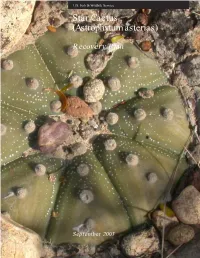
U.S. Fish & Wildlife Service Star Cactus (Astrophytum asterias) Recovery Plan September 2003 DISCLAIMER Recovery plans delineate reasonable actions which are believed to be required to recover and/or protect listed species. Plans are published by the U.S. Fish and Wildlife Service, sometimes prepared with the assistance of recovery teams, contractors, State agencies, and others. Objectives will be attained and any necessary funds made available subject to budgetary and other constraints affecting the parties involved as well as the need to address other priorities. Recovery plans do not necessarily represent the views or the official positions or approval of any individuals or agencies involved in the plan formulation, other than the U.S. Fish and Wildlife Service only after they have been signed by the Regional Director as approved. Approved recovery plans are subject to modification as dictated by new findings, changes in species status, and the completion of recovery tasks. Literature citations should read as follows: U.S. Fish and Wildlife Service. 2003. Recovery Plan for Star Cactus (Astrophytum asterias). U.S. DOI Fish and Wildlife Service, Albuquerque, New Mexico. i-vii + 38pp., A1-19, B- 1-8. Additional copies may be purchased from: Fish and Wildlife Reference Service 5430 Grosvenor Lane, Suite 110 Bethesda, Maryland 20814 1-301-492-6403 or 1-800-582-3421 The fee for the Plan varies depending on the number of pages of the Plan. Recovery Plans can be downloaded from the U.S. Fish and Wildlife Service website: http://endangered.fws.gov. -i- ACKNOWLEDGMENTS The author wishes to express great appreciation to Ms. -

Roadrunner News Newsletter of the Long Beach Cactus Club Founded 1933; Affiliate of the Cactus and Succulent Society of America, Inc
May 2018 Roadrunner News Newsletter of the Long Beach Cactus Club Founded 1933; Affiliate of the Cactus and Succulent Society of America, Inc. Drosanthemum speciosum, photo by Krystoff Przykucki MEETING PROGRAM: Tom Glavich: “The Genus Euphorbia” LOCATION: Rancho Los Alamitos, 6400 Bixby Hill Road, Long Beach, CA 90815. We will meet in the meeting room next to the gift shop. Rancho Los Alamitos is located within Bixby Hill and accessed through the residential security gate at Anaheim and Palo Verde. From the 405 Freeway, exit at Palo Verde Avenue and turn south. From the 605 Freeway, exit at Willow, follow to Palo Verde and turn south. TIME: Sunday, May 6th, 2018 at 1:30 p.m. Setup will be from 12:30 – 1:30. Members will be working in the garden starting at 11 AM. Bring a lunch if you need to. REFRESHMENTS: We will follow the alphabet to determine who is to bring the snacks and finger foods. This month, those with last names starting with the letters A through F are asked to bring the goodies. Please feel free to bring something even if you don’t fall into this group. PLANT-OF-THE-MONTH: Cactus: Echinocactus, Ferocactus, Succulent: Monadenium, Jatropha Descriptions by Scott Bunnell: Echinocactus is a genus of cacti in the subfamily Cactoideae. It and Ferocactus are the two genera of barrel cactus. Members of the genus usually have heavy spination and relatively small flowers. The fruits are copiously woolly, which is one major distinction between Echinocactus and Ferocactus. Propagation is by seed. Perhaps the best known species is the golden barrel (Echinocactus grusonii) from Mexico, an easy-to-grow and widely cultivated plant. -

Responses of Plant Communities to Grazing in the Southwestern United States Department of Agriculture United States Forest Service
Responses of Plant Communities to Grazing in the Southwestern United States Department of Agriculture United States Forest Service Rocky Mountain Research Station Daniel G. Milchunas General Technical Report RMRS-GTR-169 April 2006 Milchunas, Daniel G. 2006. Responses of plant communities to grazing in the southwestern United States. Gen. Tech. Rep. RMRS-GTR-169. Fort Collins, CO: U.S. Department of Agriculture, Forest Service, Rocky Mountain Research Station. 126 p. Abstract Grazing by wild and domestic mammals can have small to large effects on plant communities, depend- ing on characteristics of the particular community and of the type and intensity of grazing. The broad objective of this report was to extensively review literature on the effects of grazing on 25 plant commu- nities of the southwestern U.S. in terms of plant species composition, aboveground primary productiv- ity, and root and soil attributes. Livestock grazing management and grazing systems are assessed, as are effects of small and large native mammals and feral species, when data are available. Emphasis is placed on the evolutionary history of grazing and productivity of the particular communities as deter- minants of response. After reviewing available studies for each community type, we compare changes in species composition with grazing among community types. Comparisons are also made between southwestern communities with a relatively short history of grazing and communities of the adjacent Great Plains with a long evolutionary history of grazing. Evidence for grazing as a factor in shifts from grasslands to shrublands is considered. An appendix outlines a new community classification system, which is followed in describing grazing impacts in prior sections. -
A Tale of Two Cacti –The Complex Relationship Between Peyote (Lophophora Williamsii) and Endangered Star Cactus (Astrophytum Asterias)
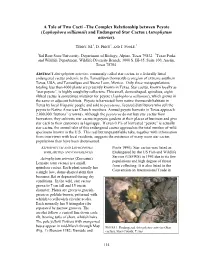
A Tale of Two Cacti –The Complex Relationship between Peyote (Lophophora williamsii) and Endangered Star Cactus (Astrophytum asterias). 1 2 2 TERRY, M. , D. PRICE , AND J. POOLE. 1Sul Ross State University, Department of Biology, Alpine, Texas 79832. 2Texas Parks and Wildlife Department, Wildlife Diversity Branch, 3000 S. IH-35, Suite 100, Austin, Texas 78704. ABSTRACT Astrophytum asterias, commonly called star cactus, is a federally listed endangered cactus endemic to the Tamaulipan thornscrub ecoregion of extreme southern Texas, USA, and Tamaulipas and Nuevo Leon, Mexico. Only three metapopulations totaling less than 4000 plants are presently known in Texas. Star cactus, known locally as “star peyote”, is highly sought by collectors. This small, dome-shaped, spineless, eight- ribbed cactus is sometimes mistaken for peyote (Lophophora williamsii), which grows in the same or adjacent habitats. Peyote is harvested from native thornscrub habitats in Texas by local Hispanic people and sold to peyoteros, licensed distributors who sell the peyote to Native American Church members. Annual peyote harvests in Texas approach 2,000,000 “buttons” (crowns). Although the peyoteros do not buy star cactus from harvesters, they cultivate star cactus in peyote gardens at their places of business and give star cacti to their customers as lagniappe. If even 0.1% of harvested “peyote” is actually star cactus, the annual take of this endangered cactus approaches the total number of wild specimens known in the U.S. This real but unquantifiable take, together with information from interviews with local residents, suggests the existence of many more star cactus populations than have been documented. ASTROPHYTUM AND LOPHOPHORA – Poole 1990). -

Tucson Cactus and Succulent Society Guide to Common Cactus and Succulents of Tucson
Tucson Cactus and Succulent Society Guide to Common Cactus and Succulents of Tucson http://www.tucsoncactus.org/c-s_database/index.html Item ID: 1 Item ID: 2 Family: Cactaceae Family: Cactaceae Genus: Ferocactus Genus: Echinocactus Species: wislizenii Species: grusonii Common Name: Fishhook Barrel Common Name: Golden Barrel Habitat: Various soil types from 1,000 Cactus to 6,000 feet elevation from grasslands Habitat: Located on rolling hills to rocky mountainous areas. and cliffs. Range: Arizona, southwestern New Range: Limited to small areas in Mexico, limited extremes of western Queretaro, Mexico. The popula- Texas, Sonora, northwest Chihuahua tion had become very low in num- and northern Sinaloa, Mexico bers over the years but is just Care: An extremely easy plant to grow now beginning to increase due to in and around the Tucson area. It re- protective laws and the fact that Photo Courtesy of Vonn Watkins quires little attention or special care as this plant is now in mass cultiva- ©1999 it is perfectly at home in almost any tion all over the world. garden setting. It is very tolerant of ex- Photo Courtesy of American Desert Care: The Golden Barrel has slow- Description treme heat as well as cold. Cold hardi- Plants ly become one of the most pur- This popular barrel cactus is noted ness tolerance is at around 10 degrees chased plants for home landscape for the beautiful golden yellow farenheit. Description in Tucson. It is an easy plant to spines that thickly surround the Propagation: Propagation of this cac- This plant is most recognized by the grow and takes no special care. -

Begin Typing Here
December 16, 2013 Kimberly D. Bose, Secretary Federal Energy Regulatory Commission 888 First Street NE, Room 1A Washington, DC 20426 Re: Sierrita Pipeline Project Draft Environmental Impact Statement Dear Secretary Bose: The Arizona Game and Fish Department (Department), along with the U.S. Fish and Wildlife Service, Buenos Aires National Wildlife Refuge (BANWR), and U.S. Customs and Border Protection, is a cooperating agency with the Federal Energy Regulatory Commission (FERC) for the National Environmental Policy Act (NEPA) analysis of the project. We have participated in the planning and review of this project with the FERC, Sierrita Gas Pipeline LLC (Sierrita), and the other cooperating agencies since early 2012. Although Sierrita has submitted to the FERC a considerable amount of detailed information pertaining to the design, construction, and post- construction restoration of the pipeline, there remains a lack of sufficient detail in some of Sierrita’s plans to engender confidence that the pipeline will not result in unmitigated impacts to wildlife habitat in the Altar Valley. Upon review of the Draft Environmental Impact Statement (EIS), the Department submits for your consideration a number of recommendations we feel would help offset wildlife and habitat impacts that would result if the pipeline is certificated. To aid in your response to comments, this letter is structured such that supporting information for each major comment is presented in descriptive paragraphs with specific actions summarized in bolded, italicized bullets. MITIGATION There is no mitigation proposed for the 376.7 acres of permanent disturbance (i.e., acres of vegetation within the 50-foot-wide permanent ROW or occupied by aboveground facilities). -

Fishhook Barrel Or Biznaga De Agua Ferocactus Wislizeni
ARIZONA-SONORA DESERT MUSEUM PLANT CARE INFORMATION Fishhook Barrel or Biznaga de Agua Ferocactus wislizeni DESCRIPTION: Fishhook Barrel is found throughout the Arizona Upland portion of the Sonoran Desert, and higher into the grasslands and Chihuahuan Desert. It is has a slow to moderate growth rate, up to 5' or more tall, and 2' wide. It has a deeply pleated surface with stout, hooked spines which start red and fade to gray. Blooming begins in July or August and continues for up to 8 weeks. Flowers vary within the species from yellow, orange, red, to coppery. Many insect species visit the flowers, but bees are the main pollinators. Fruit ripen in late fall and winter. The rind is edible and has a lemony taste. The seeds are high in oil. An unusual form, CSSA Yellow Fishhook Barrel, is now available. Not only does it have bright yellow flowers, but the spines are yellow also. RECOMMENDED USE: Accent, container, desert enhancement or revegetation CULTURE: Hardiness: Fishhook barrel is hardy to at least 15oF. Sun tolerance: Full sun or light shade produce the healthiest plants and best flowering. Please note if there is an “S” marked on the pot or box. This denotes which side has been facing south in the nursery. Keep this orientation to prevent sunburning. Whether or not there is an “S”, we recommend that you acclimatize your plant gradually to the sun. Watering and feeding: For potted plants, regular watering during the warm season is required. It can be adapted to unwatered desert conditions in the ground, but will grow faster if given occasional soaks. -
South American Cacti in Time and Space: Studies on the Diversification of the Tribe Cereeae, with Particular Focus on Subtribe Trichocereinae (Cactaceae)
Zurich Open Repository and Archive University of Zurich Main Library Strickhofstrasse 39 CH-8057 Zurich www.zora.uzh.ch Year: 2013 South American Cacti in time and space: studies on the diversification of the tribe Cereeae, with particular focus on subtribe Trichocereinae (Cactaceae) Lendel, Anita Posted at the Zurich Open Repository and Archive, University of Zurich ZORA URL: https://doi.org/10.5167/uzh-93287 Dissertation Published Version Originally published at: Lendel, Anita. South American Cacti in time and space: studies on the diversification of the tribe Cereeae, with particular focus on subtribe Trichocereinae (Cactaceae). 2013, University of Zurich, Faculty of Science. South American Cacti in Time and Space: Studies on the Diversification of the Tribe Cereeae, with Particular Focus on Subtribe Trichocereinae (Cactaceae) _________________________________________________________________________________ Dissertation zur Erlangung der naturwissenschaftlichen Doktorwürde (Dr.sc.nat.) vorgelegt der Mathematisch-naturwissenschaftlichen Fakultät der Universität Zürich von Anita Lendel aus Kroatien Promotionskomitee: Prof. Dr. H. Peter Linder (Vorsitz) PD. Dr. Reto Nyffeler Prof. Dr. Elena Conti Zürich, 2013 Table of Contents Acknowledgments 1 Introduction 3 Chapter 1. Phylogenetics and taxonomy of the tribe Cereeae s.l., with particular focus 15 on the subtribe Trichocereinae (Cactaceae – Cactoideae) Chapter 2. Floral evolution in the South American tribe Cereeae s.l. (Cactaceae: 53 Cactoideae): Pollination syndromes in a comparative phylogenetic context Chapter 3. Contemporaneous and recent radiations of the world’s major succulent 86 plant lineages Chapter 4. Tackling the molecular dating paradox: underestimated pitfalls and best 121 strategies when fossils are scarce Outlook and Future Research 207 Curriculum Vitae 209 Summary 211 Zusammenfassung 213 Acknowledgments I really believe that no one can go through the process of doing a PhD and come out without being changed at a very profound level. -

Na Europa, O Interesse Pelos Cactos Data De Princípios Do
View metadata, citation and similar papers at core.ac.uk brought to you by CORE provided by Universidade Federal de Santa Maria: Portal de Periódicos Eletrônicos da UFSM BALDUINIA, n. 56, p. 01-11, 20-III-2017 http://dx.doi.org/10.5902/2358198026215 NOTAS HISTÓRICAS SOBRE A FAMÍLIA CACTACEAE NO RIO GRANDE DO SUL (BRASIL) E URUGUAI. I – PERÍODO CLÁSSICO (1818-1950): VIAJANTES NATURALISTAS E BOTÂNICOS EUROPEUS1 RODRIGO CORRÊA PONTES2 JOSE NEWTON CARDOSO MARCHIORI3 LEOPOLDO WITECK NETO4 RESUMO O histórico das descobertas de cactáceas no Rio Grande do Sul e Uruguai é examinado a partir de registros literários dos viajantes naturalistas, horticultores e botânicos que se dedicaram à prospecção e ao estudo destas plantas no espaço regional. Palavras-chave: Botânica, Cactaceae, História, Rio Grande do Sul, Uruguai. ABSTRACT [Historical notes about the Cactaceae family in the State of Rio Grande do Sul (Brazil) and Uruguay. I – Classic period (1818-1950): naturalist travelers and european botanists]. Relevant findings about the history of Cactaceae family in Rio Grande do Sul State (Brazil) and Uruguay are examined according to literary records of ancient traveling naturalists, horticulturists and botanists who dedicated themselves to the exploration and study of these plants in the regional space. Keywords: Botany, Cactaceae, History, Rio Grande do Sul, Uruguay. INTRODUÇÃO Na Europa, o interesse pelos cactos data de Distintas paisagens do Rio Grande do Sul e princípios do século XIX, quando viajantes na- Uruguai, tais como afloramentos rochosos, turalistas deram início à busca e estudo dos areais, campos com gramíneas, escarpas e, até mesmos, sobretudo no tocante à taxonomia e mesmo, o interior de florestas densas apresen- fenologia, mas sem maior empenho no registro tam ambientes propícios ao estabelecimento de histórico dos achados e respectivos descobri- cactáceas, as quais, pela ocorrência fragmenta- dores. -

Redalyc.Fruits, Seeds and Germination in Five Species of Globose Cacteae
Interciencia ISSN: 0378-1844 interciencia@ivic.ve Asociación Interciencia Venezuela Loza Cornejo, Sofía; Terrazas, Teresa; López Mata, Lauro Fruits, seeds and germination in five species of globose Cacteae (Cactaceae) Interciencia, vol. 37, núm. 3, marzo, 2012, pp. 197-203 Asociación Interciencia Caracas, Venezuela Available in: http://www.redalyc.org/articulo.oa?id=33922725006 How to cite Complete issue Scientific Information System More information about this article Network of Scientific Journals from Latin America, the Caribbean, Spain and Portugal Journal's homepage in redalyc.org Non-profit academic project, developed under the open access initiative FRUITS, SEEDS AND GERMINATION IN FIVE SPECIES OF GLOBOSE CACTEAE (CACTACEAE) Sofía Loza-Cornejo, Teresa Terrazas and Lauro López-Mata SUMMARY The morphological characteristics of fruits and seeds, and the weight, and fruit width. Larger fruits with more seeds are ob- germination responses of freshly matured seeds of five species of served for F. histrix, whereas smaller fruits with less weight and Cacteae (Coryphantha bumamma, C. clavata, C. cornifera, Fero- fewer seeds are seen for C. clavata. Seed germination is a rapid cactus histrix and Mammillaria uncinata) were studied at room process and usually starts on the third day. High percentages of temperature under laboratory conditions. The aim of the study germination (>80%) are observed on the sixth day in F. histrix was to record the macro- and micro-morphology of fruits and and M. uncinata. It is concluded that some morphological cha- seeds of these species and to investigate specific requirements racteristics of fruits and seeds can be used to support further for germination. Variance analysis detected significant differen- systematic studies of Cactoideae genera and will contribute new ces (p<0.05) for several variables: number of seeds per fruit, knowledge for their potential use and conservation.