RENATO DULBECCO Celebrare Una Leggenda
Total Page:16
File Type:pdf, Size:1020Kb
Load more
Recommended publications
-

James D. Watson Molecular Biologist, Nobel Laureate ( 1928 – )
James D. Watson Molecular biologist, Nobel Laureate ( 1928 – ) Watson is a molecular biologist, best known as one of the co-discoverers of the struc- ture of DNA. Watson, Francis Crick, and Maurice Wilkins were awarded the 1962 Nobel Prize in Physiology or Medicine. Watson was born in Chicago, and early on showed his brilliance, appearing on Quiz Kids, a popular radio show that challenged precocious youngsters to answer ques- tions. Thanks to the liberal policy of University of Chicago president ROBERT HUTCHINS, Watson was able to enroll there at the age of 15, earning a B.S. in Zoology in 1947. He was attracted to the work of Salvador Luria, who eventually shared a Nobel Prize with Max Delbrück for their work on the nature of genetic mutations. In 1948, Watson began research in Luria’s laboratory and he received his Ph.D. in Zoology at Indiana University in 1950 at age 22. In 1951, the chemist Linus Pauling published his model of the protein alpha helix, find- ings that grew out of Pauling’s relentless efforts in X-ray crystallography and molecu- lar model building. Watson now wanted to learn to perform X-ray diffraction experi- ments so that he could work to determine the structure of DNA. Watson and Francis Crick proceeded to deduce the double helix structure of DNA, which they submitted to the journal Nature and was subsequently published on April 25, 1953. Watson subsequently presented a paper on the double helical structure of DNA at the Cold Spring Harbor Symposium on Viruses in early June 1953. -

Jewels in the Crown
Jewels in the crown CSHL’s 8 Nobel laureates Eight scientists who have worked at Cold Max Delbrück and Salvador Luria Spring Harbor Laboratory over its first 125 years have earned the ultimate Beginning in 1941, two scientists, both refugees of European honor, the Nobel Prize for Physiology fascism, began spending their summers doing research at Cold or Medicine. Some have been full- Spring Harbor. In this idyllic setting, the pair—who had full-time time faculty members; others came appointments elsewhere—explored the deep mystery of genetics to the Lab to do summer research by exploiting the simplicity of tiny viruses called bacteriophages, or a postdoctoral fellowship. Two, or phages, which infect bacteria. Max Delbrück and Salvador who performed experiments at Luria, original protagonists in what came to be called the Phage the Lab as part of the historic Group, were at the center of a movement whose members made Phage Group, later served as seminal discoveries that launched the revolutionary field of mo- Directors. lecular genetics. Their distinctive math- and physics-oriented ap- Peter Tarr proach to biology, partly a reflection of Delbrück’s physics train- ing, was propagated far and wide via the famous Phage Course that Delbrück first taught in 1945. The famous Luria-Delbrück experiment of 1943 showed that genetic mutations occur ran- domly in bacteria, not necessarily in response to selection. The pair also showed that resistance was a heritable trait in the tiny organisms. Delbrück and Luria, along with Alfred Hershey, were awarded a Nobel Prize in 1969 “for their discoveries concerning the replication mechanism and the genetic structure of viruses.” Barbara McClintock Alfred Hershey Today we know that “jumping genes”—transposable elements (TEs)—are littered everywhere, like so much Alfred Hershey first came to Cold Spring Harbor to participate in Phage Group wreckage, in the chromosomes of every organism. -

Message from the Chairman
Abstract1 6/01/09 8:36 Page 1 Abstract1 6/01/09 8:36 Page 2 MESSAGE FROM THE CHAIRMAN Recent years have been marked by unprecedented growth and development in the life sciences in areas such as gene sequencing, protein interactions and molecular biology. Research conducted during the last decade has resulted in important technological and conceptual advances, along with the development of treatments and early stage cures for diseases like cancer or neurodegenerative diseases. The full sequencing of the human genome, and of a growing number of other living organisms, has heralded a new era in molecular biology and genetics for human medicine. Although these discoveries have opened an unprecedented path toward medical advances, they have also revealed that organic, physiological and genetic mechanisms are far more complex than initially believed. I am therefore particularly honoured that such an impressive panel of scientists agreed to gather together at Ipsen’s new corporate headquarters to lecture on the challenging and exciting perspectives of medical innovation. Jean-Luc Bélingard, Chairman and CEO of the Ipsen Group Abstract1 6/01/09 8:36 Page 3 Professor at the Collège de France and the Institut Pasteur, he is a member of the French Académie des Sciences, the National Academy of Sciences US, the Institute of Medicine of the NAS. He discovered the allostery of proteins and isolated the nicotinic receptor of acetylcholine. Past president of the Comité National d’Ethique, he is the president of the Commission des dations, and the Jean-Pierre Changeux laureate of many scientific prizes: Chairperson médaille d’or du CNRS, Balzan prize, Louis-Jeantet Prize, Biotechnology Study Center of the New York University school of Medicine award, Jean-Louis Signoret Prize of la Fondation Ipsen, the National Academy of Sciences award in neurociences (2007). -

Happy Birthday to Renato Dulbecco, Cancer Researcher Extraordinaire
pbs.org http://www.pbs.org/newshour/updates/happy-birthday-renato-dulbecco-cancer-researcher-extraordinaire/ Happy birthday to Renato Dulbecco, cancer researcher extraordinaire Photo of Renato Dulbecco (public domain) Every elementary school student knows that Feb. 22 is George Washington’s birthday. Far fewer (if any) know that it is also the birthday of the Nobel Prize-winning scientist Renato Dulbecco. While not the father of his country — he was born in Italy and immigrated to the United States in 1947 — Renato Dulbecco is credited with playing a crucial role in our understanding of oncoviruses, a class of viruses that cause cancer when they infect animal cells. Dulbecco was born in Catanzaro, the capital of the Calabria region of Italy. Early in his childhood, after his father was drafted into the army during World War I, his family moved to northern Italy (first Cuneo, then Turin, and thence to Liguria). A bright boy, young Renato whizzed through high school and graduated in 1930 at the age of 16. From there, he attended the University of Turin, where he studied mathematics, physics, and ultimately medicine. Dulbecco found biology far more fascinating than the actual practice of medicine. As a result, he studied under the famed anatomist, Giuseppe Levi, and graduated at age 22 in 1936 at the top of his class with a degree in morbid anatomy and pathology (in essence, the study of disease). Soon after receiving his diploma, Dr. Dulbecco was inducted into the Italian army as a medical officer. Although he completed his military tour of duty by 1938, he was called back in 1940 when Italy entered World War II. -
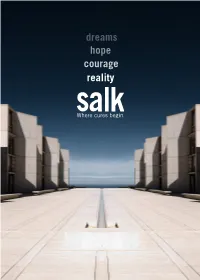
Dreams Hope Courage Reality Table of Contents
dreams hope courage reality Table of Contents 1. About Salk 14. Key Contacts 3. The Salk Difference 15. Financial Overview 4. Scientific Priorities 16. Salk Leadership 6. Discoveries 17. Board of Trustees 8. Salk Scientists 18. Salk Architecture 10. Salk by the Numbers 20. Get to Know Us 11. Why I Support Salk... 21. Our Mission 12. Supporting Discoveries About Salk Jonas Salk changed the world. Inspired to rid civilization of polio, he used basic science to solve its mysteries and in the process helped alter the course of the 20th century along with the future of science, medicine and human health. Untold millions have benefited from his work. The Salk Institute was created to attract the best scientific minds in the world. We’ve built on his vision and have become the leading center for independent research, delving into the most serious biological questions of our time. Experts come from around the globe to work in open collaboration—conducting innovative and daring research, mapping discoveries and developing the blueprints so that cures can happen, anywhere in the world. Twelve Nobel laureates have called the Salk Institute home. 1 It’s this “critical mass of intellect,” which embraces the most modern technologies and prizes discovery over credit, that distinguishes Salk. And it results in some of the world’s most breathtaking findings, which advance our understanding of cancer, aging and the brain. These are the first steps that will lead to tomorrow’s cures for cancer, Alzheimer’s, Parkinson’s, heart disease, metabolic diseases, ALS, schizophrenia, childhood development disorders and spinal cord injuries. -

Renato Dulbecco
BIOLOGIE ET HISTOIRE Renato Dulbecco Renato Dulbecco : de la virologie à la cancérologie F.N.R. RENAUD 1 résumé Né en Italie, Renato Dulbecco fait de brillantes études médicales mais est plus intéressé par la recherche en biologie que par la pratique médicale. Accueilli par Giuseppe Levi, il apprend l’histologie et la culture cellulaire avant de rejoindre le laboratoire de S.E. Luria puis celui de M. Delbrück pour travailler sur les systèmes bactéries-bactériophages puis sur la relation cellules-virus. Il met au point la méthode des plages de lyse virales sur des cultures cellulaires. Il est aussi à l’origine de la virologie tumorale moléculaire. D. Baltimore, HM Temin et lui-même sont récompensés par le prix Nobel de médecine et physiologie en 1975 pour leurs travaux sur l'interaction entre les virus tumoraux et le matériel génétique du matériel cellulaire. Très tourné vers les aspects pratiques et expérimentaux de la recherche, il est resté le plus long - temps possible à la paillasse et a initié un très grand nombre de jeunes chercheurs. mots-clés : culture cellulaire, virologie tumorale, plages de lyse, bactériophages. I. - LA JEUNESSE DE RENATO DULBECCO C'est à Catanzaro, capitale régionale de la Calabre en Italie, que naît Renato Dulbecco le 22 février 1914. Sa mère est Calabraise et son père Ligurien. Il ne reste que très peu de temps dans le sud de l’Italie, car son père est mobilisé et sa famille doit déménager dans le nord à Cuneo, puis à Turin. À la fin de la guerre, la famille Dulbeco s'ins - talle à Imperia en Ligurie. -

The Eighth Day of Creation”: Looking Back Across 40 Years to the Birth of Molecular Biology and the Roots of Modern Cell Biology
“The Eighth Day of Creation”: looking back across 40 years to the birth of molecular biology and the roots of modern cell biology Mark Peifer1 1 Department of Biology and Curriculum in Genetics and Molecular Biology, University of North Carolina at Chapel Hill, CB#3280, Chapel Hill, NC 27599-3280, USA * To whom correspondence should be addressed Email: peifer@unc.edu Phone: (919) 962-2272 1 Forty years ago, Horace Judson’s “The Eight Day of Creation” was published, a book vividly recounting the foundations of modern biology, the molecular biology revolution. This book inspired many in my generation. The anniversary provides a chance for a new generation to take a look back, to see how science has changed and hasn’t changed. Many central players in the book, including Sydney Brenner, Seymour Benzer and Francois Jacob, would go on to be among the founders of modern cell, developmental, and neurobiology. These players come alive via their own words, as complex individuals, both heroes and anti-heroes. The technologies and experimental approaches they pioneered, ranging from cell fractionation to immunoprecipitation to structural biology, and the multidisciplinary approaches they took continue to power and inspire our work today. In the process, Judson brings out of the shadows the central roles played by women in many of the era’s discoveries. He provides us with a vision of how science and scientists have changed, of how many things about our endeavor never change, and how some new ideas are perhaps not as new as we’d like to think. 2 In 1979 Horace Judson completed a ten-year project about cell and molecular biology’s foundations, unveiling “The Eighth Day of Creation”, a book I view as one of the most masterful evocations of a scientific revolution (Judson, 1979). -

EMBO Conference Takes to the Sea Life Sciences in Portugal
SUMMER 2013 ISSUE 24 encounters page 3 page 7 Life sciences in Portugal The limits of privacy page 8 EMBO Conference takes to the sea EDITORIAL Maria Leptin, Director of EMBO, INTERVIEW EMBO Associate Member Tom SPOTLIGHT Read about how the EMBO discusses the San Francisco Declaration Cech shares his views on science in Europe and Courses & Workshops Programme funds on Research Assessment and some of the describes some recent productive collisions. meetings for life scientists in Europe. concerns about Journal Impact Factors. PAGE 2 PAGE 5 PAGE 9 www.embo.org COMMENTARY INSIDE SCIENTIFIC PUBLISHING panels have to evaluate more than a hundred The San Francisco Declaration on applicants to establish a short list for in-depth assessment, they cannot be expected to form their views by reading the original publications Research Assessment of all of the applicants. I believe that the quality of the journal in More than 7000 scientists and 250 science organizations have by now put which research is published can, in principle, their names to a joint statement called the San Francisco Declaration on be used for assessment because it reflects how the expert community who is most competent Research Assessment (DORA; am.ascb.org/dora). The declaration calls to judge it views the science. There has always on the world’s scientific community to avoid misusing the Journal Impact been a prestige factor associated with the publi- Factor in evaluating research for funding, hiring, promotion, or institutional cation of papers in certain journals even before the impact factor existed. This prestige is in many effectiveness. -

Balcomk41251.Pdf (558.9Kb)
Copyright by Karen Suzanne Balcom 2005 The Dissertation Committee for Karen Suzanne Balcom Certifies that this is the approved version of the following dissertation: Discovery and Information Use Patterns of Nobel Laureates in Physiology or Medicine Committee: E. Glynn Harmon, Supervisor Julie Hallmark Billie Grace Herring James D. Legler Brooke E. Sheldon Discovery and Information Use Patterns of Nobel Laureates in Physiology or Medicine by Karen Suzanne Balcom, B.A., M.L.S. Dissertation Presented to the Faculty of the Graduate School of The University of Texas at Austin in Partial Fulfillment of the Requirements for the Degree of Doctor of Philosophy The University of Texas at Austin August, 2005 Dedication I dedicate this dissertation to my first teachers: my father, George Sheldon Balcom, who passed away before this task was begun, and to my mother, Marian Dyer Balcom, who passed away before it was completed. I also dedicate it to my dissertation committee members: Drs. Billie Grace Herring, Brooke Sheldon, Julie Hallmark and to my supervisor, Dr. Glynn Harmon. They were all teachers, mentors, and friends who lifted me up when I was down. Acknowledgements I would first like to thank my committee: Julie Hallmark, Billie Grace Herring, Jim Legler, M.D., Brooke E. Sheldon, and Glynn Harmon for their encouragement, patience and support during the nine years that this investigation was a work in progress. I could not have had a better committee. They are my enduring friends and I hope I prove worthy of the faith they have always showed in me. I am grateful to Dr. -

Gene Therapy Salk’S Own ‘Extraordinary Measures’ Revives Hope for Human Treatment
INSIDE » Board Elects New Trustees » Martin Hetzer Receives Scholar Award » One on One with Bob Lizarraga Where cures begin. THE SALK INSTITUTE FOR BIOLOGICAL STUDIES 02 | 10 Gene Therapy Salk’s Own ‘Extraordinary Measures’ Revives Hope for Human Treatment ALSO IN THIS ISSUE » Sam Pfaff Receives $15.6M Grant » Researchers Map First Human Epigenome » Unlocking the Mechanisms to Limb Regeneration Inside » 2009 Donor Honor Roll February 2010 Inside Salk 4 12 Three sisters help two terminally ill boys. One on One with Bob Lizarraga EXECUTIVE MESSAGE NEWS BRIEFS 3 Investing for the Long Term 22-23 Inder Verma Receives Spector Prize, Gates Foundation Grant COVER STORY Postdocs Honored with 4-11 Gene Therapy Fellowships from Salk’s Center Salk’s Own ‘Extraordinary for Nutritional Genomics Measures’ Revives Hope Fred H. Gage Elected to the For Human Treatment European Molecular Biology Organization INSTITUTE NEWS Clodagh O’Shea Receives One on One with … 12-21 Sontag Foundation’s Bob Lizarraga Distinguished Scientist Award William R. Brody, M.D., Ph.D. Glenn Center Scholars Program CIRM Awards Samuel L. Pfaff President Opens Door to Sharing of Ideas $15.6 Million to Develop Marsha A. Chandler, Ph.D. Stem Cell-Based ALS Therapy Executive Vice President Salk Prepares to Build on Rebecca Newman Annual Tax Seminar’s Success Martin HetzerWins 2009 Vice President, Aging Research Award Development and Communications Salk Institute Board of Susan Trebach Trustees Elects Leaders in Senior Director, Venture Capital and Publishing Communications CALENDAR to its Membership Back Cover Mauricio Minotta Director, Communications Discovery Roundup Editor, Inside Salk Gina Kirchweger Director, Scientific Communications Sarah Loffler Design and Production Coordinator Joe Belcovson and Kent Schnoeker Staff Photographers studio L. -

RECOMBINANT DNA ADVISORY COMMITTEE Minutes of Meeting December 15-16, 1997
RECOMBINANT DNA ADVISORY COMMITTEE Minutes of Meeting December 15-16, 1997 U.S. DEPARTMENT OF HEALTH AND HUMAN SERVICES Public Health Service National Institutes of Health TABLE OF CONTENTS I. Call to Order and Opening Remarks/Mickelson II. RAC Forum on New Technologies III. Food and Drug Administration (FDA) Presentation: Discussion of the Risks of Gonadal Distribution and Inadvertent Germ Line Integration in Patients Receiving Direct Administration of Gene Therapy Vectors IV. Call to Order/Mickelson V. Minutes of the September 12, 1997, Meeting/Ando, Greenblatt VI. Update on Data Management/Greenblatt VII. Amendment to Institutional Biosafety Committee Approvals of Experiments Involving Transgenic Rodents Under Section III of the NIH Guidelines/Aguilar-Cordova VIII. Amendment to Appendix K, Physical Containment for Large Scale Uses of Organisms Containing Recombinant DNA Molecules/McGarrity IX. Amendment to Section III-D-6, Experiments Involving More than 10 Liters of Culture/Knazek X. Human Gene Transfer Protocol #9708-209 entitled: Systemic and Respiratory Immune Response to Administration of an Adenovirus Type 5 Gene Transfer Vector (AdGVCD.10)/Harvey, Crystal XI. Human Gene Transfer Protocol #9711-221 entitled: Phase I Study of Direct Administration of a Replication-Deficient Adenovirus Vector (AdGVVEGF121.10) Containing the VEGF121 cDNA to the Ischemic Myocardium of Individuals with Life Threatening Diffuse Coronary Artery Disease/Crystal XII. Amendment to Appendix M-I, Submission Requirements--Human Gene Transfer Experiments Regarding the Timing of Institutional Biosafety Committee and Institutional Review Board Page 1 Approvals/Markert XIII. Human Gene Transfer Protocol #9708-211 entitled: Gene Therapy for Canavan Disease/Seashore XIV. Amendment to Appendix M-I, Submission Requirements--Human Gene Transfer Experiments Regarding Deadline Submission for RAC Review/McIvor XV. -

David Baltimore, Ph.D
DAVID BALTIMORE is an accomplished researcher, educator, administrator, and David public advocate for science and engineering and is considered one of the world’s most Baltimore, influential biologists. After serving as President of the California Institute of Technology for Ph.D. nine years, Baltimore was appointed President Emeritus and the Robert Andrews Millikan Professor of Biology in 2006. President emeritus Awarded the Nobel Prize at the age of 37 for research in virology, Baltimore at California Institute has profoundly influenced national science policy on such issues as recombi- of Technology nant DNA research and the AIDS epidemic. Nobel Laureate Born in New York City, Baltimore became interested in biology during high Member of the Broad school when he spent a summer at the Jackson Memorial Laboratory and Institute’s Board of Directors worked with research biologists on mammalian genetics. He received his B.A. in chemistry from Swarthmore College in 1960 and a Ph.D. in 1964 Member of the Broad from Rockefeller University, where he returned to serve as President from Institute’s Board of Scientific Counselors 1990–91 and faculty member until 1994. For almost 30 years, Baltimore was a faculty member at Massachusetts Institute of Technology where his early investigations examined the molecular processes underlying the ability of poliovirus to infect cells. This led him to work on other RNA viruses and then to a consideration of how cancer-causing RNA viruses manage to infect and permanently alter a healthy cell. He identi- fied the enzyme reverse transcriptase in the virus particles, thus providing strong evidence for a process of RNA to DNA conversion, the existence of which had been hypothesized some years earlier.