AUTUMN 2021 Melanie Criddle
Total Page:16
File Type:pdf, Size:1020Kb
Load more
Recommended publications
-
Contact Details Number of Breeds Within FCI Groups List of Breeds
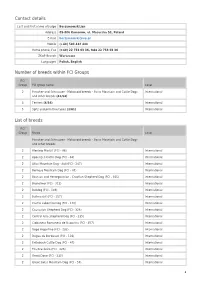
Contact details Last and First name of Judge Borzymowski Jan Address 05-806 Komorów, ul. Mazurska 53, Poland E-mail borzymowski@wp.pl Mobile (+48) 503 482 488 Home phone, Fax (+48) 22 758 03 36, faks 22 758 03 36 ZKwP Branch Warszawa Languages Polish, English Number of breeds within FCI Groups FCI Group FCI group name Level 2 Pinscher and Schnauzer - Molossoid breeds - Swiss Mountain and Cattle Dogs International and other breeds (41/54) 3 Terriers (4/34) International 5 Spitz and primitive types (1/61) International List of breeds FCI Group Breed Level Pinscher and Schnauzer - Molossoid breeds - Swiss Mountain and Cattle Dogs and other breeds 2 Alentejo Mastiff (FCI - 96) International 2 Appenzell Cattle Dog (FCI - 46) International 2 Atlas Mountain Dog - Aidi (FCI - 247) International 2 Bernese Mountain Dog (FCI - 45) International 2 Bosnian and Herzegovinian - Croatian Shepherd Dog (FCI - 355) International 2 Broholmer (FCI - 315) International 2 Bulldog (FCI - 149) International 2 Bullmastiff (FCI - 157) International 2 Castro Laboreiro Dog (FCI - 170) International 2 Caucasian Shepherd Dog (FCI - 328) International 2 Central Asia Shepherd Dog (FCI - 335) International 2 Ciobanesc Romanesc de Bucovina (FCI - 357) International 2 Dogo Argentino (FCI - 292) International 2 Dogue de Bordeaux (FCI - 116) International 2 Entlebuch Cattle Dog (FCI - 47) International 2 Fila Brasileiro (FCI - 225) International 2 Great Dane (FCI - 235) International 2 Great Swiss Mountain Dog (FCI - 58) International 1 FCI Group Breed Level 2 Hovawart (FCI -

Livestock Guardian Dogs Tompkins Conservation Wildlife Bulletin Number 2, March 2017
LIVESTOCK GUARDIAN DOGS TOMPKINS CONSERVATION WILDLIFE BULLETIN NUMBER 2, MARCH 2017 Livestock vs. Predators TABLE OF CONTENTS Introduction to an historical conflict and its mitigation PAGE 01 through the use of livestock guardian dogs Livestock vs. Predators: Introduction to an historical conflict and its mitigation through the use Since humans began domesti- stock and wild predators. Histor- of livestock guardian dogs cating animals, it has been nec- ically, humans have attempted PAGE 04 essary to protect livestock from to resolve this conflict through Livestock Guardian Dogs, wild predators. To this day, pre- a series of predator population an Ancient Tool in dation of livestock is one of the control measures including the Modern Times most prominent global hu- use of traps, hunting, and indis- PAGE 06 man-wildlife conflicts. Interest- criminate and nonselective poi- What Is the Job of a ingly, one of our most ancient soning—methods which are of- Livestock Guardian Dog? domestic companions, the dog, ten cruel and inefficient. was once a predator. One of the greatest chal- PAGE 07 The competition between lenges lies in successfully im- Breeds of Livestock man and wildlife for natural plementing effective measures Guardian Dogs spaces and resources is often that mitigate the negative im- PAGE 08 considered the main source of pacts of this conflict. It is imper- The Presence of Livestock conflict between domestic live- ative to ensure the protection of Guardian Dogs in Chile WILDLIFE BULLETIN NUMBER 2 MARCH 2017 man and his resources, includ- tion in predators is lower than PAGE 10 ing livestock, without compro- that of the United States, where Livestock in the Chacabuco Valley mising the conservation of the the losses are due to a variety of and the Transition Toward the Future Patagonia National Park native biodiversity. -
AKC Education Webinar Series: FSS/Miscellaneous Questions and Answers
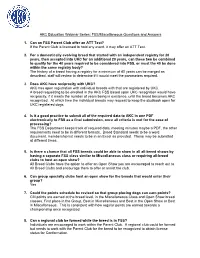
AKC Education Webinar Series: FSS/Miscellaneous Questions and Answers 1. Can an FSS Parent Club offer an ATT Test? If the Parent Club is licensed to hold any event, it may offer an ATT Test. 2. For a domestically evolving breed that started with an independent registry for 20 years, then accepted into UKC for an additional 20 years, can these two be combined to qualify for the 40 years required to be considered into FSS, or must the 40 be done within the same registry body? The history of a breed having a registry for a minimum of 40 years can be merged as described, staff will review to determine if it would meet the parameters required. 3. Does AKC have reciprocity with UKC? AKC has open registration with individual breeds with that are registered by UKC. A breed requesting to be enrolled in the AKC FSS based upon UKC recognition would have reciprocity, if it meets the number of years being in existence, until the breed becomes AKC recognized. At which time the individual breeds may request to keep the studbook open for UKC registered dogs. 4. Is it a good practice to submit all of the required data to AKC in one PDF electronically to FSS as a final submission, once all criteria is met for the ease of processing? The FSS Department keeps track of required data, meeting minutes maybe a PDF, the other requirements need to be in different formats. Breed Standard needs to be a word document, membership list needs to be in an Excel as provided. -
Canary Islands
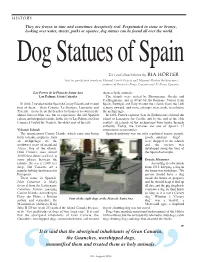
113-128.qxp_113-128 7/31/16 2:44 PM Page 118 HistoRy They are frozen in time and sometimes deceptively real. Perpetuated in stone or bronze, looking over water, streets, parks or squares, dog statues can be found all over the world. Dog Statues of Spain Text and illustrations by RiA HöRteR Text in quotations courtesy Manuel Curtó Gracia and Manuel Martín Béthencourt, authors of Perro de Presa Canario and El Presa Canario Los Perros de la Plaza de Santa Ana them as holy animals. Las Palmas, Gran Canaria The islands were visited by Phoenicians, Greeks and Carthaginians, and in 40 BC by the Romans. Sailors from In 2004, I traveled to the Spanish Canary Islands and visited Spain, Portugal and Italy visited the islands from the 14th four of them – Gran Canaria, La Gomera, Lanzarote and century onward, and some attempts were made to colonize Tenerife – not to lie on the beaches for hours or to swim in the the archipelago. almost-forever blue sea, but to experience the old Spanish In 1402, French explorer Jean de Béthencourt claimed the culture and unspoiled islands. In the city of Las Palmas on Gran island of Lanzarote for Castile, and by the end of the 15th Canaria, I visited the Vegueta, the oldest part of the city. century, all islands of the archipelago were under Spanish authority. Today, the Canaries are one of Spain’s 17 Volcanic Islands autonomous communities. The mountainous Canary Islands, which came into being Spanish authority was not only a political matter; people, from volcanic eruptions, form goods, animals – dogs! – an archipelago off the were shipped to the islands northwest coast of mainland and the society was Africa. -
Domestic Dog Breeding Has Been Practiced for Centuries Across the a History of Dog Breeding Entire Globe
ANCESTRY GREY WOLF TAYMYR WOLF OF THE DOMESTIC DOG: Domestic dog breeding has been practiced for centuries across the A history of dog breeding entire globe. Ancestor wolves, primarily the Grey Wolf and Taymyr Wolf, evolved, migrated, and bred into local breeds specific to areas from ancient wolves to of certain countries. Local breeds, differentiated by the process of evolution an migration with little human intervention, bred into basal present pedigrees breeds. Humans then began to focus these breeds into specified BREED Basal breed, no further breeding Relation by selective Relation by selective BREED Basal breed, additional breeding pedigrees, and over time, became the modern breeds you see Direct Relation breeding breeding through BREED Alive migration BREED Subsequent breed, no further breeding Additional Relation BREED Extinct Relation by Migration BREED Subsequent breed, additional breeding around the world today. This ancestral tree charts the structure from wolf to modern breeds showing overlapping connections between Asia Australia Africa Eurasia Europe North America Central/ South Source: www.pbs.org America evolution, wolf migration, and peoples’ migration. WOLVES & CANIDS ANCIENT BREEDS BASAL BREEDS MODERN BREEDS Predate history 3000-1000 BC 1-1900 AD 1901-PRESENT S G O D N A I L A R T S U A L KELPIE Source: sciencemag.org A C Many iterations of dingo-type dogs have been found in the aborigine cave paintings of Australia. However, many O of the uniquely Australian breeds were created by the L migration of European dogs by way of their owners. STUMPY TAIL CATTLE DOG Because of this, many Australian dogs are more closely related to European breeds than any original Australian breeds. -

Maquetación 1
23 April RSCE WINNER SHOW 2020 24, 25 and 26 April WORLD DOG SHOW 2020 23, 24 and 25 April SPECIALTY SHOWS 2020 REQUISITOS DE SALUD Los perros deberán estar debidamente identificados mediante el correspondiente microchip y puestas las vacunas periódicas preventivas, indicando las fechas de caducidad de las mismas. Este hecho se deberá acreditar mediante el pasaporte europeo del perro o libro de vacunaciones correspondiente del país de origen o, en su caso, de un certificado veterinario firmado por un veterinario colegiado del país. En este último caso, el certificado deberá venir en el idioma español. En el caso de vacunación frente a la rabia, la vacuna deberá haber sido administrada en el periodo de tiempo comprendido entre las tres semanas y el año anteriores a la fecha en que se produce la participación del ejemplar en el evento. Una mayor información la podrá encontrar en http://www.mapama.gob.es/es/ganaderia/temas/comercio-exterior-ganadero/desplazamiento-animales-compania/Viajar-perros-gatos-hurones.aspx Los perros con orejas cortadas, con fecha de nacimiento posterior al 1 de febrero de 2018, no pueden ser inscritos en las exposiciones que organice la RSCE independientemente del país de origen. Los perros con colas cortas, con fecha de nacimiento posterior al 1 de febrero de 2018, solo podrán ser inscritos si acompañan una declaración de un veterinario colegiado, en la que se indique que el corte se hizo por razones médicas, con su firma, o en el pasaporte europeo del perro. Los perros anuros deberán acompañar a la inscripción fotocopia del test genético de braquiuria. -

GIURIA – Verona, 13/14/15 Dicembre 2019 Agg
ENCI WINNER 2019 GIURIA Venerdi 13.12.2019 Sabato 14.12.2019 Domenica 15.12.2019 CACIB CACIB CACIB ENCI WINNER ENCI WINNER LATIN WINNER RAZZA LATIN WINNER Gruppi: 3,6,7,8,10 Gruppi: 1,2,4,5,9 GRUPPO CINOFILO RADUNI RADUNI VERONESE Gruppi: 1,2,4,5,9 Gruppi: 3,6,7,8,10 1°gruppo Cane da pastore australiano (AUS) SAMBUCCO Giancarlo FULGENZI Gianni BAUCHAL Gianfranco (Kelpie) Raduno 1°gruppo Cane da pastore belga (B) SAMBUCCO Giancarlo CUCCILLATO Alberto BOTTERO Amedeo (Belgischer Schäferhund, Belgian Sheperd Dog, Perro de pastor belga) Raduno 1°gruppo Schipperke (B) SAMBUCCO Giancarlo CUCCILLATO Alberto BOTTERO Amedeo Raduno 1°gruppo Cane da pastore tedesco (D) MURANTE Gioacchino MUSOLINO Luciano BOTTERO Amedeo (Deutscher Schäferhunde, Berger allemand, German Sheperd Dog, Pastor Aleman) Raduno 1°gruppo Cane da pastore Mallorquin (E) INZOLI Massimo ALBRIGO Anna BAUCHAL Gianfranco (Ca de Bestiar, Perro de Pastor Mallorquin, Chien de berger de Majorque, Mallorca-Schäferhund, Majorca Sheperd Dog) Raduno 1°gruppo Cane da pastore catalano (E) INZOLI Massimo ALBRIGO Anna BAUCHAL Gianfranco (Gos d'Atura Català, Chien de berger catalan, Katalanischer Schäferhund, Catalan Sheepdog) Raduno 1°gruppo Cane da pastore di Beauce (F) SAMBUCCO Giancarlo FULGENZI Gianni BAUCHAL Gianfranco (Berger de Beauce, Beauceron) Raduno 1°gruppo Cane da Pastore di Brie (F) SAMBUCCO Giancarlo CUCCILLATO Alberto BAUCHAL Gianfranco (Berger de Brie, Briard) Raduno 1°gruppo Cane da pastore di Picardia (F) SAMBUCCO Giancarlo ALBRIGO Anna BAUCHAL Gianfranco (Berger de Picardie, -
Ukc Breed / Group Designation Graph
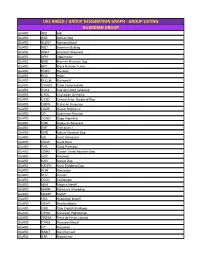
UKC BREED / GROUP DESIGNATION GRAPH - GROUP LISTING GUARDIAN GROUP GUARD AIDI Aidi GUARD AKB Akbash Dog GUARD ALENT Alentejo Mastiff GUARD ABD American Bulldog GUARD ANAT Anatolian Shepherd GUARD APN Appenzeller GUARD BMD Bernese Mountain Dog GUARD BRT Black Russian Terrier GUARD BOER Boerboel GUARD BOX Boxer GUARD BULLM Bullmastiff GUARD CORSO Cane Corso Italiano GUARD CDCL Cao de Castro Laboreiro GUARD CAUC Caucasian Ovcharka GUARD CASD Central Asian Shepherd Dog GUARD CMUR Cimarron Uruguayo GUARD DANB Danish Broholmer GUARD DP Doberman Pinscher GUARD DOGO Dogo Argentino GUARD DDB Dogue de Bordeaux GUARD ENT Entlebucher GUARD EMD Estrela Mountain Dog GUARD GS Giant Schnauzer GUARD DANE Great Dane GUARD PYR Great Pyrenees GUARD GSMD Greater Swiss Mountain Dog GUARD HOV Hovawart GUARD KAN Kangal Dog GUARD KSHPD Karst Shepherd Dog GUARD KOM Komondor GUARD KUV Kuvasz GUARD LEON Leonberger GUARD MJM Majorca Mastiff GUARD MARM Maremma Sheepdog GUARD MASTF Mastiff GUARD NEA Neapolitan Mastiff GUARD NEWF Newfoundland GUARD OEB Olde English Bulldogge GUARD OPOD Owczarek Podhalanski GUARD PRESA Perro de Presa Canario GUARD PYRM Pyrenean Mastiff GUARD RT Rottweiler GUARD SAINT Saint Bernard GUARD SAR Sarplaninac GUARD SC Slovak Cuvac GUARD SMAST Spanish Mastiff GUARD SSCH Standard Schnauzer GUARD TM Tibetan Mastiff GUARD TJAK Tornjak GUARD TOSA Tosa Ken SCENTHOUND GROUP SCENT AD Alpine Dachsbracke SCENT B&T American Black & Tan Coonhound SCENT AF American Foxhound SCENT ALH American Leopard Hound SCENT AFVP Anglo-Francais de Petite Venerie SCENT -

Breed Specific Instructions (BSI) Regarding Exaggerations in Pedigree Dogs
By the Nordic Kennel Clubs 2014 Applicable from 2014 Breed Specific Instructions (BSI) regarding exaggerations in pedigree dogs DANSK KENNEL KLUB HUNDARÆKTARFÉLAG ÍSLANDS NORSK KENNEL KLUB SUOMEN KENNELLIITTO SVENSKA KENNELKLUBBEN Index Introduction .............................................................................................................................4 Application ..............................................................................................................................6 Basics for all dogs ...................................................................................................................8 Breed types ...........................................................................................................................10 FCI GROUP 1 Sheepdogs and Cattle Dogs ..............................................................................12 FCI GROUP 2 Pinscher and Schnauzer - Molossoïd Breeds - Swiss Mountain and Cattle Dogs ...14 FCI GROUP 3 Terriers .............................................................................................................19 FCI GROUP 4 Dachshunds ......................................................................................................21 FCI GROUP 5 Spitz and Primitive types ...................................................................................22 FCI GROUP 6 Scenthounds and Related Breeds ......................................................................24 FCI GROUP 7 Pointing Dogs ....................................................................................................26 -

History of the GSMD
History of the GSMD Breed History Origins The Greater Swiss Mountain Dog is considered the oldest of the Swiss breeds and was instrumental in the early development of both the St. Bernard and the Rottweiler. There are several theories regarding the ancient origins of the Swiss Sennenhund breeds. The most popular theory states the dogs are descended from the Mollasian, a large Mastiff-type dog that accompanied the Roman Legions on their invasion of the Alpsin the 1st century B.C. However, a second theory holds that the Phoenicians (c. 1100 B.C.) brought a large breed of dog with them to settlements in Spain, and that these dogs later migrated eastward to influence the development of the Spanish Mastiff, Great Pyrenees, Dogue de Bordeaux, and eventually the large Swiss breeds. Yet a third possibility is that a large breed was indigenous to central Europeas far back as the Neolithic period. Whether or not a large breed was already in existence at the time of the Roman invasion of the Alpine regions, it seems clear that the Roman dogs would have been bred with these dogs. As a result, several breeds, including the Greater Swiss Mountain Dog, St. Bernard, and Bernese Mountain Dog, are largely descended from the Roman Mollasian. Early History in Europe The early ancestors of the Swissy were used by farmers, herdsmen, and merchants in central Europe. Selective breeding was more commonly based on the dog’s ability to perform a particular function, such as pulling loads or guarding, rather than on any acknowledged breed standard. Consequently, a group of dogs bred to perform a certain function took the name of that activity, such as Viehhunde, or cattle dog. -

Kurzform Rasse / Abbreviation Breed Stand/As Of: Sept
Kurzform Rasse / Abbreviation Breed Stand/as of: Sept. 2016 A AP Affenpinscher / Monkey Terrier AH Afghanischer Windhund / Afgan Hound AID Atlas Berghund / Atlas Mountain Dog (Aidi) AT Airedale Terrier AK Akita AM Alaskan Malamute DBR Alpenländische Dachsbracke / Alpine Basset Hound AA American Akita ACS American Cocker Spaniel / American Cocker Spaniel AFH Amerikanischer Fuchshund / American Foxhound AST American Staffordshire Terrier AWS Amerikanischer Wasserspaniel / American Water Spaniel AFPV Small French English Hound (Anglo-francais de petite venerie) APPS Appenzeller Sennenhund / Appenzell Mountain Dog ARIE Ariegeois / Arigie Hound ACD Australischer Treibhund / Australian Cattledog KELP Australian Kelpie ASH Australian Shepherd SILT Australian Silky Terrier STCD Australian Stumpy Tail Cattle Dog AUST Australischer Terrier / Australian Terrier AZ Azawakh B BARB Franzosicher Wasserhund / French Water Dog (Barbet) BAR Barsoi / Russian Wolfhound (Borzoi) BAJI Basenji BAN Basst Artesien Normad / Norman Artesien Basset (Basset artesien normand) BBG Blauer Basset der Gascogne / Bue Cascony Basset (Basset bleu de Gascogne) BFB Tawny Brittany Basset (Basset fauve de Bretagne) BASH Basset Hound BGS Bayrischer Gebirgsschweisshund / Bavarian Mountain Hound BG Beagle BH Beagle Harrier BC Bearded Collie BET Bedlington Terrier BBS Weisser Schweizer Schäferhund / White Swiss Shepherd Dog (Berger Blanc Suisse) BBC Beauceron (Berger de Beauce) BBR Briard (Berger de Brie) BPIC Picardieschäferhund / Picardy Shepdog (Berger de Picardie (Berger Picard)) -

Official Ukc Conformation Rulebook
OFFICIAL UKC CONFORMATION RULEBOOK Effective January 1, 2011 Table of Contents Regulations Governing UKC ® Licensed Conformation Shows ..............................................3 Regulations Governing Jurisdiction .................................................................3 UKC ® Licensed Who May Offer Conformation Events .......................3 Definitions ...................................................................3 Conformation Shows General Rules .............................................................6 *Effective January 1, 2011 Dog Temperament and Behavior ...............................8 UKC is the trademark of the Use of Alcohol and Illegal Drugs at Events ...............9 United Kennel Club, Inc. Misconduct and Discipline .......................................10 located in Kalamazoo, MI. Entering a UKC Event ..............................................17 The use of the initials UKC in association with any other Judging Schedule ....................................................20 registry would be in violation Judge Changes ........................................................20 of the registered trademark. Notify the United Kennel United Kennel Club Policy on Show Site Club, 100 E Kilgore Rd, Kalamazoo MI 49002-5584, Changes and Canceled Events ............................21 should you become aware of such a violation. Regular Licensed Classes ........................................23 Dogs That May Compete in Altered I. Jurisdiction. The following rules and regula - Licensed Classes ..................................................30