Party Politics in Ireland In
Total Page:16
File Type:pdf, Size:1020Kb
Load more
Recommended publications
-

A Seed Is Sown 1884-1900 (1) Before the GAA from the Earliest Times, The
A Seed is Sown 1884-1900 (1) Before the GAA From the earliest times, the people of Ireland, as of other countries throughout the known world, played ball games'. Games played with a ball and stick can be traced back to pre-Christian times in Greece, Egypt and other countries. In Irish legend, there is a reference to a hurling game as early as the second century B.C., while the Brehon laws of the preChristian era contained a number of provisions relating to hurling. In the Tales of the Red Branch, which cover the period around the time of the birth of Christ, one of the best-known stories is that of the young Setanta, who on his way from his home in Cooley in County Louth to the palace of his uncle, King Conor Mac Nessa, at Eamhain Macha in Armagh, practised with a bronze hurley and a silver ball. On arrival at the palace, he joined the one hundred and fifty boys of noble blood who were being trained there and outhurled them all single-handed. He got his name, Cuchulainn, when he killed the great hound of Culann, which guarded the palace, by driving his hurling ball through the hound's open mouth. From the time of Cuchulainn right up to the end of the eighteenth century hurling flourished throughout the country in spite of attempts made through the Statutes of Kilkenny (1367), the Statute of Galway (1527) and the Sunday Observance Act (1695) to suppress it. Particularly in Munster and some counties of Leinster, it remained strong in the first half of the nineteenth century. -
National University of Ireland Maynooth the ANCIENT ORDER
National University of Ireland Maynooth THE ANCIENT ORDER OF HIBERNIANS IN COUNTY MONAGHAN WITH PARTICULAR REFERENCE TO THE PARISH OF AGHABOG FROM 1900 TO 1933 by SEAMUS McPHILLIPS IN PARTIAL FULFILMENT OF THE REQUIREMENTS FOR THE DEGREE OF M.A. DEPARTMENT OF MODERN HISTORY NATIONAL UNIVERSITY OF IRELAND MAYNOOTH HEAD OF DEPARTMENT: Professor R. V. Comerford Supervisor of Research: Dr. J. Hill July 1999 TABLE OF CONTENTS Page Acknowledgement--------------------------------------------------------------------- iv Abbreviations---------------------------------------------------------------------------- vi Introduction----------------------------------------------------------------------------- 8 Chapter I The A.O.H. and the U.I.L. 1900 - 0 7 ------------------------------------43 Chapter II Death and destruction as home rule is denied 1908 - 21-------------81 Chapter III The A.O.H. in County Monaghan after partition 1922- 33 -------120 Conclusion-------------------------------------------------------------------------------143 ii FIGURES Figure 1 Lewis’s Map of 1837 showing Aghabog’s location in relation to County Monaghan------------------------------------------ 12 Figure 2 P. J. Duffy’s map of Aghabog parish showing the 68 townlands--------------------------------------------------13 Figure 3 P. J. Duffy’s map of the civil parishes of Clogher showing Aghabog in relation to the surrounding parishes-----------14 TABLES Table 1 Population and houses of Aghabog 1841 to 1911-------------------- 19 Illustrations------------------------------------------------------------------------------152 -

THE BELFAST GAZETTE, 23Rd DECEMBER, 1955
388 THE BELFAST GAZETTE, 23rd DECEMBER, 1955. IN THE HIGH COURT OF JUSTICE IN demands of which particulars shall have been given NORTHERN IRELAND as above required. QUEEN'S BENCH DIVISION—IN BANKRUPTCY Dated this 20th day of December, 1955. J. D. DEVLIN, Solicitor for said Adminis- Thomas Adger and Frank Adger, trading as Adger trator, Cookstown. Bros, of West Drive, Portstewart, Co. London- derry, Builders, were on the 9th day of December, 1955, adjudged Bankrupts. STATUTORY NOTICE TO CREDITORS PUBLIC SITTINGS will be held before the In the Estate of James Austin, late of 15 Grand Court at the Royal Courts of Justice (Ulster), Parade, Belfast, Builder, deceased. Belfast, on Friday, the 13th day of January, 1956, NOTICE is hereby given, pursuant to the Statute and on Friday, the 20th day of January, 1956, at 22 and 23 Vic. Cap. 35, that all persons having the hour of Eleven o'clock in the forenoon, whereat any claims or demands against the Estate of the the Bankrupts are to attend, and to make a full above deceased, who died on the 24th day of disclosure and discovery of their Estate and Effects. January, 1955, are hereby required to furnish par- Creditors may prove their Debs, and at the First ticulars of such claims or demands (in writing) on Sitting choose a Creditors' Assignee. At the last or before the 1st day of March, 1956, to the under- Sitting the Bankrupts are required to finish their signed, Solicitors for the Administratrix, to whom Examination. Letters of Administration were on the 18th day of All persons having in their possession any May, 1955, granted forth of the Principal Registry Property of the Banrupts should deliver it and all of the Queen's Bench Division (Probate) of the Debts due to the Bankrupts should be paid to William High Court of Justice in Northern Ireland. -
Challenger Party List
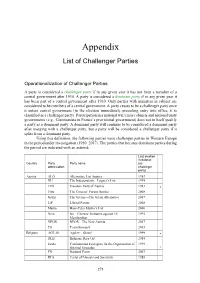
Appendix List of Challenger Parties Operationalization of Challenger Parties A party is considered a challenger party if in any given year it has not been a member of a central government after 1930. A party is considered a dominant party if in any given year it has been part of a central government after 1930. Only parties with ministers in cabinet are considered to be members of a central government. A party ceases to be a challenger party once it enters central government (in the election immediately preceding entry into office, it is classified as a challenger party). Participation in a national war/crisis cabinets and national unity governments (e.g., Communists in France’s provisional government) does not in itself qualify a party as a dominant party. A dominant party will continue to be considered a dominant party after merging with a challenger party, but a party will be considered a challenger party if it splits from a dominant party. Using this definition, the following parties were challenger parties in Western Europe in the period under investigation (1950–2017). The parties that became dominant parties during the period are indicated with an asterisk. Last election in dataset Country Party Party name (as abbreviation challenger party) Austria ALÖ Alternative List Austria 1983 DU The Independents—Lugner’s List 1999 FPÖ Freedom Party of Austria 1983 * Fritz The Citizens’ Forum Austria 2008 Grüne The Greens—The Green Alternative 2017 LiF Liberal Forum 2008 Martin Hans-Peter Martin’s List 2006 Nein No—Citizens’ Initiative against -

The Banshee's Kiss: Conciliation, Class and Conflict in Cork and The
The Banshee’s Kiss: Conciliation, Class and Conflict in Cork and the All for Ireland League. Thesis submitted in accordance with the requirements of the University of Liverpool for the degree of Doctor of Philosophy by Patrick Joseph Murphy. August 2019 1 The Banshee’s Kiss: Conciliation, Class and Conflict in Cork and the All for Ireland League. ABSTRACT Historians have frequently portrayed constitutional nationalism as being homogeneous - ‘the Home Rule movement’- after the reunification of the Irish parliamentary party in 1900. Yet there were elements of nationalist heterodoxy all over the country, but it was only in Cork where dissent took an organised form in the only formal breakaway from the Irish party when the All for Ireland League (A.F.I.L.) was launched in 1910. The AFIL took eight of the nine parliamentary seats in Cork and gained control of local government in the city and county the following year. Existing historical accounts do not adequately explain why support for the Home Rule movement collapsed in Cork, but also why the AFIL flourished there but failed, despite the aspiration of its name, to expand beyond its regional base. The AFIL is chiefly remembered for its visionary policy of conciliation with unionists following the Damascene conversion of its leader William O’Brien, transformed from the enemy of the landed classes to an apostle of a new kind of bi- confessional politics. This would, he claimed, end the ‘Banshee’s Kiss’, a cycle of conflict in which each new generation attempts to achieve Irish freedom. However, conciliation was a policy which was unpopular with both nationalists and unionists and O’Brien therefore needed to develop an electoral base by other means with more popular policies. -
UK Data Archive Study Number 66039 - Survey of Councillors in Belfast, 1966
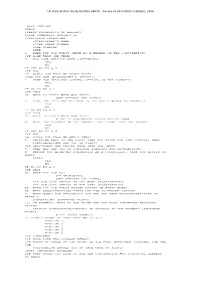
UK Data Archive Study Number 66039 - Survey of Councillors in Belfast, 1966 SSRC C001-25 66039 QUEENS UNIVERSITY OF BELFAST LOCAL COMMUNITY PROJECT II COUNCILLOR INTERVIEW INTERVIEWER'S NAME COVER SHEET NUMBER TIME STARTED DATE 1. WHEN DID YOU FIRST SERVE AS A MEMBER OF THE CORPORATION? (IF MORE THAN ONE TERM) 2. HAS YOUR SERVICE BEEN CONTINUOUS? YES NO IF YES GO TO Q.3 (IF NO) 2A WOULD YOU TELL ME ABOUT THAT? (YOU ARE NOW (RESPONDENT'S OFFICE)) 3. HAVE YOU HELD ANY (OTHER) OFFICES ON THE COUNCIL? YES NO IF NO GO TO Q.4 (IF YES) 3A WHAT IS THAT? WHEN WAS THAT? (GET OFFICES AND DATES) 4. HAVE YOU HELD ANY OFFICES IN THE PARTY GROUP ON COUNCIL? YES NO IF NO GO TO Q.5 (IF YES) 4A WHAT IS THAT? WHEN WAS THAT? (FIND IF RESPONDENT HOLDS OFFICE NOW) 5. WERE YOU ELECTED TO THE COUNCIL THE FIRST TIME YOU STOOD? YES NO IF YES GO TO Q.6 (IF NO) 5A COULD YOU TELL ME ABOUT THAT? 6. THINKING BACK TO THE FIRST TIME YOU STOOD FOR THE COUNCIL, WHAT CONSIDERATIONS LED YOU TO STAND? (IF RESPONDENT HAS SERVED MORE THAN ONE TERM) 7. WHAT HAS LED YOU TO CONTINUE STANDING FOR RE-ELECTION? 8. BEFORE YOU ACCEPTED NOMINATION AS A COUNCILLOR, WERE YOU ACTIVE IN PARTY WORK? YES NO IF NO GO TO Q.9 (IF YES) 8A WHAT DID YOU DO? (IF NECESSARY) (GET OFFICES AND DATES) DID YOU HOLD OFFICE IN ANY WARD ORGANIZATION? DID YOU HOLD OFFICE IN THE CITY ORGANIZATION? 8B WHEN DID YOU FIRST BECOME ACTIVE IN PARTY WORK? 8C WHAT CONSIDERATIONS FIRST LED YOU TO BECOME ACTIVE? 9. -

The Devlinite Irish News, Northern Ireland's "Trapped" Nationalist Minority, and the Irish Boundary Question, 1921-1925
WITHOUT A "DOG'S CHANCE:" THE DEVLINITE IRISH NEWS, NORTHERN IRELAND'S "TRAPPED" NATIONALIST MINORITY, AND THE IRISH BOUNDARY QUESTION, 1921-1925 by James A. Cousins Master ofArts, Acadia University 2000 Bachelor ofArts, Acadia University 1997 THESIS SUBMITTED IN PARTIAL FULFILLMENT OF THE REQUIREMENTS FOR THE DEGREE OF DOCTOR OF PHILOSOPHY In the Department ofHistory © James A. Cousins 2008 SIMON FRASER UNIVERSITY Summer 2008 All rights reserved. This work may not be reproduced in whole or in part, by photocopy or other means, without permission ofthe author. APPROVAL Name: James A. Cousins Degree: Doctor of Philosophy Title ofProject: Without a "Dog's Chance:" The Devlinite Irish News, Northern Ireland's "Trapped" Nationalist Minority, and the Irish Boundary Question, 1921-1925 Examining Committee: Chair Dr. Alexander Dawson, Associate Professor Department ofHistory Dr. John Stubbs, Professor Senior Supervisor Department ofHistory Dr. Wil1een Keough, Assistant Professor Supervisor Department ofHistory Dr. Leith Davis, Professor Supervisor Department ofEnglish Dr. John Craig, Professor Internal Examiner Department ofHistory Dr. Peter Hart, Professor External Examiner Department ofHistory, Memorial University of Newfoundland Date Approved: 11 SIMON FRASER UNIVERSITY LIBRARY Declaration of Partial Copyright Licence The author, whose copyright is declared on the title page of this work, has granted to Simon Fraser University the right to lend this thesis, project or extended essay to users of the Simon Fraser University Library, and to make partial or single copies only for such users or in response to a request from the library of any other university, or other educational institution, on its own behalf or for one of its users. -

Bulmer Hobson and the Nationalist Movement in Twentieth-Century Ireland by Marnie Hay Review By: Fergal Mccluskey Source: Irish Historical Studies, Vol
Review Reviewed Work(s): Bulmer Hobson and the nationalist movement in twentieth-century Ireland by Marnie Hay Review by: Fergal McCluskey Source: Irish Historical Studies, Vol. 37, No. 145 (May 2010), pp. 158-159 Published by: Cambridge University Press Stable URL: https://www.jstor.org/stable/20750083 Accessed: 31-12-2019 18:31 UTC JSTOR is a not-for-profit service that helps scholars, researchers, and students discover, use, and build upon a wide range of content in a trusted digital archive. We use information technology and tools to increase productivity and facilitate new forms of scholarship. For more information about JSTOR, please contact support@jstor.org. Your use of the JSTOR archive indicates your acceptance of the Terms & Conditions of Use, available at https://about.jstor.org/terms Cambridge University Press is collaborating with JSTOR to digitize, preserve and extend access to Irish Historical Studies This content downloaded from 82.31.34.218 on Tue, 31 Dec 2019 18:31:59 UTC All use subject to https://about.jstor.org/terms 158 Irish Historical Studies BULMER HOBSON AND THE NATIONALIST MOVEMENT IN TWENTIETH-CENTURY IRELAND. By Mamie Hay. Pp 272, illus. Manchester: Manchester University Press. 2009. ?55 hardback; ?18.99 paperback. Bulmer Hobson's formative influence in numerous political and cultural organisations begs the question as to why, until now, his autobiographical Ireland: yesterday and tomorrow (1968) remained the only consequential account of his career. Dr Hay expresses little surprise, however, at this historiographical gap. In fact, Hobson's position as 'worsted in the political game' (p. 1) serves as this book's premise. -
Introduction to the Cahir Healy Papers Adobe
INTRODUCTION CAHIR HEALY PAPERS November 2007 Cahir Healy Papers (D2991) Table of Contents Summary .................................................................................................................2 Cahir Healy's early years .........................................................................................3 The Gaelic League and Sinn Fein ...........................................................................4 The 'republican' courts.............................................................................................6 The Treaty and partition...........................................................................................7 Internment on the 'Argenta'......................................................................................8 The Boundary Commission......................................................................................9 Divisions among the nationalists............................................................................10 The National League .............................................................................................11 The wilderness years, 1935-1945..........................................................................12 Internment in Brixton..............................................................................................13 The Anti-Partition League ......................................................................................14 Physical force and abstentionism ..........................................................................16 -

History GCSE
GCSE CCEA GCSE TEACHER GUIDANCE History Unit 1 Section B Option 1: Changing Relations: Northern Ireland and its Neighbours, 1920–49 Resource Pack: The Partitioning of Ireland For first teaching from September 2017 Option 1: Changing Relations: Northern Ireland and its Neighbours, 1920–49 Introduction to Resource Pack This pack has been developed to help support the teaching and learning of ‘Changing Relations: Northern Ireland and its Neighbours, 1920-49’ and, in particular, content new to this option: ‘The partitioning of Ireland’. The specification content for this topic is: The partitioning of Ireland Reactions to the Government of Ireland Act in the north and south of Ireland For each activity, there is a ‘teacher guidance’ section as well as ‘instructions for students’. Some brief background information for each activity is also provided. Each activity provides opportunities to develop the statutory skills requirements of the Northern Ireland Curriculum at Key Stage 4 as well as the skills students will be expected to demonstrate in the examination for this option: demonstrate knowledge and understanding of the key features and characteristics of the period studied (AO1); explain and analyse historical events and periods studied using second-order historical concepts including continuity, change, cause, consequence, significance, similarity and difference (AO2); and analyse, evaluate and use sources (contemporary to the period) to make substantiated judgements, in the context of historical events studied (AO3). Background to the topic Students should develop an understanding of the main provisions of the Government of Ireland Act, 1920 and how it divided Ireland geographically and politically. The Act essentially introduced two Home Rule Parliaments – one in Belfast and one in Dublin. -

Xerox University Microfilms
INFORMATION TO USERS This material was produced from a microfilm copy of the original document. While the most advanced technological means to photograph and . reproduce________ this document have been used, the quality is heavily dependent upon t^ie quality of the original submitted. The following explanation of techniques is provided to help you understand markings or patterns which may appear on this reproductic n. 1.The sign or "target" for pages apparently lacking from the document photographed is "Missing Page(s)". If it was posiible to obtain the missing page(s) or section, they are spliced into the film ilong with adjacent pages. This may have necessitated cutting thru an image and duplicating adjacent pages to insure you complete continuity. 2. When an image on the film is obliterated with a large round black mark, it is an indication that the photographer suspected that the copy may have moved during exposure and thus cause a blurred image. You will find a good image of the page in the adjacent frame. 3. When a map, drawing or chart, etc., was pi rt of the material being photographed the photographer followed a definite method in "sectioning" the material. It is customary to begin photoing at the upper left hand corner of a large sheet and to continue photoing from left to right in equal sections with a small overlap, continued again - beginning below the first row and continuing on until complete. 4. The majority of users indicate that the textual co>ntent is of greatest value, however, a somewhat higher quality reproducti on could be made from "photographs" if essential to the understandini of the dissertation. -

UNITED KINGDOM Date of Elections: June 18, 1970 Characteristics Of
UNITED KINGDOM Date of Elections: June 18, 1970 Characteristics of Parliament The Parliament of the United Kingdom is composed of two Houses: — The House of Commons, which consists of 630 members elected for 5 years. — The House of Lords, which has approximately 850 hereditary peers; 16 peers elected for each legislature by the hereditary peers of Scotland; the survivors of the 28 life peers elected by the hereditary peers of Ireland prior to 1920; 155 peers appointed by the Crown; 9 Lords of Ordinary Appeal, high magistrates appointed for life; and 26 Lords Spiritual (the 2 Archbishops of Canterbury and York, the 3 Bishops of London, Winchester and Durham and the 21 Bishops of longest standing). The functions of President of this upper House are exercised by the Lord Chancellor who is appointed by the Prime Minister and is not necessarily a peer. British citizens were called to the polls on June 18, 1970, to elect the 630 members of the House of Commons, prematurely dissolved on May 29,1970. Electoral System All British subjects or citizens of the Irish Republic, of either sex, are entitled to vote, provided they have reached the age of 18 by the day on which the elections are held, and are registered on the electoral list (revised annually) of the constituency in which they are resident. A person whose 18th birthday will fall in the 12 months following the publication date of the electoral lists may be registered on them, but may not vote before reaching the required age. However, members of the House of Lords, the mentally deficient, criminals sentenced to more than 12 months' imprisonment, or any persons who, during the 5 years prior to the election, have been found guilty of electoral corruption or fraud may not exercise their right to vote.