4.3.2.3. Familia Proteaceae 4.3.2.3.A
Total Page:16
File Type:pdf, Size:1020Kb
Load more
Recommended publications
-
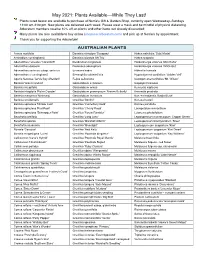
May Plant Availability List
May 2021: Plants Available—While They Last! Plants listed below are available to purchase at Norrie's Gift & Garden Shop, currently open Wednesday–Sundays 11:00 am-2:00 pm. New plants are delivered each week. Please wear a mask and be mindful of physical distancing. Arboretum members receive 10% off on plants and other items not already discounted; Many plants are also available to buy online (shopucscarboretum.com) and pick up at Norrie's by appointment; Thank you for supporting the Arboretum! AUSTRALIAN PLANTS Acacia myrtifolia Darwinia citriodora 'Seaspray' Hakea salicifolia ‘Gold Medal’ Actinodium cunninghamii Darwinia leiostyla 'Mt Trio' Hakea scoparia Adenanthos cuneatus 'Coral Drift' Dendrobium kingianum Hardenbergia violacea 'Mini Haha' Adenanthos dobsonii Dodonaea adenophora Hardenbergia violacea 'White Out' Adenanthos sericeus subsp. sericeus Eremaea hadra Hibbertia truncata Adenanthos x cunninghamii Eremophila subteretifolia Hypocalymma cordfolium 'Golden Veil' Agonis flexuosa 'Jervis Bay Afterdark' Feijoa sellowiana Isopogon anemonifolius 'Mt. Wilson' Banksia 'Giant Candles' Gastrolobium celsianum Isopogon formosus Banksia integrifolia Gastrolobium minus Kennedia nigricans Banksia integifolia 'Roller Coaster' Gastrolobium praemorsum 'Bronze Butterfly' Kennedia prostrata Banksia marginata 'Minimarg' Gastrolobium truncatum Kunzea badjensis 'Badja Blush' Banksia occidentalis Grevillea 'Bonfire' Kunzea baxteri Banksia spinulosa 'Nimble Jack' Grevillea 'Canterbury Gold' Kunzea parvifolia Banksia spinulosa 'Red Rock' Grevillea ‘Cherry -

Indigenous Plants of Bendigo
Produced by Indigenous Plants of Bendigo Indigenous Plants of Bendigo PMS 1807 RED PMS 432 GREY PMS 142 GOLD A Gardener’s Guide to Growing and Protecting Local Plants 3rd Edition 9 © Copyright City of Greater Bendigo and Bendigo Native Plant Group Inc. This work is Copyright. Apart from any use permitted under the Copyright Act 1968, no part may be reproduced by any process without prior written permission from the City of Greater Bendigo. First Published 2004 Second Edition 2007 Third Edition 2013 Printed by Bendigo Modern Press: www.bmp.com.au This book is also available on the City of Greater Bendigo website: www.bendigo.vic.gov.au Printed on 100% recycled paper. Disclaimer “The information contained in this publication is of a general nature only. This publication is not intended to provide a definitive analysis, or discussion, on each issue canvassed. While the Committee/Council believes the information contained herein is correct, it does not accept any liability whatsoever/howsoever arising from reliance on this publication. Therefore, readers should make their own enquiries, and conduct their own investigations, concerning every issue canvassed herein.” Front cover - Clockwise from centre top: Bendigo Wax-flower (Pam Sheean), Hoary Sunray (Marilyn Sprague), Red Ironbark (Pam Sheean), Green Mallee (Anthony Sheean), Whirrakee Wattle (Anthony Sheean). Table of contents Acknowledgements ...............................................2 Foreword..........................................................3 Introduction.......................................................4 -
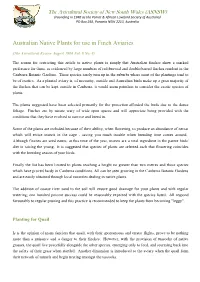
Australian Native Plants for Use in Finch Aviaries
The Avicultural Society of New South Wales (ASNSW) (Founding in 1940 as the Parrot & African Lovebird Society of Australia) PO Box 248, Panania NSW 2213, Australia Australian Native Plants for use in Finch Aviaries (The Avicultural Review August 1986 Vol. 8 No. 8) The reason for restricting this article to native plants is simply that Australian finches show a marked preference for them, as evidenced by large numbers of red-browed and double-barred finches resident in the Canberra Botanic Gardens. These species rarely turn up in the suburbs where most of the plantings tend to be of exotics. As a planted aviary is, of necessity, outside and Australian birds make up a great majority of the finches that can be kept outside in Canberra, it would seem pointless to consider the exotic species of plants. The plants suggested have been selected primarily for the protection afforded the birds due to the dense foliage. Finches are by nature wary of wide open spaces and will appreciate being provided with the conditions that they have evolved to survive and breed in. Some of the plants are included because of their ability, when flowering, to produce an abundance of nectar which will entice insects in the cage - saving you much trouble when breeding time comes around. Although finches are seed eaters, at this time of the year, insects are a vital ingredient in the parent birds' diet in raising the young. It is suggested that species of plants are selected such that flowering coincides with the breeding season of your birds. Finally the list has been limited to plants reaching a height no greater than two metres and those species which have proved hardy in Canberra conditions. -

Seed Dynamics and Seedling Establishment of Woody Species in the Tropical Savannas of Central Brazil (Cerrado) Ana A
University of Miami Scholarly Repository Open Access Dissertations Electronic Theses and Dissertations 2010-04-08 Seed Dynamics and Seedling Establishment of Woody Species in the Tropical Savannas of Central Brazil (Cerrado) Ana A. Salazar Parra University of Miami, ana@bio.miami.edu Follow this and additional works at: https://scholarlyrepository.miami.edu/oa_dissertations Recommended Citation Salazar Parra, Ana A., "Seed Dynamics and Seedling Establishment of Woody Species in the Tropical Savannas of Central Brazil (Cerrado)" (2010). Open Access Dissertations. 371. https://scholarlyrepository.miami.edu/oa_dissertations/371 This Open access is brought to you for free and open access by the Electronic Theses and Dissertations at Scholarly Repository. It has been accepted for inclusion in Open Access Dissertations by an authorized administrator of Scholarly Repository. For more information, please contact repository.library@miami.edu. UNIVERSITY OF MIAMI SEED DYNAMICS AND SEEDLING ESTABLISHMENT OF WOODY SPECIES IN THE TROPICAL SAVANNAS OF CENTRAL BRAZIL (CERRADO) By Ana A. Salazar Parra A DISSERTATION Submitted to the Faculty of the University of Miami in partial fulfillment of the requirements for the degree of Doctor of Philosophy Coral Gables, Florida May 2010 ©2010 Ana A. Salazar Parra All Rights Reserved UNIVERSITY OF MIAMI A dissertation submitted in partial fulfillment of the requirements for the degree of Doctor of Philosophy SEED DYNAMICS AND SEEDLING ESTABLISHMENT OF WOODY SPECIES IN THE TROPICAL SAVANNAS OF CENTRAL BRAZIL (CERRADO) Ana A. Salazar Parra Approved: ________________ _________________ Guillermo Goldstein, Ph.D. Terri A. Scandura, Ph.D. Professor of Biology Dean of the Graduate School ________________ _________________ David Janos, Ph.D. Leonel Sternberg, Ph.D. -
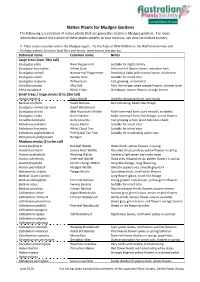
Native Plants for Mudgee Gardens the Following Is a Selection of Native Plants That Are Generally Reliable in Mudgee Gardens
Central West Group Native Plants for Mudgee Gardens The following is a selection of native plants that are generally reliable in Mudgee gardens. For more information about the culture of these plants specific to your location, ask your local plant nursery. # - Plant occurs naturally within the Mudgee region. Try the Atlas of NSW Wildlife on the NSW Environment and Heritage website for more local flora and fauna: www.bionet.nsw.gov.au/. Botanical name Common name Notes Large trees (over 10m tall) Eucalyptus elata River Peppermint Suitable for slight salinity Eucalyptus leucoxylon Yellow Gum Pink and red flowers forms, attractive bark Eucalyptus nicholii Narrow-leaf Peppermint Pendulous habit with narrow leaves, shade tree Eucalyptus ovata Swamp Gum Suitable for moist sites Eucalyptus scoparia Willow Gum Fast growing, ornamental Grevillea robusta Silky Oak Fern-like foliage, large orange flowers, attracts birds Melia azedarach White Cedar Deciduous, mauve flowers, orange berries Small trees / large shrubs (5 to 10m tall) Acacia vestita # Hairy Wattle Graceful drooping shrub, very hardy Banksia ericifolia Heath Banksia Bird attracting, heath-like foliage Eucalyptus eximia ssp nana Dwarf Bloodwood Eucalyptus stricta Blue Mountains Mallee Multi-stemmed form, bark smooth, scribbled Eucalyptus viridis Green Mallee Multi-stemmed form, fine foliage, cream flowers Grevillea barklyana Gully Grevillea Fast growing screen plant, tolerates shade Melaleuca armillaris Honey Myrtle Suitable for moist sites Melaleuca bracteata White Cloud Tree Suitable -

Pollen Morphology of Proteaceae Native to Argentina: a New Dichotomus Key for Their Identification
Rev. Mus. Argentino Cienc. Nat., n.s. 19(1): 25-37, 2017 ISSN 1514-5158 (impresa) ISSN 1853-0400 (en línea) Pollen morphology of Proteaceae native to Argentina: a new dichotomus key for their identification Damián Andrés FERNÁNDEZ Sección Paleopalinología, Museo Argentino de Ciencias Naturales “Bernardino Rivadavia”, Av. A. Gallardo 470, C1405DJR Buenos Aires, Argentina. E-mail: dafernandez@macn.gov.ar. Abstract: A dichotomous key for the identification of eight proteaceous species, native to Argentina, based on pollen morphology is presented. These species are: Embothrium coccineum, Gevuina avellana, Lomatia den- tata, L. ferruginea, L. hirsuta, Orites myrtoidea, Roupala meisneri and R. montana. The pollen morphology was analyzed with both, light and electron scanning microscopes. The morphological characters selected for species/ genera recognition are: ornamentation, pore number, equatorial diameter, the ratio of sexine/nexine thickness, and equatorial diameter/pore diameter ratio. Key words: Proteaceae, Argentina, palynology, dichotomous key. Resumen: Morfología polínica de las Proteaceae nativas de Argentina: una nueva clave dicotómi- ca para su identificación. Se presenta una clave dicotómica para la identificación de las ocho especies de Proteacea nativas de la Argentina. Las especies son: Embothrium coccineum, Gevuina avellana, Lomatia dentata, L. ferruginea, L. hirsuta, Orites myrtoidea, Roupala meisneri and R. montana. La morfología polínica fue analiza- da utilizando microscopio óptico y microscopio electrónico de barrido. Los caracteres morfológicos elegidos para reconocer las especies/géneros son: tipo de ornamentación, número de poros, diámetro ecuatorial, relación de espesor sexina/nexina y relación diámetro ecuatorial/diámetro de poro. Palabras clave: Proteaceae, Argentina, palinología, clave dicotómica. _____________ INTRODUCTION three tribes within Grevilleoideae (Embothrieae, Macadamieae, and Oriteae) are currently found The Proteaceae family comprises 83 gen- in Argentina. -

Rates of Molecular Evolution and Diversification in Plants: Chloroplast
Duchene and Bromham BMC Evolutionary Biology 2013, 13:65 http://www.biomedcentral.com/1471-2148/13/65 RESEARCH ARTICLE Open Access Rates of molecular evolution and diversification in plants: chloroplast substitution rates correlate with species-richness in the Proteaceae David Duchene* and Lindell Bromham Abstract Background: Many factors have been identified as correlates of the rate of molecular evolution, such as body size and generation length. Analysis of many molecular phylogenies has also revealed correlations between substitution rates and clade size, suggesting a link between rates of molecular evolution and the process of diversification. However, it is not known whether this relationship applies to all lineages and all sequences. Here, in order to investigate how widespread this phenomenon is, we investigate patterns of substitution in chloroplast genomes of the diverse angiosperm family Proteaceae. We used DNA sequences from six chloroplast genes (6278bp alignment with 62 taxa) to test for a correlation between diversification and the rate of substitutions. Results: Using phylogenetically-independent sister pairs, we show that species-rich lineages of Proteaceae tend to have significantly higher chloroplast substitution rates, for both synonymous and non-synonymous substitutions. Conclusions: We show that the rate of molecular evolution in chloroplast genomes is correlated with net diversification rates in this large plant family. We discuss the possible causes of this relationship, including molecular evolution driving diversification, speciation increasing the rate of substitutions, or a third factor causing an indirect link between molecular and diversification rates. The link between the synonymous substitution rate and clade size is consistent with a role for the mutation rate of chloroplasts driving the speed of reproductive isolation. -

Plant Tracker 97
Proprietor: Ashley Elliott 230 Tannery Lane Mandurang Victoria 3551 Telephone: (03) 5439 5384 PlantPlant CatalogueCatalogue Facsimile: (03) 5439 3618 E-mail: info@goldfieldsrevegetation.com.au Central & Northern Victoria's Indigenous Nursery Please contact the nursery to confirm stock availablity Non-Local Plants aneura Mulga or Yarran Acacia ramulosa Horse Mulga or Narrow Leaf Mulga Acacia aphylla Acacia redolens Acacia argrophylla Silver Mulga Acacia restiacea Acacia beckleri Barrier Range Wattle Acacia rhigiophylla Dagger-leaved Acacia Acacia cardiophylla Wyalong Wattle Acacia riceana Acacia chinchillensis Acacia rossei Acacia cliftoniana ssp congesta Acacia spectabilis Mudgee Wattle Acacia cognata River Wattle - low form Acacia spinescens Spiny Wattle Acacia cognata River or Bower Wattle Acacia spongilitica Acacia conferta Crowded-leaf Wattle Acacia squamata Bright Sedge Wattle Acacia convenyii Blue Bush Acacia stigmatophylla Acacia cultriformis Knife-leaf Wattle Acacia subcaerulea Acacia cupularis Coastal prostrate Acacia vestita Hairy Wattle Acacia cyclops Round-seeded Acacia Acacia victoriae Bramble Wattle or Elegant Wattle Acacia declinata Acacia wilhelmiana Dwarf Nealie Acacia decora Western Silver Wattle Acacia willdenowiana Leafless Wattle Acacia denticulosa Sandpaper Wattle Acacia caerulescens caerulescens Buchan Blue Acacia drummondii subsp Dwarf Drummond Wattle Acanthocladium dockeri Laura Daisy drummondii Actinodium cunninghamii Albany Daisy or Swamp Daisy Acacia elata Cedar Wattle Actinodium species (prostrate form) Acacia -
Fire Retardant Plants for the Urban Fringe and Rural Areas
Flammability Groups Leptospermum scoparium TN Pittosporum undulatum AN X Cucurbita maxima E Pumpkin Morus sp. E Mulberry Manuka, Teatree Sweet Pittosporum Cymbopogon citratus E Lemon Grass Myoporum insulare AN Boobyalla In the following list E denotes an exotic plant, TN a plant Lomandra longifolia TN Saggs Platanus x acerifolia E Plane Tree Cyphomandra betacea E Tamarillo Nerium oleander E Oleander native to Tasmania, AN a plant native to mainland Australia Melaleuca alternifolia AN Paperbark Poa sp. AN Poa Grass Delonix regia E Poinciana Olearia argophylla TN Musk Monstera deliciosa E Monstera Populas sp. E Poplar and X a known environmental weed. Dicksonia antarctica TN Man Fern Photinia glabra var. rubens E Nadina domestica E Sacred Bamboo Quercus robur E English oak Diospryros sp. E Persimmon Chinese Fire Bush or Red-leafed Photinia High Flammability Nicotiana glauca AN Tobacco Bush Spiraea catoniensis E May Eriobotrya japonica E Loquat Pittosporum bicolor TN Cheesewood Pinus elliottii E Tasmannia lanceolata TN Escallonia macrantha E Escallonia These plants have been shown to be highly flammable and Slash or Elliott’s Pine Native Pepper Pteridium esculentum TN Euryops pectinatus E Bracken Fern should not be planted or allowed to remain inside your house’s Pinus patula E Ulex europaeus E X Gorse Yellow Daisy Bush Mexican or Weeping Pine Rhododendron sp. E Rhododendron Building Protection Zone. They should also be avoided in the Viburnum opulus E Guelder Rose Genista monspessulana E X Montpellier Broom Rosa sp. E X Roses, Briars Fuel Modified Zone. Move these plants away from your house Moderate Flammability Koelreuteria paniculata E Salix babylonica E Weeping Willow and replace them with less flammable plants. -
Growing and Knowing Greville
CONTENTS CREDITS 7 CHAPTER 1 CLASSIFICATION 8 Characteristics 9 CHAPTER 2 CULTIVATION 15 Soil Type 15 Nutrition and Acidity 16 Water 16 Temperature 16 Bushfires 18 Mulching 18 Pruning 18 Pests, Diseases & Disorders 21 Propagation 25 CHAPTER 3 LANDSCAPING AND OTHER USES 27 Landscaping and Amenity Uses 28 Timber Production 30 Cut Flowers and Foliage 30 Food and Medicinal Uses 32 Lifespan 32 Attracting Birds and other Animals 33 Fragrant Grevilleas 33 Allergies 33 CHAPTER 4 SPECIES 34 Grevillea acuaria 34 Grevillea agrifolia 35 Grevillea alpina 35 Grevillea banksii 37 Grevillea bedggoodiana 38 Grevillea bipinnatifida 39 Grevillea biternata (syn. G. paniculata) 40 Grevillea bronwenae (syn. Grevillea brachystylis) 41 Grevillea calcicola 42 Grevillea curviloba 43 Grevillea delta (syn. G. thelemanniana subsp. delta) 44 Grevillea dimorpha (syn. G. speciosa subsp. dimorpha) 44 Grevillea drummondii 45 Grevillea dryandri 46 Grevillea dryandroides 47 Grevillea eriostachya 48 Grevillea x gaudichaudii 49 Grevillea georgeana 50 Grevillea heliosperma 51 Grevillea hookeriana 52 Grevillea humifusa 52 Grevillea involucrata 53 Grevillea jephcottii 53 Grevillea johnsonii 54 Grevillea juniperina 55 Grevillea juniperina subsp. sulphurea (syn. G. sulphurea) 56 Grevillea lanigera (syn. G. ericifolia) 58 Grevillea Iavandulacea 61 Grevillea leucopteris 62 Grevillea linearifolia 63 Grevillea longistyla 64 Grevillea montis-cole ssp. brevistyla 65 Grevillea nudiflora (syn. G. pedunculosa) 66 Grevillea oleoides (syn. G. speciosa subsp. oleoides) 67 Grevillea paniculata -

Gardens and Stewardship
GARDENS AND STEWARDSHIP Thaddeus Zagorski (Bachelor of Theology; Diploma of Education; Certificate 111 in Amenity Horticulture; Graduate Diploma in Environmental Studies with Honours) Submitted in fulfilment of the requirements for the degree of Doctor of Philosophy October 2007 School of Geography and Environmental Studies University of Tasmania STATEMENT OF AUTHENTICITY This thesis contains no material which has been accepted for any other degree or graduate diploma by the University of Tasmania or in any other tertiary institution and, to the best of my knowledge and belief, this thesis contains no copy or paraphrase of material previously published or written by other persons, except where due acknowledgement is made in the text of the thesis or in footnotes. Thaddeus Zagorski University of Tasmania Date: This thesis may be made available for loan or limited copying in accordance with the Australian Copyright Act of 1968. Thaddeus Zagorski University of Tasmania Date: ACKNOWLEDGEMENTS This thesis is not merely the achievement of a personal goal, but a culmination of a journey that started many, many years ago. As culmination it is also an impetus to continue to that journey. In achieving this personal goal many people, supervisors, friends, family and University colleagues have been instrumental in contributing to the final product. The initial motivation and inspiration for me to start this study was given by Professor Jamie Kirkpatrick, Dr. Elaine Stratford, and my friend Alison Howman. For that challenge I thank you. I am deeply indebted to my three supervisors Professor Jamie Kirkpatrick, Dr. Elaine Stratford and Dr. Aidan Davison. Each in their individual, concerted and special way guided me to this omega point. -

2002 12 the Cerrados of Brazil.Pdf
00 oliveira fm 7/31/02 8:11 AM Page i The Cerrados of Brazil 00 oliveira fm 7/31/02 8:11 AM Page ii 00 oliveira fm 7/31/02 8:11 AM Page iii The Cerrados of Brazil Ecology and Natural History of a Neotropical Savanna Editors Paulo S. Oliveira Robert J. Marquis Columbia University Press New York 00 oliveira fm 7/31/02 8:11 AM Page iv Columbia University Press Publishers Since 1893 New York Chichester, West Sussex © 2002 Columbia University Press All rights reserved Library of Congress Cataloging-in-Publication Data The cerrados of Brazil : ecology and natural history of a neotropical savanna / Paulo S. Oliveira and Robert J. Marquis. p. cm. Includes bibliographical references. ISBN 0-231-12042-7 (cloth : alk. paper)—ISBN 0-231-12043-5 (pbk. : alk. paper) 1. Cerrado ecology—Brazil. I. Oliveira, Paulo S., 1957– II. Marquis, Robert J., 1953– QH117 .C52 2002 577.4'8'0981—dc21 2002022739 Columbia University Press books are printed on permanent and durable acid-free paper. Printed in the United States of America c 10 9 8 7 6 5 4 3 2 1 p 10 9 8 7 6 5 4 3 2 1 00 oliveira fm 7/31/02 8:11 AM Page v Contents Preface vii 1 Introduction: Development of Research in the Cerrados 1 Paulo S. Oliveira and Robert J. Marquis I Historical Framework and the Abiotic Environment 2 Relation of Soils and Geomorphic Surfaces in the Brazilian Cerrado 13 Paulo E. F. Motta, Nilton Curi, and Donald P.