Does Floral Herbivory Reduce Pollination-Mediated Fitness In
Total Page:16
File Type:pdf, Size:1020Kb
Load more
Recommended publications
-
Scanned Document
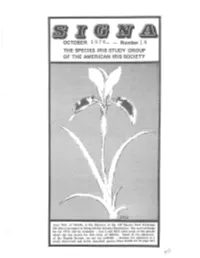
•••••OCTOBER · 19 7 4- Number 14 THE SPECIES IRIS STUDY GROUP OF THE AMERICAN IRIS SOCIETY Jean Witt, of Seattle, is the Director of the AIS Species Seed Exchange. he also is an expert at doing ink-line botanic illustrations. Her seed exchange list for 1974 will be exten ive - but it will NOT offer eeds of the pecies which she has drawn for this cover of SIGNA. Seeds of Iris afghanica, of tpe Regelia Section, are not yet available - because Iris afghanico is a newly discovered and newly described species. More details are on page 367. THE SPECIES IRIS STUDY GROUP of_ TH E AMERICAN IRIS SOCIETY OFFICERS OF THE SOCIETY Chairman- - - - - - - Roy Davidson- - - 911 Western Avenue,,_ Number 200 Seattle, Washington !:18104 phone 206-746- 2156 Secretary-Treasurer - - - Homer Metcalf - - Montana State Universi~i College of Agriculture BoLeman Montana 597 5 phone 46 6-586-5624 Librarian - - - - - - Jerry Flintoff- 5608 North 18th Street Tacoma, Washi:1gton 98406 Seed Exchange Director Jean Witt - 16516 25th, N.E. Seattle, Washington 98155 Species Robins Director- Lorena Reid 17225 McKenzie Highwa'i, Route 2 Springfield, Oregon 97477 Editor of SIGNA - - - Bill Gunther 740 Crest Road Del Ma.c, California 92014 phone , 14-755- 2798 Editor of Study Manual Roy Davidson- - 911 Western Avenue,,_ Number 200 Seattle, Washington !:18104 • • • • • • • • • • • SIGNA - - - Number 14 OCTOBER 1974 TABLE OF CONTENTS Cover--lris afghanica · Jean Witt - · · · 353 Notes on SIGNA 13 · - Roy Davidson - - · 355 It is a Gift! - - - - - Bill Gunther · · · 356 The Genus Iris: a review - - - - - - - P.J. Chittenden - - 357 Spuria Species as Garden Plants - E. -

The Scale Insects (Hemiptera: Coccoidea) of Oak Trees (Fagaceae: Quercus Spp.) in Israel
ISRAEL JOURNAL OF ENTOMOLOGY, Vol. 43, 2013, pp. 95-124 The scale insects (Hemiptera: Coccoidea) of oak trees (Fagaceae: Quercus spp.) in Israel MALKIE SPODEK1,2, YAIR BEN-DOV1 AND ZVI MENDEL1 1Department of Entomology, Volcani Center, Agricultural Research Organization, POB 6, Bet Dagan 50250, Israel 2Department of Entomology, Robert H. Smith Faculty of Agriculture, Food and Environment, The Hebrew University of Jerusalem, POB 12, Rehovot 76100, Israel Email: malkiespodek@gmail.com ABSTRACT Scale insects (Hemiptera: Coccoidea) of four species of oaks (Fagaceae: Quercus) in Israel namely, Q. boissieri, Q. calliprinos, Q. ithaburensis, and Q. look were collected and identified from natural forest stands during the period 2010-2013. A total of twenty-seven species were determined from nine scale insect families: Asterolecaniidae (3 species), Coccidae (3), Di- aspididae (7), Eriococcidae (3), Kermesidae (6), Kuwaniidae (1), Mono- phlebidae (1), Pseudococcidae (2), and Putoidae (1). Six of these species represent new records for Israel and five are identified to the genus level. Kuwaniidae is a new family record for Israel. Species that were previously collected or recorded on oaks in Israel are listed and discussed. Information is given about host trees and global distribution. The majority of the spe- cies reported here are monophagous or stenophagous and they appear to be non-pestiferous to the oak trees in Israel. General traits that describe each scale insect family in the field are provided, together with an identification key to aid in the determination of slide-mounted specimens into families represented in this study. KEY WORDS: Scale insect, Coccoidea, oak trees, Quercus, forest, survey, monophagous, univoltine, Mediterranean, Israel INTRODUCTION The genus Quercus (Fagaceae) has a rich and diverse arthropod fauna associated with it (Southwood, 1961; Southwood et al., 2005). -

These De Doctorat De L'universite Paris-Saclay
NNT : 2016SACLS250 THESE DE DOCTORAT DE L’UNIVERSITE PARIS-SACLAY, préparée à l’Université Paris-Sud ÉCOLE DOCTORALE N° 567 Sciences du Végétal : du Gène à l’Ecosystème Spécialité de doctorat (Biologie) Par Mlle Nour Abdel Samad Titre de la thèse (CARACTERISATION GENETIQUE DU GENRE IRIS EVOLUANT DANS LA MEDITERRANEE ORIENTALE) Thèse présentée et soutenue à « Beyrouth », le « 21/09/2016 » : Composition du Jury : M., Tohmé, Georges CNRS (Liban) Président Mme, Garnatje, Teresa Institut Botànic de Barcelona (Espagne) Rapporteur M., Bacchetta, Gianluigi Università degli Studi di Cagliari (Italie) Rapporteur Mme, Nadot, Sophie Université Paris-Sud (France) Examinateur Mlle, El Chamy, Laure Université Saint-Joseph (Liban) Examinateur Mme, Siljak-Yakovlev, Sonja Université Paris-Sud (France) Directeur de thèse Mme, Bou Dagher-Kharrat, Magda Université Saint-Joseph (Liban) Co-directeur de thèse UNIVERSITE SAINT-JOSEPH FACULTE DES SCIENCES THESE DE DOCTORAT DISCIPLINE : Sciences de la vie SPÉCIALITÉ : Biologie de la conservation Sujet de la thèse : Caractérisation génétique du genre Iris évoluant dans la Méditerranée Orientale. Présentée par : Nour ABDEL SAMAD Pour obtenir le grade de DOCTEUR ÈS SCIENCES Soutenue le 21/09/2016 Devant le jury composé de : Dr. Georges TOHME Président Dr. Teresa GARNATJE Rapporteur Dr. Gianluigi BACCHETTA Rapporteur Dr. Sophie NADOT Examinateur Dr. Laure EL CHAMY Examinateur Dr. Sonja SILJAK-YAKOVLEV Directeur de thèse Dr. Magda BOU DAGHER KHARRAT Directeur de thèse Titre : Caractérisation Génétique du Genre Iris évoluant dans la Méditerranée Orientale. Mots clés : Iris, Oncocyclus, région Est-Méditerranéenne, relations phylogénétiques, status taxonomique. Résumé : Le genre Iris appartient à la famille des L’approche scientifique est basée sur de nombreux Iridacées, il comprend plus de 280 espèces distribuées outils moléculaires et génétiques tels que : l’analyse de à travers l’hémisphère Nord. -
Positive and Negative Impacts of Non-Native Bee Species Around the World
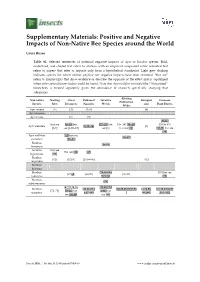
Supplementary Materials: Positive and Negative Impacts of Non-Native Bee Species around the World Laura Russo Table S1. Selected references of potential negative impacts of Apis or Bombus species. Bold, underlined, and shaded text refers to citations with an empirical component while unbolded text refers to papers that refer to impacts only from a hypothetical standpoint. Light grey shading indicates species for which neither positive nor negative impacts have been recorded. “But see” refers to manuscripts that show evidence or describe the opposite of the effect and is capitalized when only contradictory studies could be found. Note that Apis mellifera scutellata (the “Africanized” honeybee), is treated separately given the abundance of research specifically studying that subspecies. Altering Non-native Nesting Floral Pathoens/ Invasive Introgres Decrease Pollination Species Sites Resources Parasites Weeds sion Plant Fitness Webs Apis cerana [1] [2] [1–3] [4] Apis dorsata Apis florea [5] [5] [37,45] But see [8–19] but [27–35] but [36–38] [39–43] [38,46,47] Apis mellifera [9,23–26] [4] [6,7] see [6,20–22] see [6] but see [44] [48,49] but see [50] Apis mellifera [51] but see [55–57] scutellata [52–54] Bombus [58,59] hortorum Bombus But see But see [60] [61] hypnorum [60] Bombus [62] [62,63] [26,64–66] [62] impatiens Bombus lucorum Bombus [28,58,59,6 [39] but see [67,68] [69,70] [36,39] ruderatus 9,71,72] [73] Bombus [59] subterraneous [67,70,74,75, [29,58,72,9 Bombus [25,26,70,7 [38,39,68,81,97,98 [4,76,88, [47,76,49,86,97 [74–76] 77–84] but 1–95] but terrestris 6,87–90] ] 99,100] ,101–103] see [85,86] see [96] Insects 2016, 7, 69; doi:10.3390/insects7040069 www.mdpi.com/journal/insects Insects 2016, 7, 69 S2 of S8 Table S2. -
Environmental Conservation and Protected Areas in Palestine Challenges and Opportunities
ENVIRONMENTAL CONSERVATION AND PROTECTED AREAS IN PALESTINE CHALLENGES AND OPPORTUNITIES Report submitted to The Hanns Seidel Foundation 2 Foreword This publication bases on the report “Environmental conservation and protected areas in Palestine: Challenges and Opportunities” by Dr. Mazin Qumsieh, Betlehem University and Dr. Zuhair Amr, Jordan University of Science and Technology, which have been contracted by Hanns Seidel Foundation for this task. The report has been written in the framework of a project funded by the European Union’s Partnership for Peace initiative. The aim of the report is to portray the current state of nature protection in Palestine, to fathom the potential for improved environmental conservation and nature reserve management, and to suggest priorities for future environmental protection efforts. The current version is the result of an intense review process, which involved Palestinian Experts, the Environment Quality Authority as well as the team of Hanns Seidel Foundation. In addition to that, it has been edited to improve the reading. Hence, the original report written by the contracted authors has been considerably altered and shortened. Such a review always requires compromises between the original text and all the studied opinions. Often, such a compromise will not entirely please neither the authors, nor the reviewers and the contracting party. Nevertheless, we have carried out a lot of effort to harmonize all positions and to include the very many recommendations and comments, while keeping to the original. All mistakes and inaccuracies, naturally, can be entirely attributed to the contracting authority, which is the Hanns Seidel Foundation. Our foundation would like to thank the authors of the report and all other contributors for their insight and effort. -
Leaf Anatomy of a Quercus Coccifera L. Form from the East Adriatic Coast
Acta Bot. Croat. 47, 135— 144, 1988. CODEN:ABCRA2 YU ISSN 0365— 0588 UDC 581.45:582.632.2(497.1) — 20 LEAF A N A T O M Y OF A QUERCUS COCCIFERA L. FORM FROM THE EAST ADRIATIC COAST TOMISLAV BAClC and DAVOR MlhlClC (Faculty of Philosophy, University of Split, and Department of Botany, Faculty of Science, University of Zagreb) Received June 26, 1987 Two related Quercus species grow near the coast of the Mediterranean: Quercus coccifera L. and Q. calliprinos Webb. The centres of spreading of Q. coccifera are Spain and France, and of Q. calliprinos is Israel. In the central parts of the Mediterranean, between Israel and France, various new forms have developed which are more or less distant from the two starting species. One of these new forms, found in Yugoslavia in South Croatia on the East Adriatic coast, was determined as Q. coccifera, and is a representative of a plant association Orno-Cocciferetum H -c (Horvatic 1963a, b; H o r v a t e' al. 1974). In order to obtain more information about Q. coccifera form which grows on the east coast of the Adriatic, we performed anatomical and some morphological investigations of the leaf. Some similarities have been found between this form and Q. calliprinos; they both have thorny-serrate leaf margins. However, the characteristics of the type form of Q. coccifera prevailed, such as a relatively thin leaf blade, poorly developed hypoderm, early loss of trichomes and obvious intercellulars in the mesophyll. Introduction Recently, Quercus coccifera L. s. 1. has been thoroughly investigated especially by Gentile and Gastaldo (1976), who established that in the Mediterranean countries in fact two related Quercus species could be differentiated: Q. -

Pollinator Limitation on Reproductive Success in Iris Tuberosa
Research Article Pollinator limitation on reproductive success in Iris tuberosa Giuseppe Pellegrino* Department of Biology, Ecology and Earth Science, University of Calabria, I-87036 Rende, Italy Received: 22 September 2014; Accepted: 8 December 2014; Published: 19 December 2014 Associate Editor: James F. Cahill Citation: Pellegrino G. 2015. Pollinator limitation on reproductive success in Iris tuberosa. AoB PLANTS 7: plu089; doi:10.1093/aobpla/plu089 Abstract. Variation in plant and floral size can have conflicting effects on pollination and fruit production in flower- ing plants. This research examines the contributions of plant height, flower size and pollinator visitation to reproduct- ive success in four populations of Iris tuberosa. The plants were pollinated exclusively by hymenopteran species, primarily during sunny days. Pollination supplementation increased the proportion of flowers that matured into fruit, with 95 % fruit set for hand-pollinated compared with 74.15 % for naturally pollinated flowers. The pollinator visitation rate and the proportion of fruit produced were not significantly different between tall and short plants or between small and large flowers. Furthermore, the increase in plant size and floral display did not increase the frequency of pollinator visitations and so did not increase the fruit set. Thus, despite the widespread effects of flower- ing plant size on pollinator attraction and plant reproduction in other species, these effects are lacking in I. tuberosa. This study quantifies the role of pollinators in the reproductive success of I. tuberosa. Pollinators visited tall/short plants and large/small flowers in equal proportion, suggesting that plant and floral display size do not affect pollinator attraction and reproductive success in I. -

Fine-Grained Flower Classification
Fine-Grained Flower Classification Ravid Cohen Prof Daphna Weinshall (Computer Science) Prof Avi Shmida (Botanic) The Hebrew University of Jerusalem 1. Introduction Recently models for fine-grained flower-based classification tasks, in particular models that use features from pre-trained convolutional neural network as an image representation, show outstanding results, with more than 95% mean class accuracy on the Oxford Flower Database [4][6][7]. It would seem that these emerging tools may be able to address the more realistic and challenging problems posed by the varying appearance of flowers in the wild, including ‘super-fine-grained’ classification tasks. In accordance, we collected a new and even more fine-grained database of Israeli wild flowers with varying levels of similarity between categories. We then followed the classification paradigm described in Razavian et al [1] to classify both the Oxford 102 flower database and the new one. Using the most recent representations based on deep learning networks, the results on the Oxford dataset are excellent, with 94.9% mean class accuracy. When training the same classifier with our database it achieved only 79.3%, an evidence for the higher challenge the Israel Flower Database poses. The Israel Flower Database is also unique in being hierarchical (genus and species), while being labeled with accurate scientific botanical names. 2. Databases Oxford Flowers 102 (OF 102) database [3] Oxford Flowers 102 consists of 8,189 images from 102 categories. Each category contains 40-258 images of common wild flowers in the UK. Most of the categories are genera rather than species and they are labeled using their common English name. -
Iris Section Oncocyclus) and Identification of Flower Development Genes
bioRxiv preprint doi: https://doi.org/10.1101/680363; this version posted June 23, 2019. The copyright holder for this preprint (which was not certified by peer review) is the author/funder, who has granted bioRxiv a license to display the preprint in perpetuity. It is made available under aCC-BY-NC-ND 4.0 International license. De novo Transcriptome Characterization of Royal Iris (Iris section Oncocyclus) and Identification of Flower Development Genes Bar-Lev Yamit1, Senden Esther1, Pasmanik-Chor Metsada2 and Sapir Yuval1 1 The Botanical Garden, School of Plant Sciences and Food Security, G.S. Wise Faculty of Life Science, Tel Aviv University, Israel 2 Bioinformatics Unit, G.S. Wise Faculty of Life Science, Tel Aviv University, Tel Aviv 69978, Israel Bar-Lev Yamit abargily@tauex.tau.ac.il, 972-3-6407354, Author for correspondence Senden Esther esthersenden@gmail.com Pasmanik-Chor Metsada metsada@post.tau.ac.il Sapir Yuval sapiry@tauex.tau.ac.il Acknowledgements We thank the Technion Genome Center for technical assistance and the Bioinformatics Core Facility at Ben-Gurion University for their assistance in the bioinformatics analysis. We thank N. Kane for the Perl script for mining SSRs from transcriptome sequences. This research was funded by the Israel Science Foundation (grant No. 336/16). 1 bioRxiv preprint doi: https://doi.org/10.1101/680363; this version posted June 23, 2019. The copyright holder for this preprint (which was not certified by peer review) is the author/funder, who has granted bioRxiv a license to display the preprint in perpetuity. It is made available under aCC-BY-NC-ND 4.0 International license. -
De Novo Transcriptome Characterization of Iris Atropurpurea (The Royal Iris, Iris Section Oncocyclus) and Phylogenetic Analysis
bioRxiv preprint doi: https://doi.org/10.1101/680363; this version posted September 15, 2020. The copyright holder for this preprint (which was not certified by peer review) is the author/funder, who has granted bioRxiv a license to display the preprint in perpetuity. It is made available under aCC-BY-NC-ND 4.0 International license. De novo Transcriptome Characterization of Iris atropurpurea (the Royal Iris, Iris section Oncocyclus) and Phylogenetic Analysis of MADS-box and R2R3- MYB Gene Families Bar-Lev Yamit1, Senden Esther1, Pasmanik-Chor Metsada2, and Sapir Yuval1 1 The Botanical Garden, School of Plant Sciences and Food Security, G.S. Wise Faculty of Life Science, Tel Aviv University, Israel 2 Bioinformatics Unit, G.S. Wise Faculty of Life Science, Tel Aviv University, Tel Aviv 69978, Israel Bar-Lev Yamit abargily@tauex.tau.ac.il, 972-3-6407354, Author for correspondence Senden Esther esthersenden@gmail.com Pasmanik-Chor Metsada metsada@post.tau.ac.il Sapir Yuval sapiry@tauex.tau.ac.il Acknowledgments We thank the Technion Genome Center for technical assistance and the Bioinformatics Core Facility at Ben-Gurion University for their assistance in the bioinformatics analysis. We thank N. Kane for the Perl script for mining SSRs from transcriptome sequences. This research was funded by the Israel Science Foundation to YS (grant No. 336/16). 1 bioRxiv preprint doi: https://doi.org/10.1101/680363; this version posted September 15, 2020. The copyright holder for this preprint (which was not certified by peer review) is the author/funder, who has granted bioRxiv a license to display the preprint in perpetuity. -
Three New Records of Aleuroviggianus Iaccarino (Hemiptera: Sternorrhyncha: Aleyrodidae) from Iran with Identification Key
_____________Mun. Ent. Zool. Vol. 4, No. 1, January 2009__________ 117 THREE NEW RECORDS OF ALEUROVIGGIANUS IACCARINO (HEMIPTERA: STERNORRHYNCHA: ALEYRODIDAE) FROM IRAN WITH IDENTIFICATION KEY Hassan Ghahari*, Chiun-Cheng Ko** and Hadi Ostovan*** * Department of Entomology; Islamic Azad University; Science and Research Branch; Tehran, Iran; email: h_ghahhari@yahoo.com ** Department of Entomology, National Taiwan University, Taipei 106, Taiwan; email: kocc2501@ntu.edu.tw *** Department of Entomology, Islamic Azad University, Fars Science and Research Branch, Iran; email: ostovan2002@yahoo.com [Ghahari, H., Ko, C.-C. & Ostovan, H. 2009. Three new records of Aleuroviggianus Iaccarino (Hemiptera: Sternorrhyncha: Aleyrodidae) from Iran with identification key. Munis Entomology & Zoology, 4 (1): 117-120] ABSTRACT: A total of three Aleuroviggianus species including, A. adrianae Iaccarino, A. halperini Bink-Moenen, and A. zonalus Bink-Moenen were identified for the first time from Iran. Identification key, host plants and distributional data are given in this paper. KEYWORDS: Aleyrodidae, Aleuroviggianus, New record, Quercus, Iran The plant genus Quercus (Fagales: Fagaceae), commonly known as oaks, comprises species which are deciduous or evergreen trees or shrubs. There is not any literature about the exact number of Quercus species, but probably 500 species exist in different regions of the world (Weeda et al, 1985). Oaks have a mainly Holarctic distribution but in the Old World they extend from Europe to the Atlas Mountains of North Africa, and in the mountains of Asia they can be found as high as 3000 m above sea level (Camus 1939). In a total of 14 oak tree species including, Q. brandtii, Q. calliprinos, Q. cardochorum, Q. castanefolia, Q. -

The Settlers in the Central Hill Country of Palestine
THE SETTLERS IN THE CENTRAL HILL COUNTRY OF PALESTINE DURING IRON AGE I (ca 1200-1000 BCE): WHERE DID THEY COME FROM AND WHY DID THEY MOVE? by IRINA RUSSELL submitted in fulfilment of the requirements for the degree of MASTER OF ARTS in the subject BIBLICAL ARCHAEOLOGY at the UNIVERSITY OF SOUTH AFRICA SUPERVISOR: PROF MAGDEL LE ROUX NOVEMBER 2009 CONTENTS ACKNOWLEDGEMENTS SUMMARY CHAPTER 1 INTRODUCTION 1.1 BACKGROUND...................................................................................…… 1 1.1.1 Religion in the ancient Near East............................................................... 1 1.1.2 The effect of climate fluctuations on human history................................ 2 1.2 DEFINITIONS, NOMENCLATURE AND ABBREVIATIONS................. 6 1.2.1 The term ‘Palestine’..................................................................................... 6 1.2.2 ‘Israelites’ or ‘settlers’?............................................................................... 6 1.2.3 Religion.....................................................................................................… 7 1.2.4 ‘Tribes’ (shevet/matteh) or ‘clans’ (mishpahot)?....................................... 8 1.2.5 ‘BCE’/‘bce’/‘CE’/‘ce’ and ‘m bmsl’....................................................…... 10 1.3 HYPOTHESIS........................................................................................…... 11 1.4 METHODOLOGICAL CONSIDERATIONS............................................... 11 1.4.1 The structure of the dissertation...............................................................