Asteraceae) in Southern Africa
Total Page:16
File Type:pdf, Size:1020Kb
Load more
Recommended publications
-

Diabetes and Medicinal Plants: a Literature Review
ISOLATION AND IDENTIFICATION OF ANTIDIABETIC COMPOUNDS FROM BRACHYLAENA DISCOLOR DC Thesis submitted in fulfilment of the requirements for the degree Master of Science By Sabeen Abdalbagi Elameen Adam School of Chemistry and Physics University of KwaZulu-Natal Pietermaritzburg Supervisor: Professor Fanie R. van Heerden August 2017 ABSTRACT Diabetes mellitus, which is a metabolic disease resulting from insulin deficiency or diminished effectiveness of the action of insulin or their combination, is recognized as a major threat to human life. Using drugs on a long term to control glucose can increase the hazards of cardiovascular disease and some cancers. Therefore, there is an urgent need to discover new, safe, and effective antidiabetic drugs. Traditionally, there are several plants that are used to treat/control diabetes by South African traditional healers such as Brachylaena discolor. This study aimed to isolate and identify antidiabetic compounds from B. discolor. The plant materials of B. discolor was collected from University of KwaZulu-Natal botanical garden. Plant materials were dried under the fume hood for two weeks and ground to a fine powder. The powder was extracted with a mixture of dichloromethane and methanol (1:1). To investigate the antidiabetic activity, the prepared extract was tested in vitro for glucose utilization in a muscle cell line. The results revealed that blood glucose levels greater than 20 mmol/L, which measured after 24 and 48 hours of the experimental period, three fractions had positive (*p<0.05) antidiabetic activity compared to the control. The DCM:MeOH (1:1) extract of B. discolor leaves was subjected to column chromatography, yielding five fractions (A, B, C, D, and E). -

Brachylaena Elliptica and B. Ilicifolia (Asteraceae): a Comparative Analysis of Their Ethnomedicinal Uses, Phytochemistry and Biological Activities
Journal of Pharmacy and Nutrition Sciences, 2020, 10, 223-229 223 Brachylaena elliptica and B. ilicifolia (Asteraceae): A Comparative Analysis of their Ethnomedicinal Uses, Phytochemistry and Biological Activities Alfred Maroyi* Department of Botany, University of Fort Hare, Private Bag X1314, Alice 5700, South Africa Abstract: Brachylaena elliptica and B. ilicifolia are shrubs or small trees widely used as traditional medicines in southern Africa. There is need to evaluate the existence of any correlation between the medicinal uses, phytochemistry and pharmacological properties of the two species. Therefore, in this review, analyses of the ethnomedicinal uses, phytochemistry and biological activities of B. elliptica and B. ilicifolia are presented. Results of the current study are based on data derived from several online databases such as Scopus, Google Scholar, PubMed and Science Direct, and pre-electronic sources such as scientific publications, books, dissertations, book chapters and journal articles. The articles published between 1941 and 2020 were used in this study. The leaves and roots of B. elliptica and B. ilicifolia are mainly used as a mouthwash and ethnoveterinary medicines, and traditional medicines for backache, hysteria, ulcers of the mouth, diabetes, gastro-intestinal and respiratory problems. This study showed that sesquiterpene lactones, alkaloids, essential oils, flavonoids, flavonols, phenols, proanthocyanidins, saponins and tannins have been identified from aerial parts and leaves of B. elliptica and B. ilicifolia. The leaf extracts and compounds isolated from the species exhibited antibacterial, antidiabetic, antioxidant and cytotoxicity activities. There is a need for extensive phytochemical, pharmacological and toxicological studies of crude extracts and compounds isolated from B. elliptica and B. ilicifolia. -

Early Evolution of the Angiosperm Clade Asteraceae in the Cretaceous of Antarctica
Early evolution of the angiosperm clade Asteraceae in the Cretaceous of Antarctica Viviana D. Barredaa,1,2, Luis Palazzesia,b,1, Maria C. Telleríac, Eduardo B. Oliverod, J. Ian Rainee, and Félix Forestb aDivisión Paleobotánica, Museo Argentino de Ciencias Naturales “Bernardino Rivadavia,” Consejo Nacional de Investigaciones Cientificas y Técnicas, Buenos Aires C1405DJR, Argentina; bJodrell Laboratory, Royal Botanic Gardens, Kew, Richmond, Surrey TW9 3DS, United Kingdom; cLaboratorio de Sistemática y Biología Evolutiva, Museo de La Plata, La Plata B1900FWA, Argentina; dCentro Austral de Investigaciones Científicas, Consejo Nacional de Investigaciones Cientificas y Técnicas, 9410 Ushuaia, Tierra del Fuego, Argentina; and eDepartment of Palaeontology, GNS Science, Lower Hutt 5040, New Zealand Edited by Michael J. Donoghue, Yale University, New Haven, CT, and approved July 15, 2015 (received for review December 10, 2014) The Asteraceae (sunflowers and daisies) are the most diverse Here we report fossil pollen evidence from exposed Campanian/ family of flowering plants. Despite their prominent role in extant Maastrichtian sediments from the Antarctic Peninsula (Fig. 1, Fig. S1, terrestrial ecosystems, the early evolutionary history of this family and SI Materials and Methods, Fossiliferous Localities)(7)thatradi- remains poorly understood. Here we report the discovery of a cally changes our understanding of the early evolution of Asteraceae. number of fossil pollen grains preserved in dinosaur-bearing deposits from the Late Cretaceous of Antarctica that drastically pushes back Results and Discussion the timing of assumed origin of the family. Reliably dated to ∼76–66 The pollen grains reported here and discovered in the Late Cre- Mya, these specimens are about 20 million years older than previ- taceous of Antarctica are tricolporate, microechinate, with long ously known records for the Asteraceae. -

APPENDIX a Plant Species List of Boschhoek Mountain Estate Trees
APPENDIX A Plant species list of Boschhoek Mountain Estate Trees 52 Shrubs 36 Dwarf shrubs 25 Forbs 81 Grasses 78 Geophytes 4 Succulents 6 Parasites 7 Sedges 9 Ferns 5 Aliens 19 Total 322 Trees Acacia burkei swartapiesdoring black monkey-thorn Acacia caffra gewone haakdoring common hook-thorn Acacia karroo soetdoring sweet thorn Acacia robusta enkeldoring, brakdoring ankle thorn, brack thorn Albizia tanganyicensis papierbasvalsdoring paperbark false thorn Berchemia zeyheri rooi-ivoor red ivory Brachylaena rotundata bergvaalbos mountain silver oak Burkea africana wilde sering, rooisering wild seringa, red syringa Celtisa africana witstinkhout white stinkwood Combretum apiculatum rooibos red bushwillow Combretum molle fluweelboswilg velvet bushwillow Combretum zeyheri raasblaar large-fruited bushwillow Commiphora mollis fluweelkanniedood velvet corkwood Croton gratissimus laventelkoorsbessie lavender fever-berry Cussonia paniculata Hoëveldse kiepersol Highveld cabbage tree Cussonia spicata gewone kiepersol common cabbage tree Cussonia transvaalensis Transvaalse kiepersol Transvaal cabbage tree Diplorrhynchus condylocarpum horingpeulbos horn-pod tree Dombeya rotundifolia drolpeer, wilde peer wild pear Dovyalis caffra Keiappel Kei-apple Dovyalis zeyheri wilde-appelkoos wild apricot Englerophytum magalismontanum stamvrug Transvaal milkplum Erythrina lysistemon gewone koraalboom common coral tree Euclea crispa blougwarrie blue ghwarri Faurea saligna Transvaalboekenhout Transvaal beech 93 Ficus abutilifolia grootblaarrotsvy large-leaved rock -

Dry Forest Trees of Madagascar
The Red List of Dry Forest Trees of Madagascar Emily Beech, Malin Rivers, Sylvie Andriambololonera, Faranirina Lantoarisoa, Helene Ralimanana, Solofo Rakotoarisoa, Aro Vonjy Ramarosandratana, Megan Barstow, Katharine Davies, Ryan Hills, Kate Marfleet & Vololoniaina Jeannoda Published by Botanic Gardens Conservation International Descanso House, 199 Kew Road, Richmond, Surrey, TW9 3BW, UK. © 2020 Botanic Gardens Conservation International ISBN-10: 978-1-905164-75-2 ISBN-13: 978-1-905164-75-2 Reproduction of any part of the publication for educational, conservation and other non-profit purposes is authorized without prior permission from the copyright holder, provided that the source is fully acknowledged. Reproduction for resale or other commercial purposes is prohibited without prior written permission from the copyright holder. Recommended citation: Beech, E., Rivers, M., Andriambololonera, S., Lantoarisoa, F., Ralimanana, H., Rakotoarisoa, S., Ramarosandratana, A.V., Barstow, M., Davies, K., Hills, BOTANIC GARDENS CONSERVATION INTERNATIONAL (BGCI) R., Marfleet, K. and Jeannoda, V. (2020). Red List of is the world’s largest plant conservation network, comprising more than Dry Forest Trees of Madagascar. BGCI. Richmond, UK. 500 botanic gardens in over 100 countries, and provides the secretariat to AUTHORS the IUCN/SSC Global Tree Specialist Group. BGCI was established in 1987 Sylvie Andriambololonera and and is a registered charity with offices in the UK, US, China and Kenya. Faranirina Lantoarisoa: Missouri Botanical Garden Madagascar Program Helene Ralimanana and Solofo Rakotoarisoa: Kew Madagascar Conservation Centre Aro Vonjy Ramarosandratana: University of Antananarivo (Plant Biology and Ecology Department) THE IUCN/SSC GLOBAL TREE SPECIALIST GROUP (GTSG) forms part of the Species Survival Commission’s network of over 7,000 Emily Beech, Megan Barstow, Katharine Davies, Ryan Hills, Kate Marfleet and Malin Rivers: BGCI volunteers working to stop the loss of plants, animals and their habitats. -

Nuclear and Plastid DNA Phylogeny of the Tribe Cardueae (Compositae
1 Nuclear and plastid DNA phylogeny of the tribe Cardueae 2 (Compositae) with Hyb-Seq data: A new subtribal classification and a 3 temporal framework for the origin of the tribe and the subtribes 4 5 Sonia Herrando-Morairaa,*, Juan Antonio Callejab, Mercè Galbany-Casalsb, Núria Garcia-Jacasa, Jian- 6 Quan Liuc, Javier López-Alvaradob, Jordi López-Pujola, Jennifer R. Mandeld, Noemí Montes-Morenoa, 7 Cristina Roquetb,e, Llorenç Sáezb, Alexander Sennikovf, Alfonso Susannaa, Roser Vilatersanaa 8 9 a Botanic Institute of Barcelona (IBB, CSIC-ICUB), Pg. del Migdia, s.n., 08038 Barcelona, Spain 10 b Systematics and Evolution of Vascular Plants (UAB) – Associated Unit to CSIC, Departament de 11 Biologia Animal, Biologia Vegetal i Ecologia, Facultat de Biociències, Universitat Autònoma de 12 Barcelona, ES-08193 Bellaterra, Spain 13 c Key Laboratory for Bio-Resources and Eco-Environment, College of Life Sciences, Sichuan University, 14 Chengdu, China 15 d Department of Biological Sciences, University of Memphis, Memphis, TN 38152, USA 16 e Univ. Grenoble Alpes, Univ. Savoie Mont Blanc, CNRS, LECA (Laboratoire d’Ecologie Alpine), FR- 17 38000 Grenoble, France 18 f Botanical Museum, Finnish Museum of Natural History, PO Box 7, FI-00014 University of Helsinki, 19 Finland; and Herbarium, Komarov Botanical Institute of Russian Academy of Sciences, Prof. Popov str. 20 2, 197376 St. Petersburg, Russia 21 22 *Corresponding author at: Botanic Institute of Barcelona (IBB, CSIC-ICUB), Pg. del Migdia, s. n., ES- 23 08038 Barcelona, Spain. E-mail address: sonia.herrando@gmail.com (S. Herrando-Moraira). 24 25 Abstract 26 Classification of the tribe Cardueae in natural subtribes has always been a challenge due to the lack of 27 support of some critical branches in previous phylogenies based on traditional Sanger markers. -
Systematics of Dasyphyllum (Asteraceae)
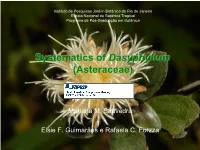
Instituto de Pesquisas Jardim Botânico do Rio de Janeiro Escola Nacional de Botânica Tropical Programa de Pós-Graduação em Botânica Systematics of Dasyphyllum (Asteraceae) Mariana M. Saavedra Elsie F. Guimarães e Rafaela C. Forzza Barnadesioideae • Synapomorphies: – axillary spines – barnadesioids trichomes • Restricted distribution in South America • 9 genus and 85 species – Dasyphyllum (33 spp.) – Chuquiraga (23 spp.) – Barnadesia (19 spp.) – Arnaldoa (3 spp.) – Doniophyton (2 spp.) – Fulcaldea (2 spp.) – Duseniella, Huarpea e Dasyphyllum vagans Schlechtendalia (1 spp.) Funk et al. 2009 Dasyphyllum Kunth Kunth (1820) – D. argenteum Cabrera (1959) – Dasyphyllum • 36 species (34 new combinations) Infrageneric classification sensu Cabrera • Trees Dasyphyllum subg. Archydasyphyllum • Pinnate leaves • Anthers’ apical appendage • 2 species obtuse or emarginate • D. diacanthoides (Less.) Cabrera • D. excelsum (D.Don) Cabrera) D. diacanthoides Stuessy et al. 1996 Dasyphyllum sensu Cabrera (1959) • Trees or shrubs Dasyphyllum subg. Dasyphyllum • Trinerved leaves • Anthers’ apical appendages bilobed Section Microcephala (=Dasyphyllum) Section Macrocephala • Small and numerous heads • Large and solitaries or few heads • 27 species, 6 varieties • 11 species, 2 varieties D. sprengelianum Stuessy et al. 1996 Stuessy et al. 1996 D. spinescens Morphological phylogeny Urtubey & Stuessy 2001 • 52 of 88 species of the subfamily • 29 spp. Dasyphyllum • 31 morphological characters • 13 characters are informative to Dasyphyllum Infrageneric classification -
Chloroplast Dna Systematics of Lilioid Monocots: Resources, Feasibility, and an Example from the Orchidaceaei
Amer. J. Bot. 76(12): 1720-1730. 1989. CHLOROPLAST DNA SYSTEMATICS OF LILIOID MONOCOTS: RESOURCES, FEASIBILITY, AND AN EXAMPLE FROM THE ORCHIDACEAEI MARK W. CHASE2 AND JEFFREY D. PALMER3 Department of Biology, University of Michigan, Ann Arbor, Michigan 48109-1048 ABSTRACT Although chloroplast DNA (cpDNA) analysis has been widely and successfully applied to systematic and evolutionary problems in a wide variety of dicots, its use in monocots has thus far been limited to the Poaceae. The cpDNAs ofgrasses are significantly altered in arrangement relative to the genomes of most vascular plants, and thus the available clone banks ofgrasses are not particularly useful in studying variation in the cpDNA ofother monocots. In this report, we present mapping studies demonstrating that cpDNAs offour lilioid monocots (Allium cepa, Alliaceae; Asparagus sprengeri, Asparagaceae; Narcissus x hybridus, Amaryllidaceae; and On cidium excavatum, Orchidaceae), which, while varying in size over as much as 18 kilobase pairs, conform to the genome arrangement typical of most vascular plants. A nearly complete (99.2%) clone bank was constructed from restriction fragments of the chloroplast genome of Oncidium excavatum; this bank should be useful in cpDNA analysis among the monocots and is available upon request. As an example of the utility of filter hybridization using this clone bank to detect systematically useful variation, we present a Wagner parsimony analysis of restriction site data from the controversial genus Trichocentrum and several sections of Oncid ium, popularly known as the "mule ear" and "rat tail oncidiums." Because of their vastly different floral morphology, the species of Trichocentrum have never been placed in Oncidium, although several authors have recently suggested a close relationship to this vegetatively modified group. -
Albuca Spiralis
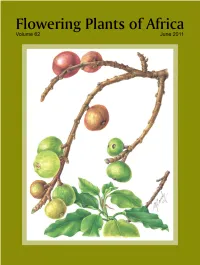
Flowering Plants of Africa A magazine containing colour plates with descriptions of flowering plants of Africa and neighbouring islands Edited by G. Germishuizen with assistance of E. du Plessis and G.S. Condy Volume 62 Pretoria 2011 Editorial Board A. Nicholas University of KwaZulu-Natal, Durban, RSA D.A. Snijman South African National Biodiversity Institute, Cape Town, RSA Referees and other co-workers on this volume H.J. Beentje, Royal Botanic Gardens, Kew, UK D. Bridson, Royal Botanic Gardens, Kew, UK P. Burgoyne, South African National Biodiversity Institute, Pretoria, RSA J.E. Burrows, Buffelskloof Nature Reserve & Herbarium, Lydenburg, RSA C.L. Craib, Bryanston, RSA G.D. Duncan, South African National Biodiversity Institute, Cape Town, RSA E. Figueiredo, Department of Plant Science, University of Pretoria, Pretoria, RSA H.F. Glen, South African National Biodiversity Institute, Durban, RSA P. Goldblatt, Missouri Botanical Garden, St Louis, Missouri, USA G. Goodman-Cron, School of Animal, Plant and Environmental Sciences, University of the Witwatersrand, Johannesburg, RSA D.J. Goyder, Royal Botanic Gardens, Kew, UK A. Grobler, South African National Biodiversity Institute, Pretoria, RSA R.R. Klopper, South African National Biodiversity Institute, Pretoria, RSA J. Lavranos, Loulé, Portugal S. Liede-Schumann, Department of Plant Systematics, University of Bayreuth, Bayreuth, Germany J.C. Manning, South African National Biodiversity Institute, Cape Town, RSA A. Nicholas, University of KwaZulu-Natal, Durban, RSA R.B. Nordenstam, Swedish Museum of Natural History, Stockholm, Sweden B.D. Schrire, Royal Botanic Gardens, Kew, UK P. Silveira, University of Aveiro, Aveiro, Portugal H. Steyn, South African National Biodiversity Institute, Pretoria, RSA P. Tilney, University of Johannesburg, Johannesburg, RSA E.J. -
Phylogenetic Uncertainty and Fossil Calibration of Asteraceae Chronograms LETTER Jose L
LETTER Phylogenetic uncertainty and fossil calibration of Asteraceae chronograms LETTER Jose L. Panero1 Barreda et al. (1) claim a Cretaceous fossil pollen type is an opposed to other Barnadesioideae. Encoding “columel- extinct Asteraceae. Concluding this pollen type is “nested late layer visibility under light microscopy” (character 19) within Dasyphyllum (crown representative),” they calibrate results in unintentional character weighting. Exine thick- a Dasyphyllum + Barnadesia crown node (Dasyphyllum ness (character 22) is much smaller in Dasyphyllum crown absent) and estimate an 85.9-Ma Asteraceae crown inerme and Dasyphyllum velutinum than in other Dasy- age that potentially compresses asterid evolution by tens phyllum spp. (3) that would be scored as other Barnade- of millions of years. However, the bootstrap majority con- sioideae and different from the fossil had they been sensus topology reported could not be reproduced from sampled. Characters 19, 21, and 22 clearly contribute the data; instead, the fossil resolved in a trichotomy with to place the fossil with Dasyphyllum. Character 17 as- Calyceraceae and Asteraceae. Thus, unambiguous assign- sumes that concavities distributed asymmetrically ment of these pollen grains to Asteraceae is premature. (sometimes absent) along the intercolpal region in the Paleocene, not Cretaceous, mean ages of Asteraceae fossil are homologous with symmetrically distributed result from calibration placement consistent with the intercolpal concavities in extant taxa and not the result fossil’s phylogenetic position in the reproduced bootstrap of compression forces during fossilization (figure 4 in tree. Calibration at the Asteraceae + Calyceraceae crown ref. 1). This character is scored as “present” in the fossil node (second calibration scenario; figure S5A and table (table S1 in ref. -
Everywhere but Antarctica: Using a Super Tree to Understand the Diversity and Distribution of the Compositae
BS 55 343 Everywhere but Antarctica: Using a super tree to understand the diversity and distribution of the Compositae VICKI A. FUNK, RANDALL J. BAYER, STERLING KEELEY, RAYMUND CHAN, LINDA WATSON, BIRGIT GEMEINHOLZER, EDWARD SCHILLING, JOSE L. PANERO, BRUCE G. BALDWIN, NURIA GARCIA-JACAS, ALFONSO SUSANNA AND ROBERT K. JANSEN FUNK, VA., BAYER, R.J., KEELEY, S., CHAN, R., WATSON, L, GEMEINHOLZER, B., SCHILLING, E., PANERO, J.L., BALDWIN, B.G., GARCIA-JACAS, N., SUSANNA, A. &JANSEN, R.K 2005. Everywhere but Antarctica: Using a supertree to understand the diversity and distribution of the Compositae. Biol. Skr. 55: 343-374. ISSN 0366-3612. ISBN 87-7304-304-4. One of every 10 flowering plant species is in the family Compositae. With ca. 24,000-30,000 species in 1600-1700 genera and a distribution that is global except for Antarctica, it is the most diverse of all plant families. Although clearly mouophyletic, there is a great deal of diversity among the members: habit varies from annual and perennial herbs to shrubs, vines, or trees, and species grow in nearly every type of habitat from lowland forests to the high alpine fell fields, though they are most common in open areas. Some are well-known weeds, but most species have restricted distributions, and members of this family are often important components of 'at risk' habitats as in the Cape Floral Kingdom or the Hawaiian Islands. The sub-familial classification and ideas about major patterns of evolution and diversification within the family remained largely unchanged from Beutham through Cronquist. Recently obtained data, both morphologi- cal and molecular, have allowed us to examine the distribution and evolution of the family in a way that was never before possible. -

Genetic Diversity and Evolution in Lactuca L. (Asteraceae)
Genetic diversity and evolution in Lactuca L. (Asteraceae) from phylogeny to molecular breeding Zhen Wei Thesis committee Promotor Prof. Dr M.E. Schranz Professor of Biosystematics Wageningen University Other members Prof. Dr P.C. Struik, Wageningen University Dr N. Kilian, Free University of Berlin, Germany Dr R. van Treuren, Wageningen University Dr M.J.W. Jeuken, Wageningen University This research was conducted under the auspices of the Graduate School of Experimental Plant Sciences. Genetic diversity and evolution in Lactuca L. (Asteraceae) from phylogeny to molecular breeding Zhen Wei Thesis submitted in fulfilment of the requirements for the degree of doctor at Wageningen University by the authority of the Rector Magnificus Prof. Dr A.P.J. Mol, in the presence of the Thesis Committee appointed by the Academic Board to be defended in public on Monday 25 January 2016 at 1.30 p.m. in the Aula. Zhen Wei Genetic diversity and evolution in Lactuca L. (Asteraceae) - from phylogeny to molecular breeding, 210 pages. PhD thesis, Wageningen University, Wageningen, NL (2016) With references, with summary in Dutch and English ISBN 978-94-6257-614-8 Contents Chapter 1 General introduction 7 Chapter 2 Phylogenetic relationships within Lactuca L. (Asteraceae), including African species, based on chloroplast DNA sequence comparisons* 31 Chapter 3 Phylogenetic analysis of Lactuca L. and closely related genera (Asteraceae), using complete chloroplast genomes and nuclear rDNA sequences 99 Chapter 4 A mixed model QTL analysis for salt tolerance in