Explosive Diversification Following a Benthic to Pelagic Shift in Freshwater
Total Page:16
File Type:pdf, Size:1020Kb
Load more
Recommended publications
-

Roundtail Chub (Gila Robusta Robusta): a Technical Conservation Assessment
Roundtail Chub (Gila robusta robusta): A Technical Conservation Assessment Prepared for the USDA Forest Service, Rocky Mountain Region, Species Conservation Project May 3, 2005 David E. Rees, Jonathan A. Ptacek, and William J. Miller Miller Ecological Consultants, Inc. 1113 Stoney Hill Drive, Suite A Fort Collins, Colorado 80525-1275 Peer Review Administered by American Fisheries Society Rees, D.E., J.A. Ptacek, and W.J. Miller. (2005, May 3). Roundtail Chub (Gila robusta robusta): a technical conservation assessment. [Online]. USDA Forest Service, Rocky Mountain Region. Available: http:// www.fs.fed.us/r2/projects/scp/assessments/roundtailchub.pdf [date of access]. ACKNOWLEDGMENTS We would like to thank those people who promoted, assisted, and supported this species assessment for the Region 2 USDA Forest Service. Ryan Carr and Kellie Richardson conducted preliminary literature reviews and were valuable in the determination of important or usable literature. Laura Hillger provided assistance with report preparation and dissemination. Numerous individuals from Region 2 national forests were willing to discuss the status and management of this species. Thanks go to Greg Eaglin (Medicine Bow National Forest), Dave Gerhardt (San Juan National Forest), Kathy Foster (Routt National Forest), Clay Spease and Chris James (Grand Mesa, Uncompahgre, and Gunnison National Forest), Christine Hirsch (White River National Forest), as well as Gary Patton and Joy Bartlett from the Regional Office. Dan Brauh, Lory Martin, Tom Nesler, Kevin Rogers, and Allen Zincush, all of the Colorado Division of Wildlife, provided information on species distribution, management, and current regulations. AUTHORS’ BIOGRAPHIES David E. Rees studied fishery biology, aquatic ecology, and ecotoxicology at Colorado State University where he received his B.S. -
WDFW Final Status Report for the Pygmy Whitefish
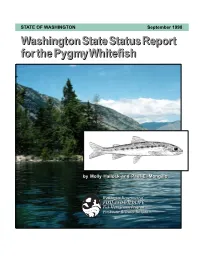
STATE OF WASHINGTON September 1998 WashingtonWashington StateState StatusStatus ReportReport forfor thethe PygmyPygmy Whitefish Whitefish byby MollyMolly HallockHallock andand PaulPaul E.E. MongilloMongillo Washington Department of FISH AND WILDLIFE Fish Management Program Freshwater Resource Division Washington State Status Report for the Pygmy Whitefish by Molly Hallock and Paul E. Mongillo Washington Department of Fish and Wildlife Fish Management Program 600 Capitol Way North Olympia, Washington 98501-1091 September 1998 The Washington Department of Fish and Wildlife maintains a list of endangered, threatened and sensitive species (Washington Administrative Codes 232-12-014 and 232-12-011, Appendix A). In 1990, the Washington Fish and Wildlife Commission adopted listing procedures developed by a group of citizens, interest groups, and state and federal agencies (Washington Administrative Code 232-12-297, Appendix B). The procedures include how species listing will be initiated, criteria for listing and de-listing, public review and recovery and management of listed species. The first step in the process is to develop a preliminary species status report. The report includes a review of information relevant to the species’ status in Washington and addresses factors affecting its status including, but not limited to: historic, current, and future species population trends, natural history including ecological relationships, historic and current habitat trends, population demographics and their relationship to long term sustainability, and historic and current species management activities. The procedures then provide for a 90-day public review opportunity for interested parties to submit new scientific data relevant to the status report, classification recommendation, and any State Environmental Policy Act findings. During the 90-day review period, the Department holds statewide public meetings to answer questions and take comments. -

A Thesis Entitled Molecular, Morphological, and Biogeographic Resolution of Cryptic Taxa in the Greenside Darter Etheostoma Blen
A Thesis Entitled Molecular, morphological, and biogeographic resolution of cryptic taxa in the Greenside Darter Etheostoma blennioides complex By Amanda E. Haponski Submitted as partial fulfillment of the requirements for The Master of Science Degree in Biology (Ecology-track) ____________________________ Advisor: Dr. Carol A. Stepien ____________________________ Committee Member: Dr. Timothy G. Fisher ____________________________ Committee Member: Dr. Johan F. Gottgens ____________________________ College of Graduate Studies The University of Toledo December 2007 Copyright © 2007 This document is copyrighted material. Under copyright law, no parts of this document may be reproduced without the expressed permission of the author. An Abstract of Molecular, morphological, and biogeographic resolution of cryptic taxa in the Greenside Darter Etheostoma blennioides complex Amanda E. Haponski Submitted as partial fulfillment of the requirements for The Master of Science Degree in Biology (Ecology-track) The University of Toledo December 2007 DNA sequencing has led to the resolution of many cryptic taxa, which are especially prevalent in the North American darter fishes (Family Percidae). The Greenside Darter Etheostoma blennioides commonly occurs in the lower Great Lakes region, where two putative subspecies, the eastern “Allegheny” type E. b. blennioides and the western “Prairie” type E. b. pholidotum , overlap. The objective of this study was to test the systematic identity and genetic divergence distinguishing the two subspecies in areas of sympatry and allopatry in comparison to other subspecies and close relatives. DNA sequences from the mtDNA cytochrome b gene and control region and the nuclear S7 intron 1 comprising a total of 1,497 bp were compared from 294 individuals across 18 locations, including the Lake Erie basin and the Allegheny, Meramec, Obey, Ohio, Rockcastle, Susquehanna, and Wabash River systems. -

Early Development of the Devils River Minnow, Dionda Diaboli (Cyprinidae)
THE SOUTHWESTERN NATURALIST 52(3):378–385 SEPTEMBER 2007 EARLY DEVELOPMENT OF THE DEVILS RIVER MINNOW, DIONDA DIABOLI (CYPRINIDAE) JULIE HULBERT,TIMOTHY H. BONNER,* JOE N. FRIES,GARY P. GARRETT, AND DAVID R. PENDERGRASS Department of Biology, Texas State University, 601 University Drive, San Marcos, TX 78666 (JH, THB, DRP) National Fish Hatchery and Technology Center, 500 McCarty Lane, San Marcos, TX 78666 (JNF) Texas Parks and Wildlife Department, 5103 Junction Highway, Ingram, TX 78025 (GPG) *Correspondent: TBonner@txstate.edu ABSTRACT—The Devils River minnow (Dionda diaboli) coexists with at least 2 congeners and several other cyprinids throughout its range in southern Texas and northern Mexico. Larval and juvenile descriptions are needed to monitor D. diaboli larvae and juveniles as part of recovery efforts for this species of conservation concern. The purpose of this study was to describe and quantify characteristics of early life stages of D. diaboli from hatching to 128 d post hatch to facilitate larval and juvenile identification. Descriptive characters include mid-lateral band of melanophores by Day 8 (.5.1 mm SL; .5.4 mm TL), mid-lateral band of melanophores separate from a rounded caudal spot and lateral snout-to-eye melanophores by Day 16 (.5.8 mm SL; .6.3 mm TL), initial coiling of intestine by Day 32 (.6.2 mm SL; .7.2 mm TL), wedge-shaped caudal spot by Day 64 (.8.7 mm SL; .10.0 mm TL), and melanophores around scale margins and mid-lateral double dashes along lateral line by Day 128 (.13.5 mm SL; .16.0 mm TL). -
Development of a System-Wide Predator Control Program: Northern Squawfish Management Program
Development of a System-wide Predator Control Program Northern Squawfish Management Program - Implementation Annual Report 1997 October 1998 DOE/BP-24514-8 This Document should be cited as follows: Young, Franklin, "Development of a System-wide Predator Control Program; Northern Squawfish Management Program - Implementation", 1997 Annual Report, Project No. 199007700, 100 electronic pages, (BPA Report DOE/BP-24514-8) Bonneville Power Administration P.O. Box 3621 Portland, OR 97208 This report was funded by the Bonneville Power Administration (BPA), U.S. Department of Energy, as part of BPA's program to protect, mitigate, and enhance fish and wildlife affected by the development and operation of hydroelectric facilities on the Columbia River and its tributaries. The views in this report are the author's and do not necessarily represent the views of BPA. DEVELOPMENT OF A SYSTEMWIDE PREDATOR CONTROL PROGRAM: STEPWISE IMPLEMENTATION OF A PREDATION INDEX, PREDATOR CONTROL FISHERIES, AND EVALUATION PLAN IN THE COLUMBIA RIVER BASIN SECTION I: IMPLEMENTATION 1997 ANNUAL REPORT Prepared by: Franklin R. Young Columbia Basin Fish and Wildlife Authority In Cooperation With Nez Perce Tribe of Idaho Oregon Department of Fish and Wildlife Washington Department of Fish and Wildlife Pacific States Marine Fisheries Commission Columbia River Inter-tribal Fish Commission Confederated Tribes of the Umatilla Indian Reservation Confederated Tribes of the Warm Springs Reservation of Oregon Confederated Tribes and Bands of the Yakama Indian Reservation Prepared -
Dionda Diaboli), 6 with Implications for Its Conservation…………………………………
ECOLOGICAL PROFILES FOR SELECTED STREAM-DWELLING TEXAS FRESHWATER FISHES IV A Final Report To The Texas Water Development Board Prepared by: Robert J. Edwards Department of Biology University of Texas-Pan American Edinburg, TX 78541 TWDB Contract Number: 95-483-107 30 August 2003 TABLE OF CONTENTS Table of Contents ………………………………………….…………………….. 2 Introduction 3 Scientific Publications Resulting From This TWDB Contract………...………. 3 Discovery of a New Population of Devils River Minnow (Dionda diaboli), 6 With Implications for its Conservation…………………………………. Acknowledgements………………………………………………………..………. 14 Literature Cited……………….………………………………………….……….. 14 2 Introduction A major goal of the Water Development Board's mission are its research, monitoring, and assessment programs designed to minimize the effects of water development projects on the affected native aquatic fauna and to maintain the quality and availability of instream habitats for the use of dependent aquatic resources. The instream flows necessary for the successful survival, growth and reproduction of affected aquatic life are a major concern. Unfortunately, instream flow data with respect to the ecological requirements of Texas riverine fishes are largely unknown. While some information can be found in the published literature, a substantial but unknown quantity of information is also present in various agencies and research museums around the state. In order to minimize the disruptions to the native fauna, quantitative and qualitative information concerning life histories, survival, -

Petition to List the Clear Lake Hitch Under the Endangered Species
Petition to List the Clear Lake Hitch (Lavinia exilicauda chi) As Endangered or Threatened Under the Endangered Species Act Submitted To: U. S. Fish and Wildlife Service Sacramento Fish and Wildlife Office 2800 Cottage Way, Room W-2605 Sacramento, CA 95825 Secretary of the Interior Department of the Interior 1849 C Street, N.W. Washington, DC 20240 Submitted By: Center for Biological Diversity Date: September 25, 2012 1 EXECUTIVE SUMMARY The Center for Biological Diversity petitions the U.S. Fish and Wildlife Service to list the Clear Lake hitch (Lavinia exilicauda chi) as an endangered or threatened species under the federal Endangered Species Act. The Clear Lake hitch is a fish species endemic to Clear Lake, California and its tributaries. A large minnow once so plentiful that it was a staple food for the original inhabitants of the Clear Lake region, the Clear Lake hitch has declined precipitously in abundance as the ecology of its namesake lake has been altered and degraded. Clear Lake hitch once spawned in all of the tributary streams to Clear Lake. The hitch life cycle involves migration each spring, when adults make their way upstream in tributaries of Clear Lake, spawning, and then return to Clear Lake. The biologically significant masses of hitch were a vital part of the Clear Lake ecosystem, an important food source for numerous birds, fish, and other wildlife. Hitch in “unimaginably abundant” numbers once clogged the lake’s tributaries during spectacular spawning runs. Historical accounts speak of “countless thousands” and “enormous” and “massive” numbers of hitch. The Clear Lake basin and its tributaries have been dramatically altered by urban development and agriculture. -

Molecular Systematics of Western North American Cyprinids (Cypriniformes: Cyprinidae)
Zootaxa 3586: 281–303 (2012) ISSN 1175-5326 (print edition) www.mapress.com/zootaxa/ ZOOTAXA Copyright © 2012 · Magnolia Press Article ISSN 1175-5334 (online edition) urn:lsid:zoobank.org:pub:0EFA9728-D4BB-467E-A0E0-0DA89E7E30AD Molecular systematics of western North American cyprinids (Cypriniformes: Cyprinidae) SUSANA SCHÖNHUTH 1, DENNIS K. SHIOZAWA 2, THOMAS E. DOWLING 3 & RICHARD L. MAYDEN 1 1 Department of Biology, Saint Louis University, 3507 Laclede Avenue, St. Louis, MO 63103, USA. E-mail S.S: susana.schonhuth@gmail.com ; E-mail RLM: cypriniformes@gmail.com 2 Department of Biology and Curator of Fishes, Monte L. Bean Life Science Museum, Brigham Young University, Provo, UT 84602, USA. E-mail: shiozawa@byu.edu 3 School of Life Sciences, Arizona State University, Tempe, AZ 85287-4501, USA. E-mail: Thomas.Dowling@asu.edu Abstract The phylogenetic or evolutionary relationships of species of Cypriniformes, as well as their classification, is in a era of flux. For the first time ever, the Order, and constituent Families are being examined for relationships within a phylogenetic context. Relevant findings as to sister-group relationships are largely being inferred from analyses of both mitochondrial and nuclear DNA sequences. Like the vast majority of Cypriniformes, due to an overall lack of any phylogenetic investigation of these fishes since Hennig’s transformation of the discipline, changes in hypotheses of relationships and a natural classification of the species should not be of surprise to anyone. Basically, for most taxa no properly supported phylogenetic hypothesis has ever been done; and this includes relationships with reasonable taxon and character sampling of even families and subfamilies. -
Table of Contents
13.0 LITERATURE CIT TABLE OF CONTENTS 13.0 LITERATURE CITED AND PREPARATION STAFF ..................................................... 13-1 13.1 PREPARATION STAFF ............................................................................................ 13-1 13.1.1 Solano County Water Agency ........................................................................ 13-1 13.1.2 Plan Participants ............................................................................................. 13-1 13.1.3 LSA Associates, Inc. ...................................................................................... 13-1 13.2 LITERATURE CITED ............................................................................................... 13-2 ED AND PREPARATION S TAFF 13-i Oct 2012 This page intentionally left blank ND PREPARATION STAFF ED A 13.0 LITERATURE CIT Oct 2012 13-ii 13.0 LITERATURE CIT 13.0 LITERATURE CITED AND PREPARATION STAFF 13.1 PREPARATION STAFF 13.1.1 Solano County Water Agency General Manager: David Okita Supervising Environmental Scientist: Chris Lee ED AND PREPARATION S 13.1.2 Plan Participants • City of Dixon: ○ David Dowswell, ○ Justin Hardy ○ Rebecca Van Burren • City of Fairfield: Erin Beavers • City of Rio Vista: Tom Bland • City of Suisun City: ○ Gary Cullen TAFF ○ Jake Raper • City of Vacaville: ○ Fred Buderi ○ Scott Sexton • City of Vallejo: Brian Dolan • Dixon Resource Conservation District (Dixon RCD): John Currey • Fairfield-Suisun Sewer District (FSSD): Larry Bahr • Maine Prairie Water District (MPWD): Don Holdener -

Teleostei: Cyprinidae) from Cytochrome B Sequences
Copeia, 2002(3), pp. 665±678 Evolutionary Relationships of the Plagopterins (Teleostei: Cyprinidae) from Cytochrome b Sequences THOMAS E. DOWLING,C.ALANA TIBBETS,W.L.MINCKLEY, AND GERALD R. SMITH Sequences of cytochrome b (cytb) were used to examine composition and phylo- genetic relationships of cyprinid ®shes of the tribe Plagopterini, endemic to the Great Basin and Lower Colorado River in southwestern North America. The pla- gopterin genera, Lepidomeda, Meda, Plagopterus, and Snyderichthys, were most closely af®liated with the chubs Couesius and Margariscus of northern and eastern North America. As indicated by previous morphologic, allozymic, and mtDNA studies, Sny- derichthys is intimately related to Lepidomeda. The relationship is paraphyletic, how- ever, according to our molecular data. Snyderichthys from the Snake and Bear River drainages are part of a clade that includes Lepidomeda mollispinis and Lepidomeda albivallis according to the cytb sequence, with Snyderichthys from the central and southern Bonneville basin more divergent. This paraphyly and the complex geo- graphic relationships of mtDNA sequences indicate a complex history of the group and cast doubt on the validity of morphologically diagnosed Snyderichthys. Estimates of divergence time, based on a combination of fossil and molecular data, indicate that the plagopterins are an ancient clade, at least 17 million years old. HE Cyprinidae or minnows are the most di- They hypothesized existence of three major T verse freshwater ®sh family in North Amer- groups: ``shiner,'' ``chub,'' and ``western'' ica, represented by more than 300 species in clades. Plagopterins fell within a Gila clade of approximately 50 genera (Burr and Mayden, western minnows, most closely related to a clade 1992). -

Volume II, Chapter 2 Columbia River Estuary and Lower Mainstem Subbasins
Volume II, Chapter 2 Columbia River Estuary and Lower Mainstem Subbasins TABLE OF CONTENTS 2.0 COLUMBIA RIVER ESTUARY AND LOWER MAINSTEM ................................ 2-1 2.1 Subbasin Description.................................................................................................. 2-5 2.1.1 Purpose................................................................................................................. 2-5 2.1.2 History ................................................................................................................. 2-5 2.1.3 Physical Setting.................................................................................................... 2-7 2.1.4 Fish and Wildlife Resources ................................................................................ 2-8 2.1.5 Habitat Classification......................................................................................... 2-20 2.1.6 Estuary and Lower Mainstem Zones ................................................................. 2-27 2.1.7 Major Land Uses................................................................................................ 2-29 2.1.8 Areas of Biological Significance ....................................................................... 2-29 2.2 Focal Species............................................................................................................. 2-31 2.2.1 Selection Process............................................................................................... 2-31 2.2.2 Ocean-type Salmonids -
Phylogenetic Relationships of Eurasian and American Cyprinids Using Cytochrome B Sequences
Journal of Fish Biology (2002) 61, 929–944 doi:10.1006/jfbi.2002.2105, available online at http://www.idealibrary.com on Phylogenetic relationships of Eurasian and American cyprinids using cytochrome b sequences C. C*, N. M*, T. E. D†, A. G‡ M. M. C*§ *Centro de Biologia Ambiental, Departamento de Zoologia e Antropologia, Faculdade de Cieˆncia de Lisboa, Campo Grande, Bloco C2, 3 Piso. 1749-016 Lisboa, Portugal, †Department of Biology, Arizona State University, Tempe, Arizona 85287-1501, U.S.A. and ‡Laboratoire d’Hydrobiology, Universite´ de Provence, 1 Place Victor Hugo, 1331 Marseille, France (Received 30 January 2002, Accepted 6 August 2002) Neighbour-joining and parsimony analyses identified five lineages of cyprinids: (1) European leuciscins (including Notemigonus)+North American phoxinins (including Phoxinus phoxinus); (2) European gobionins+Pseudorasbora; (3) primarily Asian groups [cultrins+acheilognathins+ gobionins (excluding Abbotina)+xenocyprinins]; (4) Abbottina+Sinocyclocheilus+Acrossocheilus; (5) cyprinins [excluding Sinocyclocheilus and Acrossocheilus]+barbins+labeonins. Relationships among these lineages and the enigmatic taxa Rhodeus were not well-resolved. Tests of mono- phyly of subfamilies and previously proposed relationships were examined by constraining cytochrome b sequences data to fit previous hypotheses. The analysis of constrained trees indicated that sequence data were not consistent with most previously proposed relationships. Inconsistency was largely attributable to Asian taxa, such as Xenocypris and Xenocyprioides. Improved understanding of historical and taxonomic relationships in Cyprinidae will require further morphological and molecular studies on Asian cyprinids and taxa representative of the diversity found in Africa. 2002 The Fisheries Society of the British Isles. Published by Elsevier Science Ltd. All rights reserved. Key words: Cyprinidae; molecular phylogeny; cytochrome b; monophyly of subfamilies.