World War II
Total Page:16
File Type:pdf, Size:1020Kb
Load more
Recommended publications
-

The World at War: the Second World
Towards World War II: International Relations 1931-1939 I. Fascist Aggression in Asia, Africa and Europe II. The Policy of Appeasement III. Blitzkrieg: Europe at War (1939) Fascism and the European Balance of Power • 1931-1939-Fascist powers expand and challenge traditional balance of world power • Fascism inherently militaristic, expansionist and imperial. • 1931-Japan invades Manchuria. • 1935-Italy invades Ethiopia. • 1935-39-Germany expands in central Europe. • 1936-Spanish Civil War-Fascists (Nationalist) fight socialists (Republicans) in Spain. Japanese Occupation of China Execution of Chinese soldiers and civilians Japan and World War II • 1905 victory over Russians and part of allied victory in WWI. • Authoritarian, militaristic government in power. • Invades Manchuria and China in 1931 and occupies it until 1945. • Attacks U.S. at Pearl Harbor in 1941 due to oil embargo and U.S. naval power in Pacific. Map of China Under Japanese Occupation Anti-Fascist Propaganda During Spanish Civil War (1936) Fascist Spain Nazi Ideology and Foreign Policy • Ideology determines foreign policy. • Ethnic Fundamentalism. • Reclaim the “German East”- (Nazi Germany). • Ethnic Germany and Ethnic Germans living in the east. Definition: Anschluss The conquest of German speaking territories by Nazi Germany Racial Map of Europe, 1923 Europe in 1919 The Anschluss • March, 1936: Annexation of the Rhineland • March 1938: Annexation of Austria • September, 1938: Conference in Munich between Hitler and Allies Hitler and Chamberlain at the Munich Conference, 1938 The Policy of Appeasement 1. Many believed Hitler’s claims were justified after Versailles. 2. Europeans feared another war after WWI. 3. Capitalist nations feared that war would unleash communist revolutions. -

Art House Биоскоп Кинотека Дани Мексичког Филма Дани Словеначког Филма 11
Новембар 2015 ISSN 1820-6549 музеја програмпрограм југословенске кинотеке ART HOUSE БИОСКОП КИНОТЕКА ДАНИ МЕКСИЧКОГ ФИЛМА ДАНИ СЛОВЕНАЧКОГ ФИЛМА 11. ФЕСТИВАЛ „СЛОБОДНА ЗОНА“ 21. ФЕСТИВАЛ АУТОРСКОГ ФИЛМА ВЕЛИКАНИ СВЕТСКОГ ФИЛМА: ЕНТОНИ КВИН (Anthony Quinn) ФОКУС: РАЈНЕР ВЕРНЕР ФАСБИНДЕР (Rainer Werner Fassbinder) МАРТИН СКОРСЕЗЕ (други део) (Martin Scorsese) ПЈЕР ПАОЛО ПАЗОЛИНИ – на бис (Pier Paolo Pasolini) ЈАПАНСКО-СРПСКИ ФИЛМСКИ ФЕСТИВАЛ ВЕЧЕ НАЈСТАРИЈИХ РЕКЛАМА 10. ФЕСТИВАЛ СРПСКОГ ФИЛМА ФАНТАСТИКЕ ПРЕДСТАВЉА: ЛАМБЕРТО БАВА (Lamberto Bava) ШОК КОРИДОР ПРЕДСТАВЉА: ВИЛИЈАМ ГИДЛЕР (William Girdler) ISSN 1820-6549 Музеј југословенске кинотеке ПРОГРАМ Новембар 2015. ART HOUSE БИОСКОП КИНОТЕКА ДАНИ МЕКСИЧКОГ ФИЛМА ДАНИ СЛОВЕНАЧКОГ ФИЛМА 11. ФЕСТИВАЛ „СЛОБОДНА ЗОНА“ 21. ФЕСТИВАЛ АУТОРСКОГ ФИЛМА ВЕЛИКАНИ СВЕТСКОГ ФИЛМА: ЕНТОНИ КВИН (Anthony Quinn) ФОКУС: РАЈНЕР ВЕРНЕР ФАСБИНДЕР (Rainer Werner Fassbinder) МАРТИН СКОРСЕЗЕ (други део) (Martin Scorsese) ПЈЕР ПАОЛО ПАЗОЛИНИ – на бис (Pier Paolo Pasolini) ЈАПАНСКО-СРПСКИ ФИЛМСКИ ФЕСТИВАЛ ВЕЧЕ НАЈСТАРИЈИХ РЕКЛАМА 10. ФЕСТИВАЛ СРПСКОГ ФИЛМА ФАНТАСТИКЕ ПРЕДСТАВЉА: ЛАМБЕРТО БАВА (Lamberto Bava) ШОК КОРИДОР ПРЕДСТАВЉА: ВИЛИЈАМ ГИДЛЕР (William Girdler) музеј југословенске кинотеке програм Импресум: За издавача: Радослав Зеленовић Уредници: Марјан Вујовић, Александар Саша Ердељановић Уредник програма Студија за електронске медије „Др Влада Петрић“: Борислав Станојевић Сарадници на програму: Александар Саша Ердељановић, Марјан Вујовић, Ненад Беквалац, Борислав Станојевић, Петар Михајловић, Ђорђе Зеленовић, -
Surviving Antigone: Anouilh, Adaptation, and the Archive
SURVIVING ANTIGONE: ANOUILH, ADAPTATION AND THE ARCHIVE Katelyn J. Buis A Thesis Submitted to the Graduate College of Bowling Green State University in partial fulfillment of the requirements for the degree of MASTER OF ARTS May 2014 Committee: Cynthia Baron, Advisor Jonathan Chambers ii ABSTRACT Dr. Cynthia Baron, Advisor The myth of Antigone has been established as a preeminent one in political and philosophical debate. One incarnation of the myth is of particular interest here. Jean Anouilh’s Antigone opened in Paris, 1944. A political and then philosophical debate immediately arose in response to the show. Anouilh’s Antigone remains a well-known play, yet few people know about its controversial history or the significance of its translation into English immediately after the war. It is this history and adaptation of Anouilh’s contested Antigone that defines my inquiry. I intend to reopen interpretive discourse about this play by exploring its origins, its journey, and the archival limitations and motivations controlling its legacy and reception to this day. By creating a space in which multiple readings of this play can exist, I consider adaptation studies and archival theory and practice in the form of theatre history, with a view to dismantle some of the misconceptions this play has experienced for over sixty years. This is an investigation into the survival of Anouilh’s Antigone since its premiere in 1944. I begin with a brief overview of the original performance of Jean Anouilh’s Antigone and the significant political controversy it caused. The second chapter centers on the changing reception of Anouilh’s Antigone beginning with the liberation of Paris to its premiere on the Broadway stage the following year. -

The World at War, 1937-1945 Chapter 24
The World at War, 1937-1945 Chapter 24 The Road to War • The Great Depression led to anti-democratic movements in Italy, Germany, Japan, and Spain (Mussolini, Hitler, Tojo, Franco). • Fascism: disparaged parliamentary government, independent labor movements, and individual rights. Promoted strong nationalism and imperialism. The Rise of Fascism • Germany severely punished by Treaty of Versailles • Japan and Italy undermined by Treaty Japan and Italy • Japan occupied Manchuria (1931); Full scale invasion in China (1937) • Italy denied claim of lands after WW1. Invasion of Ethiopia Hitler’s Germany • Fear of communism, unemployment, and labor unrest fueled the Nazi Party • Mein Kampf • Hitler (1933) rearmed Germany; Rome-Berlin Axis, alliance with Japan • No action by France or England Isolationists versus Interventionists • Republicans claimed that arms manufacturers influenced Wilson to enter WW1 • Neutrality Acts of 1935- • Banned loans to belligerent nations in 1936 • “Cash and carry” 1937 • Conservative groups lead isolationist sentiment • Some pacifist groups were isolationist The Popular Front- • American Communist Party (100,000) opposed fascism The Failure of Appeasement • Hitler annexed: Austria and Czechoslovakia (Munich Conference) • France and England appeasement • In 1939 Hitler launched “blitzkrieg” on Poland • Effect- • Reaction by Roosevelt- • Germany annexed: Denmark, Netherlands, Norway, Luxemburg, Belgium, and France War Arrives • Congress in 1939 allowed sale of arms to Allies • Traded 50 destroyers from WW1 to England • Defense spending and peacetime draft • Lend and Lease Policy in 1941 • Axis threat to democracy • Germany invaded Soviet Union in 1941 • In 1941 Nazi U-boats and American Navy were exchanging fire in Atlantic The Attack on Pearl Harbor • U.S. refused to intervene after “Rape of Nanking” in 1937 • Japanese troops occupied French-Indochina (Vietnam, Cambodia, Laos) • Effect: • Japanese reaction in 1941… • U.S. -
Ordinary Heroes: Depictions of Masculinity in World War II Film a Thesis Submitted to the Miami University Honors Program in Pa
Ordinary Heroes: Depictions of Masculinity in World War II Film A thesis submitted to the Miami University Honors Program in partial fulfillment of the requirements for University Honors with Distinction by Robert M. Dunlap May 2007 Oxford, Ohio Abstract Much work has been done investigating the historical accuracy of World War II film, but no work has been done using these films to explore social values. From a mixed film studies and historical perspective, this essay investigates movie images of American soldiers in the European Theater of Operations to analyze changing perceptions of masculinity. An examination of ten films chronologically shows a distinct change from the post-war period to the present in the depiction of American soldiers. Masculinity undergoes a marked change from the film Battleground (1949) to Band of Brothers (2001). These changes coincide with monumental shifts in American culture. Events such as the loss of the Vietnam War dramatically changed perceptions of the Second World War and the men who fought during that time period. The United States had to deal with a loss of masculinity that came with their defeat in Vietnam and that shift is reflected in these films. The soldiers depicted become more skeptical of their leadership and become more uncertain of themselves while simultaneously appearing more emotional. Over time, realistic images became acceptable and, in fact, celebrated as truthful while no less masculine. In more recent years, there is a return to the heroism of the World War II generation, with an added emotionality and dimensionality. Films reveal not only the popular opinions of the men who fought and reflect on the validity of the war, but also show contemporary views of masculinity and warfare. -
The Rhine River Crossings by Barry W
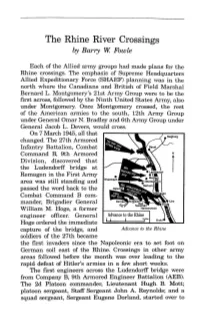
The Rhine River Crossings by Barry W. Fowle Each of the Allied army groups had made plans for the Rhine crossings. The emphasis of Supreme Headquarters Allied Expeditionary Force (SHAEF) planning was in the north where the Canadians and British of Field Marshal Bernard L. Montgomery's 21st Army Group were to be the first across, followed by the Ninth United States Army, also under Montgomery. Once Montgomery crossed, the rest of the American armies to the south, 12th Army Group under General Omar N. Bradley and 6th Army Group under General Jacob L. Devers, would cross. On 7 March 1945, all that Slegburg changed. The 27th Armored Infantry Battalion, Combat Beuel Command B, 9th Armored Division, discovered that the Ludendorff bridge at 9th NFANR " Lannesdorf I0IV R Remagen in the First Army " Mehlem Rheinbach area was still standing and Oberbachem = : kum h RM Gelsd srn passed the word back to the q 0o~O kiVl 78th e\eaeo Combat Command B com- INP L)IV Derna Ahweile Llnz mander, Brigadier General SInzig e Neuenahi Helmershelm William M. Hoge, a former G1 Advance to the Rhine engineer officer. General 5 10 Mile Brohl Hoge ordered the immediate capture of the bridge, and Advance to the Rhine soldiers of the 27th became the first invaders since the Napoleonic era to set foot on German soil east of the Rhine. Crossings in other army areas followed before the month was. over leading to the rapid defeat of Hitler's armies in a few short weeks. The first engineers across the Ludendorff bridge were from Company B, 9th Armored Engineer Battalion (AEB). -

JOURNAL House of Representatives GENERAL ASSEMBLY
JOURNAL OF THE House of Representatives OF THE 2015 GENERAL ASSEMBLY OF THE STATE OF NORTH CAROLINA SECOND SESSION 2016 OFFICERS AND MEMBERS OF THE HOUSE OF REPRESENTATIVES 2016 SECOND SESSION Tim Moore, Speaker ............................... Kings Mountain, Cleveland County Paul Stam, Speaker Pro Tempore ................................... Apex, Wake County Denise G. Weeks, Principal Clerk .............................. Raleigh, Wake County Garland Shepheard, Sergeant-at-Arms ............. Tarboro, Edgecombe County REPRESENTATIVES 1st District: Camden, Chowan, Currituck, Pasquotank (Part), Perquimans, and Tyrrell. Bob Steinburg (R) .................... Chowan .................................. Edenton 2nd District: Granville (Part) and Person. Larry Yarborough (R) ................ Person ........................................ Roxboro 3rd District: Beaufort (Part), Craven (Part), and Pamlico. Michael Speciale (R) ............... Craven ................................. New Bern 4th District: Duplin (Part) and Wayne (Part). Jimmy Dixon (R) ..................... Duplin .................................. Mt. Olive 5th District: Bertie, Gates, Hertford, and Pasquotank (Part). Howard J. Hunter, III (D) ........ Hertford ................................. Ahoskie 6th District: Beaufort (Part), Dare, Hyde, and Washington. Paul Tine (U) ........................... Dare .................................. Kitty Hawk 7th District: Franklin (Part) and Nash (Part). Bobbie Richardson (D) ............ Franklin ............................... Louisburg -

Study Guide REFUGE
A Guide for Educators to the Film REFUGE: Stories of the Selfhelp Home Prepared by Dr. Elliot Lefkovitz This publication was generously funded by the Selfhelp Foundation. © 2013 Bensinger Global Media. All rights reserved. 1 Table of Contents Acknowledgements p. i Introduction to the study guide pp. ii-v Horst Abraham’s story Introduction-Kristallnacht pp. 1-8 Sought Learning Objectives and Key Questions pp. 8-9 Learning Activities pp. 9-10 Enrichment Activities Focusing on Kristallnacht pp. 11-18 Enrichment Activities Focusing on the Response of the Outside World pp. 18-24 and the Shanghai Ghetto Horst Abraham’s Timeline pp. 24-32 Maps-German and Austrian Refugees in Shanghai p. 32 Marietta Ryba’s Story Introduction-The Kindertransport pp. 33-39 Sought Learning Objectives and Key Questions p. 39 Learning Activities pp. 39-40 Enrichment Activities Focusing on Sir Nicholas Winton, Other Holocaust pp. 41-46 Rescuers and Rescue Efforts During the Holocaust Marietta Ryba’s Timeline pp. 46-49 Maps-Kindertransport travel routes p. 49 2 Hannah Messinger’s Story Introduction-Theresienstadt pp. 50-58 Sought Learning Objectives and Key Questions pp. 58-59 Learning Activities pp. 59-62 Enrichment Activities Focusing on The Holocaust in Czechoslovakia pp. 62-64 Hannah Messinger’s Timeline pp. 65-68 Maps-The Holocaust in Bohemia and Moravia p. 68 Edith Stern’s Story Introduction-Auschwitz pp. 69-77 Sought Learning Objectives and Key Questions p. 77 Learning Activities pp. 78-80 Enrichment Activities Focusing on Theresienstadt pp. 80-83 Enrichment Activities Focusing on Auschwitz pp. 83-86 Edith Stern’s Timeline pp. -

List of Shows Master Collection
Classic TV Shows 1950sTvShowOpenings\ AdventureStory\ AllInTheFamily\ AManCalledShenandoah\ AManCalledSloane\ Andromeda\ ATouchOfFrost\ BenCasey\ BeverlyHillbillies\ Bewitched\ Bickersons\ BigTown\ BigValley\ BingCrosbyShow\ BlackSaddle\ Blade\ Bonanza\ BorisKarloffsThriller\ BostonBlackie\ Branded\ BrideAndGroom\ BritishDetectiveMiniSeries\ BritishShows\ BroadcastHouse\ BroadwayOpenHouse\ BrokenArrow\ BuffaloBillJr\ BulldogDrummond\ BurkesLaw\ BurnsAndAllenShow\ ByPopularDemand\ CamelNewsCaravan\ CanadianTV\ CandidCamera\ Cannonball\ CaptainGallantOfTheForeignLegion\ CaptainMidnight\ captainVideo\ CaptainZ-Ro\ Car54WhereAreYou\ Cartoons\ Casablanca\ CaseyJones\ CavalcadeOfAmerica\ CavalcadeOfStars\ ChanceOfALifetime\ CheckMate\ ChesterfieldSoundOff\ ChesterfieldSupperClub\ Chopsticks\ ChroniclesOfNarnia\ CimmarronStrip\ CircusMixedNuts\ CiscoKid\ CityBeneathTheSea\ Climax\ Code3\ CokeTime\ ColgateSummerComedyHour\ ColonelMarchOfScotlandYard-British\ Combat\ Commercials50sAnd60s\ CoronationStreet\ Counterpoint\ Counterspy\ CourtOfLastResort\ CowboyG-Men\ CowboyInAfrica\ Crossroads\ DaddyO\ DadsArmy\ DangerMan-S1\ DangerManSeason2-3\ DangerousAssignment\ DanielBoone\ DarkShadows\ DateWithTheAngles\ DavyCrockett\ DeathValleyDays\ Decoy\ DemonWithAGlassHand\ DennisOKeefeShow\ DennisTheMenace\ DiagnosisUnknown\ DickTracy\ DickVanDykeShow\ DingDongSchool\ DobieGillis\ DorothyCollins\ DoYouTrustYourWife\ Dragnet\ DrHudsonsSecretJournal\ DrIQ\ DrSyn\ DuffysTavern\ DuPontCavalcadeTheater\ DupontTheater\ DustysTrail\ EdgarWallaceMysteries\ ElfegoBaca\ -

World War II Information Collection, 1942-1951
WORLD WAR II INFORMATION COLLECTION A Register, 1942-1951 Overview of Collection Repository: Clemson University Libraries Special Collections, Clemson, SC Creator: War Information Center (Clemson Agricultural College of South Carolina) Collection Number: Mss 253 Title: World War II Information Collection, 1942-1951 Abstract: The War Information Center was established at Clemson College in April 1942. It was one of roughly 140 colleges and universities across the United States designated by the Library Service Division of the U.S. Office of Education to receive a wide range of publications and information in order to keep communities informed about the war effort in an age before mass media. The collection contains materials that document the events of World War II and its immediate aftermath. Quantity: 24 cubic feet consisting of 93 folders in 6 letter-sized boxes / 84 oversized folders / 10 oversized boxes. Scope and Content Note The collection includes publications, brochures, newsletters, news-clippings, posters, maps, ration coupons, and Newsmaps detailing the events of World War II. The collection dates from 1942-1951. The bulk of the material dates from the U.S. war years of 1942-1945. The subject files date from 1942-1945 with one correspondence file dated 1951. The World War II posters date from 1942-1946. The war-related maps date from 1941-1945. The Newsmaps date from 1942-1948. The subject files are arranged in alphabetical order by folder title. The news-clippings are arranged in chronological order. The oversized World War II posters, maps, and Newsmaps have detailed separation lists provided. The subject files contain pamphlets, newsletters, publications, brochures, and articles that document the activities of countries that fell to German occupation. -

Frederick Henry Bing, 63Rd Infantry Division
RUTGERS, THE STATE UNIVERSITY OF NEW JERSEY NEW BRUNSWICK AN INTERVIEW WITH FREDERICK HENRY BING FOR THE RUTGERS ORAL HISTORY ARCHIVES OF WORLD WAR II INTERVIEW CONDUCTED BY SANDRA STEWART HOLYOAK and KEVIN BING and STEPHEN KEMPINSKI EMERSON, NEW JERSEY NOVEMBER 18, 2003 TRANSCRIPT BY DOMINGO DUARTE Kevin Bing: This begins an interview with Fredrick Henry Bing in Emerson, New Jersey on November 18, 2003 with Kevin Bing … Sandra Stewart Holyoak: Sandra Stewart Holyoak … Stephen Kempinski: … Stephen Kempinski. SH: Mr. Bing, we’d like to thank you for taking time today to sit down with us and talk about your experiences in World War II. To begin with would you please tell us where and when you were born? FB: I was born in Irvington, New York, Irvington-on-the-Hudson and that was April 17, 1918. A very tiny town on the Hudson River and I was there until I went in the service in 1943, and then I came back from the service to Irvington. I lived there a short time and then I lived in Dobbs Ferry with my in-laws before I came to New Jersey, in 1950, I came to New Jersey. SH: Let’s back it up a bit and Kevin and Steve will ask you some questions about growing up. KB: I was going to ask you about what it was like growing up in Irvington. I understand you’re very interested in the history of the town. FB: Irvington was a very small town. The streets were almost like a wishbone, where they came out north and south and they deadended on real big private estates that were owned by multi- millionaires. -

The World at War, 1914–1945 by Jeremy Black (Review) Robert Niebuhr
The World at War, 1914–1945 by Jeremy Black (review) Robert Niebuhr Marine Corps History, Volume 6, Number 1, Summer 2020, pp. 80-81 (Review) Published by Marine Corps University Press For additional information about this article https://muse.jhu.edu/article/796457/summary [ Access provided at 30 Sep 2021 23:08 GMT with no institutional affiliation ] This work is licensed under a Creative Commons Attribution 4.0 International License. 80 MARINE CORPS HISTORY VOL. 6, NO. 1 Robert Niebuhr, PhD The World at War, 1914–1945. By Jeremy Black. (Lanham, MD: Rowman and Littlefield, 2019. Pp. 351. $98.00 cloth; $39.00 paperback; $37.00 e-book.) Scholarship on World War II is prodigious and the spends significant time looking at the late nineteenth continued interest for both students and the general century and trying to understand topics such as the public alike is proof that more works will be forthcom- worldview and influence of Pan-Germans and Marx- ing in the foreseeable future. One of the questions, of ists, and then link Hitler’s experience in World War course, for any author writing on this period to ask is I with his deliberate moves to prompt World War II. how they can contribute to such a well-covered field. Black’s work offers something broader in scope Archives have been combed through for decades now, yet stays close to military aspects to show the conti- and only a handful of topics—such as prisoners—re- nuities between these wars. The book has a clear or- main understudied. The purpose of The World at War, ganization schema and remains consistent across the 1914–1945, however, transcends World War II and tries chapters in terms of content covered.