Cassivelaunus (Corystidae), Platepistoma Nanum
Total Page:16
File Type:pdf, Size:1020Kb
Load more
Recommended publications
-
A Classification of Living and Fossil Genera of Decapod Crustaceans
RAFFLES BULLETIN OF ZOOLOGY 2009 Supplement No. 21: 1–109 Date of Publication: 15 Sep.2009 © National University of Singapore A CLASSIFICATION OF LIVING AND FOSSIL GENERA OF DECAPOD CRUSTACEANS Sammy De Grave1, N. Dean Pentcheff 2, Shane T. Ahyong3, Tin-Yam Chan4, Keith A. Crandall5, Peter C. Dworschak6, Darryl L. Felder7, Rodney M. Feldmann8, Charles H. J. M. Fransen9, Laura Y. D. Goulding1, Rafael Lemaitre10, Martyn E. Y. Low11, Joel W. Martin2, Peter K. L. Ng11, Carrie E. Schweitzer12, S. H. Tan11, Dale Tshudy13, Regina Wetzer2 1Oxford University Museum of Natural History, Parks Road, Oxford, OX1 3PW, United Kingdom sammy.degrave@oum.ox.ac.uk lydgoulding@googlemail.com 2Natural History Museum of Los Angeles County, 900 Exposition Blvd., Los Angeles, CA 90007 United States of America pentcheff@gmail.com jmartin@nhm.org rwetzer@nhm.org 3Marine Biodiversity and Biosecurity, NIWA, Private Bag 14901, Kilbirnie Wellington, New Zealand s.ahyong@niwa.co.nz 4Institute of Marine Biology, National Taiwan Ocean University, Keelung 20224, Taiwan, Republic of China tychan@mail.ntou.edu.tw 5Department of Biology and Monte L. Bean Life Science Museum, Brigham Young University, Provo, UT 84602 United States of America keith.crandall@byu.edu 6Dritte Zoologische Abteilung, Naturhistorisches Museum, Wien, Austria Peter.Dworschak@nhm-wien.ac.at 7Department of Biology, University of Louisiana, Lafayette, LA 70504 United States of America dlf4517@louisiana.edu 8Department of Geology, Kent State University, Kent, OH 44242 United States of America rfeldman@kent.edu 9Nationaal Natuurhistorisch Museum, P. O. Box 9517, 2300 RA Leiden, The Netherlands Fransen@naturalis.nnm.nl 10Invertebrate Zoology, Smithsonian Institution, National Museum of Natural History, 10th and Constitution Avenue, Washington, DC 20560 United States of America lemaitrr@si.edu 11Department of Biological Sciences, National University of Singapore, Science Drive 4, Singapore 117543 martyn@nus.edu.sg peterng@nus.edu.sg sweehee@nus.edu.sg 12Department of Geology, Kent State University Stark Campus, 6000 Frank Ave. -

A Revision of the Palaeocorystoidea and the Phylogeny of Raninoidian Crabs (Crustacea, Decapoda, Brachyura, Podotremata)
Zootaxa 3215: 1–216 (2012) ISSN 1175-5326 (print edition) www.mapress.com/zootaxa/ Monograph ZOOTAXA Copyright © 2012 · Magnolia Press ISSN 1175-5334 (online edition) ZOOTAXA 3215 A revision of the Palaeocorystoidea and the phylogeny of raninoidian crabs (Crustacea, Decapoda, Brachyura, Podotremata) BARRY W.M. VAN BAKEL1, 6, DANIÈLE GUINOT2, PEDRO ARTAL3, RENÉ H.B. FRAAIJE4 & JOHN W.M. JAGT5 1 Oertijdmuseum De Groene Poort, Bosscheweg 80, NL–5283 WB Boxtel, the Netherlands; and Nederlands Centrum voor Biodiver- siteit [Naturalis], P.O. Box 9517, NL–2300 RA Leiden, the Netherlands E-mail: barryvanbakel@gmail.com 2 Département Milieux et peuplements aquatiques, Muséum national d'Histoire naturelle, 61 rue Buffon, CP 53, F–75231 Paris Cedex 5, France E-mail: guinot@mnhn.fr 3 Museo Geológico del Seminario de Barcelona, Diputación 231, E–08007 Barcelona, Spain E-mail: partal@optimus.es 4 Oertijdmuseum De Groene Poort, Bosscheweg 80, NL–5283 WB Boxtel, the Netherlands E-mail: info@oertijdmuseum.nl 5 Natuurhistorisch Museum Maastricht, de Bosquetplein 6–7, NL–6211 KJ Maastricht, the Netherlands E-mail: john.jagt@maastricht.nl 6 Corresponding author Magnolia Press Auckland, New Zealand Accepted by P. Castro: 2 Dec. 2011; published: 29 Feb. 2012 BARRY W.M. VAN BAKEL, DANIÈLE GUINOT, PEDRO ARTAL, RENÉ H.B. FRAAIJE & JOHN W.M. JAGT A revision of the Palaeocorystoidea and the phylogeny of raninoidian crabs (Crustacea, Deca- poda, Brachyura, Podotremata) (Zootaxa 3215) 216 pp.; 30 cm. 29 Feb. 2012 ISBN 978-1-86977-873-6 (paperback) ISBN 978-1-86977-874-3 (Online edition) FIRST PUBLISHED IN 2012 BY Magnolia Press P.O. -
Crustacea, Decapoda, Brachyura) Danièle Guinot
New hypotheses concerning the earliest brachyurans (Crustacea, Decapoda, Brachyura) Danièle Guinot To cite this version: Danièle Guinot. New hypotheses concerning the earliest brachyurans (Crustacea, Decapoda, Brachyura). Geodiversitas, Museum National d’Histoire Naturelle Paris, 2019, 41 (1), pp.747. 10.5252/geodiversitas2019v41a22. hal-02408863 HAL Id: hal-02408863 https://hal.sorbonne-universite.fr/hal-02408863 Submitted on 13 Dec 2019 HAL is a multi-disciplinary open access L’archive ouverte pluridisciplinaire HAL, est archive for the deposit and dissemination of sci- destinée au dépôt et à la diffusion de documents entific research documents, whether they are pub- scientifiques de niveau recherche, publiés ou non, lished or not. The documents may come from émanant des établissements d’enseignement et de teaching and research institutions in France or recherche français ou étrangers, des laboratoires abroad, or from public or private research centers. publics ou privés. 1 Changer fig. 19 initiale Inverser les figs 15-16 New hypotheses concerning the earliest brachyurans (Crustacea, Decapoda, Brachyura) Danièle GUINOT ISYEB (CNRS, MNHN, EPHE, Sorbonne Université), Institut Systématique Évolution Biodiversité, Muséum national d’Histoire naturelle, case postale 53, 57 rue Cuvier, F-75231 Paris cedex 05 (France) guinot@mnhn.fr An epistemological obstacle will encrust any knowledge that is not questioned. Intellectual habits that were once useful and healthy can, in the long run, hamper research Gaston Bachelard, The Formation of the Scientific -
Downloaded from Brill.Com10/11/2021 08:33:28AM Via Free Access 224 E
Contributions to Zoology, 67 (4) 223-235 (1998) SPB Academic Publishing bv, Amsterdam Optics and phylogeny: is there an insight? The evolution of superposition eyes in the Decapoda (Crustacea) Edward Gaten Department of Biology, University’ ofLeicester, Leicester LEI 7RH, U.K. E-mail: gat@leicester.ac.uk Keywords: Compound eyes, superposition optics, adaptation, evolution, decapod crustaceans, phylogeny Abstract cannot normally be predicted by external exami- nation alone, and usually microscopic investiga- This addresses the of structure and in paper use eye optics the tion of properly fixed optical elements is required construction of and crustacean phylogenies presents an hypoth- for a complete diagnosis. This largely rules out esis for the evolution of in the superposition eyes Decapoda, the use of fossil material in the based the of in comparatively on distribution eye types extant decapod fami- few lies. It that arthropodan specimens where the are is suggested reflecting superposition optics are eyes symplesiomorphic for the Decapoda, having evolved only preserved (Glaessner, 1969), although the optics once, probably in the Devonian. loss of Subsequent reflecting of some species of trilobite have been described has superposition optics occurred following the adoption of a (Clarkson & Levi-Setti, 1975). Also the require- new habitat (e.g. Aristeidae,Aeglidae) or by progenetic paedo- ment for good fixation and the fact that complete morphosis (Paguroidea, Eubrachyura). examination invariably involves the destruction of the specimen means that museum collections Introduction rarely reveal enough information to define the optics unequivocally. Where the optics of the The is one of the compound eye most complex component parts of the eye are under investiga- and remarkable not on of its fixation organs, only account tion, specialised to preserve the refrac- but also for the optical precision, diversity of tive properties must be used (Oaten, 1994). -
68 Guide to Crustacea
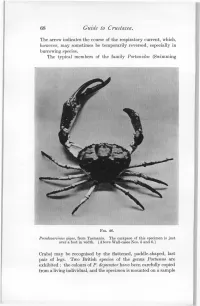
68 Guide to Crustacea. The arrow indicates the course of the respiratory current, which, however, may sometimes be temporarily reversed, especially in burrowing species. The typical members of the family Portunidae (Swimming FIG. 46. Pseudocarcinus gigas, from Tasmania. The carapace of this specimen is just over a foot in width. [Above Wall-cases Nos. 5 and 6.] Crabs) may be recognised by the flattened, paddle-shaped, last pair of legs. Two British species of the genus Portunus are exhibited : the colours of P. depurator have been carefully copied from a living individual, and the specimen is mounted on a sample Decapoda—Brachyura. 69 of the shell-gravel on which it was actually caught. The large Neptunus pelagicus is the commonest edible Crab in many parts of the East. The Common Shore Crab, Carcinus maenas, is also referred to this family, although the paddle-shape of the last legs is not so marked as in the more typical Portunidae. Podophthalmus vigil (Fig. 47) is remarkable for the great length of the eye-stalks, which is quite unusual among the Cyclometopa, and gives this Crab a curious likeness to the genus Macrophthalmus among the Ocypodidae (see Table-case No. 16). The resemblance, however, is quite superficial, for in this case FIG. 47. Podophthalmus vigil (reduced). [Table-case No. 15.] it is the first of the two segments of the eye-stalk which is elongated, while in Macrophthalmus it is the second. The genus Platyonychus, of which a group of specimens is mounted in Wall-case No. 5, also belongs to this family. -
Part I. an Annotated Checklist of Extant Brachyuran Crabs of the World
THE RAFFLES BULLETIN OF ZOOLOGY 2008 17: 1–286 Date of Publication: 31 Jan.2008 © National University of Singapore SYSTEMA BRACHYURORUM: PART I. AN ANNOTATED CHECKLIST OF EXTANT BRACHYURAN CRABS OF THE WORLD Peter K. L. Ng Raffles Museum of Biodiversity Research, Department of Biological Sciences, National University of Singapore, Kent Ridge, Singapore 119260, Republic of Singapore Email: peterng@nus.edu.sg Danièle Guinot Muséum national d'Histoire naturelle, Département Milieux et peuplements aquatiques, 61 rue Buffon, 75005 Paris, France Email: guinot@mnhn.fr Peter J. F. Davie Queensland Museum, PO Box 3300, South Brisbane, Queensland, Australia Email: Peter.Davie@qm.qld.gov.au ABSTRACT. – An annotated checklist of the extant brachyuran crabs of the world is presented for the first time. Over 10,500 names are treated including 6,793 valid species and subspecies (with 1,907 primary synonyms), 1,271 genera and subgenera (with 393 primary synonyms), 93 families and 38 superfamilies. Nomenclatural and taxonomic problems are reviewed in detail, and many resolved. Detailed notes and references are provided where necessary. The constitution of a large number of families and superfamilies is discussed in detail, with the positions of some taxa rearranged in an attempt to form a stable base for future taxonomic studies. This is the first time the nomenclature of any large group of decapod crustaceans has been examined in such detail. KEY WORDS. – Annotated checklist, crabs of the world, Brachyura, systematics, nomenclature. CONTENTS Preamble .................................................................................. 3 Family Cymonomidae .......................................... 32 Caveats and acknowledgements ............................................... 5 Family Phyllotymolinidae .................................... 32 Introduction .............................................................................. 6 Superfamily DROMIOIDEA ..................................... 33 The higher classification of the Brachyura ........................ -

Population Structure, Recruitment, and Mortality of the Freshwater Crab Dilocarcinus Pagei Stimpson, 1861 (Brachyura, Trichodactylidae) in Southeastern Brazil
Invertebrate Reproduction & Development ISSN: 0792-4259 (Print) 2157-0272 (Online) Journal homepage: https://www.tandfonline.com/loi/tinv20 Population structure, recruitment, and mortality of the freshwater crab Dilocarcinus pagei Stimpson, 1861 (Brachyura, Trichodactylidae) in Southeastern Brazil Fabiano Gazzi Taddei, Thiago Maia Davanso, Lilian Castiglioni, Daphine Ramiro Herrera, Adilson Fransozo & Rogério Caetano da Costa To cite this article: Fabiano Gazzi Taddei, Thiago Maia Davanso, Lilian Castiglioni, Daphine Ramiro Herrera, Adilson Fransozo & Rogério Caetano da Costa (2015) Population structure, recruitment, and mortality of the freshwater crab Dilocarcinuspagei Stimpson, 1861 (Brachyura, Trichodactylidae) in Southeastern Brazil, Invertebrate Reproduction & Development, 59:4, 189-199, DOI: 10.1080/07924259.2015.1081638 To link to this article: https://doi.org/10.1080/07924259.2015.1081638 Published online: 15 Sep 2015. Submit your article to this journal Article views: 82 View Crossmark data Citing articles: 2 View citing articles Full Terms & Conditions of access and use can be found at https://www.tandfonline.com/action/journalInformation?journalCode=tinv20 Invertebrate Reproduction & Development, 2015 Vol. 59, No. 4, 189–199, http://dx.doi.org/10.1080/07924259.2015.1081638 Population structure, recruitment, and mortality of the freshwater crab Dilocarcinus pagei Stimpson, 1861 (Brachyura, Trichodactylidae) in Southeastern Brazil Fabiano Gazzi Taddeia*, Thiago Maia Davansob, Lilian Castiglionic, Daphine Ramiro Herrerab, Adilson Fransozod and Rogério Caetano da Costab aLaboratório de Estudos de Crustáceos Amazônicos (LECAM), Universidade do Estado do Amazonas – UEA/CESP, Centro de Estudos Superiores de Parintins, Estrada Odovaldo Novo, KM 1, 69152-470 Parintins, AM, Brazil; bFaculdade de Ciências, Laboratório de Estudos de Camarões Marinhos e Dulcícolas (LABCAM), Departamento de Ciências Biológicas, Universidade Estadual Paulista (UNESP), Av. -

Belgian Register of Marine Species
BELGIAN REGISTER OF MARINE SPECIES September 2010 Belgian Register of Marine Species – September 2010 BELGIAN REGISTER OF MARINE SPECIES, COMPILED AND VALIDATED BY THE VLIZ BELGIAN MARINE SPECIES CONSORTIUM VLIZ SPECIAL PUBLICATION 46 SUGGESTED CITATION Leen Vandepitte, Wim Decock & Jan Mees (eds) (2010). Belgian Register of Marine Species, compiled and validated by the VLIZ Belgian Marine Species Consortium. VLIZ Special Publication, 46. Vlaams Instituut voor de Zee (VLIZ): Oostende, Belgium. 78 pp. ISBN 978‐90‐812900‐8‐1. CONTACT INFORMATION Flanders Marine Institute – VLIZ InnovOcean site Wandelaarkaai 7 8400 Oostende Belgium Phone: ++32‐(0)59‐34 21 30 Fax: ++32‐(0)59‐34 21 31 E‐mail: leen.vandepitte@vliz.be or wim.decock@vliz.be ‐ 2 ‐ Belgian Register of Marine Species – September 2010 Content Introduction ......................................................................................................................................... ‐ 5 ‐ Used terminology and definitions ....................................................................................................... ‐ 7 ‐ Belgian Register of Marine Species in numbers .................................................................................. ‐ 9 ‐ Belgian Register of Marine Species ................................................................................................... ‐ 12 ‐ BACTERIA ............................................................................................................................................. ‐ 12 ‐ PROTOZOA ........................................................................................................................................... -
How to Become a Crab: Phenotypic Constraints on a Recurring Body Plan
Preprints (www.preprints.org) | NOT PEER-REVIEWED | Posted: 25 December 2020 doi:10.20944/preprints202012.0664.v1 How to become a crab: Phenotypic constraints on a recurring body plan Joanna M. Wolfe1*, Javier Luque1,2,3, Heather D. Bracken-Grissom4 1 Museum of Comparative Zoology and Department of Organismic & Evolutionary Biology, Harvard University, 26 Oxford St, Cambridge, MA 02138, USA 2 Smithsonian Tropical Research Institute, Balboa–Ancon, 0843–03092, Panama, Panama 3 Department of Earth and Planetary Sciences, Yale University, New Haven, CT 06520-8109, USA 4 Institute of Environment and Department of Biological Sciences, Florida International University, Biscayne Bay Campus, 3000 NE 151 Street, North Miami, FL 33181, USA * E-mail: jowolfe@g.harvard.edu Summary: A fundamental question in biology is whether phenotypes can be predicted by ecological or genomic rules. For over 140 years, convergent evolution of the crab-like body plan (with a wide and flattened shape, and a bent abdomen) at least five times in decapod crustaceans has been known as ‘carcinization’. The repeated loss of this body plan has been identified as ‘decarcinization’. We offer phylogenetic strategies to include poorly known groups, and direct evidence from fossils, that will resolve the pattern of crab evolution and the degree of phenotypic variation within crabs. Proposed ecological advantages of the crab body are summarized into a hypothesis of phenotypic integration suggesting correlated evolution of the carapace shape and abdomen. Our premise provides fertile ground for future studies of the genomic and developmental basis, and the predictability, of the crab-like body form. Keywords: Crustacea, Anomura, Brachyura, Carcinization, Phylogeny, Convergent evolution, Morphological integration 1 © 2020 by the author(s). -
Phylogenetics of the Brachyuran Crabs (Crustacea: Decapoda): the Status of Podotremata Based on Small Subunit Nuclear Ribosomal RNA
Available online at www.sciencedirect.com Molecular Phylogenetics and Evolution 45 (2007) 576–586 www.elsevier.com/locate/ympev Phylogenetics of the brachyuran crabs (Crustacea: Decapoda): The status of Podotremata based on small subunit nuclear ribosomal RNA Shane T. Ahyong a,*, Joelle C.Y. Lai b, Deirdre Sharkey c, Donald J. Colgan c, Peter K.L. Ng b a Biodiversity and Biosecurity, National Institute of Water and Atmospheric Research, Private Bag 14901 Kilbirnie, Wellington, New Zealand b School of Biological Sciences, National University of Singapore, Kent Ridge, Singapore c Australian Museum, 6 College Street, Sydney, NSW 2010, Australia Received 26 January 2007; revised 13 March 2007; accepted 23 March 2007 Available online 13 April 2007 Abstract The true crabs, the Brachyura, are generally divided into two major groups: Eubrachyura or ‘advanced’ crabs, and Podotremata or ‘primitive’ crabs. The status of Podotremata is one of the most controversial issues in brachyuran systematics. The podotreme crabs, best recognised by the possession of gonopores on the coxae of the pereopods, have variously been regarded as mono-, para- or polyphyletic, or even as non-brachyuran. For the first time, the phylogenetic positions of the podotreme crabs were studied by cladistic analysis of small subunit nuclear ribosomal RNA sequences. Eight of 10 podotreme families were represented along with representatives of 17 eubr- achyuran families. Under both maximum parsimony and Bayesian Inference, Podotremata was found to be significantly paraphyletic, comprising three major clades: Dromiacea, Raninoida, and Cyclodorippoida. The most ‘basal’ is Dromiacea, followed by Raninoida and Cylodorippoida. Notably, Cyclodorippoida was identified as the sister group of the Eubrachyura. -
A Biotope Sensitivity Database to Underpin Delivery of the Habitats Directive and Biodiversity Action Plan in the Seas Around England and Scotland
English Nature Research Reports Number 499 A biotope sensitivity database to underpin delivery of the Habitats Directive and Biodiversity Action Plan in the seas around England and Scotland Harvey Tyler-Walters Keith Hiscock This report has been prepared by the Marine Biological Association of the UK (MBA) as part of the work being undertaken in the Marine Life Information Network (MarLIN). The report is part of a contract placed by English Nature, additionally supported by Scottish Natural Heritage, to assist in the provision of sensitivity information to underpin the implementation of the Habitats Directive and the UK Biodiversity Action Plan. The views expressed in the report are not necessarily those of the funding bodies. Any errors or omissions contained in this report are the responsibility of the MBA. February 2003 You may reproduce as many copies of this report as you like, provided such copies stipulate that copyright remains, jointly, with English Nature, Scottish Natural Heritage and the Marine Biological Association of the UK. ISSN 0967-876X © Joint copyright 2003 English Nature, Scottish Natural Heritage and the Marine Biological Association of the UK. Biotope sensitivity database Final report This report should be cited as: TYLER-WALTERS, H. & HISCOCK, K., 2003. A biotope sensitivity database to underpin delivery of the Habitats Directive and Biodiversity Action Plan in the seas around England and Scotland. Report to English Nature and Scottish Natural Heritage from the Marine Life Information Network (MarLIN). Plymouth: Marine Biological Association of the UK. [Final Report] 2 Biotope sensitivity database Final report Contents Foreword and acknowledgements.............................................................................................. 5 Executive summary .................................................................................................................... 7 1 Introduction to the project .............................................................................................. -
Evolutionary Transformations of the Reproductive System in Eubrachyura (Crustacea: Decapoda)
EVOLUTIONARY TRANSFORMATIONS OF THE REPRODUCTIVE SYSTEM IN EUBRACHYURA (CRUSTACEA: DECAPODA) DISSERTATION zur Erlangung des akademischen Grades Doctor rerum naturalium (Dr. rer. nat.) eingereicht an der Lebenswissenschaftlichen Fakultät der Humboldt-Universität zu Berlin von M. Sc. Katja, Kienbaum, geb. Jaszkowiak Präsidentin der Humboldt-Universität zu Berlin Prof. Dr.-Ing. Dr. Sabine Kunst Dekan der Lebenswissenschaftlichen Fakultät der Humboldt-Universität zu Berlin Prof. Dr. Bernhard Grimm Gutachter 1. Prof. Dr. Gerhard Scholtz 2. PD Dr. Thomas Stach 3. PD Dr. Christian Wirkner Tag der mündlichen Prüfung: 03.05.2019 CONTENT C ONTENT A BSTRACT v i - vii Z USAMMENFASSUNG viii - x 1 | INTRODUCTION 1 - 11 1.1 | THE BRACHYURA 1 1.1.1 | OBJECT OF INVESTIGATION 1 - 5 1.1.2 | WHAT WE (DO NOT) KNOW ABOUT THE PHYLOGENY OF EUBRACHURA 6 - 10 1. 2 |MS AI 10 - 11 2 | THE MORPHOLOGY OF THE MALE AND FEMALE REPRODUCTIVE SYSTEM IN TWO 12 - 34 SPECIES OF SPIDER CRABS (DECAPODA: BRACHYURA: MAJOIDEA) AND THE ISSUE OF THE VELUM IN MAJOID REPRODUCTION. 2.1 | INTRODUCTION 13 - 14 2.2 | MATERIAL AND METHODS 14 - 16 2.3 | RESULTS 16 - 23 2.4 | DISCUSSION 24 - 34 3 | THE MORPHOLOGY OF THE REPRODUCTIVE SYSTEM IN THE CRAB 35 - 51 PERCNON GIBBESI (DECAPODA: BRACHYURA: GRAPSOIDEA) REVEALS A NEW COMBINATION OF CHARACTERS. 3.1 | INTRODUCTION 36 - 37 3.2 | MATERIAL AND METHODS 37 - 38 3.3 | RESULTS 39 - 46 3.4 | DISCUSSION 46 - 51 4 | THE REPRODUCTIVE SYSTEM OF LIMNOPILOS NAIYANETRI INDICATES A 52 - 64 THORACOTREME AFFILIATION OF HYMENOSOMATIDAE (DECAPODA, EUBRACHYURA).