Acute Mountain Sickness - Prediction and Treatment During Climbing Expeditions
Total Page:16
File Type:pdf, Size:1020Kb
Load more
Recommended publications
-

Human Physiology an Integrated Approach
Gas Exchange and Transport Gas Exchange in the Lungs and Tissues 18 Lower Alveolar P Decreases Oxygen Uptake O2 Diff usion Problems Cause Hypoxia Gas Solubility Aff ects Diff usion Gas Transport in the Blood Hemoglobin Binds to Oxygen Oxygen Binding Obeys the Law of Mass Action Hemoglobin Transports Most Oxygen to the Tissues P Determines Oxygen-Hb Binding O2 Oxygen Binding Is Expressed As a Percentage Several Factors Aff ect Oxygen-Hb Binding Carbon Dioxide Is Transported in Three Ways Regulation of Ventilation Neurons in the Medulla Control Breathing Carbon Dioxide, Oxygen, and pH Infl uence Ventilation Protective Refl exes Guard the Lungs Higher Brain Centers Aff ect Patterns of Ventilation The successful ascent of Everest without supplementary oxygen is one of the great sagas of the 20th century. — John B. West, Climbing with O’s , NOVA Online (www.pbs.org) Background Basics Exchange epithelia pH and buff ers Law of mass action Cerebrospinal fl uid Simple diff usion Autonomic and somatic motor neurons Structure of the brain stem Red blood cells and Giant liposomes hemoglobin of pulmonary Blood-brain barrier surfactant (40X) From Chapter 18 of Human Physiology: An Integrated Approach, Sixth Edition. Dee Unglaub Silverthorn. Copyright © 2013 by Pearson Education, Inc. All rights reserved. 633 Gas Exchange and Transport he book Into Thin Air by Jon Krakauer chronicles an ill- RUNNING PROBLEM fated trek to the top of Mt. Everest. To reach the summit of Mt. Everest, climbers must pass through the “death zone” T High Altitude located at about 8000 meters (over 26,000 ft ). Of the thousands of people who have attempted the summit, only about 2000 have been In 1981 a group of 20 physiologists, physicians, and successful, and more than 185 have died. -

Legalization of the Non-Medical Use of Drugs Is Presented Below
I. OVERVIEW 1. Measures taken nationally and internationally to reduce drug abuse and trafficking have yet to yield more universally visible and decisive results and, consequently, the validity and appropriateness of the drug control measures that Governments have agreed upon in international conventions and resolutions have continued to be questioned. The drug abuse and trafficking situation, which is accompanied by violence and corruption, remains grim, but the International Narcotics Control Board is not convinced that valid alternatives to present policies have been found that would meaningfully reverse the situation. Worldwide efforts to combat drug abuse and trafficking have to be continuous, balanced and in an internationally concerted manner in order for further positive results to be achieved. Drug abuse is closely linked to political, social and economic problems, and progress in these areas will undeniably contribute to the solution of the drug abuse problem. In a number of countries positive developments have been reported and these should be more carefully studied and discussed so that successful experiences in one country can be considered by others. In addition, the mass media are invited to analyse and report on such positive developments. 2. The efforts of the United Nations International Drug Control Programme (UNDCP) are highly appreciated by the Board. During 1992, UNDCP cooperated with 97 countries through 130 regional and country-specific drug control programmes. In addition, the operational work programme for 1992 included 30 global projects supporting a broad range of drug control activities, such as specialized training, research and advisory services. These activities have been implemented by UNDCP in collaboration with various specialized agencies of the United Nations system, other international organizations and various non-governmental organizations. -
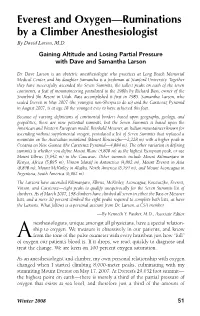
Everest and Oxygen—Ruminations by a Climber Anesthesiologist by David Larson, M.D
Everest and Oxygen—Ruminations by a Climber Anesthesiologist By David Larson, M.D. Gaining Altitude and Losing Partial Pressure with Dave and Samantha Larson Dr. Dave Larson is an obstetric anesthesiologist who practices at Long Beach Memorial Medical Center, and his daughter Samantha is a freshman at Stanford University. Together they have successfully ascended the Seven Summits, the tallest peaks on each of the seven continents, a feat of mountaineering postulated in the 1980s by Richard Bass, owner of the Snowbird Ski Resort in Utah. Bass accomplished it first in 1985. Samantha Larson, who scaled Everest in May 2007 (the youngest non-Sherpa to do so) and the Carstensz Pyramid in August 2007, is at age 18 the youngest ever to have achieved this feat. Because of varying definitions of continental borders based upon geography, geology, and geopolitics, there are nine potential summits, but the Seven Summits is based upon the American and Western European model. Reinhold Messner, an Italian mountaineer known for ascending without supplemental oxygen, postulated a list of Seven Summits that replaced a mountain on the Australian mainland (Mount Kosciuszko—2,228 m) with a higher peak in Oceania on New Guinea (the Carstensz Pyramid—4,884 m). The other variation in defining summits is whether you define Mount Blanc (4,808 m) as the highest European peak, or use Mount Elbrus (5,642 m) in the Caucasus. Other summits include Mount Kilimanjaro in Kenya, Africa (5,895 m), Vinson Massif in Antarctica (4,892 m), Mount Everest in Asia (8,848 m), Mount McKinley in Alaska, North America (6,194 m), and Mount Aconcagua in Argentina, South America (6,962 m). -

DEATH ZONE FREERIDE About the Project
DEATH ZONE FREERIDE About the project We are 3 of Snow Leopards, who commit the hardest anoxic high altitude ascents and perform freeride from the tops of the highest mountains on Earth (8000+). We do professional one of a kind filming on the utmost altitude. THE TRICKIEST MOUNTAINS ON EARTH NO BOTTLED OXYGEN CHALLENGES TO HUMAN AND NATURE NO EXTERIOR SUPPORT 8000ERS FREERIDE FROM THE TOPS MOVIES ALONE WITH NATURE FREERIDE DESCENTS 5 3 SNOW LEOS Why the project is so unique? PROFESSIONAL FILMING IN THE HARDEST CONDITIONS ❖ Higher than 8000+ m ❖ Under challenging efforts ❖ Without bottled oxygen & exterior support ❖ Severe weather conditions OUTDOOR PROJECT-OF-THE-YEAR “CRYSTAL PEAK 2017” AWARD “Death zone freeride” project got the “Crystal Peak 2017” award in “Outdoor project-of-the-year” nomination. It is comparable with “Oscar” award for Russian outdoor sphere. Team ANTON VITALY CARLALBERTO PUGOVKIN LAZO CIMENTI Snow Leopard. Snow Leopard. Leader The first Italian Snow Leopard. MC in mountaineering. Manaslu of “Mountain territory” club. Specializes in a ski mountaineering. freeride 8163m. High altitude Ski-mountaineer. Participant cameraman. of more than 20 high altitude expeditions. Mountains of the project Manaslu Annapurna Nanga–Parbat Everest K2 8163m 8091m 8125m 8848m 8611m The highest mountains on Earth ❖ 8027 m Shishapangma ❖ 8167 m Dhaulagiri I ❖ 8035 m Gasherbrum II (K4) ❖ 8201 m Cho Oyu ❖ 8051 m Broad Peak (K3) ❖ 8485 m Makalu ❖ 8080 m Gasherbrum I (Hidden Peak, K5) ❖ 8516 m Lhotse ❖ 8091 m Annapurna ❖ 8586 m Kangchenjunga ❖ 8126 m Nanga–Parbat ❖ 8614 m Chogo Ri (K2) ❖ 8156 m Manaslu ❖ 8848 m Chomolungma (Everest) Mountains that we climbed on MANASLU September 2017 The first and unique freeride descent from the altitude 8000+ meters among Russian sportsmen. -

Deadly High Altitude Pulmonary Disorders: Acute Mountain Sickness
Research Article Int J Pul & Res Sci Volume 1 Issue 1 - April 2016 Copyright © All rights are reserved by Michael Obrowski DOI : 10.19080/IJOPRS.2016.01.555553 Deadly High Altitude Pulmonary Disorders: Acute Mountain Sickness (AMS); High Altitude Pulmonary Edema (HAPE) and High Altitude Cerebral Edema (HACE): A Clinical Review Michael Obrowski1* and Stephanie Obrowski2 1Doctor of Medicine (M.D. – 2000); Assistant Professor of Anatomy; CEO, Chief Physician and Surgeon of Wilderness Physicians, European Union 2Doctor of Medicine (M.D. – 2019); Medical University of Łódź; President of Wilderness Physicians, European Union Submission: January 26, 2016; Published: April 15, 2016 *Corresponding author: Michael Obrowski, M.D., Doctor of Medicine (M.D. – 2000); Assistant Professor of Anatomy; CEO, Chief Physician and Surgeon of Wilderness Physicians, European Union, 43C Żeligowskiego Street, #45, Łódź, Poland 90-644, Email: Abstract Acute Mountain Sickness (AMS); High Altitude Pulmonary Edema (HAPE) and High Altitude Cerebral Edema (HACE). These three disorders, withMountain relatively Sickness, unimportant also smallcalled variationsHigh Altitude seen Sickness, in some isPulmonology specifically aTextbooks, triad of different because disorders, these are inso orderserious, of increasingthey are all seriousness: potentially deadly pulmonary disorders and we will discuss these three major, deadly disorders. Each one, starting with AMS, can progress rapidly to HAPE and then HACE. The two authors of this article have over half a century of high altitude mountaineering experience. They have also alsohad anddisaster still domedicine. have, for Since the lastspring twenty is rapidly years, approaching an NGO, Non-Profit and many Medical “weekend Organization backpackers” (Wilderness will start Physicians going into www.wildernessphysicians. -
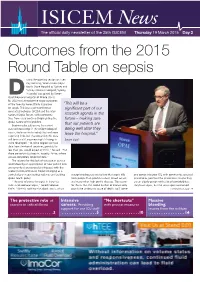
Outcomes from the 2015 Round Table on Sepsis
The official daily newsletter of the 35th ISICEM Thursday 19 March 2015 Day 3 Outcomes from the 2015 Round Table on sepsis uring the opening session on Tues- day morning, Simon Finfer (Royal North Shore Hospital of Sydney and Sydney Adventist Hospital, Sydney, Australia) was joined by Steven DOpal (Memorial Hospital of Rhode Island, RI, USA) to summarize the major outcomes of the two-day Round Table discussion “This will be a on sepsis. This was a joint conference significant part of our conducted between ISICEM and the Inter- national Sepsis Forum, with representa- research agenda in the tives from every continent highlighting the future – making sure global nature of the problem. Beginning by addressing the current that our patients are state of knowledge in the epidemiology of doing well after they sepsis, Professor Finfer noted that we know leave the hospital.” surprising little, but that obtaining this data will be crucial if any meaningful strategy is Steven Opal to be developed: “To some degree we have data from developed countries, possibly far less than you would expect or think,” he said. “But there are certainly places in, notably, Africa, where we are completely devoid of data.” The reasons for this lack of data can in part be understood by an appreciation of how patient data are currently characterized and treated, with the Global Burden of Disease Project emerging as a central player in generating evidence and guiding is surprising because we believe that sepsis kills one comes into your ICU with community-acquired global health policy. more people than prostate cancer, breast cancer, pneumonia, you treat the pneumonia; maybe they “The only reference to sepsis in these sta- and many other high profile diseases. -

Mount Everest's Death Zone
Mount Everest’s Death Zone Climate change and crowds of climbers are making the world’s tallest mountain more dangerous than ever Mara Grunbaum ast year, 73-year-old Tamae Watanabe of Japan became the oldest woman to climb Mount Everest, the world’s tallest mountain. In L 2010, 13-year-old Jordan Romero of California became the youngest to reach the top. All sorts of people of varying abilities scale the massive mountain in Asia these days. That may not be a good thing—for Everest or the climbers. Last year, more than 500 people reached the top of the Himalayan mountain, which towers 8,850 meters (29,035 feet) above sea level. Hundreds more climbed partway up. While it’s a great achievement to scale Everest, it can sometimes cause problems for the climbers and the mountain itself. Everest is changing. Warming Up Why is Everest becoming more dangerous to climb? One reason is changes in its environment. Much of the mountain is covered in huge sheets of ice called glaciers. Lately, warmer temperatures in the region have been melting these glaciers. Some places that used to be covered in ice year-round are now completely ice-free in the summer. Shrinking glaciers put climbers at risk. As glaciers melt, snow, ice, and rock are more likely to tumble down the mountain in huge avalanches. These snowslides can injure or even kill climbers. “As it gets warmer, more debris tends to fall down,” says American climbing guide Freddie Wilkinson. He’s one of a number of people who think that climbing Everest is becoming too risky. -
Into the Clouds
Into the Clouds ALSO BY TOD OLSON THE LOST® SERIES: Lost in the Pacific, 1942 Lost in Outer Space Lost in the Amazon Lost in the Antarctic Into the Clouds The Race to Climb the World’s Most Dangerous Mountain TOD OLSON New York Copyright © 2020 by Tod Olson All rights reserved. Published by Scholastic Focus, an imprint of Scholastic Inc., Publishers since 1920. SCHOLASTIC, SCHOLASTIC FOCUS, and associated logos are trademarks and/ or registered trademarks of Scholastic Inc. The publisher does not have any control over and does not assume any responsibility for author or third- party websites or their content. No part of this publication may be reproduced, stored in a retrieval system, or transmitted in any form or by any means, electronic, mechanical, photocopying, recording, or otherwise, without written permission of the publisher. For information regarding permission, write to Scholastic Inc., Attention: Permissions Department, 557 Broadway, New York, NY 10012. Library of Congress Cataloging-in-Publication Data Names: Olson, Tod, author. Title: Into the clouds : the race to climb the world’s most dangerous mountain / Tod Olson. Description: New York, NY : Scholastic Focus, 2020. | Audience: Age 10-14. Identifiers: LCCN 2019002127 (print) | LCCN 2019014682 (ebook) | ISBN 9781338207378 (E-book) | ISBN 9781338207361 (hardcover : alk. paper) Subjects: LCSH: K2 (Pakistan : Mountain)—Juvenile literature. | Mountaineering—Pakistan—K2 (Mountain)—Juvenile literature. Classification: LCC GB546.K13 (ebook) | LCC GB546.K13 O55 2020 (print) | DDC -

Beverages of Latin America
ANT4930: Food and Gastronomy in Latin America Beverages of Latin America [00:00:05.53] Beverages of Latin America for the court's food and gastronomy in Latin America. There have been many major contributions to beverages worldwide that have come from Latin America. Including one of the world's most widely consumed beverages Coca-Cola, the story is quite interesting. [00:00:23.86] There was a pharmacist in Atlanta by the name of John Pemberton who heard about Coca wine being made in France. Of course, in France, they were getting the Coca leaves from the hyaline Andes where the plant is native. So he got some Coca wine and instead took the alcohol out of it but left the cocaine in and began marketing the syrup. The syrup was Coca-Cola syrup and with the addition of carbonated water people could make the beverage Coca-Cola. [00:00:51.16] In 1983 the cocaine was removed from the beverage but the leaves were left in it as a flavoring agent, and to this day lives are still imported and make up part of the secret formula or so- called secret formula for Coca-Cola as a flavoring agent. Meanwhile tea from coca leaves has a really long history of consumption in its native habitat in the Andes. Long before European arrival, indigenous peoples there were drinking Coca tea. [00:01:17.38] It's very beneficial for adjusting to the high elevations and it's quite common to find it in markets in the Andes today. The impact of Coca-Cola on Latin America has been pretty widespread. -
The Coca Debate: Headed Toward Polarization Or Common Ground?
The Coca Debate: Headed toward Polarization or Common Ground? By Kathryn Ledebur and Coletta A. Youngers May 2008 In March 2008, the International Narcotics Control Board (INCB, a United Nations agency) provoked outrage in Bolivia by calling for the elimination of traditional uses of coca, such as chewing coca leaves and drinking coca tea. Although a 1961 anti-drug convention called for the elimination of all such uses of coca within 25 years, subsequent UN statements have recognized the legitimacy of traditional coca consumption. Dismayed by the lack of sensitivity to indigenous cultures, President Evo Morales’ government announced that it would formally request coca’s declassification as a narcotic drug, as it is presently listed in the 1961convention. Such a move would have no bearing on the status of cocaine under the conventions. Even though modifying the status of coca under the UN conventions would not affect provisions related to controlling cocaine and other illicit drugs, the obstacles to coca declassification remain formidable. Historically, UN member states have resisted changes to the established conventions and significant political support would need to be built among countries that have ratified the 1961 convention. Moreover, the Bolivian government is facing a delicate political situation domestically, which understandably diverts attention and resources from other, less immediate initiatives. In any case, changing coca’s status will be a difficult and lengthy endeavor, but it would represent an important step toward promoting respect for indigenous rights in Bolivia and other Andean countries. The INCB’s condemnation of the coca leaf comes at a time when the Bolivian government is making significant headway in meeting its international anti-drug obligations. -

The Kun Lun Shan: Desert Peaks of Central Asia
The Kun Lun Shan: Desert Peaks of Central Asia MICHAEL WARD (Plates 29, 30, 32) he gaunt, bare backbone of the Kun Lun range runs for 2250km from the Russian Pamir to western China over 30 degrees of longitude. Older than the Himalaya, it separates the plateaux of the Pamir and Tibet from the deserts of Central Asia, and it is one of the longest and least known of the world's mountain ranges, with peaks up to 7700m.4,8,17,22,5l At its western end it is joined by the Tien Shan (Celestial Mountains) that forms the northern border of the Tarim-Basin, in which lies the Takla Makan desert, and in this angle is the strategic oasis city of Kashgar (Kashi).1l,29,36,59 Here four arms of the Silk Route meet: one from the Indian sub-continent to the south, two from China to the east, by the north and south rims ofthe Tarim, and one from Europe to the west. The Silk Route is the world's oldest, longest and most important land-route, linking the civilizations of the Mediterranean with those of China and India, and for more than 5000 years it has been a conduit for ideas, religion, culture, disease, invasion and trade. 10 The Kun Lun's western portion separates the Pamir and the Central Asian plateau from the Takla Makan desert and the Lop NUr.6l At 800 E it splits into two, the northern portion becoming the Altyn Tagh, while the southern continues as the East Kun Lun, ending in the Amne Machin group. -

The Plight of Bolivian Coca Leaves: Bolivia's Quest for Decriminalization in the Face of Inconsistent International Legislation
Washington University Global Studies Law Review Volume 13 Issue 3 The Legal Challenges of Globalization: A View from the Heartland (Symposium Edition) 2014 The Plight of Bolivian Coca Leaves: Bolivia's Quest for Decriminalization in the Face of Inconsistent International Legislation Abraham Kim Washington University in St. Louis Follow this and additional works at: https://openscholarship.wustl.edu/law_globalstudies Part of the Criminal Law Commons, International Law Commons, Legislation Commons, and the Transnational Law Commons Recommended Citation Abraham Kim, The Plight of Bolivian Coca Leaves: Bolivia's Quest for Decriminalization in the Face of Inconsistent International Legislation, 13 WASH. U. GLOBAL STUD. L. REV. 559 (2014), https://openscholarship.wustl.edu/law_globalstudies/vol13/iss3/13 This Note is brought to you for free and open access by the Law School at Washington University Open Scholarship. It has been accepted for inclusion in Washington University Global Studies Law Review by an authorized administrator of Washington University Open Scholarship. For more information, please contact digital@wumail.wustl.edu. THE PLIGHT OF BOLIVIAN COCA LEAVES: BOLIVIA’S QUEST FOR DECRIMINALIZATION IN THE FACE OF INCONSISTENT INTERNATIONAL LEGISLATION INTRODUCTION On March 12, 2012, at a United Nations narcotics control summit in Vienna, Austria, a man held up a green leaf in front of representatives from fifty-three nations.1 This man, Bolivian President Evo Morales, declared that his countrymen possessed an “ancestral right” to consume