Retrospektive Viennale 1993 ÖSTERREICHISCHES
Total Page:16
File Type:pdf, Size:1020Kb
Load more
Recommended publications
-
The Representation of Reality and Fantasy in the Films of Powell and Pressburger: 1939-1946
The Representation of Reality and Fantasy In the Films of Powell and Pressburger 1939-1946 Valerie Wilson University College London PhD May 2001 ProQuest Number: U642581 All rights reserved INFORMATION TO ALL USERS The quality of this reproduction is dependent upon the quality of the copy submitted. In the unlikely event that the author did not send a complete manuscript and there are missing pages, these will be noted. Also, if material had to be removed, a note will indicate the deletion. uest. ProQuest U642581 Published by ProQuest LLC(2015). Copyright of the Dissertation is held by the Author. All rights reserved. This work is protected against unauthorized copying under Title 17, United States Code. Microform Edition © ProQuest LLC. ProQuest LLC 789 East Eisenhower Parkway P.O. Box 1346 Ann Arbor, Ml 48106-1346 The Representation of Reality and Fantasy In the Films of Powell and Pressburger: 1939-1946 This thesis will examine the films planned or made by Powell and Pressburger in this period, with these aims: to demonstrate the way the contemporary realities of wartime Britain (political, social, cultural, economic) are represented in these films, and how the realities of British history (together with information supplied by the Ministry of Information and other government ministries) form the basis of much of their propaganda. to chart the changes in the stylistic combination of realism, naturalism, expressionism and surrealism, to show that all of these films are neither purely realist nor seamless products of artifice but carefully constructed narratives which use fantasy genres (spy stories, rural myths, futuristic utopias, dreams and hallucinations) to convey their message. -

WALLACE, (Richard Horatio) Edgar Geboren: Greenwich, Londen, 1 April 1875
WALLACE, (Richard Horatio) Edgar Geboren: Greenwich, Londen, 1 april 1875. Overleden: Hollywood, USA, 10 februari 1932 Opleiding: St. Peter's School, Londen; kostschool, Camberwell, Londen, tot 12 jarige leeftijd. Carrière: Wallace was de onwettige zoon van een acteur, werd geadopteerd door een viskruier en ging op 12-jarige leeftijd van huis weg; werkte bij een drukkerij, in een schoen- winkel, rubberfabriek, als zeeman, stukadoor, melkbezorger, in Londen, 1886-1891; corres- pondent, Reuter's, Zuid Afrika, 1899-1902; correspondent, Zuid Afrika, London Daily Mail, 1900-1902 redacteur, Rand Daily News, Johannesburg, 1902-1903; keerde naar Londen terug: journalist, Daily Mail, 1903-1907 en Standard, 1910; redacteur paardenraces en later redacteur The Week-End, The Week-End Racing Supplement, 1910-1912; redacteur paardenraces en speciaal journalist, Evening News, 1910-1912; oprichter van de bladen voor paardenraces Bibury's Weekly en R.E. Walton's Weekly, redacteur, Ideas en The Story Journal, 1913; schrijver en later redacteur, Town Topics, 1913-1916; schreef regelmatig bijdragen voor de Birmingham Post, Thomson's Weekly News, Dundee; paardenraces columnist, The Star, 1927-1932, Daily Mail, 1930-1932; toneelcriticus, Morning Post, 1928; oprichter, The Bucks Mail, 1930; redacteur, Sunday News, 1931; voorzitter van de raad van directeuren en filmschrijver/regisseur, British Lion Film Corporation. Militaire dienst: Royal West Regiment, Engeland, 1893-1896; Medical Staff Corps, Zuid Afrika, 1896-1899; kocht zijn ontslag af in 1899; diende bij de Lincoln's Inn afdeling van de Special Constabulary en als speciaal ondervrager voor het War Office, gedurende de Eerste Wereldoorlog. Lid van: Press Club, Londen (voorzitter, 1923-1924). Familie: getrouwd met 1. -

Westminsterresearch the Artist Biopic
WestminsterResearch http://www.westminster.ac.uk/westminsterresearch The artist biopic: a historical analysis of narrative cinema, 1934- 2010 Bovey, D. This is an electronic version of a PhD thesis awarded by the University of Westminster. © Mr David Bovey, 2015. The WestminsterResearch online digital archive at the University of Westminster aims to make the research output of the University available to a wider audience. Copyright and Moral Rights remain with the authors and/or copyright owners. Whilst further distribution of specific materials from within this archive is forbidden, you may freely distribute the URL of WestminsterResearch: ((http://westminsterresearch.wmin.ac.uk/). In case of abuse or copyright appearing without permission e-mail repository@westminster.ac.uk 1 THE ARTIST BIOPIC: A HISTORICAL ANALYSIS OF NARRATIVE CINEMA, 1934-2010 DAVID ALLAN BOVEY A thesis submitted in partial fulfilment of the requirements of the University of Westminster for the degree of Master of Philosophy December 2015 2 ABSTRACT The thesis provides an historical overview of the artist biopic that has emerged as a distinct sub-genre of the biopic as a whole, totalling some ninety films from Europe and America alone since the first talking artist biopic in 1934. Their making usually reflects a determination on the part of the director or star to see the artist as an alter-ego. Many of them were adaptations of successful literary works, which tempted financial backers by having a ready-made audience based on a pre-established reputation. The sub-genre’s development is explored via the grouping of films with associated themes and the use of case studies. -

Bob Oei Thesis Final Final
ABSTRACT The Cinematography of Closet Memories Robert Oei, M.A. Advisor: Christopher J. Hansen, M.F.A. The cinematography of a film heavily influences the audience’s mood and their perception of tension. The way a director of photography uses lights and the camera can enhance or destroy the moments of a film a director has built. Keeping this knowledge in mind, the cinematography of Closet Memories uses film noir lighting, a mixture of handheld and smooth camera work, and other techniques to maintain the emotional content of the film’s scenes. The Cinematography of Closet Memories by Robert Oei, B.A. A Thesis Approved by the Department of Communication David W. Schlueter, Ph.D., Chairperson Submitted to the Graduate Faculty of Baylor University in Partial Fulfillment of the Requirements for the Degree of Master of Arts Approved by the Thesis Committee Christopher J. Hansen, M.F.A., Chairperson James Kendrick, Ph.D. DeAnna M. Toten Beard Ph.D. Accepted by the Graduate School May 2013 J. Larry Lyon, Ph.D., Dean Page bearing signatures is kept on file in the Graduate School Copyright © 2013 by Robert Oei All rights reserved TABLE OF CONTENTS Chapter One: Introduction ..................................................................................................1 Chapter Two: Literature Review .........................................................................................6 Chapter Three: Methodology .............................................................................................14 Scene 1 and 2 ........................................................................................................15 -

CHRISTOPHER WEEDMAN Department of English (618) 559-8593, Cell Phone Middle Tennessee State University (615) 898-5156, Office Phone 1301 E
CHRISTOPHER WEEDMAN Department of English (618) 559-8593, cell phone Middle Tennessee State University (615) 898-5156, office phone 1301 E. Main St. (Box 70) Christopher.Weedman@mtsu.edu, e-mail Murfreesboro, TN 37132 http://www.christopherweedman.net, website EDUCATION Ph.D. English, Southern Illinois University, Carbondale, IL, 2011 Specialties: Film Studies, Drama, and 20th-century British Literature Dissertation: Exilic Vision and the Cinematic Interrogation of Britain: The Joseph Losey and Harold Pinter Collaboration (Tony Williams, chair) M.A. English, Eastern Illinois University, Charleston, IL, 2005 B.A. Journalism, Eastern Illinois University, Charleston, IL, 2000 EMPLOYMENT . Assistant Professor of Film Studies. Department of English. Middle Tennessee State University. Murfreesboro, TN. 2017 to present. Affiliate Faculty: Women’s and Gender Studies. Middle Tennessee State University. Murfreesboro, TN. 2018 to present. Assistant Professor of Film Studies (temporary faculty, non-tenure track). Department of English. Kutztown University of Pennsylvania. Kutztown, PA. 2013 to 2017. Assistant Director, Communication Center (university-wide, multimodal writing and communication center). The Georgia Institute of Technology. Atlanta, GA. 2012 to 2013. Marion L. Brittain Postdoctoral Fellow. School of Literature, Media, and Communication. The Georgia Institute of Technology. Atlanta, GA. 2011 to 2013. Graduate Assistant. Department of English. Southern Illinois University. Carbondale, IL. 2005 to 2011. RESEARCH AND TEACHING INTERESTS . British, American, and European film history and criticism; film aesthetics; film genres; film and censorship; film representations of class, gender, and sexual identity; and post-1945 British literature and drama. Dr. Christopher Weedman 2 CURRENT PROJECTS Book Manuscript . Anne Heywood: Beauty, Sex, and the Controversial Film. U of Mississippi P (in progress, under advance contract). -

HP0221 Teddy Darvas
BECTU History Project - Interview No. 221 [Copyright BECTU] Transcription Date: Interview Dates: 8 November 1991 Interviewer: John Legard Interviewee: Teddy Darvas, Editor Tape 1 Side A (Side 1) John Legard: Teddy, let us start with your early days. Can you tell us where you were born and who your parents were and perhaps a little about that part of your life? The beginning. Teddy Darvas: My father was a very poor Jewish boy who was the oldest of, I have forgotten how many brothers and sisters. His father, my grandfather, was a shoemaker or a cobbler who, I think, preferred being in the cafe having a drink and seeing friends. So he never had much money and my father was the one brilliant person who went to school and eventually to university. He won all the prizes at Gymnasium, which is the secondary school, like a grammar school. John Legard: Now, tell me, what part or the world are we talking about? Teddy Darvas: This is Budapest. He was born in Budapest and whenever he won any prizes which were gold sovereigns, all that money went on clothes and things for brothers and sisters. And it was in this Gymnasium that he met Alexander Korda who was in a parallel form. My father was standing for Student's Union and he found somebody was working against him and that turned out to be Alexander Korda, of course the family name was Kelner. They became the very, very greatest of friends. Alex was always known as Laci which is Ladislav really - I don't know why. -

Shail, Robert, British Film Directors
BRITISH FILM DIRECTORS INTERNATIONAL FILM DIRECTOrs Series Editor: Robert Shail This series of reference guides covers the key film directors of a particular nation or continent. Each volume introduces the work of 100 contemporary and historically important figures, with entries arranged in alphabetical order as an A–Z. The Introduction to each volume sets out the existing context in relation to the study of the national cinema in question, and the place of the film director within the given production/cultural context. Each entry includes both a select bibliography and a complete filmography, and an index of film titles is provided for easy cross-referencing. BRITISH FILM DIRECTORS A CRITI Robert Shail British national cinema has produced an exceptional track record of innovative, ca creative and internationally recognised filmmakers, amongst them Alfred Hitchcock, Michael Powell and David Lean. This tradition continues today with L GUIDE the work of directors as diverse as Neil Jordan, Stephen Frears, Mike Leigh and Ken Loach. This concise, authoritative volume analyses critically the work of 100 British directors, from the innovators of the silent period to contemporary auteurs. An introduction places the individual entries in context and examines the role and status of the director within British film production. Balancing academic rigour ROBE with accessibility, British Film Directors provides an indispensable reference source for film students at all levels, as well as for the general cinema enthusiast. R Key Features T SHAIL • A complete list of each director’s British feature films • Suggested further reading on each filmmaker • A comprehensive career overview, including biographical information and an assessment of the director’s current critical standing Robert Shail is a Lecturer in Film Studies at the University of Wales Lampeter. -

Download (1.72MB)
Series Editors Claire Gorrara (Cardiff University) Shelley Godsland (University of Birmingham) Giuliana Pieri (Royal Holloway, London) Editorial Board Margaret Atack (University of Leeds) George Demko (Dartmouth College) John Foot (University College London) Stephen Knight (University of Melbourne) Nickianne Moody (Liverpool John Moores University) Elfriede Müller (Berlin) Anne White (University of Bradford) Also in Series Claire Gorrara (ed.) French Crime Fiction Andrew Nestingen and Paula Arvas (eds) Scandinavian Crime Fiction Nancy Vosburg (ed.) Iberian Crime Fiction Guiliana Pieri (ed.) Italian Crime Fiction Lucy Andrew and Catherine Phelps (eds) Crime Fiction in the City: Capital Crimes 00 prelims CrimeFiction in German 2016_2_4.indd 2 2/4/2016 4:47:52 PM EUROPEAN CRIME FICTIONS CRIME FICTION IN GERMAN DER KRIMI Edited by Katharina Hall CARDIFF 2016 00 prelims CrimeFiction in German 2016_2_4.indd 3 2/4/2016 4:47:52 PM © The Contributors, 2016 All rights reserved. No part of this book may be reproduced in any material form (including photocopying or storing it in any medium by electronic means and whether or not transiently or incidentally to some other use of this publication) without the written permission of the copyright owner except in accordance with the provisions of the Copyright, Designs and Patents Act. Applications for the copyright owner’s written permission to reproduce any part of this publication should be addressed to the University of Wales Press, 10 Columbus Walk, Brigantine Place, Cardiff, CF10 4UP. www.uwp.co.uk British Library Cataloguing-in-Publication Data A catalogue record for this book is available from the British Library. ISBN 978-1-78316-816-3 (hb) 978-1-78316-817-0 (pb) e-ISBN 978-1-78316-818-7 The right of the Contributors to be identified as authors of their contributions has been asserted by them in accordance with sections 77 and 79 of the Copyright, Designs and Patents Act 1988. -

Escala En Buenos Aires: Los Primeros Años De John Alton En El Cine Argentino
149 Escala en Buenos Aires: los primeros años de John Alton en el cine argentino Por Iván Morales* Resumen: El siguiente artículo estudia los primeros años de John Alton en el cine argentino, donde se desempeñó como director de fotografía entre 1932 y 1939. Alton nació en el Imperio austrohúngaro, se formó en Hollywood durante los años veinte, a fines de esa década viajó a Europa para ocuparse de los estudios que Paramount tenía en Francia, trabajó brevemente como camarógrafo de exteriores en países de Asia y África, y finalmente llegó a la Argentina, donde permaneció durante siete largos años hasta que regresó a Hollywood definitivamente. El primer aspecto que desarrollaré es la cultura viajera de John Alton y su llegada a Buenos Aires. En segundo lugar, analizaré el rol clave que tuvo Alton en la consolidación de una joven cinematografía nacional que aspiraba a convertirse en industria. A partir de su paso por el proyecto cosmopolita de la productora SIFAL, trabajaré con la película Escala en la ciudad (Alberto de Zavalía, 1935) para dar cuenta de cómo su fotografía implicó una modernización técnica y estética inédita para el cine argentino. Palabras clave: John Alton, dirección de fotografía, cine argentino, film noir. Resumo: Este artigo estuda os primeiros anos de John Alton no cinema argentino, onde atuou como diretor de fotografia entre 1932 e 1939. Alton nasceu no Império Austro-Húngaro, se formou em Hollywood durante os anos 1920, no final dessa década viajou à Europa para trabalhar nos estúdios que a Paramount tinha na França, trabalhou brevemente como cinematografista de exteriores em países da África e da Ásia e, finalmente, chegou à Argentina, onde permaneceu durante sete anos até regressar a Hollywood definitivamente. -
LUCAS-DISSERTATION.Pdf (3.422Mb)
Copyright by Robert Christopher Lucas 2011 The Dissertation Committee for Robert Christopher Lucas Certifies that this is the approved version of the following dissertation: Crafting Digital Cinema: Cinematographers in Contemporary Hollywood Committee: Thomas Schatz, Supervisor Sharon Strover Nancy Schiesari Bruce Hunt James Hay Crafting Digital Cinema: Cinematographers in Contemporary Hollywood by Robert Christopher Lucas, B.A.; M.A. Dissertation Presented to the Faculty of the Graduate School of The University of Texas at Austin in Partial Fulfillment of the Requirements for the Degree of Doctor of Philosophy The University of Texas at Austin August 2011 Dedication For Julie Acknowledgements I am very grateful for my committee members‟ support through this long process. Thomas Schatz showed unflagging confidence in the project‟s value and in my ability to finish it. Sharon Strover offered feedback and encouragement at key moments and generously provided workspace in the crucial last months. James Hay was a wonderful source of challenging questions and reassurance. Bruce Hunt and Nancy Schiesari provided new perspectives on this subject that I greatly appreciated. Also, William Christ and Jennifer Henderson kindly hired me to teach at Trinity University for several semesters running and another Trinity colleague, Patrick Keating, helped invigorate this project with his research and our conversations. My graduate colleagues Kyle Barnett, Avi Santo, Hollis Griffin, Alison Perlman, and Holly Custard have encouraged me with welcome feedback and timely commiseration. The cinematographers and filmmakers that spoke with me were remarkably generous with their time. There are too many to thank here, but Curtis Clark, the chairman of the ASC Technology Committee, deserves a special mention for sharing his unique perspective and great knowledge. -

Playing the Big Easy: a History of New Orleans in Film and Television
PLAYING THE BIG EASY: A HISTORY OF NEW ORLEANS IN FILM AND TELEVISION Robert Gordon Joseph A Dissertation Submitted to the Graduate College of Bowling Green State University in partial fulfillment of the requirements for the degree of DOCTOR OF PHILOSOPHY May 2018 Committee: Cynthia Baron, Advisor Marlise Lonn Graduate Faculty Representative Clayton Rosati Andrew Schocket © 2018 Robert Joseph All Rights Reserved iii ABSTRACT Cynthia Baron, Advisor Existing cultural studies scholarship on New Orleans explores the city’s exceptional popular identity, often focusing on the origins of that exceptionality in literature and the city’s twentieth century tourism campaigns. This perceived exceptionality, though originating from literary sources, was perpetuated and popularized in the twentieth and twenty-first centuries by film and television representations. As Hollywood’s production standards evolved throughout the twentieth century, New Orleans’ representation evolved with it. In each filmmaking era, representations of New Orleans reflected not only the production realities of that era, but also the political and cultural debates surrounding the city. In the past two decades, as the aftermath of Hurricane Katrina and the passage of film tax credits by the Louisiana Legislature increased New Orleans’ profile, these debates have been more present and driven by New Orleans’ filmed representations. Using the theoretical framework of Guy Debord’s spectacle and the methodology of New Film History and close “to the background” textual analysis, this study undertakes an historical overview of New Orleans’ representation in film and television. This history starts in the era of Classical Hollywood (1928-1947) and continues through Transitional Hollywood (1948-1966), New Hollywood (1967-1975), and the current Age of the Blockbuster (1975-). -
Newsletter 01/12 DIGITAL EDITION Nr
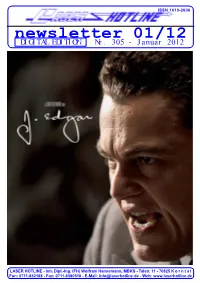
ISSN 1610-2606 ISSN 1610-2606 newsletter 01/12 DIGITAL EDITION Nr. 305 - Januar 2012 Michael J. Fox Christopher Lloyd LASER HOTLINE - Inh. Dipl.-Ing. (FH) Wolfram Hannemann, MBKS - Talstr. 11 - 70825 K o r n t a l Fon: 0711-832188 - Fax: 0711-8380518 - E-Mail: info@laserhotline.de - Web: www.laserhotline.de Newsletter 01/12 (Nr. 305) Januar 2012 editorial Hallo Laserdisc- und sten Mustervorführungen geschlossen. Um Ihnen DVD-Fans, waren bereits vielverspre- schon einen kleinen Vorge- liebe Filmfreunde! chend. Seien Sie also ge- schmack zu geben, haben spannt. Wir werden Sie na- wir auf dieser Seite schon Mit 86 prall gefüllten Seiten türlich rechtzeitig informie- mal das Teaser-Poster ab- heissen wir Sie ganz herzlich ren, sobald unser Projekt gebildet. willkommen zu unserem er- fertiggestellt ist. Denn dann sten Newsletter in unserem werden Sie den “Director’s In diesem Sinne – freuen Jubiläumsjahr 2012. Gerne Cut” auf unserer Website Sie sich mit uns zusammen hätten wir Ausgabe 305 (www.laserhotline.de) an- auf ein adrenalintreibendes schon wesentlich früher ins schauen können. Eine an- Jahr! Feld geschickt, doch wie es schließende Kinoauswertung halt immer so ist: Termine, ist übrigens auch nicht aus- Ihr Laser Hotline Team Termine, Termine. Dafür aber sieht die aktuelle Aus- gabe vom Umfang eher aus wie eine Doppelnummer – und das obwohl wir auf Grafik praktisch fast voll- kommen verzichtet haben. Aber Sie kennen ja unsere Einstellung: Information geht vor! Auch wenn Sie lange nichts mehr von uns gehört haben, so waren wir doch extrem fleissig. Denn um un- ser 20jähriges Jubiläum ge- bührend feiern zu können, haben wir mit der Produkti- on unseres ersten eigenen Films begonnen.