The Diaries of Mariam Davis Sidebottom Houchens
Total Page:16
File Type:pdf, Size:1020Kb
Load more
Recommended publications
-

', :':':;"Texa's- Agricultural , Ex-Ten '
4> ~ -,' , :':':;"TEXA'S- AGRICULTURAL , EX-TEN ' . ... -:>-.~ -~•• ,....,~ hi.t~.' ~ ___ '>::"'" - 'J. E .. 'Hutchison, 'Director, College:.shlt~QP" Texas GRAHAM HARD NENA ROBERSON RHEBA MERLE BOYLES FANNIE BROWN EATON EXTENSION CLOTHING SPECIALISTS The A. and M. College of Texas THE CHARACTERISTICS OF FABRICS which . give 3. Fabrics made of chemically treated cotton, them the virtues of quick drying, crease re linen and rayon. The resin finishes are the most sistance, little or no ironing, keeping their orig commonly used. These finishes should last the inal shape and size during use and care, retaining normal life of a garment. a look of newness and fresh crispness after being worn and cleaned continuously also create sewing FABRIC SELECTION difficulties. The surface often is smoother and The best guides in the selection of quality harder which makes the fabric less pliable and fabrics are informative labels of reputable manu more difficult to handle. These qualities can facturers. Good quality finishes add to the cost cause seams to pucker. Even in the softest blends of fabrics, but compensate for the extra cost in there is a springiness which requires more care in durability and appearance. handling ease, as in the sleeve cap. Each fabric presents different problems. Look Wash-and-wear fabrics may be divided into at the fabric and feel it. Is it closely or loosely three groups: woven? Is it soft and firm, or stiff and wiry? 1. Fabrics woven or knitted from yarns of Will it fray? What style pattern do you have in 100 percent man-made fibers. These fabrics, if mind? properly finished, are highly crease resistant and The correctness of fabric grain is important keep their original shape and size during use and in sewing. -

Finish That Seam Barbara Short Iowa State College
Volume 30 Article 7 Number 5 The Iowa Homemaker vol.30, no.5 1950 Finish That Seam Barbara Short Iowa State College Follow this and additional works at: http://lib.dr.iastate.edu/homemaker Part of the Home Economics Commons Recommended Citation Short, Barbara (1950) "Finish That Seam," The Iowa Homemaker: Vol. 30 : No. 5 , Article 7. Available at: http://lib.dr.iastate.edu/homemaker/vol30/iss5/7 This Article is brought to you for free and open access by the Student Publications at Iowa State University Digital Repository. It has been accepted for inclusion in The oI wa Homemaker by an authorized editor of Iowa State University Digital Repository. For more information, please contact digirep@iastate.edu. Finish That Seam - But fi rst be sure the finish is the proper one for you r material. Here are the recent 1 findings of two textiles and I clothing graduate students. I I j I I J I I J by Barbara Short I J Technical Journalism Junior I I I J I I I > HEN your mother was a little girl, often seam I > j W stresses stayed in the house for a week to outfit "'--- I the family each year. Then the inside of a dress was just as finished as the outside. Those seamstresses took 1. Double-stitch finish; 2. Pinked finish; 3. Q,·er-cast edges. pains to finish each seam so that they could be sure it wouldn't ravel. Recent graduate research at Iowa State has taken guesswork out of seam finishing. Find Hiltbold points out that the ridge produced when ings will mean no more unnecessary sewing or hope the edge is turned shows on certain fabrics. -

Offshore-October-November-2005.Pdf
THE MAGAZ IN E OF THE CRUIS IN G YACHT CLUB OF AUSTRALIA I OFFSHORE OCTOBER/ NOVEMB rn 2005 YACHTING I AUSTRALIA FIVE SUPER R MAXIS ERIES FOR BIG RACE New boats lining up for Rolex Sydney Hobart Yacht Race HAMILTON ISLAND& HOG'S BREATH Northern regattas action t\/OLVO OCEAN RACE Aussie entry gets ready for departure The impeccable craftsmanship of Bentley Sydney's Trim and Woodwork Special ists is not solely exclusive to motor vehicles. Experience the refinement of leather or individually matched fine wood veneer trim in your yacht or cruiser. Fit your pride and joy with premium grade hide interiors in a range of colours. Choose from an extensive selection of wood veneer trims. Enjoy the luxury of Lambswool rugs, hide trimmed steering wheels, and fluted seats with piped edging, designed for style and unparalleled comfort. It's sea-faring in classic Bentley style. For further details on interior styling and craftsmanship BENTLEY contact Ken Boxall on 02 9744 51 I I. SYDNEY contents Oct/Nov 2005 IMAGES 8 FIRSTTHOUGHT Photographer Andrea Francolini's view of Sydney 38 Shining Sea framed by a crystal tube as it competes in the Hamilton Island Hahn Premium Race Week. 73 LAST THOUGHT Speed, spray and a tropical island astern. VIEWPOINT 10 ATTHE HELM CYCA Commodore Geoff Lavis recounts the many recent successes of CYCA members. 12 DOWN THE RHUMBLINE Peter Campbell reports on sponsorship and media coverage for the Rolex Sydney H obart Yacht Race. RACES & REGATTAS 13 MAGIC DRAGON TAKES GOLD A small boat, well sailed, won out against bigger boats to take victory in the 20th anniversary Gold Coast Yacht Race. -

La. 1913-1914
Many Pupils on Honor Roll “AS YOU LIKE IT" in Orange Public School PILGRIM PATRIOTS Chester E. Taylor, principal of the Cleveland Street School, Orange, has announced a list of names of pupils of the school who were neither absent nor ©arar tardy the school $c GIVEN IN OPEN-AIR during year STOP AT RUTGERS (La. 1913-1914. The honor roll is as fol- Mirljarl lows: Myra Kotze, Matie Naulty and Saturday hours, 9 to 6 (Formerly W. V. Snyder & Co.) Other Days, 9 to 5:30 Harry Wilkerson, eighth grade; Mar- Nutley Society People See garet Holcomb, Charles Murray, Follow Washington's Route. Elsmere Westes and Alfred Williams, Shakespearian Play Pre- advanced seventh; Esther Dowling, Will Hold Impressive Cere- Gertrude Kelly, Albert Klump, t sented for Charity. Beatrice Seery and Addie Stocker, monies at Newark Tomorrow. ? seventh; William Hauser, advanced seventh; Charles Beecher and Elsie Shoes and Shirtwaists An open-air performance of Shakes- Hoffman, sixth; Harold Marks, ad- |S|iPnal to the Evening Star.J Garments, Undermuslins, vanced fifth; peare's "As You Like It" was given Amy Schrope and Cath- NEW BRUNSWICK. June 24.—With erine Whelan, fifth; Velma Bird, before an audience of over 300 last officials l Howard Roberts and Edward Smo- impressive ceremonies, city night on the lawn of the of Sons of the In a Sale on Second Floor Hayfields, linsky, advanced fourth; George and local members the Three-Day residence of James R. Hay, the En- Beecher and Wilbur Bruen. fourth: American Revolution today joined the closure, Nutley. A group of white Hattie Bruen, Evelyn Jordan and three members of the organization Mabel Whittle, fourth; Rose This sale is the result of our most birch trees made a beautiful stage Torlucci, who are making the pilgrimage from very laid and the of able advanced third; Gertrude Getcliffe carefully plans employment eettjng. -
Historic Costuming Presented by Jill Harrison
Historic Southern Indiana Interpretation Workshop, March 2-4, 1998 Historic Costuming Presented By Jill Harrison IMPRESSIONS Each of us makes an impression before ever saying a word. We size up visitors all the time, anticipating behavior from their age, clothing, and demeanor. What do they think of interpreters, disguised as we are in the threads of another time? While stressing the importance of historically accurate costuming (outfits) and accoutrements for first- person interpreters, there are many reasons compromises are made - perhaps a tight budget or lack of skilled construction personnel. Items such as shoes and eyeglasses are usually a sticking point when assembling a truly accurate outfit. It has been suggested that when visitors spot inaccurate details, interpreter credibility is downgraded and visitors launch into a frame of mind to find other inaccuracies. This may be true of visitors who are historical reenactors, buffs, or other interpreters. Most visitors, though, lack the heightened awareness to recognize the difference between authentic period detailing and the less-than-perfect substitutions. But everyone will notice a wristwatch, sunglasses, or tennis shoes. We have a responsibility to the public not to misrepresent the past; otherwise we are not preserving history but instead creating our own fiction and calling it the truth. Realistically, the appearance of the interpreter, our information base, our techniques, and our environment all affect the first-person experience. Historically accurate costuming perfection is laudable and reinforces academic credence. The minute details can be a springboard to important educational concepts; but the outfit is not the linchpin on which successful interpretation hangs. -

Teaching the Short Story: a Guide to Using Stories from Around the World. INSTITUTION National Council of Teachers of English, Urbana
DOCUMENT RESUME ED 397 453 CS 215 435 AUTHOR Neumann, Bonnie H., Ed.; McDonnell, Helen M., Ed. TITLE Teaching the Short Story: A Guide to Using Stories from around the World. INSTITUTION National Council of Teachers of English, Urbana, REPORT NO ISBN-0-8141-1947-6 PUB DATE 96 NOTE 311p. AVAILABLE FROM National Council of Teachers of English, 1111 W. Kenyon Road, Urbana, IL 61801-1096 (Stock No. 19476: $15.95 members, $21.95 nonmembers). PUB 'TYPE Guides Classroom Use Teaching Guides (For Teacher) (052) Collected Works General (020) Books (010) EDRS PRICE MF01/PC13 Plus Postage. DESCRIPTORS Authors; Higher Education; High Schools; *Literary Criticism; Literary Devices; *Literature Appreciation; Multicultural Education; *Short Stories; *World Literature IDENTIFIERS *Comparative Literature; *Literature in Translation; Response to Literature ABSTRACT An innovative and practical resource for teachers looking to move beyond English and American works, this book explores 175 highly teachable short stories from nearly 50 countries, highlighting the work of recognized authors from practically every continent, authors such as Chinua Achebe, Anita Desai, Nadine Gordimer, Milan Kundera, Isak Dinesen, Octavio Paz, Jorge Amado, and Yukio Mishima. The stories in the book were selected and annotated by experienced teachers, and include information about the author, a synopsis of the story, and comparisons to frequently anthologized stories and readily available literary and artistic works. Also provided are six practical indexes, including those'that help teachers select short stories by title, country of origin, English-languag- source, comparison by themes, or comparison by literary devices. The final index, the cross-reference index, summarizes all the comparative material cited within the book,with the titles of annotated books appearing in capital letters. -
Barry's Still Making Waves.Pdf
Barry's still making waves By DAVID BRASCH “We got flogged by a boat BARRY Russell would called Venom, designed pardon the pun, but he’s and sailed by Bob Miller been sailing along since he who later changed his took up greyhound racing name to Ben Lexcen. 20 years ago. Lexcen would go on to be Russell, 68, his wife a great 12-metre Maureen and sons Darren designer,” said Barry. and Andrew, have Even though the world achieved more than their title opposition in fair share of success with Brisbane was too tough gallopers like Tears For for Russell, he caught the Jupiter, Tough Hombre, eye. “I got a phone call Huge Day Hughie etc. just after that from Frank But Barry has been sailing McKnoulty, a great 18ft along all his life ... sailor, to try out for the 12 literally. metres.” A born and bred Balmain Packer was putting boy, Barry boasts a sailing together Australia’s first career which took him to America’s Cup challenge. the ultimate of ocean He made the crew and for racing, the 12 metre months sailed a US boat America’s Cup challenge, called Vim which Packer and took him there twice. had leased to train his Barry was part of the Sir team. Frank Packerbacked challenge by Gretel in 1962 Barry went to Newport on Rhode Island just and Gretel II in 1970, challenges which north of New York to take on the invincible eventually paved the way for Allan Bond’s Yanks. Australia II to win the thing in 1983. -
Identifying Textile Types and Weaves 1750-1950 DATS in Partnership with the V&A
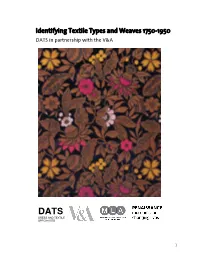
Identifying Textile Types and Weaves 1750-1950 DATS in partnership with the V&A DATS DRESS AND TEXTILE SPECIALISTS 1 Identifying Textile Types and Weaves 1750-1950 Text copyright © DATS, 2007 Image copyrights as specified in each section. This information pack has been produced to accompany a one-day workshop of the same name taught by Sue Kerry and held at Birmingham Museum and Art Gallery Collections Centre on 29th November 2007. The workshop is one of three produced in collaboration between DATS and the V&A, funded by the Renaissance Subject Specialist Network Implementation Grant Programme, administered by the MLA. The purpose of the workshops is to enable participants to improve the documentation and interpretation of collections and make them accessible to the widest audience. Participants will have the chance to study objects at first hand to help increase their confidence in identifying textile materials and techniques. This information pack is intended as a means of sharing the knowledge communicated in the workshops with colleagues and the public. Other workshops / information packs in the series: Identifying Printed Textiles in Dress 1740 -1890 Identifying Handmade and Machine Lace Front Cover - English silk tissue, 1875, Spitalfields. T.147-1972 , Image © V&A Images / Victoria and Albert Museum 2 Identifying Textile Types and Weaves Contents Page 2. List of Illustrations 1 3. Introduction and identification checklist 3 4. Identifying Textile Types - Fibres and Yarns 4 5. Weaving and Woven Cloth Historical Framework - Looms 8 6. Identifying Basic Weave Structures – Plain Cloths 12 7. Identifying Basic Weave Structures – Figured / Ornate Cloths 17 8. -
Adventuring with Books: a Booklist for Pre-K-Grade 6. the NCTE Booklist
DOCUMENT RESUME ED 311 453 CS 212 097 AUTHOR Jett-Simpson, Mary, Ed. TITLE Adventuring with Books: A Booklist for Pre-K-Grade 6. Ninth Edition. The NCTE Booklist Series. INSTITUTION National Council of Teachers of English, Urbana, Ill. REPORT NO ISBN-0-8141-0078-3 PUB DATE 89 NOTE 570p.; Prepared by the Committee on the Elementary School Booklist of the National Council of Teachers of English. For earlier edition, see ED 264 588. AVAILABLE FROMNational Council of Teachers of English, 1111 Kenyon Rd., Urbana, IL 61801 (Stock No. 00783-3020; $12.95 member, $16.50 nonmember). PUB TYPE Books (010) -- Reference Materials - Bibliographies (131) EDRS PRICE MF02/PC23 Plus Postage. DESCRIPTORS Annotated Bibliographies; Art; Athletics; Biographies; *Books; *Childress Literature; Elementary Education; Fantasy; Fiction; Nonfiction; Poetry; Preschool Education; *Reading Materials; Recreational Reading; Sciences; Social Studies IDENTIFIERS Historical Fiction; *Trade Books ABSTRACT Intended to provide teachers with a list of recently published books recommended for children, this annotated booklist cites titles of children's trade books selected for their literary and artistic quality. The annotations in the booklist include a critical statement about each book as well as a brief description of the content, and--where appropriate--information about quality and composition of illustrations. Some 1,800 titles are included in this publication; they were selected from approximately 8,000 children's books published in the United States between 1985 and 1989 and are divided into the following categories: (1) books for babies and toddlers, (2) basic concept books, (3) wordless picture books, (4) language and reading, (5) poetry. (6) classics, (7) traditional literature, (8) fantasy,(9) science fiction, (10) contemporary realistic fiction, (11) historical fiction, (12) biography, (13) social studies, (14) science and mathematics, (15) fine arts, (16) crafts and hobbies, (17) sports and games, and (18) holidays. -
Open in New Window
8th 17 1837-2014 Australia Day Regatta Endorsed by Celebrating 92 YEARS OF BUILDING SUCCESS www.awedwards.com.au White Bay Cruise Terminal RAS Main Arena (Skoda Stadium) Newington College Liverpool Courthouse 8th 17 From the President This has been a time of double celebration for Sydney Harbour. In early October 2013, the International Fleet Review, which hosted ships from twenty nations, was a spectacular celebration of the 100th anniversary of the establishment of the Royal Australian Navy and commemorated the arrival of the first seven ships on 4 October 1913. Today’s celebration on Australia Day reminds us of our history, honours those who contributed to that history and celebrates the foundation of our nation. In doing so, we acknowledge the first Australians and pay respect to the Gadigal and Cammeragil people, recognising them as having been fine custodians of Sydney Harbour. On this 178th Australia Day Regatta on Sydney Harbour, hundreds of sailors and their families will participate in a wonderful spectacle on one of the world’s greatest waterways. The Anniversary Regatta, as it was then known, commenced in 1837 just one year after South Australia was proclaimed a colony and before Victoria, Queensland or Tasmania (it was still called Van Diemen’s Land) were formally declared provinces. There is no better way to mark the birth of a nation surrounded by sea and developed through our great maritime heritage than by participating in the Australia Day Regatta. We welcome all those who have entered their craft, large or small, old or new. With the support of our host clubs they will celebrate Australia Day on more than 20 different waterways. -

Of Weaving Terms for Today's Weavers
THE FAMILY TREE OF WEAVES SIMPLE WEAVES WEAVES WITH COMPOUND SETS COMPOUND WEAVES OF ELEMENTS one warp and one weft more than one warp; more than one weave more than one weft structure A POCKET plain weave supplementary warp double weave: twill supplementary weft two weave structures satin weaves that produce weaves that produce two independent and pattern blocks pattern blocks equal structures DICTIONARY M's and O's overshot connected by spot weaves crackle exchanging faces: of weaving terms ‘diversified plain figured double weave weave’ weaves that produce repp weaves pattern blocks with two independent for today’s weavers units structures (face and weaves that produce —supplementary-weft back) connected by pattern blocks with structures with 2, 3, or stitching with: units 4 tie-down ends –warp from bottom repp weaves —warp or weft pile layer over weft from lace weaves: huck and weaves: velvet and top (piqué and other Bronson lace terry stitched double cloths) ‘diversified plain –warp from top layer weave’ complementary warp under weft from turned twill complementary weft bottom turned satin (damask) —warp-faced, weft- –extra warp faced ‘polychromes’ –extra weft —warp-faced compound tabby and twill two independent but —weft-faced compound unequal structures tabby (taqueté) and (main and secondary) twill (samitum) connected where the secondary weft swivel interlaces above the Bedford cord main structure —the two structures can form free double cloth where main structure is on the top Madelyn van der Hoogt or they can be PO Box 1228 completely interwoven Coupeville, WA 98239 Bateman weaves: park, plain-weave ground cloth. The ratio of must contain the complete threading more complementary sets of warp, one boulevard, and chevron: tie-down ends to pattern ends is 1:1; sequence of the tie-down ends. -
Identifying Woven Textiles 1750-1950 Identification
Identifying Woven Textiles 1750–1950 DATS in partnership with the V&A 1 Identifying Woven Textiles 1750–1950 This information pack has been produced to accompany two one-day workshops taught by Katy Wigley (Director, School of Textiles) and Mary Schoeser (Hon. V&A Senior Research Fellow), held at the V&A Clothworkers’ Centre on 19 April and 17 May 2018. The workshops are produced in collaboration between DATS and the V&A. The purpose of the workshops is to enable participants to improve the documentation and interpretation of collections and make them accessible to the widest audience. Participants will have the chance to study objects at first hand to help increase their confidence in identifying woven textile materials and techniques. This information pack is intended as a means of sharing the knowledge communicated in the workshops with colleagues and the wider public and is also intended as a stand-alone guide for basic weave identification. Other workshops / information packs in the series: Identifying Textile Types and Weaves Identifying Printed Textiles in Dress 1740–1890 Identifying Handmade and Machine Lace Identifying Fibres and Fabrics Identifying Handmade Lace Front Cover: Lamy et Giraud, Brocaded silk cannetille (detail), 1878. This Lyonnais firm won a silver gilt medal at the Paris Exposition Universelle with a silk of this design, probably by Eugene Prelle, their chief designer. Its impact partly derives from the textures within the many-coloured brocaded areas and the markedly twilled cannetille ground. Courtesy Francesca Galloway. 2 Identifying Woven Textiles 1750–1950 Table of Contents Page 1. Introduction 4 2. Tips for Dating 4 3.