The Arts Backbone AUGUST 2002
Total Page:16
File Type:pdf, Size:1020Kb
Load more
Recommended publications
-

Art Gallery of New South Wales Annual Report 2012 – 13
ART GALLERY OF NEW SOUTH WALES ANNUAL REPORT 2012 – 13 1 CONTENTS 4 Vision and strategic direction 2010 – 15 5 President’s foreword 9 Director’s statement 13 At a glance 15 Access 15 Exhibitions and audience programs 19 Future exhibitions 21 Publishing 23 Engaging 23 Digital engagement 23 Community 30 Education 35 Outreach Regional NSW 40 Stewarding 40 Building and environmental management 42 Corporate Governance 58 Collecting 58 Major collection acquisitions 67 Other collection activity 70 Appendices 123 General Access Information 131 Financial statements 2 ART GALLERY OF NSW ANNUAL REPORT 12-13 The Hon George Souris MP Minister for Tourism, Major Events, Hospitality and Racing, and Minister for the Arts Parliament House Macquarie Street SYDNEY NSW 2000 Dear Minister It is our pleasure to forward to you for presentation to the NSW Parliament the annual report for the Art Gallery of NSW for the year ended 30 June 2013. This report has been prepared in accordance with the provisions of the Annual Report (Statutory Bodies) Act 1984 and the Annual Reports (Statutory Bodies) Regulations 2010. Yours sincerely Steven Lowy Michael Brand President Director Art Gallery of NSW Trust 21 October 2013 3 VISION AND STRATEGIC DIRECTION 2010 – 2015 Vision The Gallery is dedicated to serving the widest possible audience, both nationally and internationally, as a centre of excellence for the collection, preservation, documentation, . interpretation and display of Australian and international art. The Gallery is also dedicated to providing a forum for scholarship, art education and the exchange of ideas. Strategic Directions Access To continue to improve access to our collection, resources and expertise through exhibitions, publishing, programs, new technologies and partnerships. -

Imagining Mumeka: Bureaucratic and Kuninjku Perspectives Jon Altman1
14 Imagining Mumeka: Bureaucratic and Kuninjku perspectives Jon Altman1 Mumeka is the name of a place; it was once the location of a seasonal camp. Since the late 1960s it has been called an outstation or homeland. The name first appears in the archive in the late 1960s, but the immediate precursor to its establishment was the blazing of a vehicular track from Oenpelli to Maningrida in the Northern Territory in 1963 that crossed the Mann River adjacent to this wet season camp (see Figure 14.1). That place was inhabited by members of a community that speak what we now refer to as the Kuninjku dialect of the pan-dialectical Bining Gunwok language (Evans 2003). In this chapter, I want to say something about the lives of Kuninjku people over the 50 years since 1963 through the locational lens of Mumeka and their engagements with the Australian state and capitalism, including during a policy period termed self-determination. I then want to say something about current Kuninjku circumstances and the indeterminacy of their future, even as the future of Mumeka, the place, seems reasonably assured. 1 I would like to thank John Mawurndjul and the Kuninjku community for productive collaborations over many years; Melinda Hinkson, Chris Haynes and Dan Gillespie for helpful comments on an earlier draft; Ben Heaslip when at the National Archives of Australia; and anonymous referees for their constructive comments. 279 ExPERIMENTS IN SELF-Determination Map 14.1 Mumeka and outstations in the Maningrida region. Source: Karina Pelling, CartogIS, ANu College of Asia and the Pacific Opening vignette In 1979 and 1980, I lived with John Mawurndjul at Mumeka. -
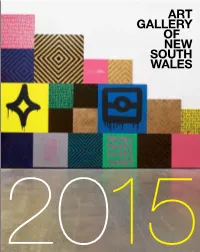
Art Gallery of New South Wales 2015 Year in Review
Art Gallery of New South Wales Art Wales South Gallery New of ART GALLERY OF NEW SOUTH WALES 2015 2015 ART GALLERY OF NEW SOUTH WALES 2015 2 Art Gallery of New South Wales 2015 Art Gallery of New South Wales 2015 3 Our year in review 4 Art Gallery of New South Wales 2015 Art Gallery of New South Wales 2015 5 We dedicate this inaugural Art Gallery of New South Wales annual review publication to the Australian artists represented in the Gallery’s collection who have passed away during the year. 8 OUR VISION 9 FROM THE PRESIDENT Guido Belgiorno-Nettis 10 FROM THE DIRECTOR Michael Brand 12 YEAR AT A GLANCE 14 SYDNEY MODERN PROJECT 23 ART 42 IDEAS 50 AUDIENCE 60 PARTNERSHIPS 74 EXECUTIVE 75 CONTACTS 80 2016 PREVIEW Our vision From its base in Sydney, the Art Gallery of New South Wales is dedicated to serving the widest possible audience as a centre of excellence for the collection, preservation, documentation, interpretation and display of Australian and international art, and a forum for scholarship, art education and the exchange of ideas. Our goal is that by the time of our As Australia’s premier art museum, 150th anniversary in 2021, the Gallery we must reflect the continuing evolution will be recognised, both nationally of the visual arts in the 21st century and internationally, for the quality of alongside the development of new our collection, our facilities, our staff, channels of global communication that our scholarship and the innovative increasingly transcend national ways in which we engage with our boundaries. -

Mr R Peters 1934 - 2020, Springvale Station, Turkey Creek, WA
Mr R Peters 1934 - 2020, Springvale Station, Turkey Creek, WA BIOGRAPHY: Rusty Peters is a senior Gija man of Juwurru skin. His bush name Dirjji refers to dingo pups looking out of a hole at the sunrise. He was born under a Warlagarri or Supplejack tree on Springvale Station south west of Turkey Creek the same day as his jimarri or age mate Charlie McAdam. His spirit came from a crocodile his father had killed when his mother became pregnant. He grew up on Springvale learning traditional law and working as a stockman and at other things such as welding fences and stock yards. When his father was killed in a tragic riding accident at Roses Yard, the family moved to Mabel Downs where he became renowned as a horse breaker. He lived for some time at Nine Mile reserve at Wyndham after the introduction of award wages forced people off stations but then moved to Turkey Creek where with other senior Gija artists such as Hector Jandany and George Mung-Mung he helped start the school. In 1989 he moved to Kununurra where he was employed at Waringarri Aboriginal Arts as an assistant. He was a long time friend of Rover Thomas, caring for him on most of the trips he made in the later part of his life. He made prints and did some painting while working for Waringarri Arts. He moved to Crocodile Hole when Freddie Timms based the Jirrawun Aboriginal Arts group there in 1997 and began to paint on large canvases. His detailed knowledge of the land and stories from Springvale and neighbouring Moolabulla stations is reflected in distinctive paintings in traditional red and yellow ochres and black charcoal. -
Ngarranggarni Gija Two-Way Learning and the University of Melbourne Gabriel Nodea and Robyn Sloggett
ngarranggarni Gija Two-Way Learning and the University of Melbourne Gabriel Nodea and Robyn Sloggett Introduction knowledge and are responsible for many of the cattle stations, in the Warmun is a small township owned keeping it strong, and for teaching it early 1970s Warmun became a refugee and managed by Gija people in the to future generations. This knowledge camp. People were physically removed east Kimberley region of Western cannot be passed on without the from their country, so that simple acts Australia. Situated between Kununurra permission of the Old People. like finding food and water, as well as and Hall’s Creek, Warmun is also On one level, this article is about complex activities like ceremony and located on the ancient Wirnan an educational partnership between caring for country, could no longer be (sharing and trading) exchange the Grimwade Centre for Cultural carried out. This made Gija people route that stretched inland from the Materials Conservation at the feel disempowered and sad. They coastline around Derby to the west, to University of Melbourne and the felt as if they had been pushed aside that around Wadeye to the north-east. Warmun Art Centre, but it is also from the country they had looked Trade and shared knowledge have about the contemporary influence after through all time, and that they always been an important part of the of Ngarranggarni, which has become could no longer make decisions about social, cultural and spiritual fabric of an important part of the education caring for country. It brought down Gija life, and it was along this route programs at the Grimwade Centre, their spirits and made them feel that Gija people—working through and is now extending beyond like they were losing their strength. -

The Making of Indigenous Australian Contemporary Art
The Making of Indigenous Australian Contemporary Art The Making of Indigenous Australian Contemporary Art: Arnhem Land Bark Painting, 1970-1990 By Marie Geissler The Making of Indigenous Australian Contemporary Art: Arnhem Land Bark Painting, 1970-1990 By Marie Geissler This book first published 2020 Cambridge Scholars Publishing Lady Stephenson Library, Newcastle upon Tyne, NE6 2PA, UK British Library Cataloguing in Publication Data A catalogue record for this book is available from the British Library Copyright © 2020 by Marie Geissler All rights for this book reserved. No part of this book may be reproduced, stored in a retrieval system, or transmitted, in any form or by any means, electronic, mechanical, photocopying, recording or otherwise, without the prior permission of the copyright owner. ISBN (10): 1-5275-5546-1 ISBN (13): 978-1-5275-5546-4 Front Cover: John Mawurndjul (Kuninjku people) Born 1952, Kubukkan near Marrkolidjban, Arnhem Land, Northern Territory Namanjwarre, saltwater crocodile 1988 Earth pigments on Stringybark (Eucalyptus tetrodonta) 206.0 x 85.0 cm (irreg) Collection Art Gallery of South Australia Maude Vizard-Wholohan Art Prize Purchase Award 1988 Accession number 8812P94 © John Mawurndjul/Copyright Agency 2020 TABLE OF CONTENTS Acknowledgements .................................................................................. vii Prologue ..................................................................................................... ix Theorizing contemporary Indigenous art - post 1990 Overview ................................................................................................ -

Lauraine Diggins Fine
5 Malakoff Street, North Caulfield, Vic, 3161 Telephone: (61 3) 9509 9855 Facsimile: (61 3) 9509 4549 Email: ausart@diggins.com.au Website: www.diggins.com.au ABN.19006 457 101 L A U R A I N E · D I G G I N S · F I N E · A R T Memorial Service to celebrate the life of Lauraine Diggins OAM Monday 17th June 2019, The Pavilion, Arts Centre Melbourne TRIBUTES MC: Ruth Lovell, manager, Lauraine Diggins Fine Art Acknowledgement of Country: Professor Margo Neale, Senior Curator and Principal Indigenous Advisor, National Museum of Australia Speakers: Ms Lin Oke, O.T. Group Dr Daniel Thomas, Emeritus Director Art Gallery of South Australia Ms Antonia Syme, Director, Australian Tapestry Workshop Mr Adrian Newstead, Founding Director, Cooee Art Mr Steve Dimopoulos MP, Member for Oakleigh Mr Gerard Vaughan, former Director National Gallery of Australia Ms Anne-Marie Schwirtlich, former Director National Library of Australia (delivered by Nerida Blanche, daughter of Lauraine Diggins) Mr Michael Blanche, husband of Lauraine Diggins Tribute to Lauraine Diggins by Ms Lin Oke Reflections Occupational Therapy Back in 1965, 42 of us 17 and 18 year olds, from around Victoria started our journey into the Occupational therapy profession. Strong bonds of friendship developed amongst us. Lauraine stood out – vivacious, full of fun, elegant, tall – with those long legs that resulted in some of us calling her Lolly Legs. Following Lauraine’s passing we shared our memories and smiled on our reflections. I’m pleased to share some of these reflections with you today. One of our group summed up the closeness of Course 18 in this way: “In 1965 the small campus of the OT School at 33 Lansell Road provided an intimate atmosphere favourable for the development of strong bonds. -

Sunday 24 March, 2013 at 2Pm Museum of Contemporary Art Sydney, Australia Tional in Fi Le Only - Over Art Fi Le
Sunday 24 March, 2013 at 2pm Museum of Contemporary Art Sydney, Australia tional in fi le only - over art fi le 5 Bonhams The Laverty Collection 6 7 Bonhams The Laverty Collection 1 2 Bonhams Sunday 24 March, 2013 at 2pm Museum of Contemporary Art Sydney, Australia Bonhams Viewing Specialist Enquiries Viewing & Sale 76 Paddington Street London Mark Fraser, Chairman Day Enquiries Paddington NSW 2021 Bonhams +61 (0) 430 098 802 mob +61 (0) 2 8412 2222 +61 (0) 2 8412 2222 101 New Bond Street mark.fraser@bonhams.com +61 (0) 2 9475 4110 fax +61 (0) 2 9475 4110 fax Thursday 14 February 9am to 4.30pm laverty@bonhams.com Friday 15 February 9am to 4.30pm Greer Adams, Specialist in Press Enquiries www.bonhams.com/sydney Monday 18 February 9am to 4.30pm Charge, Aboriginal Art Gabriella Coslovich Tuesday 19 February 9am to 4.30pm +61 (0) 414 873 597 mob +61 (0) 425 838 283 Sale Number 21162 greer.adams@bonhams.com New York Online bidding will be available Catalogue cost $45 Bonhams Francesca Cavazzini, Specialist for the auction. For futher 580 Madison Avenue in Charge, Aboriginal Art information please visit: Postage Saturday 2 March 12pm to 5pm +61 (0) 416 022 822 mob www.bonhams.com Australia: $16 Sunday 3 March 12pm to 5pm francesca.cavazzini@bonhams.com New Zealand: $43 Monday 4 March 10am to 5pm All bidders should make Asia/Middle East/USA: $53 Tuesday 5 March 10am to 5pm Tim Klingender, themselves aware of the Rest of World: $78 Wednesday 6 March 10am to 5pm Senior Consultant important information on the +61 (0) 413 202 434 mob following pages relating Illustrations Melbourne tim.klingender@bonhams.com to bidding, payment, collection fortyfive downstairs Front cover: Lot 21 (detail) and storage of any purchases. -

Remembering Forward: Paintings of Australian Aborigines Since 1960 240 Pages, Hardback, 310 X 240 Mm, 150 Illustrations
Paul Holberton publishing THIRD FLOOR 89 BOROUGH HIGH STREET LONDON SE1 1NL TEL 020 7407 0809 FAX 020 7407 4615 BOOKS@PAUL-HOLBERTON.NET WWW.PAUL-HOLBERTON.NET Remembering Forward Paintings of Australian Aborigines since 1960 Edited by Kasper König, Emily Evans and Falk Wolf The publication Remembering Forward accompanies the exhibition at the Museum Ludwig in Cologne, 20 November 2010 to 20 March 2011, which presents the work of nine of the most prominent Australian Aboriginal artists of recent years: Paddy Bedford, Emily Kame Kngwarreye, Queenie McKenzie, Dorothy Napangardi, Rover Thomas, Ronnie Tjampitjinpa, Clifford Possum Tjapaltjarri, Tim Leura Tjapaltjarri and Turkey Tolson Tjupurrula. This is the first time that an art museum outside Australasia has devoted an exhibition to the works of these artists. The title Remembering Forward refers to the tension among tradition, present and future that determines the demands made of artists. On the one hand, they usually take as their subject the so-called ‘Dreamtime’ of prehistory from which myths of the earth’s and humankind’s creation have been handed down. In that regard they are deeply traditional. On the other, these artists have radically changed their medium and method of art-making over the last forty years. Inherited practices of sand- and body-painting have been transformed such that the paintings are executed in acrylic on canvas or other portable media. These changes afforded the artists entry to the global art market. Thus they have adjusted to address an outside public and keep the images free of those parts of the Dreamings that, in their own culture, are reserved for the initiated. -

Indigenous History: Indigenous Art Practices from Contemporary Australia and Canada
Sydney College of the Arts The University of Sydney Doctor of Philosophy 2018 Thesis Towards an Indigenous History: Indigenous Art Practices from Contemporary Australia and Canada Rolande Souliere A thesis submitted in partial fulfilment of requirements for the degree of Doctor of Philosophy at Sydney College of the Arts, University of Sydney This is to certify that to the best of my knowledge, the content of this thesis is my own work. This thesis has not been submitted for any degree or other purposes. I certify that the intellectual content of this thesis is the product of my own work and that all the assistance received in preparing this thesis and sources have been acknowledged. Rolande Souliere i ACKNOWLEDGEMENTS I would like to thank Dr. Lynette Riley for her assistance in the final process of writing this thesis. I would also like to thank and acknowledge Professor Valerie Harwood and Dr. Tom Loveday. Photographer Peter Endersbee (1949-2016) is most appreciated for the photographic documentation over my visual arts career. Many people have supported me during the research, the writing and thesis preparation. First, I would like to thank Sydney College of the Arts, University of Sydney for providing me with this wonderful opportunity, and Michipicoten First Nation, Canada, especially Linda Petersen, for their support and encouragement over the years. I would like to thank my family - children Chloe, Sam and Rohan, my sister Rita, and Kristi Arnold. A special thank you to my beloved mother Carolyn Souliere (deceased) for encouraging me to enrol in a visual arts degree. I dedicate this paper to her. -

Mca Presents a Major Survey by Bark Painter John Mawurndjul John Mawurndjul: I Am the Old and the New
MCA PRESENTS A MAJOR SURVEY BY BARK PAINTER JOHN MAWURNDJUL JOHN MAWURNDJUL: I AM THE OLD AND THE NEW [Sydney, 22 June 2018] The Museum of Contemporary Art Australia (MCA) is delighted to present Image: John the first major survey of works by one of Australia’s leading contemporary artists – master bark Mawurndjul, Ngalyod (Female rainbow painter John Mawurndjul from Friday 6 July until Sunday 23 September. Developed and co- serpent) (detail), presented by the MCA and Art Gallery of South Australia (AGSA), in association with Maningrida 1988, earth pigments Arts & Culture, this landmark exhibition includes over 160 works, spanning forty years of the artist’s on Stringybark practice. (Eucalyptus tetrodonta), Museum John Mawurndjul AM is celebrated for his mastery of rarrk (cross-hatching) and his depiction of djang of Contemporary Art, (sacred sites), a tradition shared by generations of Kuninjku artists. Bark paintings and sculptures purchased with funds drawn from private and public collections across the world tell the stories of Kuninjku culture and the donated by Mr and Mr significant locations surrounding the artist’s home in central north Arnhem Land. Click here to view the Jim Bain, 1989, © John Mawurndjul, licensed microsite. by Copyright Agency 2018, photograph: Born in 1952, Mawurndjul lives and works in Milmilngkan in western Arnhem Land and Maningrida in Jessica Maurer. central north Arnhem Land. Since his first exhibition in 1980, he has become one of Australia’s most widely recognised artists. In 1989 his work was included in the ground-breaking exhibition Magiciens de la Terre at the Centre Georges Pompidou and Grande Halle de la Villette in Paris, and his works have been included in numerous solo and group exhibitions in Australia, America, Germany and Japan. -

'Old' and 'New' in Western Arnhem Land Bark Painting
6. Categories of ‘Old’ and ‘New’ in Western Arnhem Land Bark Painting Luke Taylor Introduction This chapter compares two instances of development in the market for bark painting in western Arnhem Land at the towns of Oenpelli (Kunbarlanya) and Maningrida, east of Kakadu National Park in the Northern Territory. The intention is to compare the impacts of the agency of art collectors with that of the artists on the developing market for bark paintings, including a consideration of the entanglements of art creation and its respective intellectual frames in intercultural circumstances. In particular, I examine the effects of western categories used to define the bark paintings and how this in turn shapes the translation of their meaning in different periods. In addition, western curatorial perspectives of the art have influenced the expectations of the market and thus the trajectory of market development in each locale. Theoretical conversations of the western art world often play out with little regard for the non-western artist’s perspective. Western concepts of ‘fine art’ obscure the fact that non-western artists have a strong understanding of the historical circumstances of their art production, of what the works mean in the context of their ever-increasing engagements with the market, while possessing local theories of aesthetic value. Art history and anthropology as western disciplines of thought are now required to be reflective of their own categories, and to acknowledge the existence of a multiplicity of alternate histories of arts in the world context. Spencer at Oenpelli Baldwin Spencer travelled to Oenpelli in 1912 and his collection of bark paintings, made with the help of Paddy Cahill, brought this art to world prominence.1 Spencer worked with Kakadu-speaking artists and with a group called the Kulunglutji from further east, who are most likely to have been 1 Spencer 1914, 1928.