Microbial Ecology of an Extreme Acidic Environment, the Tinto River E
Total Page:16
File Type:pdf, Size:1020Kb
Load more
Recommended publications
-

Download Download
http://wjst.wu.ac.th Natural Sciences Diversity Analysis of an Extremely Acidic Soil in a Layer of Coal Mine Detected the Occurrence of Rare Actinobacteria Megga Ratnasari PIKOLI1,*, Irawan SUGORO2 and Suharti3 1Department of Biology, Faculty of Science and Technology, Universitas Islam Negeri Syarif Hidayatullah Jakarta, Ciputat, Tangerang Selatan, Indonesia 2Center for Application of Technology of Isotope and Radiation, Badan Tenaga Nuklir Nasional, Jakarta Selatan, Indonesia 3Department of Chemistry, Faculty of Science and Computation, Universitas Pertamina, Simprug, Jakarta Selatan, Indonesia (*Corresponding author’s e-mail: meggapikoli@uinjkt.ac.id, meggapikoli@yahoo.com) Received: 7 September 2017, Revised: 11 September 2018, Accepted: 29 October 2018 Abstract Studies that explore the diversity of microorganisms in unusual (extreme) environments have become more common. Our research aims to predict the diversity of bacteria that inhabit an extreme environment, a coal mine’s soil with pH of 2.93. Soil samples were collected from the soil at a depth of 12 meters from the surface, which is a clay layer adjacent to a coal seam in Tanjung Enim, South Sumatera, Indonesia. A culture-independent method, the polymerase chain reaction based denaturing gradient gel electrophoresis, was used to amplify the 16S rRNA gene to detect the viable-but-unculturable bacteria. Results showed that some OTUs that have never been found in the coal environment and which have phylogenetic relationships to the rare actinobacteria Actinomadura, Actinoallomurus, Actinospica, Streptacidiphilus, Aciditerrimonas, and Ferrimicrobium. Accordingly, the highly acidic soil in the coal mine is a source of rare actinobacteria that can be explored further to obtain bioactive compounds for the benefit of biotechnology. -
Proteome Cold-Shock Response in the Extremely Acidophilic Archaeon, Cuniculiplasma Divulgatum
microorganisms Article Proteome Cold-Shock Response in the Extremely Acidophilic Archaeon, Cuniculiplasma divulgatum Rafael Bargiela 1 , Karin Lanthaler 1,2, Colin M. Potter 1,2 , Manuel Ferrer 3 , Alexander F. Yakunin 1,2, Bela Paizs 1,2, Peter N. Golyshin 1,2 and Olga V. Golyshina 1,2,* 1 School of Natural Sciences, Bangor University, Deiniol Rd, Bangor LL57 2UW, UK; f.bargiela@bangor.ac.uk (R.B.); k.lanthaler@bangor.ac.uk (K.L.); colin.potter@bangor.ac.uk (C.M.P.); a.iakounine@bangor.ac.uk (A.F.Y.); paizsxbela@gmail.com (B.P.); p.golyshin@bangor.ac.uk (P.N.G.) 2 Centre for Environmental Biotechnology, Bangor University, Deiniol Rd, Bangor LL57 2UW, UK 3 Systems Biotechnology Group, Department of Applied Biocatalysis, CSIC—Institute of Catalysis, Marie Curie 2, 28049 Madrid, Spain; mferrer@icp.csic.es * Correspondence: o.golyshina@bangor.ac.uk; Tel.: +44-1248-388607; Fax: +44-1248-382569 Received: 27 April 2020; Accepted: 15 May 2020; Published: 19 May 2020 Abstract: The archaeon Cuniculiplasma divulgatum is ubiquitous in acidic environments with low-to-moderate temperatures. However, molecular mechanisms underlying its ability to thrive at lower temperatures remain unexplored. Using mass spectrometry (MS)-based proteomics, we analysed the effect of short-term (3 h) exposure to cold. The C. divulgatum genome encodes 2016 protein-coding genes, from which 819 proteins were identified in the cells grown under optimal conditions. In line with the peptidolytic lifestyle of C. divulgatum, its intracellular proteome revealed the abundance of proteases, ABC transporters and cytochrome C oxidase. From 747 quantifiable polypeptides, the levels of 582 proteins showed no change after the cold shock, whereas 104 proteins were upregulated suggesting that they might be contributing to cold adaptation. -
UQ111450 OA.Pdf
APPLIED AND ENVIRONMENTAL MICROBIOLOGY, Apr. 2004, p. 2079–2088 Vol. 70, No. 4 0099-2240/04/$08.00ϩ0 DOI: 10.1128/AEM.70.4.2079–2088.2004 Copyright © 2004, American Society for Microbiology. All Rights Reserved. Characterization of Ferroplasma Isolates and Ferroplasma acidarmanus sp. nov., Extreme Acidophiles from Acid Mine Drainage and Industrial Bioleaching Environments Mark Dopson,1† Craig Baker-Austin,1 Andrew Hind,1 John P. Bowman,2 and Philip L. Bond1,3* Downloaded from School of Biological Sciences1 and Centre for Ecology, Evolution and Conservation,3 University of East Anglia, Norwich NR4 7TJ, United Kingdom, and School of Agricultural Science, University of Tasmania, Hobart 7001, Tasmania, Australia2 Received 23 September 2003/Accepted 6 January 2004 Three recently isolated extremely acidophilic archaeal strains have been shown to be phylogenetically similar to Ferroplasma acidiphilum YT by 16S rRNA gene sequencing. All four Ferroplasma isolates were capable of growing chemoorganotrophically on yeast extract or a range of sugars and chemomixotrophically on ferrous http://aem.asm.org/ iron and yeast extract or sugars, and isolate “Ferroplasma acidarmanus” Fer1T required much higher levels of organic carbon. All four isolates were facultative anaerobes, coupling chemoorganotrophic growth on yeast extract to the reduction of ferric iron. The temperature optima for the four isolates were between 35 and 42°C and the pH optima were 1.0 to 1.7, and “F. acidarmanus” Fer1T was capable of growing at pH 0. The optimum yeast extract concentration for “F. acidarmanus” Fer1T was higher than that for the other three isolates. Phenotypic results suggested that isolate “F. acidarmanus” Fer1T is of a different species than the other three strains, and 16S rRNA sequence data, DNA-DNA similarity values, and two-dimensional polyacrylamide gel electrophoresis protein profiles clearly showed that strains DR1, MT17, and YT group as a single species. -

Isolation and Characterization of Ferroplasma Thermophilum Sp. Nov
http://www.paper.edu.cn Journal of Applied Microbiology ISSN 1364-5072 ORIGINAL ARTICLE Isolation and characterization of Ferroplasma thermophilum sp. nov., a novel extremely acidophilic, moderately thermophilic archaeon and its role in bioleaching of chalcopyrite H. Zhou1,2, R. Zhang1,P.Hu1, W. Zeng1, Y. Xie1,C.Wu1,3 and G. Qiu1,2 1 School of Minerals Processing and Bioengineering, Central South University, Changsha, P.R. China 2 Key Laboratory of Biometallurgy, Ministry of Education, Central South University, Changsha, P.R. China 3 China Ocean Mineral Resources R&D Association, Beijing, P.R. China Keywords Abstract 16S rRNA gene, archaeon, chalcopyrite, T Ferroplasma sp., ferrous iron-oxidizing. Aims: To isolate Ferroplasma thermophilum L1 from a low pH environment and to understand its role in bioleaching of chalcopyrite. Correspondence Methods and Results: Using serial dilution method, a moderately thermophilic Guanzhou Qiu, School of Minerals Processing and acidophilic ferrous iron-oxidizing archaeon, named L1T, was isolated from and Bioengineering, Central South University, a chalcopyrite-leaching bioreactor. The morphological, biochemical and physio- Changsha, 410083, P.R. China. logical characteristics of strain L1T and its role in bioleaching of chalcopyrite E-mail: qgzhoucsu@163.com were studied. Strain L1T was a nonmotile coccus that lacked cell wall. Strain T 2007 ⁄ 1566: received 26 September 2007, L1 had a temperature optimum of 45°C and the optimum pH for growth was T revised and accepted 24 January 2008 1Æ0. Strain L1 was capable of chemomixotrophic growth on ferrous iron and yeast extract. Results of fatty acid analysis, DNA–DNA hybridization, G+C con- doi:10.1111/j.1365-2672.2008.03807.x tent, and analysis based on 16S rRNA gene sequence indicated that strain L1T should be grouped in the genus Ferroplasma, and represented a new species, Ferroplasma thermophilum. -
Chemolithotrophic Nitrate-Dependent Fe(II)-Oxidizing Nature of Actinobacterial Subdivision Lineage TM3
The ISME Journal (2013) 7, 1582–1594 & 2013 International Society for Microbial Ecology All rights reserved 1751-7362/13 www.nature.com/ismej ORIGINAL ARTICLE Chemolithotrophic nitrate-dependent Fe(II)-oxidizing nature of actinobacterial subdivision lineage TM3 Dheeraj Kanaparthi1, Bianca Pommerenke1, Peter Casper2 and Marc G Dumont1 1Department of Biogeochemistry, Max Planck Institute for Terrestrial Microbiology, Marburg, Germany and 2Leibniz-Institute of Freshwater Ecology and Inland Fisheries, Department of Limnology of Stratified Lakes, Stechlin, Germany Anaerobic nitrate-dependent Fe(II) oxidation is widespread in various environments and is known to be performed by both heterotrophic and autotrophic microorganisms. Although Fe(II) oxidation is predominantly biological under acidic conditions, to date most of the studies on nitrate-dependent Fe(II) oxidation were from environments of circumneutral pH. The present study was conducted in Lake Grosse Fuchskuhle, a moderately acidic ecosystem receiving humic acids from an adjacent bog, with the objective of identifying, characterizing and enumerating the microorganisms responsible for this process. The incubations of sediment under chemolithotrophic nitrate- dependent Fe(II)-oxidizing conditions have shown the enrichment of TM3 group of uncultured Actinobacteria. A time-course experiment done on these Actinobacteria showed a consumption of Fe(II) and nitrate in accordance with the expected stoichiometry (1:0.2) required for nitrate- dependent Fe(II) oxidation. Quantifications done by most probable number showed the presence of 1 Â 104 autotrophic and 1 Â 107 heterotrophic nitrate-dependent Fe(II) oxidizers per gram fresh weight of sediment. The analysis of microbial community by 16S rRNA gene amplicon pyrosequencing showed that these actinobacterial sequences correspond to B0.6% of bacterial 13 16S rRNA gene sequences. -
Metagenome-Scale Analysis Yields Insights Into the Structure And
Zhang et al. BMC Genetics (2016) 17:21 DOI 10.1186/s12863-016-0330-4 RESEARCH ARTICLE Open Access Metagenome-scale analysis yields insights into the structure and function of microbial communities in a copper bioleaching heap Xian Zhang1,2, Jiaojiao Niu1,2, Yili Liang1,2, Xueduan Liu1,2 and Huaqun Yin1,2* Abstract Background: Metagenomics allows us to acquire the potential resources from both cultivatable and uncultivable microorganisms in the environment. Here, shotgun metagenome sequencing was used to investigate microbial communities from the surface layer of low grade copper tailings that were industrially bioleached at the Dexing Copper Mine, China. A bioinformatics analysis was further performed to elucidate structural and functional properties of the microbial communities in a copper bioleaching heap. Results: Taxonomic analysis revealed unexpectedly high microbial biodiversity of this extremely acidic environment, as most sequences were phylogenetically assigned to Proteobacteria,whileEuryarchaeota-related sequences occupied little proportion in this system, assuming that Archaea probably played little role in the bioleaching systems. At the genus level, the microbial community in mineral surface-layer was dominated by the sulfur- and iron-oxidizing acidophiles such as Acidithiobacillus-like populations, most of which were A. ferrivorans-like and A. ferrooxidans-like groups. In addition, Caudovirales were the dominant viral type observed in this extremely environment. Functional analysis illustrated that the principal participants related to the key metabolic pathways (carbon fixation, nitrogen metabolism, Fe(II) oxidation and sulfur metabolism) were mainly identified to be Acidithiobacillus-like, Thiobacillus-like and Leptospirillum-like microorganisms, indicating their vital roles. Also, microbial community harbored certain adaptive mechanisms (heavy metal resistance, low pH adaption, organic solvents tolerance and detoxification of hydroxyl radicals) as they performed their functions in the bioleaching system. -

Thermophilic and Alkaliphilic Actinobacteria: Biology and Potential Applications
REVIEW published: 25 September 2015 doi: 10.3389/fmicb.2015.01014 Thermophilic and alkaliphilic Actinobacteria: biology and potential applications L. Shivlata and Tulasi Satyanarayana * Department of Microbiology, University of Delhi, New Delhi, India Microbes belonging to the phylum Actinobacteria are prolific sources of antibiotics, clinically useful bioactive compounds and industrially important enzymes. The focus of the current review is on the diversity and potential applications of thermophilic and alkaliphilic actinobacteria, which are highly diverse in their taxonomy and morphology with a variety of adaptations for surviving and thriving in hostile environments. The specific metabolic pathways in these actinobacteria are activated for elaborating pharmaceutically, agriculturally, and biotechnologically relevant biomolecules/bioactive Edited by: compounds, which find multifarious applications. Wen-Jun Li, Sun Yat-Sen University, China Keywords: Actinobacteria, thermophiles, alkaliphiles, polyextremophiles, bioactive compounds, enzymes Reviewed by: Erika Kothe, Friedrich Schiller University Jena, Introduction Germany Hongchen Jiang, The phylum Actinobacteria is one of the most dominant phyla in the bacteria domain (Ventura Miami University, USA et al., 2007), that comprises a heterogeneous Gram-positive and Gram-variable genera. The Qiuyuan Huang, phylum also includes a few Gram-negative species such as Thermoleophilum sp. (Zarilla and Miami University, USA Perry, 1986), Gardenerella vaginalis (Gardner and Dukes, 1955), Saccharomonospora -

Comparison of Actinobacterial Diversity in Marion Island Terrestrial
Comparison of actinobacterial diversity in Marion Island terrestrial habitats Walter Tendai Sanyika A thesis submitted in partial fulfillment of the requirements for the degree of Doctor of Philosophy in the Department of Biotechnology, University of the Western Cape. Supervisor: Prof D. A. Cowan November 2008 DECLARATION I declare that “Comparison of actinobacterial diversity in Marion Island terrestrial habitats” is my own work, that it has not been submitted for any degree or examination in any other university, and that all the sources I have used or quoted have been indicated and acknowledged by complete references. Walter Tendai Sanyika November 2008 -------------------------------------- ii Abstract Marion Island is a sub-Antarctica Island that consists of well-characterised terrestrial habitats. A number of previous studies have been conducted, which involved the use of culture-dependent and culture-independent identification of bacterial communities from Antarctic and sub-Antarctic soils. Previous studies have shown that actinobacteria formed the majority of microorganisms frequently identified, suggesting that they were adapted to cold environments. In this study, metagenomic DNA was directly isolated from the soil and actinomycete, actinobacterial and bacterial 16S rRNA genes were amplified using specific primers. Hierarchical clustering and multidimensional scaling were used to relate the microbiological diversity to the habitat plant and soil physiochemical properties. The habitats clusters obtained were quite similar based on the analysis of soil and plant characteristics. However, the clusters obtained from the analysis of environmental factors were not similar to those obtained using microbiological diversity. The culture- independent studies were based on the 16S rRNA genes. Soil salinity was the major factor determining the distribution of microorganisms in habitats based on DGGE and PCA. -

Genome Analysis of the Thermoacidophilic Archaeon Acidianus Copahuensis Focusing on the Metabolisms Associated to Biomining Acti
Urbieta et al. BMC Genomics (2017) 18:445 DOI 10.1186/s12864-017-3828-x RESEARCH ARTICLE Open Access Genome analysis of the thermoacidophilic archaeon Acidianus copahuensis focusing on the metabolisms associated to biomining activities María Sofía Urbieta1,3*†, Nicolás Rascovan2†, Martín P. Vázquez2 and Edgardo Donati1 Abstract Background: Several archaeal species from the order Sulfolobales are interesting from the biotechnological point of view due to their biomining capacities. Within this group, the genus Acidianus contains four biomining species (from ten known Acidianus species), but none of these have their genome sequenced. To get insights into the genetic potential and metabolic pathways involved in the biomining activity of this group, we sequenced the genome of Acidianus copahuensis ALE1 strain, a novel thermoacidophilic crenarchaeon (optimum growth: 75 °C, pH 3) isolated from the volcanic geothermal area of Copahue at Neuquén province in Argentina. Previous experimental characterization of A. copahuensis revealed a high biomining potential, exhibited as high oxidation activity of sulfur and sulfur compounds, ferrous iron and sulfide minerals (e.g.: pyrite). This strain is also autotrophic and tolerant to heavy metals, thus, it can grow under adverse conditions for most forms of life with a low nutrient demand, conditions that are commonly found in mining environments. Results: In this work we analyzed the genome of Acidianus copahuensis and describe the genetic pathways involved in biomining processes. We identified the enzymes that are most likely involved in growth on sulfur and ferrous iron oxidation as well as those involved in autotrophic carbon fixation. We also found that A. copahuensis genome gathers different features that are only present in particular lineages or species from the order Sulfolobales, some of which are involved in biomining. -
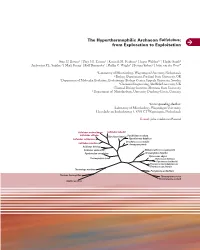
The Hyperthermophilic Archaeon Sulfolobus: from Exploration to Exploitation
The Hyperthermophilic Archaeon Sulfolobus: from Exploration to Exploitation Stan J.J. Brouns1 | Thijs J.G. Ettema1 | Kenneth M. Stedman2 | Jasper Walther1,3 | Hauke Smidt1 Ambrosius P.L. Snijders4 | Mark Young5 | Rolf Bernander3 | Phillip C. Wright4 | Bettina Siebers6 | John van der Oost1* 1 Laboratory of Microbiology, Wageningen University, Netherlands 2 Biology Department, Portland State University, OR 3 Department of Molecular Evolution, Evolutionary Biology Center, Uppsala University, Sweden 4 Chemical Engineering, Sheffield University, UK 5Thermal Biology Institute, Montana State University 6 Department of Microbiologie, University Duisburg-Essen, Germany *Corresponding Author: Laboratory of Microbiology, Wageningen University, Hesselink van Suchtelenweg 4, 6703 CT Wageningen, Netherlands E-mail: john.vanderoost@wur.nl Sulfolobus acidocaldarius Sulfolobus tokodaii Sulfolobus shibatae Pyrolobus fumari Pyrodictium occultum Sulfolobus solfataricus Hyperthermus butylicus Desulfurococcus mobilis Sulfolobus islandicus Aeropyrum pernix Acidianus brierleyi Acidianus ambivalens Methanocaldococcus jannaschii Pyrobaculum aerophilum Archaeoglobus fulgidus Pyrococcus abyssi Thermoproteus tenax Pyrococcus furiosus Pyrococcus horikoshii Thermococcus kodakaraensis Thermococcus litoralis Thermotoga maritima Ferroplasma acidiphilum Thermus thermophilus Thermoplasma volcanium Thermoplasma acidophilum Aquifex aeolicus 262 GEOTHERMAL BIOLOGY AND GEOCHEMISTRY IN YELLOWSTONE NATIONAL PARK ABSTRACT In the early 1970s, Sulfolobus was first isolated by Thomas -

The Novel Extremely Acidophilic, Cell-Wall-Deficient Archaeon
International Journal of Systematic and Evolutionary Microbiology (2016), 66, 332–340 DOI 10.1099/ijsem.0.000725 The novel extremely acidophilic, cell-wall-deficient archaeon Cuniculiplasma divulgatum gen. nov., sp. nov. represents a new family, Cuniculiplasmataceae fam. nov., of the order Thermoplasmatales Olga V. Golyshina,1 Heinrich Lu¨nsdorf,2 Ilya V. Kublanov,3 Nadine I. Goldenstein,4 Kai-Uwe Hinrichs4 and Peter N. Golyshin1 Correspondence 1School of Biological Sciences, Bangor University, Deiniol Rd, Bangor LL57 2UW, UK Olga V. Golyshina 2Central Unit of Microscopy, Helmholtz Centre for Infection Research, Inhoffenstrasse 7, o.golyshina@bangor.ac.uk Braunschweig 38124, Germany 3Winogradsky Institute of Microbiology, Russian Academy of Sciences, Prospect 60-Letiya Oktyabrya 7/2, Moscow 117312, Russia 4MARUM – Center for Marine Environmental Sciences, University of Bremen, Leobener Str., Bremen 28359, Germany Two novel cell-wall-less, acidophilic, mesophilic, organotrophic and facultatively anaerobic archaeal strains were isolated from acidic streamers formed on the surfaces of copper-ore- containing sulfidic deposits in south-west Spain and North Wales, UK. Cells of the strains varied from 0.1 to 2 mm in size and were pleomorphic, with a tendency to form filamentous structures. The optimal pH and temperature for growth for both strains were 1.0–1.2 and 2 37–40 8C, with the optimal substrates for growth being beef extract (3 g l 1) for strain S5T and 2 beef extract with tryptone (3 and 1 g l 1, respectively) for strain PM4. The lipid composition was dominated by intact polar lipids consisting of a glycerol dibiphytanyl glycerol tetraether (GDGT) core attached to predominantly glycosidic polar headgroups. -
The Metal Oxides of Abandoned Tin Mining Pit Waters As an Indicator for Bacterial Diversity Andri Kurniawan
The metal oxides of abandoned tin mining pit waters as an indicator for bacterial diversity Andri Kurniawan Department of Aquaculture, Faculty of Agricultural, Fishery, and Biology, University of Bangka Belitung, Bangka, Bangka Belitung Archipelago Province, Indonesia. Corresponding author: A. Kurniawan, andri_pangkal@yahoo.co.id Abstract. This study aimed to provide information about the form of metal oxides of heavy metals identified in abandoned tin mining pit waters with different ages and explain their relationship to the diversity of acidophilic bacteria and the presence of fish in acid mine waters in Bangka Regency, Indonesia. The analysis of metal oxides was carried out using X-Ray Fluorescence (XRF). The 16 oxide forms of heavy metals identified showed that iron (III) oxide (Fe2O3), tantalum (V) oxide (Ta2O5), tin (IV) oxide (SnO2), manganese (II) oxide (MnO) were found in high concentrations in all mine waters of different ages. The presence of heavy metals and their oxides affected the water quality, especially the pH value, decreasing it by oxidation processes. This condition contributed to the presence of acidophilic bacterial groups such as phyla Proteobacteria, Bacteriodetes, Planctomycetes, Actinobacteria, Chloroflexi, Firmicutes, Chlorobi, Acidobacteria, Cyanobacteria, etc. They play the important role in biogeochemical processes, changing the environment. The changes of chronosequences in the ecosystem can support the life of organisms such as fish (Aplocheilus sp., Rasbora sp., Betta sp., Puntius sp., Channa sp., Oreochromis sp., Belontia sp., Anabas sp., and Trichopodus sp.). Furthermore, the fish produce organic material. The organic material was decomposed by bacteria in anions and functional groups, which react to protons and cause the neutralization pH.