'Vile' Pakistan Bombing
Total Page:16
File Type:pdf, Size:1020Kb
Load more
Recommended publications
-
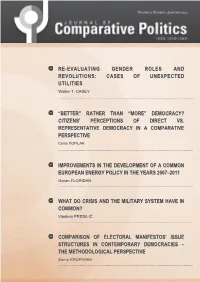
Re-Evaluating Gender Roles and Revolutions: Cases of Unexpected Utilities
RE-EVALUATING GENDER ROLES AND REVOLUTIONS: CASES OF UNEXPECTED UTILITIES Walter T. CASEY ........................................................................................................................ “BETTER” RATHER THAN “MORE” DEMOCRACY? CITIZENS’ PERCEPTIONS OF DIRECT VS. REPRESENTATIVE DEMOCRACY IN A COMPARATIVE PERSPECTIVE Cirila TOPLAK ........................................................................................................................ IMPROVEMENTS IN THE DEVELOPMENT OF A COMMON EUROPEAN ENERGY POLICY IN THE YEARS 2007–2011 Goran FLORIDAN ........................................................................................................................ WHAT DO CRISIS AND THE MILITARY SYSTEM HAVE IN COMMON? Vladimir PREBILIČ ........................................................................................................................ COMPARISON OF ELECTORAL MANIFESTOS’ ISSUE STRUCTURES IN CONTEMPORARY DEMOCRACIES – THE METHODOLOGICAL PERSPECTIVE Samo KROPIVNIK ........................................................................................................................ JOURNAL OF COMPARATIVE POLITICS 2 EDITORIAL TEAM General Editor General Editor Miro Haček Peter Csányi ............................................................ ............................................................ Faculty of social sciences Faculty of Political and Social Sciences University of Ljubljana University in Sladkovicovo Kardeljeva ploščad 5 Richterova ul. 1171 Ljubljana, Slovenia Sladkovicovo, -

Volume 1 TOGHCHÁIN ÁITIÚLA, 1999 LOCAL ELECTIONS, 1999
TOGHCHÁIN ÁITIÚLA, 1999 LOCAL ELECTIONS, 1999 Volume 1 TOGHCHÁIN ÁITIÚLA, 1999 LOCAL ELECTIONS, 1999 Volume 1 DUBLIN PUBLISHED BY THE STATIONERY OFFICE To be purchased through any bookseller, or directly from the GOVERNMENT PUBLICATIONS SALE OFFICE, SUN ALLIANCE HOUSE, MOLESWORTH STREET, DUBLIN 2 £12.00 €15.24 © Copyright Government of Ireland 2000 ISBN 0-7076-6434-9 P. 33331/E Gr. 30-01 7/00 3,000 Brunswick Press Ltd. ii CLÁR CONTENTS Page Foreword........................................................................................................................................................................ v Introduction .................................................................................................................................................................... vii LOCAL AUTHORITIES County Councils Carlow...................................................................................................................................................................... 3 Cavan....................................................................................................................................................................... 8 Clare ........................................................................................................................................................................ 12 Cork (Northern Division) .......................................................................................................................................... 19 Cork (Southern Division)......................................................................................................................................... -

Galway Campus
POSTGDUATE PROSPECTUS 2019 YOU START THE NEXT CHAPTER TOP % of Universities1 worldwide based on data from QS NUI Galway Campus Áras de Brún (School of Mathematics, Statistics and Applied Mathematics) Áras Uí Chathail/Student Information Desk (SID) Áras na Gaeilge The Quadrangle Áras na Mac Léinn and Bailey Allen Hall University Hospital Galway Lambe Institute for Translational Research and HRB Clinical Research Facility Centre for Adult Learning and Professional Development Huston School of Film and Digital Media Martin Ryan Building (Environmental, Marine and Energy Research) O’Donoghue Centre for Drama, Theatre and Performance Human Biology Building Biomedical Sciences Hardiman Library and Hardiman Research Building Lifecourse Building Arts Millennium Building Corrib Village (Student Residences) School of Psychology Engineering Building J.E. Cairnes School of Business & Economics Áras Moyola (School of Nursing and Midwifery; School of Health Sciences) Research and Innovation Centre Sports Centre Postgraduate Prospectus 2019 Prospectus Postgraduate IT Building Arts/Science Building NUI Galway NUI Galway Orbsen Building (NCBES and REMEDI) 01 Why Choose NUI Galway? of UNIVERSITIES WORLDWIDE according 92% to the QS World University of POSTGRADUATES are in employment Rankings 2018 or additional education or research within six months of graduating OVER YEARS of Home to INSIGHT innovative teaching and National Centre research excellence for Data Analytics SPINOUT COMPANIES €65.5m 16 in five years in RESEARCH funding in 2017 OF ALL STENTS -

Postgraduate Prospectus 2021 >90 Ostgraduate Prospectus 2021 SUSTAINABLE DEVELOPMENT MULTI
National University of Ireland, Galway 175 Ollscoil na hÉireann, Gaillimh T +353 91 524 411 E postgrad@nuigalway.ie Prospectus 2021 Prospectus Postgraduate Postgraduate 2021 Prospectus National University of Ireland, Galway of Ireland, University National NUI Galway Campus Áras de Brún (School of Mathematics, Statistics and Applied Mathematics) Áras Uí Chathail/Student Information Desk (SID) Áras na Gaeilge The Quadrangle Áras na Mac Léinn and Bailey Allen Hall University Hospital Galway Lambe Institute for Translational Research and HRB Clinical Research Facility Pictured in the Quadrangle, NUI Galway, Sinéad Shaughnessy, scholarship recipient, master’s student 2019–20. Centre for Adult Learning and Professional Development Postgraduate Scholarships Scheme for full-time taught masters’ students At NUI Galway we are keen to ensure that the brightest and most committed students progress to postgraduate study. Our Postgraduate Scholarships are designed to reward excellent students who have performed exceptionally well in their undergraduate studies. Scholarships are worth €1,500 per student. Scholarships will be awarded to EU students who: Huston School of Film and Digital Media • Have been accepted on to a full-time taught master’s programme commencing September 2021 Martin Ryan Building (Environmental, Marine and Energy Research) • Have a First Class Honours undergraduate degree O’Donoghue Centre for Drama, Theatre and Performance More information/how to apply Human Biology Building www.nuigalway.ie/postgraduate_scholarships T: +353 91 -

Cumann Na Mban: During the Easter Rising
Cumann na mBan: During the Easter Rising Dylan Savoie Junior Division Individual Documentary Process Paper: 500 words Once I learned about National History Day, I immediately wanted to do something related to my Irish heritage seeing as my mother was born in Ireland. In my research, I found the Easter Rising. Now that I had narrowed my selection down, I began to dig deeper, and I came across an Irish women's group, Cumann na mBan, that helped greatly in the Rising but has gone largely unnoticed in history. I tried to have a wide range of research. First, I began by searching for a video about Cumann na mBan. I had found an RTE documentary on the Easter Rising of 1916. It was in that documentary that I came across Fr. Oliver Rafferty, a professor at Boston College. I was able to obtain his email address, contact him, and we had a phone interview. I searched websites and books at my local and Boston Public Library, taking notes and citing them in Noodletools as I went. The Burns Library at Boston College has the most extensive Irish History collection outside of Ireland, so in January, I went there too and was able to obtain many primary sources. In February, I went to Boston College and interviewed Fr. Rafferty in person. I was able to talk with him and combine what I had learned in my research to understand my topic in more depth than I had before. After I collected my research, I decided that my project would be best represented in the form of a documentary. -

Seanad Éireann
Vol. 245 Wednesday, No. 7 27 January 2016 DÍOSPÓIREACHTAÍ PARLAIMINTE PARLIAMENTARY DEBATES SEANAD ÉIREANN TUAIRISC OIFIGIÚIL—Neamhcheartaithe (OFFICIAL REPORT—Unrevised) Insert Date Here 27/01/2016A00100Business of Seanad 381 27/01/2016A00300Commencement Matters 381 27/01/2016A00400Wastewater Treatment 381 27/01/2016B00350Defence Forces Ombudsman Complaints 383 27/01/2016C01050Family Support Services 386 27/01/2016G00050Order of Business 389 27/01/2016S00100National Anthem (Protection of Copyright and Related Rights) (Amendment) Bill 2016: First Stage 407 27/01/2016S01000Death of Former Member: Expressions of Sympathy 408 27/01/2016Z00100Joint Committee of Inquiry into the Banking Crisis: Motion 419 27/01/2016Z00500Public Transport Bill 2015: Second Stage 419 27/01/2016GG00700Public Transport Bill 2015: Committee and Remaining Stages 434 27/01/2016JJ01300Direct Provision System: Motion 439 27/01/2016VV00100Horse Racing Ireland Bill 2015: Second Stage 462 27/01/2016FFF00300Horse -
Neill Lecture Theatre, Trinity Long Room Hub)
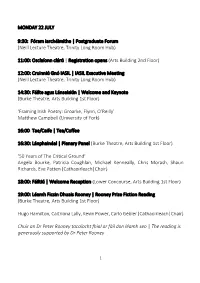
MONDAY 22 JULY 9:30: Fóram iarchéimithe | Postgraduate Forum (Neill Lecture Theatre, Trinity Long Room Hub) 11:00: Osclaíonn clárú | Registration opens (Arts Building 2nd Floor) 12:00: Cruinniú Gnó IASIL | IASIL Executive Meeting (Neill Lecture Theatre, Trinity Long Room Hub) 14:30: Fáilte agus Lánseisiún | Welcome and Keynote (Burke Theatre, Arts Building 1st Floor) ‘Framing Irish Poetry: Groarke, Flynn, O’Reilly’ Matthew Campbell (University of York) 16:00: Tae/Caife | Tea/Coffee 16:30: Lánphainéal | Plenary Panel (Burke Theatre, Arts Building 1st Floor) ‘50 Years of The Critical Ground’ Angela Bourke, Patricia Coughlan, Michael Kenneally, Chris Morash, Shaun Richards, Eve Patten (Cathaoirleach|Chair) 18:00: Fáiltiú | Welcome Reception (Lower Concourse, Arts Building 1st Floor) 19:00: Léamh Ficsin Dhuais Rooney | Rooney Prize Fiction Reading (Burke Theatre, Arts Building 1st Floor) Hugo Hamilton, Caitriona Lally, Kevin Power, Carlo Gébler (Cathaoirleach|Chair) Chuir an Dr Peter Rooney tacaíocht fhial ar fáil don léamh seo | The reading is generously supported by Dr Peter Rooney 1 TUESDAY 23 JULY 9:30: Seisiún Painéal 1 | Panel Session 1 (Mis)Representations: Oscar Wilde on Film (Neill Lecture Theatre, Trinity Long Room Hub) The Happy Prince: Biography, Boys, and Binaries Helena Gurfinkel (Cathaoirleach|Chair) Oscar Wilde, Postmodern Identities and Brian Gilbert’s Graham Price Wilde Sexual representation and the zeitgeist: Wilde, film, Julie-Ann Robson and A Man of No Importance Writing Art (TRiSS Seminar Room, Arts Building 6th Floor) -
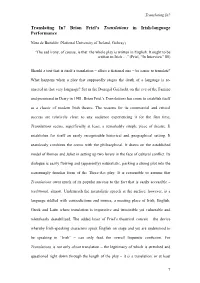
Brian Friel's Translations in Irish-Language Performance
Translating In? Translating In? Brian Friel’s Translations in Irish-language Performance Nóra de Buiteléir (National University of Ireland, Galway) “The sad irony, of course, is that the whole play is written in English. It ought to be written in Irish …” (Friel, “In Interview” 80) Should a text that is itself a translation – albeit a fictional one – be easier to translate? What happens when a play that supposedly stages the death of a language is re- enacted in that very language? Set in the Donegal Gaeltacht on the eve of the Famine and premiered in Derry in 1981, Brian Friel’s Translations has come to establish itself as a classic of modern Irish theatre. The reasons for its commercial and critical success are relatively clear: to any audience experiencing it for the first time, Translations seems, superficially at least, a remarkably simple piece of theatre. It establishes for itself an easily recognisable historical and geographical setting. It seamlessly combines the comic with the philosophical. It draws on the established model of Romeo and Juliet in setting up two lovers in the face of cultural conflict. Its dialogue is easily flowing and (apparently) naturalistic, packing a strong plot into the reassuringly familiar form of the Three-Act play. It is reasonable to assume that Translations owes much of its popular success to the fact that is easily accessible – traditional , almost. Underneath the naturalistic speech at the surface, however, is a language riddled with contradictions and ironies, a meeting place of Irish, English, Greek and Latin where translation is imperative and irresistible yet vulnerable and relentlessly destabilized. -

Brian Friel's Appropriation of the O'donnell Clan
University of Louisville ThinkIR: The University of Louisville's Institutional Repository Electronic Theses and Dissertations 5-2008 Celtic subtleties : Brian Friel's appropriation of the O'Donnell clan. Leslie Anne Singel 1984- University of Louisville Follow this and additional works at: https://ir.library.louisville.edu/etd Recommended Citation Singel, Leslie Anne 1984-, "Celtic subtleties : Brian Friel's appropriation of the O'Donnell clan." (2008). Electronic Theses and Dissertations. Paper 1331. https://doi.org/10.18297/etd/1331 This Master's Thesis is brought to you for free and open access by ThinkIR: The University of Louisville's Institutional Repository. It has been accepted for inclusion in Electronic Theses and Dissertations by an authorized administrator of ThinkIR: The University of Louisville's Institutional Repository. This title appears here courtesy of the author, who has retained all other copyrights. For more information, please contact thinkir@louisville.edu. "CELTIC SUBTLETIES": BRIAN FRIEL'S APPROPRIATION OF THE O'DONNELL CLAN By Leslie Anne Singel B.A., University of Dayton, 2006 A Thesis Submitted to the Faculty of the Graduate School at the University of Louisville in Partial Fulfillment of the Requirements for the Degree of Master of Arts Department of English University of Louisville Louisville, Kentucky May 2008 “CELTIC SUBLETIES”: BRIAN FRIEL’S APPROPRIATION OF THE O’DONNELL CLAN By Leslie Anne Singel B.A., University of Dayton, 2006 A Thesis Approved on April 9, 2008 by the following Thesis Committee: Thesis Director ii DEDICATION This thesis is dedicated to the McGarry family and to Roger Casement 111 ABSTRACT "CELTIC SUBTLETIES": BRIAN FRIEL'S APPROPRIATION OF THE O'DONNELL CLAN Leslie Anne Singel April 11, 2008 This thesis is a literary examination of three plays from Irish playwright Brian Friel, Translations, Philadelphia, Here I Come! and Aristocrats, all of which feature a family ofthe O'Donnell name and all set in the fictional Donegal village of Ballybeg. -
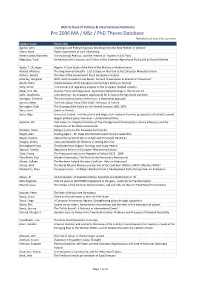
Theses Database School up to 2006 for the Website.Xlsx
UCD School of Politics & International Relations Pre 2006 MA / MSc / PhD Theses Datebase Alphabetical order by surname Student name Thesis Title Agnew, John Challenges and Policy Responses Resulting form the New Politics' of Welfare Ahern, Mark Public Assessment of Junk Advertising Aileen Forbes Munnelly The Hysterical Alienists and the Theatre of Hysteria in 19C Paris Akgunduz, Yucel An Analysis of the Success and Failure of the Common Agricultural Policy and its Recent Reform Apata, T. Olusegun Nigeria: A Case Study of the Role of the Military in Modernisation Arackal, Markose The long and narrow path: East Europe on the road to the European Monetary Union Arthurs, Gerard The Role of the Government Press Secretary in Ireland Atherlay, Margaret GATT and the Audio-Visual Sector: Cultural Preservation or Economic Protection? Avard, Tullan Critical Analysis of the European Community’s Policy on Tourism Baily, Simon A structural and regulatory analysis of the European football industry Baker, Erin, Ms Science, Policy and Regulation: Agricultural Biotechnology in the US and EU. Balfe, Dearbhalla Latin America - An untapped opportunity for European foreign direct investors Bannigan, Vivienne The internationalisation of the Euro: a theoretical approach Barrett, Helen The Irish Labour Party 1916-1918: The Roots of Failure Barrington, Ruth The Shaping of the Policy on Irish Health Services 1961-1970 Barry, John Limits to Growth Barry, Olga Unneutral Ireland: Irish Neutrality and Anglo-Irish relations from the perspective of Ireland’s second largest -
Brian Friel and the Politics of the Anglo-Irish Language
Colby Quarterly Volume 26 Issue 4 December Article 7 December 1990 Brian Friel and the Politics of the Anglo-Irish Language F. C. McGrath Follow this and additional works at: https://digitalcommons.colby.edu/cq Recommended Citation Colby Quarterly, Volume 26, no.4, December 1990, p.241-248 This Article is brought to you for free and open access by Digital Commons @ Colby. It has been accepted for inclusion in Colby Quarterly by an authorized editor of Digital Commons @ Colby. McGrath: Brian Friel and the Politics of the Anglo-Irish Language Brian Friel and the Politics of the Anglo-Irish Language byF. C. McGRATH ANGUAGE has always been used as a political and social weapon. It has been L used to oppress a colonized or conquered people, and it has been used to police the borders ofsocial class. In Ireland it has been used in both these ways. After the British had consolidated their colonization of Ireland, Gaelic was outlawed, and its use stigmatized a class of people who were conquered, oppressed, and impoverished. B~fore independence in 1922 Irish-accented Eng lish' including degrees ofIrish accent, established social hierarchies-thecloser to British English, the higher the class. George Steiner's observation about upperclass British accents applied with particular force in Ireland: "Upper-class English diction, with its sharpened vowels, elisions, and modish slurs, is both a code for mutual recognition-accent is worn like a coat of arms-and an instrument of ironic exclusion" (32). Since the late nineteenth century, however, knowledge ofthe old Gaelic has been turned into an offensive political weapon and a badge of Irish nationalist affiliation; and today the status of the Anglo-Irish language, that is, English as spoken by the Irish, has become a major concern for Brian Friel and other Irish writers associated with his Field Day Theatre Group. -

No. 47, September 2018
1 No. 47, September 2018 Editors: L. Görke – Prof. Dr. K. P. Müller – R. Walker Scottish Studies Newsletter 47, September 2018 2 Table of Contents Scottish Studies Newsletter 47, Sept 2018 Editorial 3 Scotland and the Turmoil of Brexit - A. L. Kennedy, "A toxic culture" 6 - Iain MacWhirter, "How to win Indyref 2? Keep it simple" 8 - "Sir Ivan Rogers' letter to staff in full" 11 Exchange students' reports - Josip Brekalo / Marco Giovanazzi, 14 "People make Glasgow" - A report from the perspective of two exchange students - Simona Hildebrand, "Fuireach anns an Dùn Eideann – Living in Edinburgh" 15 - Marsida Toska, "Edinburgh, my Love!" 16 - Jessica Völkel, "Autumn in Edinburgh" 18 Britain after the Brexit Decision Klaus Peter Müller, "The State of Britain 2018 - 2021: All Out War and Overall Bankruptcy" 19 Common Weal, "Scottish National Investment Bank Success" 41 New Scottish Poetry: Peter McCarey 43 Ian McGhee (Secretary, The John Galt Society), John Galt – Observer and Recorder 43 Stewart Whyte, Swithering Whytes or What to do with a troublesome cat? 47 (New) Media on Scotland 49 Education Scotland 104 Scottish Award Winners 114 New Publications March 2016 – February 2018 114 Book Reviews Peter Auger on Barbour's 'Bruce' and its Cultural Contexts 135 Chelsea Hartlen on Women and Violent Crime in Enlightenment Scotland 137 Richie McCaffery on Scotland in Europe / Europe in Scotland: … 139 James M. Morris on Facts and Inventions: Selections from the Journalism of J. Boswell 140 Klaus Peter Müller on Sir Walter Scott. A Life in Story 142 Carla Sassi on Opium and Empire: The Lives and Careers of W.