Honorary Freedom of the City
Total Page:16
File Type:pdf, Size:1020Kb
Load more
Recommended publications
-

Book of Remembrance 1829 – 1899
Book of Remembrance 1829 – 1899 1830 PC Joseph Grantham Kicked in the head attempting to arrest a drunken man at a disturbance in Somers Town. PC John Long Stabbed to death when he challenged three suspected burglars at night in Gray's Inn Lane. 1831 PC Michael Pratt Collapsed and died from a ruptured heart chasing four suspected thieves in Old Kent Road. 1832 PC Thomas Hart Drowned when a stray cow he was attempting to catch knocked him into the River Brent. 1833 PC Robert Culley Fatally stabbed during a riot at a political meeting in Coldbath Fields, Clerkenwell. 1836 PC William Bruff Found collapsed on his beat in Bunhill burial ground and died the next day 1838 PC John Barton Drowned when he fell in the River Lea from an unprotected towpath while on night duty. 1839 PC William Aldridge Died from a fractured skull after he was stoned by a mob during an arrest at Deptford. 1840 PC Peter Beadle Accidentally drowned when he fell in London Docks while patrolling his beat late at night. PC John Husbands Drowned in the Grosvenor Canal after having fallen from an unprotected bank while on night duty. 1841 PC James Carroll Attacked by a mob and struck with his own truncheon while making an arrest in Bethnal Green. 1842 PC Timothy Daly Shot dead attempting to arrest an armed and dangerous man for highway robbery at Highbury. PC Thomas Everett Drowned in London Docks having fallen from the unprotected quayside while on night duty. PC James Fulkes Found dead in the early hours on his beat at Holborn having struck his head in a fall. -

Title Information
Title information Newcastle United Minute by Minute Covering More Than 500 Goals, Penalties, Red Cards and Other Intriguing Facts By David Jackson Key features • Fascinating look back at Newcastle’s most important moments and greatest goals • First book of its kind on Newcastle United, with hundreds of memorable moments revisited • A treasure trove of nostalgia for United fans, charting the Magpies’ proud history with all the drama, elation, heartache, highs and lows • Records the goals and moments that inspired four top- flight titles and won United six FA Cups • Revisits the goals scored by such legends as Kevin Keegan, Jackie Milburn, Andy Cole and Alan Shearer • Publicity campaign planned including radio, newspapers, websites and magazines Description Newcastle United: Minute by Minute takes you on a fantastic journey through the Magpies’ matchday history. Relive all the breathtaking goals, heroic penalty saves, sending offs and other memorable moments in this unique by-the-clock guide. From United’s glorious early years and domestic domination through to the present day, the book covers everything from Frank Watt’s trophy-hunters to Stan Seymour’s FA Cup legends, Kevin Keegan’s swashbuckling entertainers, Sir Bobby Robson’s superb side and the Alan Shearer years. Revisit Newcastle’s most spectacular modern feats and learn things you didn’t know about the club’s proud history. From goals scored in the opening seconds to those last-gasp extra-time winners that have thrilled generations of fans at St James’ Park and around the world, Newcastle United: Minute by Minute is packed with memorable moments. With countless goals from the legendary Shearer, Milburn, Ginola and hundreds of others – the book is filled with thrilling memories from kick-off through to the final whistle. -

Orme) Wilberforce (Albert) Raymond Blackburn (Alexander Bell
Copyrights sought (Albert) Basil (Orme) Wilberforce (Albert) Raymond Blackburn (Alexander Bell) Filson Young (Alexander) Forbes Hendry (Alexander) Frederick Whyte (Alfred Hubert) Roy Fedden (Alfred) Alistair Cooke (Alfred) Guy Garrod (Alfred) James Hawkey (Archibald) Berkeley Milne (Archibald) David Stirling (Archibald) Havergal Downes-Shaw (Arthur) Berriedale Keith (Arthur) Beverley Baxter (Arthur) Cecil Tyrrell Beck (Arthur) Clive Morrison-Bell (Arthur) Hugh (Elsdale) Molson (Arthur) Mervyn Stockwood (Arthur) Paul Boissier, Harrow Heraldry Committee & Harrow School (Arthur) Trevor Dawson (Arwyn) Lynn Ungoed-Thomas (Basil Arthur) John Peto (Basil) Kingsley Martin (Basil) Kingsley Martin (Basil) Kingsley Martin & New Statesman (Borlasse Elward) Wyndham Childs (Cecil Frederick) Nevil Macready (Cecil George) Graham Hayman (Charles Edward) Howard Vincent (Charles Henry) Collins Baker (Charles) Alexander Harris (Charles) Cyril Clarke (Charles) Edgar Wood (Charles) Edward Troup (Charles) Frederick (Howard) Gough (Charles) Michael Duff (Charles) Philip Fothergill (Charles) Philip Fothergill, Liberal National Organisation, N-E Warwickshire Liberal Association & Rt Hon Charles Albert McCurdy (Charles) Vernon (Oldfield) Bartlett (Charles) Vernon (Oldfield) Bartlett & World Review of Reviews (Claude) Nigel (Byam) Davies (Claude) Nigel (Byam) Davies (Colin) Mark Patrick (Crwfurd) Wilfrid Griffin Eady (Cyril) Berkeley Ormerod (Cyril) Desmond Keeling (Cyril) George Toogood (Cyril) Kenneth Bird (David) Euan Wallace (Davies) Evan Bedford (Denis Duncan) -
Sir Bobby Charlton
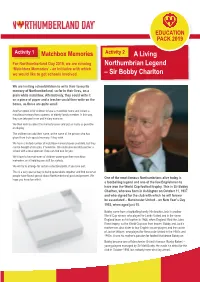
EDUCATION PACK 2019 Activity 1 Matchbox Memories Activity 2 A Living For Northumberland Day 2019, we are running Northumbrian Legend ‘Matchbox Memories’ - an initiative with which we would like to get schools involved. – Sir Bobby Charlton We are inviting schoolchildren to write their favourite memory of Northumberland, so far in their lives, on a plain white matchbox. Alternatively, they could write it on a piece of paper and a teacher could then write on the boxes, as these are quite small. Another option is for children to take a matchbox home and collect a matchbox memory from a parent, or elderly family member. In this way, they can take part in an oral history exercise. We then wish to collect the memory boxes and put as many as possible on display. The children can add their name, or the name of the person who has given them their special memory, if they wish. We have a limited number of matchbox memory boxes available, but they can be bought at Amazon, if needs be. We could also possibly partner a school with a local sponsor, if we can find one for you. We’d love to have pictures of children working on their matchbox memories, or all holding one aloft for a photo. We will try to arrange for certain collection points, if you take part. This is a very special way to being generations together and find out what people have found special about Northumberland, past and present. We hope you have fun with it. One of the most famous Northumbrians alive today is a footballing legend and one of the few Englishmen to have won the World Cup football trophy. -
Two Day Autograph Auction Day 1 Saturday 02 November 2013 11:00
Two Day Autograph Auction Day 1 Saturday 02 November 2013 11:00 International Autograph Auctions (IAA) Office address Foxhall Business Centre Foxhall Road NG7 6LH International Autograph Auctions (IAA) (Two Day Autograph Auction Day 1 ) Catalogue - Downloaded from UKAuctioneers.com Lot: 1 tennis players of the 1970s TENNIS: An excellent collection including each Wimbledon Men's of 31 signed postcard Singles Champion of the decade. photographs by various tennis VG to EX All of the signatures players of the 1970s including were obtained in person by the Billie Jean King (Wimbledon vendor's brother who regularly Champion 1966, 1967, 1968, attended the Wimbledon 1972, 1973 & 1975), Ann Jones Championships during the 1970s. (Wimbledon Champion 1969), Estimate: £200.00 - £300.00 Evonne Goolagong (Wimbledon Champion 1971 & 1980), Chris Evert (Wimbledon Champion Lot: 2 1974, 1976 & 1981), Virginia TILDEN WILLIAM: (1893-1953) Wade (Wimbledon Champion American Tennis Player, 1977), John Newcombe Wimbledon Champion 1920, (Wimbledon Champion 1967, 1921 & 1930. A.L.S., Bill, one 1970 & 1971), Stan Smith page, slim 4to, Memphis, (Wimbledon Champion 1972), Tennessee, n.d. (11th June Jan Kodes (Wimbledon 1948?), to his protégé Arthur Champion 1973), Jimmy Connors Anderson ('Dearest Stinky'), on (Wimbledon Champion 1974 & the attractive printed stationery of 1982), Arthur Ashe (Wimbledon the Hotel Peabody. Tilden sends Champion 1975), Bjorn Borg his friend a cheque (no longer (Wimbledon Champion 1976, present) 'to cover your 1977, 1978, 1979 & 1980), reservation & ticket to Boston Francoise Durr (Wimbledon from Chicago' and provides Finalist 1965, 1968, 1970, 1972, details of the hotel and where to 1973 & 1975), Olga Morozova meet in Boston, concluding (Wimbledon Finalist 1974), 'Crazy to see you'. -

Durham E-Theses
Durham E-Theses A history of north east shipbuilding: being an attempt to describe and analyse the development of shipbuilding in the North East of England from earliest times to the end of 1967 Dougan, D. J. How to cite: Dougan, D. J. (1968) A history of north east shipbuilding: being an attempt to describe and analyse the development of shipbuilding in the North East of England from earliest times to the end of 1967, Durham theses, Durham University. Available at Durham E-Theses Online: http://etheses.dur.ac.uk/9906/ Use policy The full-text may be used and/or reproduced, and given to third parties in any format or medium, without prior permission or charge, for personal research or study, educational, or not-for-prot purposes provided that: • a full bibliographic reference is made to the original source • a link is made to the metadata record in Durham E-Theses • the full-text is not changed in any way The full-text must not be sold in any format or medium without the formal permission of the copyright holders. Please consult the full Durham E-Theses policy for further details. Academic Support Oce, Durham University, University Oce, Old Elvet, Durham DH1 3HP e-mail: e-theses.admin@dur.ac.uk Tel: +44 0191 334 6107 http://etheses.dur.ac.uk 2 j> i^ ovw / si-. ABSTKACT OF Art bt.A. SUBMISSION ^ ^ "A hISTOKY <.)F wOKTn EAST SHIPrtUILtilNXi" PKKSEwTEU BY U.JJ. OOUOA1K)UGAw« FPU AN w.Aw .A. ^fr'MffffffJJgliBKK*. DECEri MBK 196g IS69 At the end or the lyth century, trie united Kingdom produced four out of every five ships built in tne whole world, and the North East coast of England, stretching from jjlyth in tne North to Whitby in the South, was responsible for tvo out of those five ships. -

STATE of POLICING Foreword This Is My Report to the Secretary of State Under Section 54 of the Police Act 1996
© PA Images STATE OF POLICINGOF STATE Foreword This is my report to the Secretary of State under section 54 of the Police Act 1996. It contains my assessment of the efectiveness FOREWORD and efciency of policing in England and Wales, based on the inspections we carried out between April 2018 and May 2019. My report on the efectiveness and efciency of fire and rescue services in England will be published separately. This report’s structure and purpose Part 1 contains my assessment of the state of policing in England and Wales. In making my assessment, I have drawn on the inspections we carried out over the past year, as well as the fndings and reports of other organisations, and other information and analysis available to me. Part 2 gives an overview of the fndings of the inspections we carried out between 1 April 2018 and 2 May 2019, including a summary of our police effciency, effectiveness and legitimacy (PEEL) inspections. Part 3 sets out the full list of our inspections and other work in the year in question. The results of our individual inspections enable an assessment of the performance of individual forces, or a more general assessment of performance in specifc aspects of policing. I hope that people, including the public, who hold policing to account will draw on the overall conclusions in this report just as much as they draw on the specifc conclusions we have reached for each force. 6 STATE OF POLICINGOF STATE FOREWORD © Sussex Police Changes to our PEEL programme Inspection is a continuous process of design, monitoring and reporting; it isn’t just when we have ‘boots on the ground’. -
Alan Shearer Was Assigned the Task to Track Down Anthony Mitchell
The Sporting Image: What If? Chapter 9 Taxi for Agent Alan, to Rio and the French Connection Sean Dean and Clive Palmer Research Preface HE CREATIVE STORY IN THIS CHAPTER is a spoof comedic account of Alan Shearer playing the part of a CIA Agent. In order to spin T such a yarn it is seemingly helpful to know some context as to how such a story might come about. The tale starts when Alan retires from playing football after an illustrious career in the game. To all intents and purposes his stature and reputation within football as a player and now as an ambassador for the game may be a perfect cover to mask his secret agent activities for the USA! Alan Shearer was born in, Gosforth, Newcastle in 1970 to working-class parents Alan and Anne Shearer (Wikipedia, 2009). His father wanted him to take up football as a youngster. His football career started when he was a teenager playing for Wallsend Boys Club and from here he was scouted to trial at Southampton. He was offered a contract to play for Southampton in April 1986 (Wikipedia, 2009). Alan played for the Southampton first team in 1988 and was already starting to show his goal scoring prowess when he, “became the first man to score 30 Premier League goals in three successive seasons” (Newcastle United Football Club, 2008). After spending four years at the club he went on to play for Blackburn Rovers Football Club. At Blackburn FC, who paid at the time “a British record £3.6m fee in 1992” (NUFC, 2008), he would have his best years of football success in the Premiership. -
Genesis of Football Support
View metadata, citation and similar papers at core.ac.uk brought to you by CORE provided by Northumbria Research Link Northumbria Research Link Citation: Dixon, Kevin (2014) Football fandom and Disneyisation in late-modern life. Leisure Studies, 33 (1). pp. 1-21. ISSN 0261-4367 Published by: Taylor & Francis URL: https://doi.org/10.1080/02614367.2012.667819 <https://doi.org/10.1080/02614367.2012.667819> This version was downloaded from Northumbria Research Link: http://nrl.northumbria.ac.uk/id/eprint/43466/ Northumbria University has developed Northumbria Research Link (NRL) to enable users to access the University’s research output. Copyright © and moral rights for items on NRL are retained by the individual author(s) and/or other copyright owners. Single copies of full items can be reproduced, displayed or performed, and given to third parties in any format or medium for personal research or study, educational, or not-for-profit purposes without prior permission or charge, provided the authors, title and full bibliographic details are given, as well as a hyperlink and/or URL to the original metadata page. The content must not be changed in any way. Full items must not be sold commercially in any format or medium without formal permission of the copyright holder. The full policy is available online: http://nrl.northumbria.ac.uk/pol i cies.html This document may differ from the final, published version of the research and has been made available online in accordance with publisher policies. To read and/or cite from the published version of the research, please visit the publisher’s website (a subscription may be required.) Football Fandom and Disneyization in Late Modern Life In 1999 Alan Bryman coined the term Disneyization to make the case that more and more sectors of social and cultural life are coming to take on the manifestations of a commercial style theme park. -

Employment Sites 2014/15
Employment Sites 2014/15 Planning & Housing Services, Planning, Economy & Housing As at 31st March 2015 Northumberland 2014/15 Employment Site Schedule Acknowledgement This schedule is part of a regular monitoring exercise undertaken annually by the County Council’s Spatial Planning & Delivery team. Information is based on sites monitored within the former district/borough Local Plans and/or Core Strategies. A number of internal and external sources are used to provide information on land uptake and occupier change. We gratefully acknowledge the assistance of the following :- Northumberland County Council Building Control Edwin Thompson Northumberland Corporate Research Unit George F White North Northumberland Development Management Team GVA Strategic & Urban Development Management Team Johnson Tucker West Northumberland Development Management Team Jones Lang Laselle Knight Frank Arch (Commercial Enterprise) Ltd MJM Commercial Bizspace Ltd Naylors Chartered Surveyors Blagdon Estates Northumberland Estates Blyth Community Enterprise Centre Philip Gifford & Associates BNP Paribas Sanderson Weatherall Whittle Jones Front Cover image courtesy of STP Construction Youngs Chartered Surveyors Disclaimer This schedule covers the period up to 31st March 2015. Whilst every effort is made to ensure it’s accuracy, the Council can accept no responsibility for any loss as a result of using this information. If there are any queries regarding this schedule, please contact Emma Thomas on 01670 622 691 Site Plans These are based on O. S. map material, Crown -
The Eagle 1950 (Michaelmas)
.ft THE EAGLE vi jJ,fagazine , SUPPORTED BY MEMBERS OF Sf 'Yohn's College S"iJoIL Doll, Id", aa.ll!llbl VOLUME LIV, No. 238 PRINTED A T THE UNIVERSITY PRESS FOR SUBSCRIBERS ONLY MCMLI Printed in Great Britain at the University Press, Cambridge (Brooke Crutchley, University Printer) Rt CONTENTS PAGE John Williams: a Tercentenary Commemoration Sennon by the Reverend Charles Smyth 225 Poem: November 243 A Symposium 244 Sonnet 247 EDITORIAL COMMITTEE Century Cambridge Exercises in the Seventeenth 248 Mr BA MBROUGH� DR EVANs, C. C. GOL DSMITH, Mr HINSLE Y (Treasurer), M. T. HOPPE R, M. W. STEP HENS (Secretary), Mr WATT Epic Fragments 259 (Editor). Sad Story 260 All contributions for the next issue of the Magazine should be sent to The Editors, The Eagle, St John's College, by 1 June 1951. The Poem 262 Editors will welcome assistance in mal{ing the College Notes, and the Magazine generally, as complete a record as possible of the Sea Time 263 careers of members of the College. They will welcome books or articles dealing with the College and its members for review; and College Athletic Cups: December 1950 266 books published by members of the College for shorter notice. "The Zeal of Thy House" : December 1950 267 College Notes 270 Obituary: Martin Percival Charlesworth 278 Book Reviews 286 Johniana 290 Illustrations: The We stminster Portrait of John Williams Frontispiece The College Athletic Cups: December 1950 fa cingp . 266 Martin ;?ercival Charlesworth . " 278 THE EAGLE ���������������������� ��������� ��� VOL. LIV JANUARY 1951 No. 238 ���������������������������������� JOHN WILLIAMS (1582-1650) TE RCENTEN ARY Commemoration Sermon preached in the Chapel of St John's College, Cambridge, on Sunday, 5 ANovember 1950, by the Reverend CHARLES SMY TH, Canon of Westminster and Rector of St Margaret's. -

Industrial Period 1750-1950
INDUSTRIAL PERIOD 1750-1950 Industry is a term that describes a wide range of economic activities based on the sourcing, manipulation and movement of raw materials for commercial gain. In the modern era the term is used widely to describe activities as diverse as banking, computer software engineering and forestry, but in the period of industrial development between about 1750 and 1950 it is usually associated with the transformation of natural raw materials into useful products using water-power or coal as the primary source of energy. During the course of the 19th century, coal replaced water as the main power source of industrial Britain. The Great Northern Coalfield had long been the biggest producer of coal in the country, and a variety of other industries became established on the banks of the Tyne and Wear by taking advantage of the abundant supply of cheap fuel. However, despite the apparent advantages of the region in terms of its coal supplies and access to waterways, its industrial development was not rapid, and until well into the 19th century it lagged behind other parts of Britain, such as West Yorkshire, Merseyside and Clydeside in the crucial fields of iron production and engineering. Shipbuilding, too, was also held back by the terrible state of the rivers and by the continuation of the wooden shipbuilding tradition. The river improvements undertaken soon after the middle of the 19th century, allied to increasing iron (later steel) production in the region and the growth of iron shipbuilding from about 1850, were responsible for the transformation of the region into Britain’s foremost industrial centre.