You Dream We Deliver
Total Page:16
File Type:pdf, Size:1020Kb
Load more
Recommended publications
-

The Case of Kataragama Pāda Yātrā in Sri Lanka
Sri Lanka Journal of Social Sciences 2017 40 (1): 41-52 DOI: http://dx.doi.org/10.4038/sljss.v40i1.7500 RESEARCH ARTICLE Collective ritual as a way of transcending ethno-religious divide: the case of Kataragama Pāda Yātrā in Sri Lanka# Anton Piyarathne* Department of Social Studies, Faculty of Humanities and Social Sciences, The Open University of Sri Lanka, Nawala, Sri Lanka. Abstract: Sri Lanka has been in the prime focus of national and who are Sinhala speakers, are predominantly Buddhist, international discussions due to the internal war between the whereas the ethnic Tamils, who communicate in the Tamil Liberation Tigers of Tamil Eelam (LTTE) and the Sri Lankan language, are primarily Hindu. These two ethnic groups government forces. The war has been an outcome of the are often recognised as rivals involved in an “ethnic competing ethno-religious-nationalisms that raised their heads; conflict” that culminated in war between the LTTE (the specially in post-colonial Sri Lanka. Though today’s Sinhala Liberation Tigers of Tamil Eelam, a military movement and Tamil ethno-religious-nationalisms appear as eternal and genealogical divisions, they are more of constructions; that has battled for the liberation of Sri Lankan Tamils) colonial inventions and post-colonial politics. However, in this and the government. Sri Lanka suffered heavily as a context it is hard to imagine that conflicting ethno-religious result of a three-decade old internal war, which officially groups in Sri Lanka actually unite in everyday interactions. ended with the elimination of the leadership of the LTTE This article, explains why and how this happens in a context in May, 2009. -

Sri Lanka • Colombo & the Enchanted Isle
SRI LANKA • COLOMBO & THE ENCHANTED ISLE SRI LANKA The captivating island of Sri Lanka is rich in cultural and archaeological treasures spanning some 2,500 years in history - from the sacred city of Anuradhapura and the cave temples of Dambulla, to the palaces of the royal city of Kandy. It has 7 World Heritage Sites including one natural one - the Sinharaja Forest Reserve. Tea plantation © Shutterstock Polunnaruwa, which was Sri Lanka’s medieval SRI LANKA - THE capital. B ENCHANTED ISLE Day 4 Cultural Triangle Drive to Kandy, touring the Dambulla Cave 10 days/9 nights Temple and Spice Garden at Matale en route. From $2003 per person twin share Remainder of day at leisure. B Departs daily ex Colombo Day 5 Kandy Price per person from*: Cat A Cat B Cat C Excursion to the Royal Botanical Gardens at $2651 $2184 $2003 Peradeniya, a paradise for nature lovers. Later, *Based on two people sharing, singles on request. visit the Temple of the Tooth Relic, one of the INCLUSIONS world’s most sacred Buddhist sites and enjoy an Transfers, excursions in superior air-conditioned private evening traditional cultural performance. B vehicle with English speaking chauffeur guide, entrance fees, accommodation on a bed and breakfast basis, 1 bottle of water per person per day included for all surface travel. EXCLUSIONS Camera fees. A Jetwing Beach/Cinnamon Lodge/Elephant Stables/ Heritance Tea Factory/Anantara Tangalle/Kingsbury B Suriya Resort/Aliya Resort & Spa/Mahawali Reach/ Grand Hotel/Coco Tangalle/Galle Face Golden Temple of Dambulla © Shutterstock C Goldi Sands/Sigiriya Village/Amaya Hills/Jetwing St. -

Kandy Esala Perahera Trust - 2014
P.S.No.77/2016 - Third Installment – Part – III – Funds – Report of the Auditor General – 2014 --------------------------------------------------------------------------------------------------------------------------- Kandy Esala Perahera Trust - 2014 The audit of financial statements of the Kandy Esala Perahera Trust for the year ended 31 December 2014 comprising the balance sheet as at 31 December 2014 and the income and expenditure account and cash flow statement and a summary of significant accounting policies and other explanatory information was carried out under my direction in pursuance of provisions in Article 154(3) of the Constitution of the Democratic Socialist Republic of Sri Lanka read in conjunction with Section 16(2) of the Kandy Esala Perahera Trust Act, No. 34 of 1980. 1.2 Management’s Responsibility for the Financial Statements --------------------------------------------------------------------------- The management is responsible for the preparation and fair presentation of these financial statements in accordance with Sri Lanka Public Sector Accounting Standards and for such internal control as the management determines is necessary to enable the preparation of financial statements that are free from material misstatements, whether due to fraud or error. 1.3 Auditor’s Responsibility --------------------------------- My responsibility is to express an opinion on these financial statements based on my audit. I conducted my audit in accordance with Sri Lanka Auditing Standards consistent with International Standards of Supreme Audit Institutions (ISSAI 1000-1810). Those Standards require that I comply with ethical requirements and plan and perform the audit to obtain reasonable assurance about whether the financial statements are free from material misstatements. An audit involves performing procedures to obtain audit evidence about the amounts and disclosures in the financial statements. -
Buddhist Forest Monasteries and Meditation Centres in Sri Lanka a Guide for Foreign Buddhist Monastics and Lay Practitioners
Buddhist Forest Monasteries and Meditation Centres in Sri Lanka A Guide for Foreign Buddhist Monastics and Lay Practitioners Updated: April 2018 by Bhikkhu Nyanatusita Introduction In Sri Lanka there are many forest hermitages and meditation centres suitable for foreign Buddhist monastics or for experienced lay Buddhists. The following information is particularly intended for foreign bhikkhus, those who aspire to become bhikkhus, and those who are experienced lay practitioners. Another guide is available for less experienced, short term visiting lay practitioners. Factors such as climate, food, noise, standards of monastic discipline (vinaya), dangerous animals and accessibility have been considered with regard the places listed in this work. The book Sacred Island by Ven. S. Dhammika—published by the BPS—gives exhaustive information regarding ancient monasteries and other sacred sites and pilgrimage places in Sri Lanka. The Amazing Lanka website describes many ancient monasteries as well as the modern (forest) monasteries located at the sites, showing the exact locations on satellite maps, and giving information on the history, directions, etc. There are many monasteries listed in this guides, but to get a general idea of of all monasteries in Sri Lanka it is enough to see a couple of monasteries connected to different traditions and in different areas of the country. There is no perfect place in samṃsāra and as long as one is not liberated from mental defilements one will sooner or later start to find fault with a monastery. There is no monastery which is perfectly quiet and where the monks are all arahants. Rather than trying to find the perfect external place, which does not exist, it is more realistic to be content with an imperfect place and learn to deal with the defilements that come up in one’s mind. -
Colombo Final Plot Final
U.S. Department of State Overseas Building Office Makayla Bellamy University of Virginia School of Architecture Juwan Palmer Felix Yizhou Li Systems, Sites and Building, Fall 2014 Colombo, Sri Lanka is the largest urban city on the island just off of the southern coast of India. The island has a history of immigration, trade, and colonial invasion, providing the city with a diverse variety of ethnic groups, languages, and religions. While the largest religion on the island is Buddhism, there is a large collections of Tamils and Muslims. The topography of Sri Lanka is classified into two regions; the dry-zone that stretches from north to southeast, and the wet-zone that stretches from west to south. The dry highlands consist of a variety of temples and man-made lakes, while the dry lowlands are preferred farmland. The wetlands consist of sites preferable for fishing, and tourist attracting beaches. This is where Colombo is located. The construction of Sri Lanka was based off of a hierarchical system, in which only buildings of high elite were designed to maintain permanence. This left many ruins throughout the island that are representative of this elite system. The architecture current- ly is mainly religious, and because of the high religious diversity, there is a diverse architectural landscape. Around the island, there is a large percentage of the poor that live in mud and thatched roof houses using designs that date back to ancient times. In Colombo however, there is a high percentage of lower middle class, most of which prefer white washed cements houses with polished cement floors. -
MICE-Proposal-Sri-Lanka-Part-2.Pdf
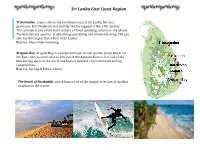
Sri Lanka East Coast Region Trincomalee , a port city on the northeast coast of Sri Lanka. Set on a peninsula, Fort Frederick was built by the Portuguese in the 17th century. Trincomalee is one of the main centers of Tamil speaking culture on the island. The beaches are used for scuba diving, snorkeling and whale watching. The city also has the largest Dutch Fort in Sri Lanka. Best for: blue-whale watching. Arugam Bay, Arugam Bay is a unique and spectacular golden sandy beach on the East coast, located close to Pottuvil in the Ampara district. It is one of the best surfing spots in the world and hosts a number of international surfing competitions. Best for: Surfing & Ethnic Charm The beach of Pasikudah, which boasts one of the longest stretches of shallow coastline in the world. Sri Lanka ‘s Cultural Triangle Sri Lanka’s Cultural triangle is situated in the centre of the island and covers an area which includes 5 World Heritage cultural sites(UNESCO) of the Sacred City of Anuradhapura, the Ancient City of Polonnaruwa, the Ancient City of Sigiriya, the Ancient City of Dambulla and the Sacred City of Kandy. Due to the constructions and associated historical events, some of which are millennia old, these sites are of high universal value; they are visited by many pilgrims, both laymen and the clergy (prominently Buddhist), as well as by local and foreign tourists. Kandy the second largest city in Sri- Lanka and a UNESCO world heritage site, due its rich, vibrant culture and history. This historic city was the Royal Capital during the 16th century and maintains its sanctified glory predominantly due to the sacred temples. -

Humanistic Elements in Early Buddhism and the "Theravada Tradition"
Humanistic Elements in Early Buddhism and the "Theravada Tradition" By Ananda W. P. Guruge ABSTRACT The paper begins with an examination of the different defuritions of humanism. Humanism primarily consistsof a concern with interests andideals of human beings, a way of peefection of human personality, a philosophical attitude which places the human and human val.Mes above all others, and a pragmatic system (e.g. that of F. C. S. Schiller and William James) whichdiscounts abstract theorizing and concentrates on the knowable and the doable. EarlyBuddhism, by whichis meant the teachingsof the Buddha as found in the PallCanon and the AgamaSutras, isdistinguished from other tradifions. The paperclarifies the error of equating Early Buddhism with the so-called Theravada Tradition of South and SoutheastAsia. Historically, the independent Theravada Tradifion with whatever specificity it had in doctrines came to an end when the three Buddhist schools (Mahavihara, Abhayagiri andJetavana) of SriLanka were unifiedin the twelfth century. What developed since then and spread to South andSoutheast Asia is an amalgam of allBuddhist traditions with the Pall Canon andits commentaries as the scriptures. With the reform measures in the eighteenth and the nineteenth centuries, the kind of modern Buddhism prevalent as "Theravada" is flexible, tolerant and reinforced by modernizing influence of Western Christian values. The paper analyses references to the Buddha's own autobiographical statements and other data in the Pali Canon and Commentaries and shows that the Buddha stood as a man before human beings to demonstrate how they could develop themselves by their own effort and reach the end of suffering. This final goal of peefedion is within the reach of every human being. -

THE Conttubtjtion of TAMIL CULTURE to WORLD Civilization
THE CONTtuBtJTION OF TAMIL CULTURE TO WORLD CIVILIZATioN Kumaran SUBERAMANIAN :MALBZYAJMALAYSIA Culture has been defined as the pursuit of perfection, which is the embodiment of sweetness and light. Culture reveals the various stages in the "development of an individual, a group or class or of a whole society". Culture, consists in the images that make imagination possible, in the media with which we mediate experience. All the artifacts we make and the relationships we enter into, have in that sense 'culture' consequences, for they gave form and shape to the way we think about other artifacts, other relationships. In cuiture is the distilled essence of the way of life of people, then, in the case of the people, the distillation process has covered a time span of more than two thousand years. And, today, the Tamil people, living in many lands and across distant seas acquire strength from the richness of their own cultural heritage - not only because that culture has somethirtg to do with their own roots and their way of life but also because they believe that culture has a significant contributions to make to the world. The following works of art and literature are among the most remarkable contributions of the Tamil creative genius to the world's cultural treasure and should be familiar to the whole world and admired and beloved by aU. The Thirukkural one of the great books of the world, one those singular emanations of the human heart and spirit which preacnes positive love and forgiveness and peace. The epical poem Cilappatikaram which by the 'baroque splendor' and by the charm and magic of its lyrical parts belongs to the epic masterpieces of the world. -

Sri Pada': TRENDS in POPULAR BUDDHISM in SRI LANKA
GOD OF COMPASSION AND THE DIVINE PROTECTOR OF 'sRi pADA': TRENDS IN POPULAR BUDDHISM IN SRI LANKA Introduction Theravada Buddhism in Sri Lanka has always coexisted with various forms of other religious practices oriented to deities, planets, astrology and demons (yakku), and some of these often figure in the Hindu tradition as well. However, the Buddhist doctrine in its canonical form stands apart from the culturally- specific forms of popular religious practices. Beliefs in gods and other supernatural powers and rituals are, in theory, inappropriate to be considered as part of Buddhism. But many anthropologists and sociologists who have spent extended periods of time in Theravada Buddhist societies have shown that Buddhists do believe in various types of supernatural powers and the magical efficacy of rituals which are outside the Buddhist doctrine. According to Obeyesekere (1962) astrology, gods and demon belief in 'Sinhala Buddhism' are guided by basic Buddhist principles such as karma, rebirth, suffering etc. So in that sense the practice of deity worship cannot be described as totally un- Buddhistic, yet at the same time it does not fall into the category of folk religious practices like bali and tovil adopted by popular Buddhism (see De Silva 2000, 2006). In Sri Lanka. there are four deities regarded as the guardians of the Buddha-sasana in the island: Vishnu, Saman, Kataragama, Natha and Pattini. Although Vishnu and Kataragama (Skanda) are originally Hindu gods, the Buddhists have taken them over as Buddhist deities, referring to them also by the localized designation, Uppalavanna and Kataragama. The role of Kataragama, Vi1inI1UNatha, and Pattini worship in the contemporary Sri Lankan society has been well researched by several scholars (e.g., Obeyesekere 1984; Holt 1991,2005; Gunasekara 2007) but the position of god Saman in the similar context has not been adequately investigated. -

And Dasa-Silas in Sinhala
3 Pañipatti 4 5 Arhant Mahinda as Redactor of the Buddhapåjàva and the Pa¤ca-, Aññhangika- and Dasa-sãlas in Sinhala Buddhism Trinity College, Suwanda H J Sugunasiri University of Toronto; Nalanda College Abstract of Buddhist Studies (Canada) Buddha Påjà ‘Homage to the Buddha’ is a religious practice found in every Buddhist temple and many a Buddhist household around the world. Over the last two millennia or more, it has taken many a shape and turn. This treatment, however, relates to the Buddha Påjà in the particular cultural context of Sinhala Buddhism, writing it as a single word, Buddhapåjàva (with a -va Canadian Journal of denoting the Sinhalizing suffix) to distinguish it from the ritual in Buddhist Studies, Number Eight, 2012 other cultural contexts. It is as practiced in Sri Lanka, ironically, not in Sinhala but in Pali, Buddhism being introduced in the 3rd c. BCE by Arhant Mahinda during the reign of Devanampiya Tissa in the Anuradhapura period. It is not the Buddhapåjàva itself, however, that is the topic of this paper, but its authorship. Finding no evidence of its authorship, or origin, in India, it comes to be located in Sri Lanka. Seeking evidence for its Redactor from within the ritual itself, we are led to none other than Arhant Mahinda who introduces the Buddhadhamma to the island. It is also established how, in the very process of creating the Buddhapåjàva, the pa¤ca-, aññhangika- and dasa-sãlas also come to be systematized into a coherent pattern. Two alternative dates for the possible launch of the ceremony © 2012 are suggested, making it the oldest living Buddhapåjà ritual in the by Nalanda College world. -

Traditional Knowledge Systems and the Conservation and Management of Asia’S Heritage Rice Field in Bali, Indonesia by Monicavolpin (CC0)/Pixabay
ICCROM-CHA 3 Conservation Forum Series conservation and management of Asia’s heritage conservation and management of Asia’s Traditional Knowledge Systems and the Systems Knowledge Traditional ICCROM-CHA Conservation Forum Series Forum Conservation ICCROM-CHA Traditional Knowledge Systems and the conservation and management of Asia’s heritage Traditional Knowledge Systems and the conservation and management of Asia’s heritage Rice field in Bali, Indonesia by MonicaVolpin (CC0)/Pixabay. Traditional Knowledge Systems and the conservation and management of Asia’s heritage Edited by Gamini Wijesuriya and Sarah Court Forum on the applicability and adaptability of Traditional Knowledge Systems in the conservation and management of heritage in Asia 14–16 December 2015, Thailand Forum managers Dr Gamini Wijesuriya, Sites Unit, ICCROM Dr Sujeong Lee, Cultural Heritage Administration (CHA), Republic of Korea Forum advisors Dr Stefano De Caro, Former Director-General, ICCROM Prof Rha Sun-hwa, Administrator, Cultural Heritage Administration (CHA), Republic of Korea Mr M.R. Rujaya Abhakorn, Centre Director, SEAMEO SPAFA Regional Centre for Archaeology and Fine Arts Mr Joseph King, Unit Director, Sites Unit, ICCROM Kim Yeon Soo, Director International Cooperation Division, Cultural Heritage Administration (CHA), Republic of Korea Traditional Knowledge Systems and the conservation and management of Asia’s heritage Edited by Gamini Wijesuriya and Sarah Court ISBN 978-92-9077-286-6 © 2020 ICCROM International Centre for the Study of the Preservation and Restoration of Cultural Property Via di San Michele, 13 00153 Rome, Italy www.iccrom.org This publication is available in Open Access under the Attribution Share Alike 3.0 IGO (CCBY-SA 3.0 IGO) license (http://creativecommons.org/licenses/by-sa/3.0/igo). -

Swadeshi Khomba Illuminates Kiri Vehera & Ruhunu Maha
Swadeshi Khomba illuminates Kiri Vehera & Ruhunu Maha Kataragama Devalaya at Kataragama for the 20th consecutive year The 2021 Esala festivals of the Kataragama Kiri Vehera and the Ruhunu Kataragama Maha Devalaya, two important places of worship in Sri Lanka, are being illuminated by The Swadeshi Industrial Works PLC the pioneer herbal – personal care products manufacturer. The illumination is done under the theme of “Swadeshi Khomba Aloka Puja Sathkaraya” In addition Swadeshi illuminated one of the most three important locations in Kataragama the “Sella Kataragama” devalaya for the third time this year. The on-going events began on July 10th and end on July 23rd 2021, and Swadeshi is sponsoring the Aloka Poojawa for the 20th consecutive year. Ms. Amari Wijewardene, Chairperson of Swadeshi said that as a Sri Lankan owned company, we consider it a duty to safeguard the culture and traditional heritage of Sri Lanka by supporting activities such as this annual Aloka Poojawa. She further observed that, Swadeshi illuminates places of worship in the country for the benefit of all worshippers and also to educate the younger generation on the importance of safeguarding the country’s heritage. The illumination is followed by a colourful cultural pageant which highlights Sri Lankan traditions and history. Source: The Nation According to the Mahavamsa, Kiri Vehera was built by King Mahanaga in a commemoration of the Buddha’s visit to Kataragama Kihiri Uyana to deliver dharma during his third visit to Sri Lanka. The Kataragama Devalaya was built by King Dutugemunu as a fulfilment of a vow made to safeguard the national interests of Sri Lanka.