Summer Lilies..P17 Wood Duck Boxes..P8
Total Page:16
File Type:pdf, Size:1020Kb
Load more
Recommended publications
-

Liliaceae S.L. (Lily Family)
Liliaceae s.l. (Lily family) Photo: Ben Legler Photo: Hannah Marx Photo: Hannah Marx Lilium columbianum Xerophyllum tenax Trillium ovatum Liliaceae s.l. (Lily family) Photo: Yaowu Yuan Fritillaria lanceolata Ref.1 Textbook DVD KRR&DLN Erythronium americanum Allium vineale Liliaceae s.l. (Lily family) Herbs; Ref.2 Stems often modified as underground rhizomes, corms, or bulbs; Flowers actinomorphic; 3 sepals and 3 petals or 6 tepals, 6 stamens, 3 carpels, ovary superior (or inferior). Tulipa gesneriana Liliaceae s.l. (Lily family) “Liliaceae” s.l. (sensu lato: “in the broad sense”) - Lily family; 288 genera/4950 species, including Lilium, Allium, Trillium, Tulipa; This family is treated in a very broad sense in this class, as in the Flora of the Pacific Northwest. The “Liliaceae” s.l. taught in this class is not monophyletic. It is apparent now that the family should be treated in a narrower sense and some of the members should form their own families. Judd et al. recognize 15+ families: Agavaceae, Alliaceae, Amarylidaceae, Asparagaceae, Asphodelaceae, Colchicaceae, Dracaenaceae (Nolinaceae), Hyacinthaceae, Liliaceae, Melanthiaceae, Ruscaceae, Smilacaceae, Themidaceae, Trilliaceae, Uvulariaceae and more!!! (see web reading “Consider the Lilies”) Iridaceae (Iris family) Photo: Hannah Marx Photo: Hannah Marx Iris pseudacorus Iridaceae (Iris family) Photo: Yaowu Yuan Photo: Yaowu Yuan Sisyrinchium douglasii Sisyrinchium sp. Iridaceae (Iris family) Iridaceae - 78 genera/1750 species, Including Iris, Gladiolus, Sisyrinchium. Herbs, aquatic or terrestrial; Underground stems as rhizomes, bulbs, or corms; Leaves alternate, 2-ranked and equitant Ref.3 (oriented edgewise to the stem; Gladiolus italicus Flowers actinomorphic or zygomorphic; 3 sepals and 3 petals or 6 tepals; Stamens 3; Ovary of 3 fused carpels, inferior. -

Summary of Offerings in the PBS Bulb Exchange, Dec 2012- Nov 2019
Summary of offerings in the PBS Bulb Exchange, Dec 2012- Nov 2019 3841 Number of items in BX 301 thru BX 463 1815 Number of unique text strings used as taxa 990 Taxa offered as bulbs 1056 Taxa offered as seeds 308 Number of genera This does not include the SXs. Top 20 Most Oft Listed: BULBS Times listed SEEDS Times listed Oxalis obtusa 53 Zephyranthes primulina 20 Oxalis flava 36 Rhodophiala bifida 14 Oxalis hirta 25 Habranthus tubispathus 13 Oxalis bowiei 22 Moraea villosa 13 Ferraria crispa 20 Veltheimia bracteata 13 Oxalis sp. 20 Clivia miniata 12 Oxalis purpurea 18 Zephyranthes drummondii 12 Lachenalia mutabilis 17 Zephyranthes reginae 11 Moraea sp. 17 Amaryllis belladonna 10 Amaryllis belladonna 14 Calochortus venustus 10 Oxalis luteola 14 Zephyranthes fosteri 10 Albuca sp. 13 Calochortus luteus 9 Moraea villosa 13 Crinum bulbispermum 9 Oxalis caprina 13 Habranthus robustus 9 Oxalis imbricata 12 Haemanthus albiflos 9 Oxalis namaquana 12 Nerine bowdenii 9 Oxalis engleriana 11 Cyclamen graecum 8 Oxalis melanosticta 'Ken Aslet'11 Fritillaria affinis 8 Moraea ciliata 10 Habranthus brachyandrus 8 Oxalis commutata 10 Zephyranthes 'Pink Beauty' 8 Summary of offerings in the PBS Bulb Exchange, Dec 2012- Nov 2019 Most taxa specify to species level. 34 taxa were listed as Genus sp. for bulbs 23 taxa were listed as Genus sp. for seeds 141 taxa were listed with quoted 'Variety' Top 20 Most often listed Genera BULBS SEEDS Genus N items BXs Genus N items BXs Oxalis 450 64 Zephyranthes 202 35 Lachenalia 125 47 Calochortus 94 15 Moraea 99 31 Moraea -
Srgc Bulb Log Diary
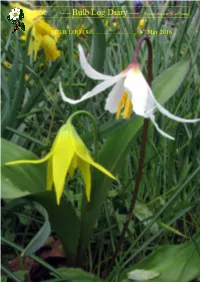
SRGC ----- Bulb Log Diary ----- Pictures and text © Ian Young BULB LOG 18..................................4th May 2016 Yellow Erythronium grandiflorum and the pure white of Erythronium elegans, growing in the rock garden, are featured on this week’s cover picture. Despite all the extremes that our weather is delivering the flowering of the Erythroniums is at a peak just now. In one of the sand plunge beds a basket of Erythronium hendersonii opens its flowers responding to one of the sunny periods. View across the rock garden bed to one of the sand plunges. Erythronium revolutum hybrids These are two of the Erythronium revolutum hybrids that I lifted for assessment a few years ago. I grew them in pots for a year then transferred them into plunge baskets last summer to allow them more space to increase. They both have well-marked leaves and interesting markings in the flowers so the main thing I am trialling them for is to see how quickly they will increase. Erythronium ‘Joanna’ One of the plants that has suffered a bit in the bad weather is Erythronium ‘Joanna’. The flowers of this group, growing in a plunge basket, have become spotted with some withering at the tips while others planted out under the cover of Rhododendrons are fine. I also notice similar damage on flowers of Erythronium tuloumnense, one of the parents of E. ‘Joanna’. Erythronium ‘Craigton Cover Girl’ There is no doubt that the flowers of some species are more resistent to the cold wet conditions and that resilience is passed on to hybrids. Erythronium ‘Craigton Cover Girl’ has E. -

Alplains 2013 Seed Catalog P.O
ALPLAINS 2013 SEED CATALOG P.O. BOX 489, KIOWA, CO 80117-0489, U.S.A. Three ways to contact us: FAX: (303) 621-2864 (24 HRS.) email: alandean7@msn.com website: www.alplains.com Dear Growing Friends: Welcome to our 23rd annual seed catalog! The summer of 2012 was long, hot and brutal, with drought afflicting most of the U.S. Most of my botanical explorations were restricted to Idaho, Wash- ington, Oregon and northern California but even there moisture was below average. In a year like this, seeps, swales, springs, vestigial snowbanks and localized rainstorms became much more important in my search for seeding plants. On the Snake River Plains of southern Idaho and the scab- lands of eastern Washington, early bloomers such as Viola beckwithii, V. trinervata, Ranunculus glaberrimus, Ranunculus andersonii, Fritillaria pudica and Primula cusickiana put on quite a show in mid-April but many populations could not set seed. In northern Idaho, Erythronium idahoense flowered extensively, whole meadows were covered with thousands of the creamy, pendant blossoms. One of my most satisfying finds in the Hells Canyon area had to be Sedum valens. The tiny glaucous rosettes, surround- ed by a ring of red leaves, are a succulent connoisseur’s dream. Higher up, the brilliant blue spikes of Synthyris missurica punctuated the canyon walls. In southern Oregon, the brilliant red spikes of Pedicularis densiflora lit up the Siskiyou forest floor. Further north in Oregon, large populations of Erythronium elegans, Erythronium oregonum ssp. leucandrum, Erythro- nium revolutum, trilliums and sedums provided wonderful picture-taking opportunities. Eriogonum species did well despite the drought, many of them true xerics. -

Lilium Columbianum (Columbia Lily) Predicted Suitable Habitat Modeling
Lilium columbianum (Columbia Lily) Predicted Suitable Habitat Modeling Distribution Status: Present State Rank: S2 (Species of Concern) Global Rank: G5 Modeling Overview Data Source Last Updated: October 27, 2016 Model Produced On: June 11, 2021 Deductive Modeling Modeling Process, Outputs, and Suggested Uses This is a simple rule-based model using species occurrences delineated for vascular and non-vascular plant species. These species could not be modeled with inductive methods, either due to limited observations or spatial extent or because an inductive model had poor performance. Species occurrences are discretely mapped polygons where the species has been documented. Plant species occurrence polygons are delineated by the MTNHP Botanist, and can be generated in two ways: 1) Polygons are hand-mapped and scaled to aggregate neighboring observation points and their adjacent habitat, while trying to exclude barriers, reduce known unoccupied habitat, and ignore management boundaries, or 2) Circular polygons are automatically generated by buffering the single observation point by its location uncertainty distance. For compatibility with other predictive distribution models the Montana Natural Heritage Program produces, we have intersected these species occurrences with a uniform grid of hexagons that have been used for planning efforts across the western United States (e.g. Western Association of Fish and Wildlife Agencies - Crucial Habitat Assessment Tool). Each hexagon is one square mile in area and approximately one kilometer in length on each side. Any hexagon that intersected a species occurrence was classified as suitable habitat. Model outputs are not evaluated and we suggest they be used to generate potential lists of species that may occupy lands within each hexagon for the purposes of landscape-level planning. -

ERYTHRONIUMS in CULTIVATION © Ian Young Erythronium Californicum
ERYTHRONIUMS IN CULTIVATION © Ian Young ERYTHRONIUMS IN CULTIVATION © Ian Young Erythronium californicum ERYTHRONIUMS IN CULTIVATION © Ian Young Erythronium californicum Erythronium californicum filaments are narrow, ribbon-like with milky white pollen , the flowers are also creamy white with a yellow centre; some forms have dark red zig zag patterns around the centre. Erythronium californicum is another excellent garden plant which is most often seen under the cultivar name of Erythronium ‘White Beauty’ this is readily available. I include ‘White Beauty’ here, rather than under hybrids, as there are no morphological indications that any other species is involved. What makes this form such a good garden plant is its ability to tolerate a wide range of garden types and increase well by division: a healthy well- grown bulb can make two new flowering sized bulbs plus have several smaller offsets every year – it also regularly sets seed. Erythronium ‘White Beauty’ ERYTHRONIUMS IN CULTIVATION © Ian Young Erythronium californicum All forms are free flowering, setting seed most years provided the weather conditions at flowering time are not too cold and wet. Erythronium ‘White Beauty’ has fewer seeds in the capsule compared to other forms; about one third of the number. Erythronium californicum seeds ERYTHRONIUMS IN CULTIVATION © Ian Young Bulb On the left is a group of Erythronium californicum bulbs showing the typical shape – the longer thin ones are younger bulbs still taking themselves down into the ground seeking the best conditions. Most forms will increase by offsets, soon forming clumps – forms such as ‘White Beauty’ form clumps quickly, see below, and are best lifted and divided every three to five years to maintain good flowering. -
Checklist of the Vascular Plants of Redwood National Park
Humboldt State University Digital Commons @ Humboldt State University Botanical Studies Open Educational Resources and Data 9-17-2018 Checklist of the Vascular Plants of Redwood National Park James P. Smith Jr Humboldt State University, james.smith@humboldt.edu Follow this and additional works at: https://digitalcommons.humboldt.edu/botany_jps Part of the Botany Commons Recommended Citation Smith, James P. Jr, "Checklist of the Vascular Plants of Redwood National Park" (2018). Botanical Studies. 85. https://digitalcommons.humboldt.edu/botany_jps/85 This Flora of Northwest California-Checklists of Local Sites is brought to you for free and open access by the Open Educational Resources and Data at Digital Commons @ Humboldt State University. It has been accepted for inclusion in Botanical Studies by an authorized administrator of Digital Commons @ Humboldt State University. For more information, please contact kyle.morgan@humboldt.edu. A CHECKLIST OF THE VASCULAR PLANTS OF THE REDWOOD NATIONAL & STATE PARKS James P. Smith, Jr. Professor Emeritus of Botany Department of Biological Sciences Humboldt State Univerity Arcata, California 14 September 2018 The Redwood National and State Parks are located in Del Norte and Humboldt counties in coastal northwestern California. The national park was F E R N S established in 1968. In 1994, a cooperative agreement with the California Department of Parks and Recreation added Del Norte Coast, Prairie Creek, Athyriaceae – Lady Fern Family and Jedediah Smith Redwoods state parks to form a single administrative Athyrium filix-femina var. cyclosporum • northwestern lady fern unit. Together they comprise about 133,000 acres (540 km2), including 37 miles of coast line. Almost half of the remaining old growth redwood forests Blechnaceae – Deer Fern Family are protected in these four parks. -

Selected Wildflowers of the Modoc National Forest Selected Wildflowers of the Modoc National Forest
United States Department of Agriculture Selected Wildflowers Forest Service of the Modoc National Forest An introduction to the flora of the Modoc Plateau U.S. Forest Service, Pacific Southwest Region i Cover image: Spotted Mission-Bells (Fritillaria atropurpurea) ii Selected Wildflowers of the Modoc National Forest Selected Wildflowers of the Modoc National Forest Modoc National Forest, Pacific Southwest Region U.S. Forest Service, Pacific Southwest Region iii Introduction Dear Visitor, e in the Modoc National Forest Botany program thank you for your interest in Wour local flora. This booklet was prepared with funds from the Forest Service Celebrating Wildflowers program, whose goals are to serve our nation by introducing the American public to the aesthetic, recreational, biological, ecological, medicinal, and economic values of our native botanical resources. By becoming more thoroughly acquainted with local plants and their multiple values, we hope to consequently in- crease awareness and understanding of the Forest Service’s management undertakings regarding plants, including our rare plant conservation programs, invasive plant man- agement programs, native plant materials programs, and botanical research initiatives. This booklet is a trial booklet whose purpose, as part of the Celebrating Wildflowers program (as above explained), is to increase awareness of local plants. The Modoc NF Botany program earnestly welcomes your feedback; whether you found the book help- ful or not, if there were too many plants represented or too few, if the information was useful to you or if there is more useful information that could be added, or any other comments or concerns. Thank you. Forest J. R. Gauna Asst. -

November 2009 an Analysis of Possible Risk To
Project Title An Analysis of Possible Risk to Threatened and Endangered Plant Species Associated with Glyphosate Use in Alfalfa: A County-Level Analysis Authors Thomas Priester, Ph.D. Rick Kemman, M.S. Ashlea Rives Frank, M.Ent. Larry Turner, Ph.D. Bernalyn McGaughey David Howes, Ph.D. Jeffrey Giddings, Ph.D. Stephanie Dressel Data Requirements Pesticide Assessment Guidelines Subdivision E—Hazard Evaluation: Wildlife and Aquatic Organisms Guideline Number 70-1-SS: Special Studies—Effects on Endangered Species Date Completed August 22, 2007 Prepared by Compliance Services International 7501 Bridgeport Way West Lakewood, WA 98499-2423 (253) 473-9007 Sponsor Monsanto Company 800 N. Lindbergh Blvd. Saint Louis, MO 63167 Project Identification Compliance Services International Study 06711 Monsanto Study ID CS-2005-125 RD 1695 Volume 3 of 18 Page 1 of 258 Threatened & Endangered Plant Species Analysis CSI 06711 Glyphosate/Alfalfa Monsanto Study ID CS-2005-125 Page 2 of 258 STATEMENT OF NO DATA CONFIDENTIALITY CLAIMS The text below applies only to use of the data by the United States Environmental Protection Agency (US EPA) in connection with the provisions of the Federal Insecticide, Fungicide, and Rodenticide Act (FIFRA) No claim of confidentiality is made for any information contained in this study on the basis of its falling within the scope of FIFRA §10(d)(1)(A), (B), or (C). We submit this material to the United States Environmental Protection Agency specifically under the requirements set forth in FIFRA as amended, and consent to the use and disclosure of this material by EPA strictly in accordance with FIFRA. By submitting this material to EPA in accordance with the method and format requirements contained in PR Notice 86-5, we reserve and do not waive any rights involving this material that are or can be claimed by the company notwithstanding this submission to EPA. -

Rock Garden Quarterly
ROCK GARDEN QUARTERLY VOLUME 55 NUMBER 2 SPRING 1997 COVER: Tulipa vvedevenskyi by Dick Van Reyper All Material Copyright © 1997 North American Rock Garden Society Printed by AgPress, 1531 Yuma Street, Manhattan, Kansas 66502 ROCK GARDEN QUARTERLY BULLETIN OF THE NORTH AMERICAN ROCK GARDEN SOCIETY VOLUME 55 NUMBER 2 SPRING 1997 FEATURES Life with Bulbs in an Oregon Garden, by Molly Grothaus 83 Nuts about Bulbs in a Minor Way, by Andrew Osyany 87 Some Spring Crocuses, by John Grimshaw 93 Arisaema bockii: An Attenuata Mystery, by Guy Gusman 101 Arisaemas in the 1990s: An Update on a Modern Fashion, by Jim McClements 105 Spider Lilies, Hardy Native Amaryllids, by Don Hackenberry 109 Specialty Bulbs in the Holland Industry, by Brent and Becky Heath 117 From California to a Holland Bulb Grower, by W.H. de Goede 120 Kniphofia Notes, by Panayoti Kelaidis 123 The Useful Bulb Frame, by Jane McGary 131 Trillium Tricks: How to Germinate a Recalcitrant Seed, by John F. Gyer 137 DEPARTMENTS Seed Exchange 146 Book Reviews 148 82 ROCK GARDEN QUARTERLY VOL. 55(2) LIFE WITH BULBS IN AN OREGON GARDEN by Molly Grothaus Our garden is on the slope of an and a recording thermometer, I began extinct volcano, with an unobstructed, to discover how large the variation in full frontal view of Mt. Hood. We see warmth and light can be in an acre the side of Mt. Hood facing Portland, and a half of garden. with its top-to-bottom 'H' of south tilt• These investigations led to an inter• ed ridges. -

Federal Register / Vol. 61, No. 40 / Wednesday, February 28, 1996 / Proposed Rules
7596 Federal Register / Vol. 61, No. 40 / Wednesday, February 28, 1996 / Proposed Rules DEPARTMENT OF THE INTERIOR appointment in the Regional Offices SUPPLEMENTARY INFORMATION: listed below. Fish and Wildlife Service Information relating to particular taxa Background in this notice may be obtained from the The Endangered Species Act (Act) of 50 CFR Part 17 Service's Endangered Species 1973, as amended, (16 U.S.C. 1531 et Coordinator in the lead Regional Office seq.) requires the Service to identify Endangered and Threatened Wildlife identified for each taxon and listed species of wildlife and plants that are and Plants; Review of Plant and below: endangered or threatened, based on the Animal Taxa That Are Candidates for Region 1. California, Commonwealth best available scientific and commercial Listing as Endangered or Threatened of the Northern Mariana Islands, information. As part of the program to Species Hawaii, Idaho, Nevada, Oregon, Pacific accomplish this, the Service has AGENCY: Fish and Wildlife Service, Territories of the United States, and maintained a list of species regarded as Interior. Washington. candidates for listing. The Service maintains this list for a variety of ACTION: Notice of review. Regional Director (TE), U.S. Fish and Wildlife Service, Eastside Federal reasons, includingÐto provide advance SUMMARY: In this notice the Fish and Complex, 911 N.E. 11th Avenue, knowledge of potential listings that Wildlife Service (Service) presents an Portland, Oregon 97232±4181 (503± could affect decisions of environmental updated list of plant and animal taxa 231±6131). planners and developers; to solicit input native to the United States that are Region 2. -

A University Thesis Presented to the Faculty
ISOLATION AND CHARACTERIZATION OF VIRUS-LIKE PARTICLES FROM LILIACEAE __________________ A University Thesis Presented to the Faculty of California State University, East Bay __________________ In Partial Fulfillment of the Requirements for the Degree Master of Science in Biology __________________ By Anna-Louise Doss December, 2013 ! ! "! ! Abstract Transposable elements are mobile genetic elements that have the ability to replicate and relocate to different positions in the genome of a cell. These elements are ubiquitous in the genomes of all eukaryotic organisms and are credited with being the source of the vast variation in genome size among related organisms, such as angiosperms, which can differ in genome size by as much as 1000-fold. Retroelements in particular are very predominant in angiosperms and have been shown to account for anywhere from 30% to 90% of the genome. The massive genomes that are common in the Liliaceae family (mean C value of 50 pg) are extreme examples of retroelement proliferation. The Family Liliaceae provides a good model system for studying the mechanisms utilized by transposable elements to proliferate and evade host defenses, and for studying the impact transposable elements have on the evolution of genomes. However, due to their large genome size and the vast prevalence of repetitive DNA, members of the Liliaceae have not yet been fully sequenced nor have their transposable elements been fully characterized. In addition, there has been no attempt to isolate and characterize active retroelements from Liliaceae species in the form of virus-like particles. This thesis research will utilize and modify existing virus-like particle isolation techniques for retroelement isolation and characterization using barley as a model plant.