Guizhou Gui'an New District New Urbanization Smart Transport
Total Page:16
File Type:pdf, Size:1020Kb
Load more
Recommended publications
-

Medical Geology Newsletter International Medical Geology Association
MEDICAL GEOLOGY NEWSLETTER INTERNATIONAL MEDICAL GEOLOGY ASSOCIATION www.medicalgeology.org Newsletter 30 January 2019 ISSN 1651‐5250 CHAIRMAN’S MESSAGE IN THIS ISSUE Chairman’s message Dear Friends and Colleagues: A short note from the Dr. Diego Fridman, Director, editor. Research Department, FUNCEI, Buenos Aires, Argentina , IMGA MedGe0’19 Chairman IMGA News Simulating the human gut It is a great pleasure to welcome you Activities of the IMGA to our 30th edition of the International Medical chapters Geology Association (IMGA) Newsletter. IMGA was founded in 2006 and since then, one of the IMGA Structure and main objectives of the executive committee has been to organization inform members about Medical Geology education and research international opportunities as well as various Recent publications activities worldwide through IMGA Newsletters. Now we are beginning our first period of this IMGA chairing and the EC councilors have changed by the nomination and elections process. We are actively working on the modernization of our website and have adopted measures to encourage the use of social networks for the benefit of our association. We want to welcome new members and congratulate the establishment of a new chapter in Egypt and thank you all again for your great support and contributions on behalf of IMGA. We hope to see you soon in our 8th International Conference on Medical Geology, Guiyan-Guizhou China, MEDGEO19 (August 12-15). IMGA Newsletter January 2019 Page 1 "None of us is as smart as all of us.." - Eric Schmidt, University of Pennsylvania Commencement Address, 2009 NOTE FROM THE EDITOR I would like to welcome you to the first IMGA newsletter of 2019. -

11 Days Guizhou Guilin Ethnic Culture Tour with Li River Cruise
info@windhorsetour.com +86-28-85593923 11 days Guizhou Guilin ethnic culture tour with Li River cruise https://windhorsetour.com/guizhou-tour/guizhou-guilin-tour-with-li-river-cruise Guiyang Anshun Kaili Rongjiang Congjiang Zhaoxing Sanjiang Longsheng Guilin Yangshuo Guilin This south China tour balances an ethnic discovery in Guizhou province and a Li River cruise from Guilin to Yangshuo. Endless natural landscapes await to be found. Added with a cultural visit to the ethnic minorities in Guizhou and Guilin. Type Private Duration 11 days Trip code GE-03 Price From ¥ 9,500 per person Itinerary This tour combines an ethnic cultural trip in Guizhou province and a memorable Guilin Li River cruise. Enjoy a wonderful time by viewing the spectacular scenery of the largest waterfall in Asia, Huangguoshu Waterfall. Experience the lifestyle of Miao and Dong ethnic minorities by visiting their villages. At the end of this tour you will have a cruise along the Li River from Guilin to Yangshuo. Immerse yourself into the unspoiled landscapes and more. Your journey is full of memories. Day 01 : Arrive Guiyang As the entrance point of this ethnic tour, Guiyang, the capital of Guizhou province, is home to more than 30 minority ethnic groups including Miao, Buyi, Dong and Hui. Upon your arrival at the airport or railway station, be assisted by your local guide and then get settled into the downtown hotel for a short break. After having lunch at the hotel, drive to the Qingyan ancient town located in the southern suburb of Guiyang city. As one of the most famous historical and cultural towns in Guizhou province, Qingyan was first built in 1378 as a station for transferring military messages and to house a standing army. -

The Research and Analysis of Rural Information Poverty in Guizhou
International Conference on Social Science and Higher Education (ICSSHE 2015) The Research and Analysis of Rural Information Poverty in Guizhou He Jun, Li Ou, Cai Mei The development strategy research center of Karst region Library of Guizhou University Guiyang, China Abstract—The information poverty in Guizhou has its own Bangladesh gonokendra model studies the information and character and genesis. With the rapid development of communication technologies (ICT) in the development and information technology, the problem is increasingly outstanding. improvement of extended architecture in the suffering area of Information poverty increases the cost of the rural economy the developing country. Sri Lanka's kothmale model proposes development in corresponding areas, while hampering the to create the appropriate model, for those who cannot access economic development. In-depth and systematic research of rural the Internet or no language ability to understand the Internet information poverty in Guizhou has important value and content. International edge area reconstruction agency in the significance. This article summarizes its characteristic, analyzes Philippines (IIRR) is committed to using its own information its genesis and the difficulty of information poverty alleviation resources, technology providers’ advice and the sane decisions work as well as explores the solutions through analysis of of the proposal to deal with the needs of the rural areas[10- 12]. investigation about the present situation of information poverty in Guizhou. Guizhou is a poor province with unbalanced social and economic development. Its unique natural conditions not only Keywords—Rural Guizhou; Information Poverty; Present affect the region's economic development, but also affect its Situation; Genesis; Solution information development. -
Continuing Crackdown in Inner Mongolia
CONTINUING CRACKDOWN IN INNER MONGOLIA Human Rights Watch/Asia (formerly Asia Watch) CONTINUING CRACKDOWN IN INNER MONGOLIA Human Rights Watch/Asia (formerly Asia Watch) Human Rights Watch New York $$$ Washington $$$ Los Angeles $$$ London Copyright 8 March 1992 by Human Rights Watch All rights reserved. Printed in the United States of America. ISBN 1-56432-059-6 Human Rights Watch/Asia (formerly Asia Watch) Human Rights Watch/Asia was established in 1985 to monitor and promote the observance of internationally recognized human rights in Asia. Sidney Jones is the executive director; Mike Jendrzejczyk is the Washington director; Robin Munro is the Hong Kong director; Therese Caouette, Patricia Gossman and Jeannine Guthrie are research associates; Cathy Yai-Wen Lee and Grace Oboma-Layat are associates; Mickey Spiegel is a research consultant. Jack Greenberg is the chair of the advisory committee and Orville Schell is vice chair. HUMAN RIGHTS WATCH Human Rights Watch conducts regular, systematic investigations of human rights abuses in some seventy countries around the world. It addresses the human rights practices of governments of all political stripes, of all geopolitical alignments, and of all ethnic and religious persuasions. In internal wars it documents violations by both governments and rebel groups. Human Rights Watch defends freedom of thought and expression, due process and equal protection of the law; it documents and denounces murders, disappearances, torture, arbitrary imprisonment, exile, censorship and other abuses of internationally recognized human rights. Human Rights Watch began in 1978 with the founding of its Helsinki division. Today, it includes five divisions covering Africa, the Americas, Asia, the Middle East, as well as the signatories of the Helsinki accords. -
Directors, Supervisors and Parties Involved in the [Redacted]
THIS DOCUMENT IS IN DRAFT FORM. THE INFORMATION CONTAINED HEREIN IS INCOMPLETE AND IS SUBJECT TO CHANGE. THIS DOCUMENT MUST BE READ IN CONJUNCTION WITH THE SECTION HEADED “WARNING” ON THE COVER OF THIS DOCUMENT. DIRECTORS, SUPERVISORS AND PARTIES INVOLVED IN THE [REDACTED] DIRECTORS Name Address Nationality Executive Directors Mr. LI Zhiming No. 10-8-3, Dong Ting Yi Cun, Chinese (李志明) Wuchang District, Wuhan, Hubei Province, PRC Mr. XU An No. 5, Jianshe Road, Chinese (許安) Xixiu District, Anshun, Guizhou Province, PRC Non-executive Directors Mr. YANG Mingshang Sub No. 13, Unit 2, Chinese (楊明尚) No. 1, Shiling Street, Nanming District, Guiyang, Guizhou Province, PRC Mr. CHEN Yongjun No. 1102, Unit 2 Chinese (陳永軍) Building 903, Bihai Qiantu, Bihai Garden, Jinyang New District, Yunyan District, Guiyang, Guizhou Province, PRC Ms. GONG Taotao 14G, Zi Teng Xuan, Chinese (龔濤濤) Cai Tian Ming Yuan, Futian District, Shenzhen, Guangdong Province, PRC Mr. LU Lin Unit 1, Building 3, Chinese (盧麟) No. 71 Guanjing Road, Honghuagang District, Zunyi, Guizhou Province, PRC –79– THIS DOCUMENT IS IN DRAFT FORM. THE INFORMATION CONTAINED HEREIN IS INCOMPLETE AND IS SUBJECT TO CHANGE. THIS DOCUMENT MUST BE READ IN CONJUNCTION WITH THE SECTION HEADED “WARNING” ON THE COVER OF THIS DOCUMENT. DIRECTORS, SUPERVISORS AND PARTIES INVOLVED IN THE [REDACTED] Name Address Nationality Independent Non-executive Directors Mr. TANG Xin No.143, Block Northwestern 1, Chinese (湯欣) Tsinghua University, Haidian District, Beijing, PRC Mr. WANG Gefan Room 401, Suite 2, Building No. 10, Chinese (王革凡) Guoyingyuan Xiaoqu, Xicheng District, Beijing, PRC Mr. SONG Ke Room 15004, Chinese (宋科) No. -

DOE/NREL Inner Mongolia Household PV/Wind Hybrid
February 2005 • NREL/TP-710-37678 DOE/NREL Inner Mongolia PV/Wind Hybrid Systems Pilot Project: A Post-Installation Assessment K.K. Stroup National Renewable Energy Laboratory 1617 Cole Boulevard, Golden, Colorado 80401-3393 303-275-3000 • www.nrel.gov Operated for the U.S. Department of Energy Office of Energy Efficiency and Renewable Energy by Midwest Research Institute • Battelle Contract No. DE-AC36-99-GO10337 February 2005 • NREL/TP-710-37678 DOE/NREL Inner Mongolia PV/Wind Hybrid Systems Pilot Project: A Post-Installation Assessment K.K. Stroup Prepared under Task No. IGIN.5300 National Renewable Energy Laboratory 1617 Cole Boulevard, Golden, Colorado 80401-3393 303-275-3000 • www.nrel.gov Operated for the U.S. Department of Energy Office of Energy Efficiency and Renewable Energy by Midwest Research Institute • Battelle Contract No. DE-AC36-99-GO10337 NOTICE This report was prepared as an account of work sponsored by an agency of the United States government. Neither the United States government nor any agency thereof, nor any of their employees, makes any warranty, express or implied, or assumes any legal liability or responsibility for the accuracy, completeness, or usefulness of any information, apparatus, product, or process disclosed, or represents that its use would not infringe privately owned rights. Reference herein to any specific commercial product, process, or service by trade name, trademark, manufacturer, or otherwise does not necessarily constitute or imply its endorsement, recommendation, or favoring by the United States government or any agency thereof. The views and opinions of authors expressed herein do not necessarily state or reflect those of the United States government or any agency thereof. -

My Visits to the Hmong in the Triangle of Guizhou, Sichuan and Yunnan
A Hmong Scholar’s Visit to China: the Hmong in the Triangle of Guizhou, Sichuan and Yunnan by Kou Yang Nyob luag ntuj yoog luag txuj, nyob luag av yoog luag tsav (‘In Rome be like the Romans’--- Hmong proverb) I have made a few visits to the Hmong of the triangle of Guizhou, Sichuan and Yunnan, and will highlight below two of these visits: the visit in August 2009 to the Hmong of Qianxi (黔西),and my 2014 visit to the Hmong of Xingwen, Gong xian, Junlian, Gulin, Xuyong, Yanjin, Yiliang and Zhaotong. In early August 2009, I led a group of international scholars of Hmong studies to do a post conference visit to the Hmong/Miao in Guizhou Province, China. This visit was under the auspices and sponsorship of the Guizhou Miao Studies Association (also known as the Miao Cultural Development Association), and the guidance of its Vice-President, Professor Zhang Xiao. The group visited both Qiandongnan (Southeast Guizhou) and Qianxi (West Guizhou) Hmong/Miao of Guizou. The visit was my third trip to Qiandongnan, so it was not so special because I had previously written about and travelled to many areas within Qiandongnan. Moreover, Qiandongnan has been Guizhou’s premier cultural tourist region for decades; the Hmu represent the largest sub-group of the Miao in Qiandongnan. The language of the Hmu belongs to the Eastern branch of the Miao language. Economically, educationally, and politically, the Hmu are much better off than the Hmong and Ah Mao, who speak the Western branch of the Miao language. For example, I met with so many politicians, bureaucrats and professors of Hmu ancestry in Guiyang, but only one professor of Hmong descent. -
146. Dual Identifications of Science Centre: Research and Practice in China
11th International Conference on Public Communication of Science and Technology (PCST) New Delhi, India, 6-9 December 2010 146. Dual Identifications of Science Centre: Research and Practice in China Ou Yage China Science and Technology Museum No.5 Beichen East Road, Chaoyang District, Beijing 100012, P. R. China ouyage@sina.com Abstract. Science centres in China nowadays are generally facing great pressure in sustainable development. Most reasons of this dilemma are the differences between the special dual identifications of the science centre: the role of the public welfare purposes in the science centre identified by the government, the need of the market player role identified by the science centre itself. The possible solution is to give the science centre a normal identification, the marketing player identification generally owned by the international science centres. Keywords: Science centre, Identification, China In China, a government-led catch-up modernization country, the cause of science centre starts from zero and grows rapidly to be a vigorously new member in the international community of science centre s in 22 years1 . Its development experience is worthy studying by other countries, especially by the developing countries. Since its establishment in 1988, the cause of the science centre in China has made remarkable development. All kinds of science centres reach 200 and attract 40 million visitors each year, making a great contribution to the dissemination and popularization of science and technology. However, most science centres in China nowadays are facing great pressure in sustainable development and survival. Most reasons of this dilemma are the differences between the special dual identifications of science centre: the role of the public welfare purposes in the science centre identified by the government, the need of a market player role identified by the science centre itself. -
Introduction to a Sewage Treatment Pilot Project
Introduction to A Sewage Treatment Pilot Project with VGT in Caixin Village, Puding County, Guizhou Province, Southwest China Ziyuan Feng Guangzhou Vetiver Grass Industry Science and Technology Co. Ltd. Hanping Xia South China Botanical Garden, Chinese Academy Sciences Yuan Xiong The People’s Government of Anshun City June 2016 Project organizer: Agriculture Commission of Guizhou Province Project co-organizer: Agriculture Commission of Anshun City, Guizhou Province Project supervision unit: Agricultural Bureau of Puding Country, Guizhou Province Project construction unit : Guangzhou Vetiver Industry Science and Technology Co. Ltd. Project contents: 1. Integrated wastewater treatment system (60 m3/d) 2. Sewage pipe network collection system with a total length of 3000 m 3. Total project investment: 1.5 million Yuan Project completion date: November 2015 Project Profile • Caixin village is located in the Shawan Development Zone, Chengguan Town, Puding County, belonging to an economic tourism development demonstration site of municipal orchards; • The village is 6 kilometers away from the county town and 1.5 kilometers away from the drinking water source, "Yelang Lake" reservoir of Anshun City; • The whole village has a total of 129 households, of which 400 people are permanent residents; about 20 mu of fishing pond, 1000 mu (15 mu = 1 ha) of vineyard and 5 peasant-restaurants are built nearby. This village is one place of vacationlands for country or town residents; • Sewage treatment capacity of this project is 60 m3/day, and “biochemical reaction integrated system of ecological three- dimensional micro-circulation” is adopted in this project; • The project was funded by Agriculture Commission of Guizhou Province and Mayor’s Foundation of Anshun City. -

Guiyang Today
今日贵阳 GUIYANG TODAY October 2020 (the Seventeenth Issue) Guiyang Foreign Affairs Office Guiyang Daily Guiyang and Gui’an New Area Embark on the Journey of Integrated Development Huaxi University Town in Gui'an New Area (provided by the Office of the Administrative Committee) The 9th plenary session of the 10th CPC Guiyang Municipal Committee was held on August 7, 2020, during which new deployment was put forward to promote the integrated growth of Guiyang and Gui’an New Area. According to the session, we should follow new development concepts, strive for high-end, green and intensive development, uphold high standards and requirements and accelerate high-level opening up to promote high-quality growth. Following the main line of “building up the city, increasing its popularity, and attracting investment to develop industries”, with the vision of “introduction of quality products and brands for the prosperity of over 100 industries”, we endeavor to develop an economic growth pole in western China, a new highland for inland open economy and an ecological civilization demonstration zone. Why choose integrated development? Profile of Gui’an New Area Gui’an New Area features open development, boost the development of opening up, coordinated and concerted Gui’an New Area is the eighth state-level terrain and convenient location. It plays an its surrounding areas and bring into full reform and innovation, sharing of public new area approved by the State Council on indispensable role in promoting industrial play its leading role as the capital city services, joint protection and treatment of Jan. 6, 2014. Located between Guiyang and development of Guizhou Province. -
Research Report for Museum Professional Development Skills Project Name and Higher Education Needs in China
RESEARCH REPORT FOR MUSEUM PROFESSIONAL DEVELOPMENT SKILLS AND HIGHER EDUCATION NEEDS IN CHINA AUGUST, 2016 Research Report For Museum Professional Development Skills Project Name and Higher Education Needs in China Project Delivery Period August Commissioned by The British Council China Museology Department of the Minzu University of China, Researcher Research Centre for Multi-Culture 1 1 | P a g e CONTENTS 1. Research Methodologies, Relevant concepts , terminologies and explanations .......................................................................................................... 3 2. An Overview of the Development of Museums in China: Facts and Analysis ................................................................................................................. 6 3. Relevant policies, the environment and institutional setting ................. 10 A) The overall trend ........................................................................................... 10 B) Analysis on the industry’s top priorities, strategy and investment trends .............................................................................................................................. 11 C) Current issues and deficiencies in museum construction and development ....................................................................................................... 16 D) The analysis of the museum’s development strategies and trend ....... 17 4.Analysis on the Demand for Higher Education in Museology and Related Disciplines ........................................................................................... -
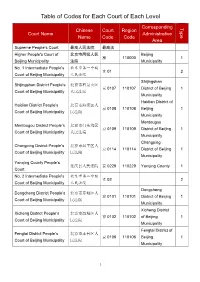
Table of Codes for Each Court of Each Level
Table of Codes for Each Court of Each Level Corresponding Type Chinese Court Region Court Name Administrative Name Code Code Area Supreme People’s Court 最高人民法院 最高法 Higher People's Court of 北京市高级人民 Beijing 京 110000 1 Beijing Municipality 法院 Municipality No. 1 Intermediate People's 北京市第一中级 京 01 2 Court of Beijing Municipality 人民法院 Shijingshan Shijingshan District People’s 北京市石景山区 京 0107 110107 District of Beijing 1 Court of Beijing Municipality 人民法院 Municipality Haidian District of Haidian District People’s 北京市海淀区人 京 0108 110108 Beijing 1 Court of Beijing Municipality 民法院 Municipality Mentougou Mentougou District People’s 北京市门头沟区 京 0109 110109 District of Beijing 1 Court of Beijing Municipality 人民法院 Municipality Changping Changping District People’s 北京市昌平区人 京 0114 110114 District of Beijing 1 Court of Beijing Municipality 民法院 Municipality Yanqing County People’s 延庆县人民法院 京 0229 110229 Yanqing County 1 Court No. 2 Intermediate People's 北京市第二中级 京 02 2 Court of Beijing Municipality 人民法院 Dongcheng Dongcheng District People’s 北京市东城区人 京 0101 110101 District of Beijing 1 Court of Beijing Municipality 民法院 Municipality Xicheng District Xicheng District People’s 北京市西城区人 京 0102 110102 of Beijing 1 Court of Beijing Municipality 民法院 Municipality Fengtai District of Fengtai District People’s 北京市丰台区人 京 0106 110106 Beijing 1 Court of Beijing Municipality 民法院 Municipality 1 Fangshan District Fangshan District People’s 北京市房山区人 京 0111 110111 of Beijing 1 Court of Beijing Municipality 民法院 Municipality Daxing District of Daxing District People’s 北京市大兴区人 京 0115