Hawaiian Mistletoes (Korthalsella Species)
Total Page:16
File Type:pdf, Size:1020Kb
Load more
Recommended publications
-

"Santalales (Including Mistletoes)"
Santalales (Including Introductory article Mistletoes) Article Contents . Introduction Daniel L Nickrent, Southern Illinois University, Carbondale, Illinois, USA . Taxonomy and Phylogenetics . Morphology, Life Cycle and Ecology . Biogeography of Mistletoes . Importance of Mistletoes Online posting date: 15th March 2011 Mistletoes are flowering plants in the sandalwood order that produce some of their own sugars via photosynthesis (Santalales) that parasitise tree branches. They evolved to holoparasites that do not photosynthesise. Holopar- five separate times in the order and are today represented asites are thus totally dependent on their host plant for by 88 genera and nearly 1600 species. Loranthaceae nutrients. Up until recently, all members of Santalales were considered hemiparasites. Molecular phylogenetic ana- (c. 1000 species) and Viscaceae (550 species) have the lyses have shown that the holoparasite family Balano- highest species diversity. In South America Misodendrum phoraceae is part of this order (Nickrent et al., 2005; (a parasite of Nothofagus) is the first to have evolved Barkman et al., 2007), however, its relationship to other the mistletoe habit ca. 80 million years ago. The family families is yet to be determined. See also: Nutrient Amphorogynaceae is of interest because some of its Acquisition, Assimilation and Utilization; Parasitism: the members are transitional between root and stem para- Variety of Parasites sites. Many mistletoes have developed mutualistic rela- The sandalwood order is of interest from the standpoint tionships with birds that act as both pollinators and seed of the evolution of parasitism because three early diverging dispersers. Although some mistletoes are serious patho- families (comprising 12 genera and 58 species) are auto- gens of forest and commercial trees (e.g. -
'Ala'alahua, Mahoe
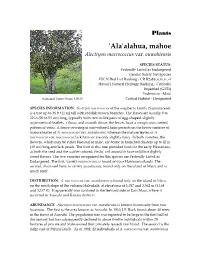
Plants ʹAlaʹalahua, mahoe Alectryon macrococcus var. auwahiensis SPECIES STATUS: Federally Listed as Endangered Genetic Safety Net Species IUCN Red List Ranking ‐ CR B2ab(i,ii,iii,iv,v) Hawai‘i Natural Heritage Ranking ‐ Critically Imperiled (G1T1) Endemism ‐ Maui Kim and Forest Starr, USGS Critical Habitat ‐ Designated SPECIES INFORMATION: Alectryon macrococcus of the soapberry family (Sapindaceae) is a tree up to 36 ft (11 m) tall with reddish brown branches. The leaves are usually 8 to 22 in (20 to 55 cm) long, typically with two to five pairs of egg‐shaped, slightly asymmetrical leaflets. Glossy and smooth above, the leaves have a conspicuous netted pattern of veins. A dense covering of rust‐colored hairs persists on the lower surfaces of mature leaves of A. macrococcus var. auwahiensis, whereas the mature leaves of A. macrococcus var. macrococcus lack hairs or are only slightly hairy. In both varieties, the flowers, which may be either bisexual or male, are borne in branched clusters up to l2 in (30 cm) long and lack petals. The fruit of this tree provided food for the early Hawaiians, as both the seed and the scarlet‐colored, fleshy aril around it have mild but slightly sweet flavors. The two varieties recognized for this species are Federally Listed as Endangered. The first, variety macrococcus, is found on four Hawaiian islands. The second, discussed here, is variety auwahiensis, found only on the island of Maui, and is much rarer. DISTRIBUTION: A. macrococcus var. auwahiensis is found only on the island of Maui, on the south slope of the volcano Haleakalā, at elevations of 1,017 and 3,562 m (1,168 and 3,337 ft). -
New Exotic Host for the Dwarf Mistletoe Korthalsella Salicornioides
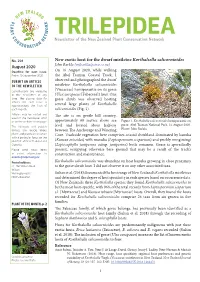
TRILEPIDEA Newsletter of the New Zealand Plant Conservation Network NO. 201 New exotic host for the dwarf mistletoe Korthalsella salicornioides August 2020 John Barkla (mjbarkla@xtra.co.nz) Deadline for next issue: On 16 August 2020, while walking Friday 16 September 2020 the Abel Tasman Coastal Track, I SUBMIT AN ARTICLE observed and photographed the dwarf TO THE NEWSLETTER mistletoe Korthalsella salicornioides Contributions are welcome [Viscaceae] hemiparasitic on its gorse to the newsletter at any (Ulex europaeus [Fabaceae]) host. One time. The closing date for gorse shrub was observed hosting articles for each issue is approximately the 15th of several large plants of Korthalsella each month. salicornioides (Fig. 1). Articles may be edited and used in the newsletter and/ Th e site is on gentle hill country, or on the website news page. approximately 60 metres above sea Figure 1. Korthalsella salicornioides hemiparasitic on The Network will publish level and located about halfway gorse. Abel Tasman National Park, 16 August 2020. almost any article about between Th e Anchorage and Watering Photo: John Barkla. plants and plant conservation Cove. Trackside vegetation here comprises coastal shrubland dominated by kanuka with a particular focus on the plant life of New Zealand and (Kunzea ericoides) with manuka (Leptospermum scoparium) and prickly mingimingi Oceania. (Leptocophylla juniperina subsp. juniperina) both common. Gorse is sporadically Please send news items present, occupying otherwise bare ground that may be a result of the track’s or event information to construction and maintenance. events@nzpcn.org.nz Postal address: Korthalsella salicornioides was abundant on host kanuka growing in close proximity c/- 160 Wilton Road to the gorse shrub host. -
Synthesizing Ecosystem Implications of Mistletoe Infection
Environmental Research Letters LETTER • OPEN ACCESS Related content - Networks on Networks: Water transport in Mistletoe, friend and foe: synthesizing ecosystem plants A G Hunt and S Manzoni implications of mistletoe infection - Networks on Networks: Edaphic constraints: the role of the soil in vegetation growth To cite this article: Anne Griebel et al 2017 Environ. Res. Lett. 12 115012 A G Hunt and S Manzoni - Impact of mountain pine beetle induced mortality on forest carbon and water fluxes David E Reed, Brent E Ewers and Elise Pendall View the article online for updates and enhancements. This content was downloaded from IP address 137.154.212.215 on 17/12/2017 at 21:57 Environ. Res. Lett. 12 (2017) 115012 https://doi.org/10.1088/1748-9326/aa8fff LETTER Mistletoe, friend and foe: synthesizing ecosystem OPEN ACCESS implications of mistletoe infection RECEIVED 28 June 2017 Anne Griebel1,3 ,DavidWatson2 and Elise Pendall1 REVISED 1 Hawkesbury Institute for the Environment, Western Sydney University, Locked Bag 1797, Penrith, NSW, Australia 12 September 2017 2 Institute for Land, Water and Society, Charles Sturt University, PO box 789, Albury, NSW, Australia ACCEPTED FOR PUBLICATION 3 Author to whom any correspondence should be addressed. 29 September 2017 PUBLISHED E-mail: griebel.anne@gmail.com 16 November 2017 Keywords: mistletoe, climate change, biodiversity, parasitic plants, tree mortality, forest disturbance Original content from this work may be used Abstract under the terms of the Creative Commons Biotic disturbances are affecting a wide range of tree species in all climates, and their occurrence is Attribution 3.0 licence. contributing to increasing rates of tree mortality globally. -
(Rattus Spp. and Mus Musculus) in The
CHAPTER SIX: CONCLUSIONS Aaron B. Shiels Department of Botany University of Hawaii at Manoa 3190 Maile Way Honolulu, HI. 96822 173 Along with humans, introduced rats (Rattus rattus, R. norvegicus, and R. exulans) and mice (Mus musculus) are among the most invasive and widely distributed mammals on the planet; they occur on more than 80% of the world‘s islands groups (Atkinson 1985; Towns 2009). By incorporating modern technology, such as aerial broadcast of rodenticides, the number of islands where invasive rodents can be successfully removed has recently increased (Howald et al. 2007). However, successful rat and mouse eradication on relatively large (> 5000 ha) or human-inhabited islands such as the main Hawaiian Islands rarely occurs (Howald et al. 2007) despite large sums of money and research efforts annually to combat invasive rodent problems (see Chapter 1 section ―Rat history in Hawaii‖; Tobin et al. 1990). Therefore, it is highly unlikely that invasive rats and mice will be eradicated from relatively large, human-occupied islands such as Oahu in the near or distant future (Howald et al. 2007); and accepting this may be a first step towards increasing the likelihood of native species conservation in archipelagos like Hawaii where introduced rodents have established. Determining which invasive rodent species are present at a given site is important because the risks that some rodent species pose to particular (prey) species and/or habitats differ from those posed by other rodent species. Two sympatric species cannot occupy the same niche indefinitely, in a stable environment (Gause 1934), which may partly explain why some rodent species may not occur where others are present (Harper 2006). -

Heterotrophic Carbon Gain and Mineral Nutrition of the Root Hemi-Parasite Santalum Album L
128 Heterotrophic carbon gain and mineral nutrition of Santa fum album L. Heterotrophic carbon gain and mineral nutrition of the root hemi-parasite Santalum album L. in pot culture with different hosts. Andrew M. Radomiljaci.2·A, Jen A. McComb2 and JohnS. Pate3 1Present address: Department of Conservation and Land Management, CALMSharefarms Maritime Pine, Lot 1, 260 Kalamunda Road, South Guilford, 6055, Western Australia 2Division of Science, Biological Sciences, Murdoch University, Perth 6150, Western Australia 3Department of Botany, University of Western Australia, Nedlands, Perth 6907, Western Australia Revised manuscript received 8 January 1999 Summary tices in relation to the best host species, and how to achieve This paper examines heterotrophic gain of carbon and min the highest volume and quality of sandalwood in a particular eral composition of Santalum album partnered singly in pot set of environmental circumstances. culture with three beneficial woody N,-tixing hosts and a non Our current projects, aimed at defining the best protocols for beneficial eucalypt host. Based on dry matter gains of the growth of S. album under irrigation culture in the Ord River parasite at 33 weeks, Sesbaniaformosa proved the best host region of North West Australia, have utilised a native herba followed by Acacia ampliceps and A. trachycarpa while no ceous perennial, Alternanthera nana R. Br., as a host during improvement in growth was seen with Eucalyptus pot culture with seedlings of the parasite, followed by use of camaldulensis as a host in comparison with Santalum grown various fast growing but relatively short lived species as 'in without a host. Numbers of haustoria formed by Santalum termediate hosts' once plants are transferred to the field. -

List 01 Hawaiian Names 01 Plants
V\.{). 3 v BOTANICAL BULLETIN NO.2 JUNE. 1913 TERRITORY OF HAWAII BOARD OF AGRICULTURE AND FORESTRY List 01 Hawaiian Names 01 Plants BY JOSEPH F. ROCK Consulting Botanist, Board of Agriculture and Forestry HONOLULU: HAWAIIAN GAZETTE CO., LTD. 1913 ALPHABETICAL LIST OF HAWAIIAN NAMES OF PLANTS. The following list of Hawaiian plant-names has been compiled from various sources. Hillebrand in his valuable Flora of the Hawaiian Islands has given many Hawaiian names, especially of the more common species; these are incorporated in this list with a few corrections. Nearly all Hawaiian plant-names found in this list and not in Hillebrand's Flora were secured from Mr. Francis Gay of the Island of Kauai, an old resident in this Terri tory and well acquainted with its plants from a layman's stand point. It was the writer's privilege to camp with Mr. Gay in the mountains of Kauai collecting botanical material; for almost every species he could give the native name, which he had se cured in the early days from old and reliable natives. Mr. Gay had made spatter prints of many of the native plants in a large record book with their names and uses, as well as their symbolic meaning when occurring in mele (songs) or olioli (chants), at tached to them. For all this information the writer is indebted mainly to Mr. Francis Gay and also to Mr. Augustus F. Knudsen of the same Island. The writer also secured Hawaiian names from old na tives and Kahunas (priests) in the various islands of the group. -
Field Instructions for The
FIELD INSTRUCTIONS FOR THE INVENTORY OF THE PACIFIC ISLANDS 2013 Hawaii Edition Forest Inventory and Analysis Program Pacific Northwest Research Station USDA Forest Service THIS MANUAL IS BASED ON: FOREST INVENTORY AND ANALYSIS NATIONAL CORE FIELD GUIDE FIELD DATA COLLECTION PROCEDURES FOR PHASE 2 PLOTS VERSION 5.1 TABLE OF CONTENTS 1 INTRODUCTION ........................................................................................................................................................................ 1 1.1 PURPOSES OF THIS MANUAL ................................................................................................................................................... 1 1.2 ORGANIZATION OF THIS MANUAL .......................................................................................................................................... 1 1.2.1 UNITS OF MEASURE ................................................................................................................................................................. 2 1.2.2 GENERAL DESCRIPTION ............................................................................................................................................................ 2 1.2.3 PLOT SETUP .............................................................................................................................................................................. 3 1.2.4 PLOT INTEGRITY ...................................................................................................................................................................... -

Epiparasitism in Phoradendron Durangense and P. Falcatum (Viscaceae) Clyde L
Aliso: A Journal of Systematic and Evolutionary Botany Volume 27 | Issue 1 Article 2 2009 Epiparasitism in Phoradendron durangense and P. falcatum (Viscaceae) Clyde L. Calvin Rancho Santa Ana Botanic Garden, Claremont, California Carol A. Wilson Rancho Santa Ana Botanic Garden, Claremont, California Follow this and additional works at: http://scholarship.claremont.edu/aliso Part of the Botany Commons Recommended Citation Calvin, Clyde L. and Wilson, Carol A. (2009) "Epiparasitism in Phoradendron durangense and P. falcatum (Viscaceae)," Aliso: A Journal of Systematic and Evolutionary Botany: Vol. 27: Iss. 1, Article 2. Available at: http://scholarship.claremont.edu/aliso/vol27/iss1/2 Aliso, 27, pp. 1–12 ’ 2009, Rancho Santa Ana Botanic Garden EPIPARASITISM IN PHORADENDRON DURANGENSE AND P. FALCATUM (VISCACEAE) CLYDE L. CALVIN1 AND CAROL A. WILSON1,2 1Rancho Santa Ana Botanic Garden, 1500 North College Avenue, Claremont, California 91711-3157, USA 2Corresponding author (carol.wilson@cgu.edu) ABSTRACT Phoradendron, the largest mistletoe genus in the New World, extends from temperate North America to temperate South America. Most species are parasitic on terrestrial hosts, but a few occur only, or primarily, on other species of Phoradendron. We examined relationships among two obligate epiparasites, P. durangense and P. falcatum, and their parasitic hosts. Fruit and seed of both epiparasites were small compared to those of their parasitic hosts. Seed of epiparasites was established on parasitic-host stems, leaves, and inflorescences. Shoots developed from the plumular region or from buds on the holdfast or subjacent tissue. The developing endophytic system initially consisted of multiple separate strands that widened, merged, and often entirely displaced its parasitic host from the cambial cylinder. -
Title Slide. I Want to Thank Dave Watson for Inviting Me to Talk at This Symposium
Title Slide. I want to thank Dave Watson for inviting me to talk at this Symposium. It’s always a pleasure to speak to an audience that is already pre- selected as being interested in mistletoes! 1 Slide. Studies of Loranthaceae. The largest family of mistletoes is Loranthaceae. And as one might expect, it has been the subject of many scientific studies. This slide shows a variety of subdisciplines within biology that have focused on Loranthaceae, as well as a few areas that to date have not received any attention. 2 Slide. My talk today will focus upon the taxonomy and evolutionary biology of Loranthaceae. As indicated in the title, I want to demonstrate how developing a meaningful taxonomy for a group is best accomplished using the most powerful tool in the systematist’s toolkit: molecular phylogenetics. 3 Slide. Santalales: The Largest Group of Parasitic Plants. Among the twelve orders of flowering plants in which haustorial parasitism evolved, only two have more than three genera: Lamiales and Santalales. Of these, Lamiales contains a single family of hemi- and holoparasitic plants: Orobanchaceae with 93 genera (32%) and 1725 species (39%). Santalales is the largest order of parasitic plants, with 179 genera (61%) and 2407 species (54%). It’s the only order of parasitic plant with more than one family. 4 Slide. Within Santalales, Loranthaceae has by far the highest number of genera (75) with Balanophoraceae coming in second (17). 5 Slide. Loranthaceae also the highest number of species (987) with Viscaceae and Thesiaceae coming in second and third. 6 Slide. This slide has sorted the loranth genera according to size (number of species). -
Pennisetum Setaceum) on Water Availability and Productivity of Canopy Trees Within a Tropical Dry Forest in Hawaii
Functional Ecology 2008, 22, 1008–1017 doi: 10.1111/j.1365-2435.2008.01471.x TheBlackwell Publishing Ltd impact of an invasive African bunchgrass (Pennisetum setaceum) on water availability and productivity of canopy trees within a tropical dry forest in Hawaii S. Cordell1* and D. R. Sandquist2 1Institute of Pacific Islands Forestry, USDA Forest Service, Hilo, HI, USA; and 2Department of Biological Science, California State University, Fullerton, CA, USA Summary 1. Tropical dry forests are among the Earth’s most threatened ecosystems. On the Island of Hawaii the African bunchgrass Pennisetum setaceum (fountain grass) dominates the understorey of the few remaining fragments of native dry forests and is contributing to the degradation of this once diverse ecosystem. In this study, we examined the impacts of Pennisetum on water use and productivity of the dominant native canopy tree, Diospyros sandwicensis. 2. Over a 3-year period, measurements were made on tree growth rates, and physiological and morphological responses of the most common dry forest native tree, D. sandwicensis, growing with an understorey dominated by Pennisetum, and on trees growing in plots maintained free of grasses. 3. Analysis of stable oxygen isotope ratios indicated that trees growing in the absence of Pennisetum used a higher proportion of water from shallow soil sources. They also sustained higher mid-day water potentials, especially during drier periods. At the leaf level, no significant differences were found in gas exchange measurements between Diospyros trees growing with or without Pennisetum. However, trees growing without Pennisetum had 30% lower leaf mass per unit area and 40% higher diameter growth than trees growing with Pennisetum. -
The Infestation Degree of Trees with Common Mistletoe Viscum Album L
Journal of Ecological Engineering Volume 18, Issue 6, Nov. 2017, pages 80–85 DOI: 10.12911/22998993/76831 Research Article THE INFESTATION DEGREE OF TREES WITH COMMON MISTLETOE VISCUM ALBUM L. AND THEIR HEALTH STATUS (ON THE EXAMPLE OF PRASZKA CITY) Elżbieta Gołąbek1, Jarosław Sławiński1 1 Department of Land Protection, University of Opole, Oleska 22, 45-052 Opole, Poland, e-mail: golabek@uni.opole.pl; jarek19@uni.opole.pl Received: 2017.09.03 ABSTRACT Accepted: 2017.10.01 The research was carried out in September and October 2013. Their main aim was to Published: 2017.11.01 obtain the information on the abundance and distribution of the common mistletoe in Praszka, assess the health status of the trees infested with this semi-parasite, and to determine its impact on the health of the hosts. All the trees with mistletoe were exam- ined (in terms of the species, the number of semiparasite shrubs, the host health). The distribution and density hosts were presented on a prepared network with an area of 1 ha and Pearson’s correlation factor was used to determine the relationship between the infestation degree of a host and its state of health. Only the typical subspecies of mistletoe – Viscum album L. subsp. album, which occupied 11 species of trees were found in the city of Praszka. These were mainly: black poplar Populus nigra L., small- leaved lime Tilia cordata L. and black locust Robinia pseudoacacia L. (they are also the most common or the frequent hosts in the country). The distribution of mistletoe in the city is uneven, and this is mainly due to the degree of urbanization, sunshine, noise, occurrence of the most common hosts as well as the presence of birds.