Perilous Plants of Florida Citrus Groves
Total Page:16
File Type:pdf, Size:1020Kb
Load more
Recommended publications
-

Hamid Et Al.: Chemical Constituents, Antibacterial, Antifungal and Antioxidant Activities
Ife Journal of Science vol. 18, no. 2 (2016) 561 CHEMICAL CONSTITUENTS, ANTIBACTERIAL, ANTIFUNGAL AND ANTIOXIDANT ACTIVITIES OF THE AERIAL PARTS OF Cnidoscolus aconitifolius Hamid, Abdulmumeen A.1*, Oguntoye, Stephen O.1, Negi, Arvind S.2, Ajao, Ajibola1, Owolabi, Nurudeen O.1. 1Department of Chemistry, University of Ilorin, Ilorin, Nigeria 2Central Institute of Medicinal and Aromatic Plants (CIMAP), Lucknow, India *Corresponding Author: Tel No: +2347035931646 E-mail: hamidmemo@gmail.com, hamid.aa@unilorin.edu.ng (Received: 3th March, 2016; Accepted: 8th June, 2016) ABSTRACT Preliminary phytochemical investigation of crude n-Hexane, ethyl acetate and methanol extracts of the aerial parts of Cnidoscolus aconitifolius revealed the presence of anthraquinones, glycosides, steroids, flavonoids, tannins, saponins and terpenoids. All the crude extracts gave a clear zone of inhibition against the growth of the test bacteria (Staphylococcus aureus, Escherichia coli, Bacillus subtilis, Pseudomonas aeruginosa, Salmonella typhi, Klebsiellae pneumonae) and fungi (Candida albicans, Aspergillus niger, penicillium notatum and Rhizopus stolonifer) at different concentrations, except ethyl acetate extract which showed no antifungal property on Rhizopus stolonifer. Ethyl acetate and methanol extracts exhibited significant antioxidant activities by scavenging DPPH free radicals with IC50 of 12.14 and 93.85 µg/ml respectively. GC-MS analysis of n-hexane and methanol extracts showed nine compounds each, while ethyl acetate extracts afforded ten compounds. Phytol is the most abundant constituent in n-hexane, ethyl acetate and methanol extracts with their corresponding percentage of abundance of 41.07%, 35.42% and 35.07%. Keywords: Cnidoscolus aconitifolius, Antioxidant activity, GC-MS analysis, Phytochemicals, Phytol. INTRODUCTION acne, and eye problems (Diaz-Bolio, 1975). -

Poison Ivy Vs. Lookalike Species
Poison Ivy vs. Lookalike Species Poison ivy comes in many different forms. Because of its variable appearance, it can often be difficult to identify. Using the handy guide below, learn how to distinguish poison ivy from other common lookalike plants (see back for a list of lookalikes). Poison ivy (Toxicodendron radicans) is a native plant valued by wildlife. Humans are one of the few species vulnerable to its “poison.” It can be found as a vine climbing fences, posts and trees, laying low as a trail vine, or as a shrub. The vine is the easiest form to identify because of its unique “hairy” appearance; the hairs are rootlets. The three leaves of poison ivy all have pointed tips. The leaf edges can be either serrated or smooth. The leaves typically look smooth and glossy with the middle leaf being the longest. It is typically reddish in the fall, while green to yellow the remainder of the year. Most have heard the catchy phrase, “leaves of three let it be”—it’s an easy-to-remember expression to help identify the plant. Images (front, top to bottom): Young poison ivy, credit R.A. Nonenmacher, via Wikimedia Commons Mature poison ivy, credit R.A. Nonenmacher, via Wikimedia Commons Poison Ivy Vine and leaves (note “hairy” rootlets), via Wikimedia Commons Images (back, top to bottom): Virginia Creeper (note 5 leaves, smooth vine). Credit: Chris Light, via Wikimedia Commons Box elder leaves; note smooth/fuzzy stem. Credit: Susan Charkes Mock strawberry leaves and fruit. Credit: Andrewbogott, via Wikimedia Commons Jack-in-the-pulpit. -

First Record of Cnidoscolus Obtusifolius Pohl (Euphorbiaceae) for Paraíba State, Northeastern Brazil
Acta Brasiliensis 4(3): 187-190, 2020 Note http://revistas.ufcg.edu.br/ActaBra http://dx.doi.org/10.22571/2526-4338378 First record of Cnidoscolus obtusifolius Pohl (Euphorbiaceae) for Paraíba State, northeastern Brazil a i b i Maiara Bezerra Ramos h , Maria Gracielle Rodrigues Maciel h , José Iranildo Miranda de c i a,c i Melo h , Sérgio de Faria Lopes a Programa de Pós-Graduação em Etnobiologia e Conservação da Natureza, Universidade Estadual da Paraíba, Campina Grande, 58429-500, Paraíba, Brasil. *maiarabramos@hotmail.com b Universidade Estadual da Paraíba, Campina Grande, 58429-500, Paraíba, Brasil. c Programa de Pós-Graduação em Ecologia e Conservação, Universidade Estadual da Paraíba, Campina Grande, 58429-500, Paraíba, Brasil. Received: April 29, 2020 / Acepted: June 26, 2020/ Published online: September 28, 2020 Abstract Cnidoscolus obtusifolius Pohl (Euphorbiaceae), species so far known from Minas Gerais, Bahia, Alagoas and Pernambuco States in Brazil is reported for the first time for the State of Paraíba, in the northeastern region of the country. Specimens of this taxon were collected in a fragmented area considered a Caatinga vegetation relict, where total annual precipitation is 700 mm on average and elevation of 644 m a.s.l. The records were made in September and October 2019, when the species was in fertile stage as it bore flowers and fruits. Here we provide a description of its morphology along with taxonomic comments, data on the geographical range and detailed images of the species. Keywords: Caatinga; diversity; floristics; Malpighiales. Primeiro registro de Cnidoscolus obtusifolius Pohl (Euphorbiaceae) no estado da Paraíba, nordeste do Brasil Resumo Cnidoscolus obtusifolius Pohl (Euphorbiaceae) espécie até então conhecida para os Estados de Minas Gerais (Sudeste), Bahia, Alagoas e Pernambuco (Nordeste), Brasil, está sendo registrada pela primeira vez no Estado da Paraíba, nordeste do Brasil. -

Photosynthesis and Antioxidant Activity in Jatropha Curcas L. Under Salt Stress
2012 BRAZILIAN SOCIETY OF PLANT PHYSIOLOGY RESEARCH ARTICLE Photosynthesis and antioxidant activity in Jatropha curcas L. under salt stress Mariana Lins de Oliveira Campos1, Bety Shiue de Hsie1, João Antônio de Almeida Granja1, Rafaela Moura Correia1, Jarcilene Silva de Almeida-Cortez1, Marcelo Francisco Pompelli1* 1Plant Ecophysiology Laboratory, Federal University of Pernambuco, Department of Botany, Recife, PE, Brazil. *Corresponding author: mpompelli@yahoo.com.br Received: 11 August 2011; Accepted: 10 May 2012 ABSTRACT Biodiesel is an alternative to petroleum diesel fuel. It is a renewable, biodegradable, and nontoxic biofuel. Interest in the production of biodiesel from Jatropha curcas L. seeds has increased in recent years, but the ability of J. curcas to grow in salt-prone areas, such as the Caatinga semiarid region, has received considerably meager attention. The aim of this study was to identify the main physiological processes that can elucidate the pattern of responses of J. curcas irrigated with saline water, which commonly occurs in the semiarid Caatinga region. This study measured the activity of the antioxidant enzymes involved in the scavenging of reactive oxygen species, which include catalase (CAT) and ascorbate peroxidase (APX), as well as malondialdehyde (MDA) levels. The levels of chlorophyll (Chl), carotenoids, amino acids, proline, and soluble proteins were also analyzed. The net carbon assimilation rate (PN), stomata conductance (gs), and transpiration rate (E) decreased with salt stress. The activities of CAT and APX were decreased, while H2O2 and MDA levels as well as electrolyte leakage were significantly increased in salt-stressed plants compared to the untreated ones. These observations suggest that the ability of J. -

Lyonia Preserve Plant Checklist
Lyonia Preserve Plant Checklist Volusia County, Florida Aceraceae (Maple) Asteraceae (Aster) Red Maple Acer rubrum Bitterweed Helenium amarum Blackroot Pterocaulon virgatum Agavaceae (Yucca) Blazing Star Liatris sp. Adam's Needle Yucca filamentosa Blazing Star Liatris tenuifolia Nolina Nolina brittoniana Camphorweed Heterotheca subaxillaris Spanish Bayonet Yucca aloifolia Cudweed Gnaphalium falcatum Dog Fennel Eupatorium capillifolium Amaranthaceae (Amaranth) Dwarf Horseweed Conyza candensis Cottonweed Froelichia floridana False Dandelion Pyrrhopappus carolinianus Fireweed Erechtites hieracifolia Anacardiaceae (Cashew) Garberia Garberia heterophylla Winged Sumac Rhus copallina Goldenaster Pityopsis graminifolia Goldenrod Solidago chapmanii Annonaceae (Custard Apple) Goldenrod Solidago fistulosa Flag Paw paw Asimina obovata Goldenrod Solidago spp. Mohr's Throughwort Eupatorium mohrii Apiaceae (Celery) Ragweed Ambrosia artemisiifolia Dollarweed Hydrocotyle sp. Saltbush Baccharis halimifolia Spanish Needles Bidens alba Apocynaceae (Dogbane) Wild Lettuce Lactuca graminifolia Periwinkle Catharathus roseus Brassicaceae (Mustard) Aquifoliaceae (Holly) Poorman's Pepper Lepidium virginicum Gallberry Ilex glabra Sand Holly Ilex ambigua Bromeliaceae (Airplant) Scrub Holly Ilex opaca var. arenicola Ball Moss Tillandsia recurvata Spanish Moss Tillandsia usneoides Arecaceae (Palm) Saw Palmetto Serenoa repens Cactaceae (Cactus) Scrub Palmetto Sabal etonia Prickly Pear Opuntia humifusa Asclepiadaceae (Milkweed) Caesalpinceae Butterfly Weed Asclepias -

Poison Ivy (Toxicodendron Radicans) DESCRIPTION
Weed Identification and Control Sheet: www.goodoak.com/weeds Poison Ivy (Toxicodendron radicans) DESCRIPTION: Poison ivy is a native woody vine and member of the sumac family. It can be found in shady and sunny sites rambling along the ground, forming a small shrub, or climbing up trees. The vines attach to surfaces by means of thin aerial roots which grow along the length of the stem. The plant always has three leaflets which are often serrated. Usually these leaflets have one dominant lobe, giving the outer two leaves the appearance of mittens with the central leaf resembling a mitten with two thumbs. Young leaves are often dark green or maroonish, and the attractive fall foliage can range from brick to fire- engine red. Poison ivy is generally not considered a threat to native plant communities, in fact, the white berries provide winter food for birds and deer relish the foliage. Though harmless to most animals, many humans are allergic to the urushiol (yoo-roo-shee-ol) oil produced by the plant which results in itching, inflammation and blisters. This oil is found in all parts of the plant during all times of the year. This oil can also be spread by contact with clothing, shoes, pets or equipment that have touched poison ivy weeks or months after initial contact. It can even be transmitted in the air when poison ivy is burned, which presents a severe risk if inhaled and has been known to result in hospitalization and death. Though some people are not alleargic to the oil, its important to wear pants, long sleeves and gloves when working around poison ivy since the allergy can develop af- ter repeated exposures to urushiol. -

Biology and Management of Poison Ivy (Toxicodendron Radicans) in the Home Landscape1 Yuvraj Khamare and Chris Marble2
ENH1345 https://doi.org/10.32473/edis-EP609-2021 Biology and Management of Poison Ivy (Toxicodendron radicans) in the Home Landscape1 Yuvraj Khamare and Chris Marble2 Introduction Other common names Poison ivy (Toxicodendron radicans) is an allergenic plant Eastern poison ivy of the cashew family native to North America. Poison ivy and the closely related plants poison oak (Toxicodendron Life Span toxicarium) and poison sumac (Toxicodendron vernix) all Perennial growing vine or woody shrub grow in Florida and contain the oily resin called urushiol. A guide to identification of these species is available in the ar- Habitat ticle Identification of Poison Ivy, Poison Oak, Poison Sumac, Poison ivy is native to Florida and grows best in fertile, and Poison Wood. This EDIS publication is intended to aid moist, and well-drained soil. It is often found in fields, landowners, gardeners, horticulturalists, and pest manage- pastures, farms, home landscapes, and woodland areas. As ment professionals in identification and management of a vine, it can climb along fences and buildings, or it may poison ivy in residential and commercial landscapes. attach itself to shrubs, trees, or other structures (Figure 1). Species Description Distribution Class Poison ivy is native to North America, found from Maine Dicotyledon to Florida and westward from Nebraska to Texas (USDA- NRCS 2019). It is widely distributed through all the coun- Family ties in Florida (Wunderlin et al. 2019). It can also be found throughout southern Canada, Mexico, Japan, and central Anacardiaceae (Cashew family) China. 1. This document is ENH1345, one of a series of the Environmental Horticulture Department, UF/IFAS Extension. -
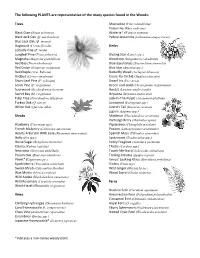
The Following PLANTS Are Representative of the Many Species Found in the Woods
The following PLANTS are representative of the many species found in the Woods: Trees Muscadine (Vitis rotundifolia) Poison Ivy (Rhus radicans) Black Gum (Nyssa sylvatica) Wisteria* (Wisteria sinensis) Black Jack Oak (Q. marilandica) Yellow Jessamine (Gelsimium sempervirens) Blue Jack Oak (Q. incana) Dogwood (Cornus florida) Herbs Loblolly Pine (P. taeda) Longleaf Pine (Pinus palustris) Blazing Star (Liatris spp.) Magnolia (Magnolia grandiflora) Bloodroot (Sanguinaria canadensis) Red Bay (Persea borbonia) Blue‐Eyed Grass (Sisyrinchium arenicola) Red Cedar (Juniperus virginiana) Blue Star (Amsonia spp.) Red Maple (Acer Rubrum) Butterfly Weed (Asclepias tuberosa) Redbud (Cercis canadensis) Crane‐Fly Orchid (Tipularia discolor) Short‐Leaf Pine (P. echinata) Dwarf Iris (Iris verna) Scrub Pine (P. virginiana) Green‐and‐Gold (Chrysogonum virginianum) Sourwood (Oxydendrum arboreum) Henbit (Lamium amplexicaule) Sweet Bay (M. virginiana) Hepatica (Hepatica americana) Tulip Tree (Liriodendron tulipifera) Jack‐In‐The‐Pulpit (Arisaema triphyllum) Turkey Oak (Q. laevis) Jointweed (Polygonum spp.) White Oak (Quercus alba) Lizard’s Tail (Saururus cernuus) Lupine (Lupinus spp.) Shrubs Mistletoe (Phoradendron serotinum) Partridge Berry (Mitchella repens) Blueberry (Vaccinium spp.) Pipsissewa (Chimaphila maculate) French Mulberry (Callicarpa americana) Pucoon (Lithospermum caroliniense) Hearts‐A’Burstin With Love (Euonymus americanus) Spanish Moss (Tillandsia usneoides) Holly (Ilex spp.) Spiderwort (Tradescantia spp.) Horse Sugar (Symplocos tinctoria) Sticky -

Trillium Reliquum)
REPRODUCTIVE BIOLOGY OF RELICT TRILLIUM (Trillium reliquum) Except where reference is made to the work of others, the work described in this thesis is my own or was done in collaboration with my advisory committee. This thesis does not include proprietary or classified information. _________________________________________ Melissa Gwynne Brooks Waddell Certificate of Approval: ________________________ _________________________ Robert Boyd Debbie R. Folkerts, Chair Professor Assistant Professor Biological Sciences Biological Sciences _____________________ _________________________ Robert Lishak Stephen L. McFarland Associate Professor Acting Dean Biological Sciences Graduate School REPRODUCTIVE BIOLOGY OF RELICT TRILLIUM (Trillium reliquum) Melissa Gwynne Brooks Waddell A Thesis Submitted to the Graduate Faculty of Auburn University in Partial Fulfillment of the Requirements for the Degree of Master of Science Auburn, Alabama August 7, 2006 REPRODUCTIVE BIOLOGY OF RELICT TRILLIUM (Trillium reliquum) Melissa Gwynne Brooks Waddell Permission is granted to Auburn University to make copies of this thesis at its discretion, upon request of individuals or institutions and at their expense. The author reserves all publication rights. ______________________________ Signature of Author ______________________________ Date of Graduation iii VITA Melissa Gwynne (Brooks) Waddell, daughter of Robert and Elaine Brooks, graduated from the University of North Alabama in 1996 with a bachelor’s degree in Geography and a minor in Biology. She graduated from Auburn University in 1998, in Horticulture and Landscape Design, and returned to Auburn University to pursue a master’s of science in 1999. Married in May 2004 to Erik Waddell, she accepted a position teaching seventh grade science and environmental science in December 2005. In July 2006, she begins a master’s degree in Education at the University of North Alabama. -

Understory Plant Community Response to Season of Burn in Natural Longleaf Pine Forests
UNDERSTORY PLANT COMMUNITY RESPONSE TO SEASON OF BURN IN NATURAL LONGLEAF PINE FORESTS John S. Kush and Ralph S. Meldahl School of Forestry, 108 M. White Smith Hall, Auburn University, AL 36849 William D. Boyer U.S. Department of Agriculture, Forest Service, Southern Research Station, 520 Devall Street, Auburn, AL 36849 ABSTRACT A season of burn study· was initiated in 1973 on the EscambiaExperimental Forest, near Brewton, Alabama. All study plots were established in l4-year-old longleaf pine (Pinus palustris) stands. Treatments conSisted of biennial burns in winter, spring, and summer, plus a no-burn check. Objectives of the current study were to determine composition and structure of understory plant communities after 22 years of seasonal burning, identify changes since last sampling in 1982, arid assess the structure of the communities that stabilized under each treatment regime. There were 114 species on biennial winter~burned plots, compared to 104 on spring- and summer-burned and 84 with no burning. The woody understory biomass «1 centimeter diameter at breast height) increased with all treatments compared with 1982. Grass and legume biomass increased with winter and spring burning. Forb biomass decreased across treatments. keywords: biomass, longleaf pine, Pinus palustris, plant response, prescribed fire, south Alabama, understory. Citation: Kush, 1.S., R$. Meldahl, and W.D. Boyer. 2000. Understory plant community response to season of burn in natural longleaf pine forests. Pages 32-39 inW Keith Moser and Cynthia F. Moser (eds.). Fire and forest ecology: innovative silviculture and vegetation management. Tall Timbers Fire Ecology Conference Proceedings, No. 21. Tall Timbers Research Station, Tallahassee, FL. -

Cnidoscolus Aconitifolius: Therapeutic Use and Phytochemical Properties
446 Rev. Fac. Med. 2020 Vol. 68 No. 3: 446-52 REVIEW ARTICLE DOI: http://dx.doi.org/10.15446/revfacmed.v68n3.75184 Received: 20/10/2018 Accepted: 21/03/2019 Revista de la Facultad de Medicina Cnidoscolus aconitifolius: therapeutic use and phytochemical properties. Literature review Cnidoscolus aconitifolius: usos terapéuticos y propiedades fitoquímicas. Revisión de la literatura Verónica Bautista-Robles1, Gabriel Guerrero-Reyes1, Gabriel Isaac Sánchez-Torres1, Felipe de Jesús Parada-Luna1, Juan José Barrios-Gutiérrez1, Dehuí Vázquez-Cerero1, Gudelia Martínez-Sala1, José Isaías Siliceo-Murrieta1, Ruth Ana María González-Villoria1, Hady Keita1 . 1 Universidad de la Sierra Sur - Postgraduate Studies Division - Master’s in Public Health - Miahuatlán de Porfirio Díaz - Oaxaca - México. Corresponding autor: Hady Keita. Maestría en Salud Pública, División de Estudios de Postgrado, Universidad de la Sierra Sur. Guillermo Rojas Mijangos S/N Esquina Avenida Universidad, Col. Ciudad Universitaria, División de Estudios de Postgrado, oficina de la Maestría en Salud Pública. Telephone number: +52 1 5513658712. Miahuatlán de Porfirio Díaz, Oaxaca. México. Email: hadykeith@yahoo.fr. Abstract Introduction: Medicinal plants have been traditionally used to cure or alleviate infectious Bautista-Robles V, Guerrero-Reyes G, and non-infectious diseases. They are widely accepted due to their low cost and low toxicity Sánchez-Torres GI, Parada-Luna FJ, Barrios-Gutiérrez JJ, Vázquez-Cerero indexes. These plants are frequently used in cases involving skin irritation, superficial wounds, D, et al. Cnidoscolus aconitifolius: the- insect bites, and snake bites. rapeutic use and phytochemical pro- Objective: To compile available evidence on the main therapeutic uses and phytochemical perties. Literature review. Rev. -

Aphid Transmission of Potyvirus: the Largest Plant-Infecting RNA Virus Genus
Supplementary Aphid Transmission of Potyvirus: The Largest Plant-Infecting RNA Virus Genus Kiran R. Gadhave 1,2,*,†, Saurabh Gautam 3,†, David A. Rasmussen 2 and Rajagopalbabu Srinivasan 3 1 Department of Plant Pathology and Microbiology, University of California, Riverside, CA 92521, USA 2 Department of Entomology and Plant Pathology, North Carolina State University, Raleigh, NC 27606, USA; drasmus@ncsu.edu 3 Department of Entomology, University of Georgia, 1109 Experiment Street, Griffin, GA 30223, USA; babusri@uga.edu * Correspondence: kiran.tnau@gmail.com. † Authors contributed equally. Received: 13 May 2020; Accepted: 15 July 2020; Published: date Abstract: Potyviruses are the largest group of plant infecting RNA viruses that cause significant losses in a wide range of crops across the globe. The majority of viruses in the genus Potyvirus are transmitted by aphids in a non-persistent, non-circulative manner and have been extensively studied vis-à-vis their structure, taxonomy, evolution, diagnosis, transmission and molecular interactions with hosts. This comprehensive review exclusively discusses potyviruses and their transmission by aphid vectors, specifically in the light of several virus, aphid and plant factors, and how their interplay influences potyviral binding in aphids, aphid behavior and fitness, host plant biochemistry, virus epidemics, and transmission bottlenecks. We present the heatmap of the global distribution of potyvirus species, variation in the potyviral coat protein gene, and top aphid vectors of potyviruses. Lastly, we examine how the fundamental understanding of these multi-partite interactions through multi-omics approaches is already contributing to, and can have future implications for, devising effective and sustainable management strategies against aphid- transmitted potyviruses to global agriculture.