Centimetres Or Millimetres
Total Page:16
File Type:pdf, Size:1020Kb
Load more
Recommended publications
-
The Not So Short Introduction to Latex2ε
The Not So Short Introduction to LATEX 2ε Or LATEX 2ε in 139 minutes by Tobias Oetiker Hubert Partl, Irene Hyna and Elisabeth Schlegl Version 4.20, May 31, 2006 ii Copyright ©1995-2005 Tobias Oetiker and Contributers. All rights reserved. This document is free; you can redistribute it and/or modify it under the terms of the GNU General Public License as published by the Free Software Foundation; either version 2 of the License, or (at your option) any later version. This document is distributed in the hope that it will be useful, but WITHOUT ANY WARRANTY; without even the implied warranty of MERCHANTABILITY or FITNESS FOR A PARTICULAR PURPOSE. See the GNU General Public License for more details. You should have received a copy of the GNU General Public License along with this document; if not, write to the Free Software Foundation, Inc., 675 Mass Ave, Cambridge, MA 02139, USA. Thank you! Much of the material used in this introduction comes from an Austrian introduction to LATEX 2.09 written in German by: Hubert Partl <partl@mail.boku.ac.at> Zentraler Informatikdienst der Universität für Bodenkultur Wien Irene Hyna <Irene.Hyna@bmwf.ac.at> Bundesministerium für Wissenschaft und Forschung Wien Elisabeth Schlegl <noemail> in Graz If you are interested in the German document, you can find a version updated for LATEX 2ε by Jörg Knappen at CTAN:/tex-archive/info/lshort/german iv Thank you! The following individuals helped with corrections, suggestions and material to improve this paper. They put in a big effort to help me get this document into its present shape. -

UNIT 1 ELECTROMAGNETIC RADIATION Radiation
Electromagnetic UNIT 1 ELECTROMAGNETIC RADIATION Radiation Structure 1.1 Introduction Objectives 1.2 What is Electromagnetic Radiation? Wave Mechanical Model of Electromagnetic Radiation Quantum Model of Electromagnetic Radiation 1.3 Consequences of Wave Nature of Electromagnetic Radiation Interference Diffraction Transmission Refraction Reflection Scattering Polarisation 1.4 Interaction of EM Radiation with Matter Absorption Emission Raman Scattering 1.5 Summary 1.6 Terminal Questions 1.7 Answers 1.1 INTRODUCTION You would surely have seen a beautiful rainbow showing seven different colours during the rainy season. You know that this colourful spectrum is due to the separation or dispersion of the white light into its constituent parts by the rain drops. The rainbow spectrum is just a minute part of a much larger continuum of the radiations that come from the sun. These are called electromagnetic radiations and the continuum of the electromagnetic radiations is called the electromagnetic spectrum. In the first unit of this course you would learn about the electromagnetic radiation in terms of its nature, characteristics and properties. Spectroscopy is the study of interaction of electromagnetic radiation with matter. We would discuss the ways in which different types of electromagnetic radiation interact with matter and also the types of spectra that result as a consequence of the interaction. In the next unit you would learn about ultraviolet-visible spectroscopy ‒ a consequence of interaction of electromagnetic radiation in the ultraviolet-visible -

Realization of a Micrometre-Sized Stochastic Heat Engine Valentin Blickle1,2* and Clemens Bechinger1,2
Erschienen in: Nature Physics ; 8 (2012), 2. - S. 143-146 https://dx.doi.org/10.1038/nphys2163 Realization of a micrometre-sized stochastic heat engine Valentin Blickle1,2* and Clemens Bechinger1,2 The conversion of energy into mechanical work is essential trapping centre and k(t), the time-dependent trap stiffness. The for almost any industrial process. The original description value of k is determined by the laser intensity, which is controlled of classical heat engines by Sadi Carnot in 1824 has largely by an acousto-optic modulator. By means of video microscopy, the shaped our understanding of work and heat exchange during two-dimensional trajectory was sampled with spatial and temporal macroscopic thermodynamic processes1. Equipped with our resolutions of 10 nm and 33 ms, respectively. Keeping hot and cold present-day ability to design and control mechanical devices at reservoirs thermally isolated at small length scales is experimentally micro- and nanometre length scales, we are now in a position very difficult to achieve, so rather than coupling our colloidal to explore the limitations of classical thermodynamics, arising particle periodically to different heat baths, here we suddenly on scales for which thermal fluctuations are important2–5. Here changed the temperature of the surrounding liquid. we demonstrate the experimental realization of a microscopic This variation of the bath temperature was achieved by a second heat engine, comprising a single colloidal particle subject to a coaxially aligned laser beam whose wavelength was matched to an time-dependent optical laser trap. The work associated with absorption peak of water. This allowed us to heat the suspension the system is a fluctuating quantity, and depends strongly from room temperature to 90 ◦C in less than 10 ms (ref. -

Hybrid Electrochemical Capacitors
Florida International University FIU Digital Commons FIU Electronic Theses and Dissertations University Graduate School 1-11-2018 Hybrid Electrochemical Capacitors: Materials, Optimization, and Miniaturization Richa Agrawal Department of Mechanical and Materials Engineering, Florida International University, ragra005@fiu.edu DOI: 10.25148/etd.FIDC006581 Follow this and additional works at: https://digitalcommons.fiu.edu/etd Part of the Materials Chemistry Commons, Materials Science and Engineering Commons, Nanoscience and Nanotechnology Commons, and the Physical Chemistry Commons Recommended Citation Agrawal, Richa, "Hybrid Electrochemical Capacitors: Materials, Optimization, and Miniaturization" (2018). FIU Electronic Theses and Dissertations. 3680. https://digitalcommons.fiu.edu/etd/3680 This work is brought to you for free and open access by the University Graduate School at FIU Digital Commons. It has been accepted for inclusion in FIU Electronic Theses and Dissertations by an authorized administrator of FIU Digital Commons. For more information, please contact dcc@fiu.edu. FLORIDA INTERNATIONAL UNIVERSITY Miami, Florida HYBRID ELECTROCHEMICAL CAPACITORS: MATERIALS, OPTIMIZATION, AND MINIATURIZATION A dissertation submitted in partial fulfillment of the requirement for the degree of DOCTOR OF PHILOSOPHY in MATERIALS SCIENCE AND ENGINEERING by Richa Agrawal 2018 To: Dean John L. Volakis College of Engineering and Computing This dissertation entitled Hybrid Electrochemical Capacitors: Materials, Optimization, and Miniaturization, written -
SI and CGS Units in Electromagnetism
SI and CGS Units in Electromagnetism Jim Napolitano January 7, 2010 These notes are meant to accompany the course Electromagnetic Theory for the Spring 2010 term at RPI. The course will use CGS units, as does our textbook Classical Electro- dynamics, 2nd Ed. by Hans Ohanian. Up to this point, however, most students have used the International System of Units (SI, also known as MKSA) for mechanics, electricity and magnetism. (I believe it is easy to argue that CGS is more appropriate for teaching elec- tromagnetism to physics students.) These notes are meant to smooth the transition, and to augment the discussion in Appendix 2 of your textbook. The base units1 for mechanics in SI are the meter, kilogram, and second (i.e. \MKS") whereas in CGS they are the centimeter, gram, and second. Conversion between these base units and all the derived units are quite simply given by an appropriate power of 10. For electromagnetism, SI adds a new base unit, the Ampere (\A"). This leads to a world of complications when converting between SI and CGS. Many of these complications are philosophical, but this note does not discuss such issues. For a good, if a bit flippant, on- line discussion see http://info.ee.surrey.ac.uk/Workshop/advice/coils/unit systems/; for a more scholarly article, see \On Electric and Magnetic Units and Dimensions", by R. T. Birge, The American Physics Teacher, 2(1934)41. Electromagnetism: A Preview Electricity and magnetism are not separate phenomena. They are different manifestations of the same phenomenon, called electromagnetism. One requires the application of special relativity to see how electricity and magnetism are united. -
A Comparative Study of Jadeite, Omphacite and Kosmochlor Jades from Myanmar, and Suggestions for a Practical Nomenclature
Feature Article A Comparative Study of Jadeite, Omphacite and Kosmochlor Jades from Myanmar, and Suggestions for a Practical Nomenclature Leander Franz, Tay Thye Sun, Henry A. Hänni, Christian de Capitani, Theerapongs Thanasuthipitak and Wilawan Atichat Jadeitite boulders from north-central Myanmar show a wide variability in texture and mineral content. This study gives an overview of the petrography of these rocks, and classiies them into ive different types: (1) jadeitites with kosmochlor and clinoamphibole, (2) jadeitites with clinoamphibole, (3) albite-bearing jadeitites, (4) almost pure jadeitites and (5) omphacitites. Their textures indicate that some of the assemblages formed syn-tectonically while those samples with decussate textures show no indication of a tectonic overprint. Backscattered electron images and electron microprobe analyses highlight the variable mineral chemistry of the samples. Their extensive chemical and textural inhomogeneity renders a classiication by common gemmological methods rather dificult. Although a deinitive classiication of such rocks is only possible using thin-section analysis, we demonstrate that a fast and non-destructive identiication as jadeite jade, kosmochlor jade or omphacite jade is possible using Raman and infrared spectroscopy, which gave results that were in accord with the microprobe analyses. Furthermore, current classiication schemes for jadeitites are reviewed. The Journal of Gemmology, 34(3), 2014, pp. 210–229, http://dx.doi.org/10.15506/JoG.2014.34.3.210 © 2014 The Gemmological Association of Great Britain Introduction simple. Jadeite jade is usually a green massive The word jade is derived from the Spanish phrase rock consisting of jadeite (NaAlSi2O6; see Ou Yang, for piedra de ijada (Foshag, 1957) or ‘loin stone’ 1999; Ou Yang and Li, 1999; Ou Yang and Qi, from its reputed use in curing ailments of the loins 2001). -

It's a Nano World
IT’S A NANO WORLD Learning Goal • Nanometer-sized things are very small. Students can understand relative sizes of different small things • How Scientists can interact with small things. Understand Scientists and engineers have formed the interdisciplinary field of nanotechnology by investigating properties and manipulating matter at the nanoscale. • You can be a scientist DESIGNED FOR C H I L D R E N 5 - 8 Y E A R S O L D SO HOW SMALL IS NANO? ONE NANOMETRE IS A BILLIONTH O F A M E T R E Nanometre is a basic unit of measurement. “Nano” derives from the Greek word for midget, very small thing. If we divide a metre by 1 thousand we have a millimetre. One thousandth of a millimetre is a micron. A thousandth part of a micron is a nanometre. MACROSCALE OBJECTS 271 meters long. Humpback whales are A full-size soccer ball is Raindrops are around 0.25 about 14 meters long. 70 centimeters in diameter centimeters in diameter. MICROSCALE OBJECTS The diameter of Pollen, which human hairs ranges About 7 micrometers E. coli bacteria, found in fertilizes seed plants, from 50-100 across our intestines, are can be about 50 micrometers. around 2 micrometers micrometers in long. diameter. NANOSCALE OBJECTS The Ebola virus, The largest naturally- which causes a DNA molecules, which Water molecules are occurring atom is bleeding disease, is carry genetic code, are 0.278 nanometers wide. uranium, which has an around 80 around 2.5 nanometers atomic radius of 0.175 nanometers long. across. nanometers. TRY THIS! Mark your height on the wall chart. -
Introducyon to the Metric System Bemeasurement, Provips0.Nformal, 'Hands-On Experiences For.The Stud4tts
'DOCUMENT RESUME ED 13A 755 084 CE 009 744 AUTHOR Cáoper, Gloria S., Ed.; Mag4,sos Joel B., Ed. TITLE q Met,rits for.Theatrical COstum g: ° INSTITUTION Ohio State Univ., Columbus. enter for Vocational Education. SPONS AGENCY Ohio State Univ., Columbus. Center for.Vocational Education. PUB DATE 76 4. CONTRACT - OEC-0-74-9335 NOTE 59p.1 For a. related docuMent see CE 009 736-790 EDRS PRICE 10-$0.8.3 C-$3.50 Plus Pdstage: DESCRIPTORS *Curriculu; Fine Arts; Instructional Materials; Learning. ctivities;xMeasurement.Instrnments; *Metric, System; S condary Education; Teaching Technigue8; *Theater AttS; Units of Sttidy (Subject Fields) ; , *Vocational Eiducation- IDENTIFIERS Costumes (Theatrical) AESTRACT . Desigliedto meet tbe job-related m4triceasgrement needs of theatrical costuming students,'thiS instructio11 alpickage is one of live-for the arts and-huminities occupations cluster, part of aset b*: 55 packages for:metric instrection in diftepent occupations.. .The package is in'tended for students who already knovthe occupaiiOnal terminology, measurement terms, and tools currently in use. Each of the five units in this instructional package.contains performance' objectiveS, learning:Activities, and'supporting information in-the form of text,.exertises,- ard tabled. In. add±tion, Suggested teaching technigueS are included. At the'back of the package*are objective-base'd:e"luation items, a-page of answers to' the exercises,and tests, a list of metric materials ,needed for the ,activities4 references,- and a/list of supPliers.t The_material is Y- designed. to accVmodate awariety of.individual teacting,:and learning k. styles, e.g., in,dependent:study, small group, or whole-class Setivity. -
CAR-ANS PART 05 Issue No. 2 Units of Measurement to Be Used In
CIVIL AVIATION REGULATIONS AIR NAVIGATION SERVICES Part 5 Governing UNITS OF MEASUREMENT TO BE USED IN AIR AND GROUND OPERATIONS CIVIL AVIATION AUTHORITY OF THE PHILIPPINES Old MIA Road, Pasay City1301 Metro Manila INTENTIONALLY LEFT BLANK CAR-ANS PART 5 Republic of the Philippines CIVIL AVIATION REGULATIONS AIR NAVIGATION SERVICES (CAR-ANS) Part 5 UNITS OF MEASUREMENTS TO BE USED IN AIR AND GROUND OPERATIONS 22 APRIL 2016 EFFECTIVITY Part 5 of the Civil Aviation Regulations-Air Navigation Services are issued under the authority of Republic Act 9497 and shall take effect upon approval of the Board of Directors of the CAAP. APPROVED BY: LT GEN WILLIAM K HOTCHKISS III AFP (RET) DATE Director General Civil Aviation Authority of the Philippines Issue 2 15-i 16 May 2016 CAR-ANS PART 5 FOREWORD This Civil Aviation Regulations-Air Navigation Services (CAR-ANS) Part 5 was formulated and issued by the Civil Aviation Authority of the Philippines (CAAP), prescribing the standards and recommended practices for units of measurements to be used in air and ground operations within the territory of the Republic of the Philippines. This Civil Aviation Regulations-Air Navigation Services (CAR-ANS) Part 5 was developed based on the Standards and Recommended Practices prescribed by the International Civil Aviation Organization (ICAO) as contained in Annex 5 which was first adopted by the council on 16 April 1948 pursuant to the provisions of Article 37 of the Convention of International Civil Aviation (Chicago 1944), and consequently became applicable on 1 January 1949. The provisions contained herein are issued by authority of the Director General of the Civil Aviation Authority of the Philippines and will be complied with by all concerned. -
Orders of Magnitude (Length) - Wikipedia
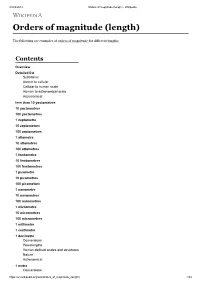
03/08/2018 Orders of magnitude (length) - Wikipedia Orders of magnitude (length) The following are examples of orders of magnitude for different lengths. Contents Overview Detailed list Subatomic Atomic to cellular Cellular to human scale Human to astronomical scale Astronomical less than 10 yoctometres 10 yoctometres 100 yoctometres 1 zeptometre 10 zeptometres 100 zeptometres 1 attometre 10 attometres 100 attometres 1 femtometre 10 femtometres 100 femtometres 1 picometre 10 picometres 100 picometres 1 nanometre 10 nanometres 100 nanometres 1 micrometre 10 micrometres 100 micrometres 1 millimetre 1 centimetre 1 decimetre Conversions Wavelengths Human-defined scales and structures Nature Astronomical 1 metre Conversions https://en.wikipedia.org/wiki/Orders_of_magnitude_(length) 1/44 03/08/2018 Orders of magnitude (length) - Wikipedia Human-defined scales and structures Sports Nature Astronomical 1 decametre Conversions Human-defined scales and structures Sports Nature Astronomical 1 hectometre Conversions Human-defined scales and structures Sports Nature Astronomical 1 kilometre Conversions Human-defined scales and structures Geographical Astronomical 10 kilometres Conversions Sports Human-defined scales and structures Geographical Astronomical 100 kilometres Conversions Human-defined scales and structures Geographical Astronomical 1 megametre Conversions Human-defined scales and structures Sports Geographical Astronomical 10 megametres Conversions Human-defined scales and structures Geographical Astronomical 100 megametres 1 gigametre -
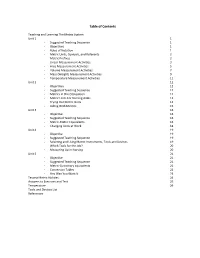
Table of Contents
Table of Contents Teaching and Learning The Metric System Unit 1 1 - Suggested Teaching Sequence 1 - Objectives 1 - Rules of Notation 1 - Metric Units, Symbols, and Referents 2 - Metric Prefixes 2 - Linear Measurement Activities 3 - Area Measurement Activities 5 - Volume Measurement Activities 7 - Mass (Weight) Measurement Activities 9 - Temperature Measurement Activities 11 Unit 2 12 - Objectives 12 - Suggested Teaching Sequence 12 - Metrics in this Occupation 12 - Metric Units For Nursing Aides 13 - Trying Out Metric Units 14 - Aiding With Metrics 15 Unit 3 16 - Objective 16 - Suggested Teaching Sequence 16 - Metric-Metric Equivalents 16 - Changing Units at Work 18 Unit 4 19 - Objective 19 - Suggested Teaching Sequence 19 - Selecting and Using Metric Instruments, Tools and Devices 19 - Which Tools for the Job? 20 - Measuring Up in Nursing 20 Unit 5 21 - Objective 21 - Suggested Teaching Sequence 21 - Metric-Customary Equivalents 21 - Conversion Tables 22 - Any Way You Want It 23 Testing Metric Abilities 24 Answers to Exercises and Test 25 Temperature 26 Tools and Devices List References metrics for nurses aides TEACHING AND LEARNING THE METRIC SYSTEM This metric instructional package was designed to meet job-related Unit 2 provides the metric terms which are used in this occupation metric measurement needs of students. To use this package students and gives experience with occupational measurement tasks. should already know the occupational terminology, measurement terms, and tools currently in use. These materials were prepared with Unit 3 focuses on job-related metric equivalents and their relation the help of experienced vocational teachers, reviewed by experts, tested ships. in classrooms in different parts of the United States, and revised before distribution. -

Land Measurements
© delta alpha publishing MEASUREMENTS LAND LINEAR MEASURE ............................................................ 2 LAND AREA MEASURE ................................................................. 3 VOLUME MEASURE ....................................................................... 4 WEIGHT or MASS ............................................................................ 5 MEASURES OF ANGLES AND ARCS ......................................... 6 AREAS AND VOLUME CALCULATIONS ................................... 6 1 back to the top http://realestatedefined.com © delta alpha publishing LAND LINEAR MEASURE Imperial/US measurements 12 inches (in or ”) = 1 foot (ft or ’) 3 feet = 1 yard (yd) 1,760 yards = 1 mile (mi) = 5,280 feet =320 rods 5½ yards = 1 rod (rd), pole or perch = 16½ feet 40 rods = 1 furlong (fur) = 220 yards 22 yards = 1 chain = 4 rods, poles or perches 220 yards = 10 chains = 1 furlong 8 furlongs = 1 mile = 80 chains 1,852 meters =1 nautical mile = 6,076.115 feet (approx.) Surveying Measurements 7.92 inches = 1 link (li) (Gunter’s or surveyor’s chain) = 0.66 foot 100 links = 1 chain (ch) = 4 rods = 66 feet 80 chains = 1 statute mile (mi.) = 320 rods = 5,280 feet 12 inches = 1 link (Engineer’s chain) 100 links = 1 chain = 100 feet 52.8 chains = 1 mile = 5,280 feet Metric measurements 10 millimetres (mm) = 1 centimetre (cm) 10 centimetres = 1 decimetre (dm) 10 decimetres = 1 meter(AmE)/metre(BrE) = 1,000 millimetres 10 metres = 1 decametre/dekametre (dam) 10 decametres = 1 hectometre (hm) = 100 metres 1,000 metres = 1 kilometre (km) 10,000 metres = 10 kilometres = 1 myriametre Imperial/US to Metric Conversion 0.3937 inches = 1 centimetre (cm) 39.37 inches = 1 metre 3.28084 feet = 1 metre (m) 1.0936 yards = 1 meter(AmE)/metre(BrE) 0.621371 miles = 1 kilometre (km) 2.5400 centimetres = 1 inch 0.3048 metres = 1 foot 0.9144 metres = 1 yard 1.609344 kilometres = 1 mile 2 back to the top http://realestatedefined.com © delta alpha publishing LAND AREA MEASURE Imperial/US measurements 1 square inch (sq.