The Fijian Colonial Experience Timothy J. Macnaught
Total Page:16
File Type:pdf, Size:1020Kb
Load more
Recommended publications
-

The Case for Lau and Namosi Masilina Tuiloa Rotuivaqali
ACCOUNTABILITY IN FIJI’S PROVINCIAL COUNCILS AND COMPANIES: THE CASE FOR LAU AND NAMOSI MASILINA TUILOA ROTUIVAQALI ACCOUNTABILITY IN FIJI’S PROVINCIAL COUNCILS AND COMPANIES: THE CASE FOR LAU AND NAMOSI by Masilina Tuiloa Rotuivaqali A thesis submitted in fulfillment of the requirements for the degree of Master of Commerce Copyright © 2012 by Masilina Tuiloa Rotuivaqali School of Accounting & Finance Faculty of Business & Economics The University of the South Pacific September, 2012 DECLARATION Statement by Author I, Masilina Tuiloa Rotuivaqali, declare that this thesis is my own work and that, to the best of my knowledge, it contains no material previously published, or substantially overlapping with material submitted for the award of any other degree at any institution, except where due acknowledgement is made in the text. Signature………………………………. Date……………………………… Name: Masilina Tuiloa Rotuivaqali Student ID No: S00001259 Statement by Supervisor The research in this thesis was performed under my supervision and to my knowledge is the sole work of Mrs. Masilina Tuiloa Rotuivaqali. Signature……………………………… Date………………………………... Name: Michael Millin White Designation: Professor in Accounting DEDICATION This thesis is dedicated to my beloved daughters Adi Filomena Rotuisolia, Adi Fulori Rotuisolia and Adi Losalini Rotuisolia and to my niece and nephew, Masilina Tehila Tuiloa and Malakai Ebenezer Tuiloa. I hope this thesis will instill in them the desire to continue pursuing their education. As Nelson Mandela once said and I quote “Education is the most powerful weapon which you can use to change the world.” i ACKNOWLEDGEMENT The completion of this thesis owes so much from the support of several people and organisations. -

We Are Kai Tonga”
5. “We are Kai Tonga” The islands of Moala, Totoya and Matuku, collectively known as the Yasayasa Moala, lie between 100 and 130 kilometres south-east of Viti Levu and approximately the same distance south-west of Lakeba. While, during the nineteenth century, the three islands owed some allegiance to Bau, there existed also several family connections with Lakeba. The most prominent of the few practising Christians there was Donumailulu, or Donu who, after lotuing while living on Lakeba, brought the faith to Moala when he returned there in 1852.1 Because of his conversion, Donu was soon forced to leave the island’s principal village, Navucunimasi, now known as Naroi. He took refuge in the village of Vunuku where, with the aid of a Tongan teacher, he introduced Christianity.2 Donu’s home island and its two nearest neighbours were to be the scene of Ma`afu’s first military adventures, ostensibly undertaken in the cause of the lotu. Richard Lyth, still working on Lakeba, paid a pastoral visit to the Yasayasa Moala in October 1852. Despite the precarious state of Christianity on Moala itself, Lyth departed in optimistic mood, largely because of his confidence in Donu, “a very steady consistent man”.3 He observed that two young Moalan chiefs “who really ruled the land, remained determined haters of the truth”.4 On Matuku, which he also visited, all villages had accepted the lotu except the principal one, Dawaleka, to which Tui Nayau was vasu.5 The missionary’s qualified optimism was shattered in November when news reached Lakeba of an attack on Vunuku by the two chiefs opposed to the lotu. -
Zorotypidae of Fiji (Zoraptera)
NUMBER 91, 42 pages 15 March 2006 BISHOP MUSEUM OCCASIONAL PAPERS FIJI ARTHROPODS VII NEAL L. EVENHUIS AND DANIEL J. BICKEL, EDITORS 7 BISHOP MUSEUM PRESS HONOLULU Bishop Museum Press has been publishing scholarly books on the natu- RESEARCH ral and cultural history of Hawai‘i and the Pacific since 1892. The Bernice P. Bishop Museum Bulletin series (ISSN 0005-9439) was begun PUBLICATIONS OF in 1922 as a series of monographs presenting the results of research in many scientific fields throughout the Pacific. In 1987, the Bulletin series BISHOP MUSEUM was superceded by the Museum’s five current monographic series, issued irregularly: Bishop Museum Bulletins in Anthropology (ISSN 0893-3111) Bishop Museum Bulletins in Botany (ISSN 0893-3138) Bishop Museum Bulletins in Entomology (ISSN 0893-3146) Bishop Museum Bulletins in Zoology (ISSN 0893-312X) Bishop Museum Bulletins in Cultural and Environmental Studies (ISSN 1548-9620) Bishop Museum Press also publishes Bishop Museum Occasional Papers (ISSN 0893-1348), a series of short papers describing original research in the natural and cultural sciences. To subscribe to any of the above series, or to purchase individual publi- cations, please write to: Bishop Museum Press, 1525 Bernice Street, Honolulu, Hawai‘i 96817-2704, USA. Phone: (808) 848-4135. Email: press@bishopmuseum.org. Institutional libraries interested in exchang- ing publications may also contact the Bishop Museum Press for more information. BISHOP MUSEUM The State Museum of Natural and Cultural History ISSN 0893-1348 1525 Bernice Street Copyright © 2007 by Bishop Museum Honolulu, Hawai‘i 96817-2704, USA FIJI ARTHROPODS Editors’ Preface We are pleased to present the seventh issue of Fiji Arthropods, a series offering rapid pub- lication and devoted to studies of terrestrial arthropods of the Fiji Group and nearby Pacific archipelagos. -

A Time Bomb Lies Buried: Fiji's Road to Independence
1. Introduction In his Christmas message to the people of Fiji, Governor Sir Kenneth Maddocks described 1961 as a year of `peaceful progress'.1 The memory of industrial disturbance and a brief period of rioting and looting in Suva in 1959 was fading rapidly.2 The nascent trade union movement, multi-ethnic in character, which had precipitated the strike, was beginning to fracture along racial lines. The leading Fijian chiefs, stunned by the unexpectedly unruly behaviour of their people, warned them against associating with people of other races, emphasising the importance of loyalty to the Crown and respect for law and order.3 The strike in the sugar industry, too, was over. Though not violent in character, the strike had caused much damage to an economy dependent on sugar, it bitterly split the Indo-Fijian community and polarised the political atmosphere.4 A commission of inquiry headed by Sir Malcolm Trustram Eve (later Lord Silsoe) was appointed to investigate the causes of the dispute and to recommend a new contract between the growers, predominantly Indo-Fijians, and the monopoly miller, the Australian Colonial Sugar Refining Company (CSR). The recommendations of the Burns Commission Ð as it came to be known, after its chairman, the former governor of the Gold Coast (Ghana), Sir Alan Burns Ð into the natural resources and population of Fiji were being scrutinised by the government.5 The construction of roads, bridges, wharves, schools, hospital buildings and water supply schemes was moving apace. The governor had good reason to hope for `peaceful progress'. Rather more difficult was the issue of political reform, but the governor's message announced that constitutional changes would be introduced. -

Fiji: Severe Tropical Cyclone Winston Situation Report No
Fiji: Severe Tropical Cyclone Winston Situation Report No. 8 (as of 28 February 2016) This report is produced by the OCHA Regional Office for the Pacific (ROP) in collaboration with humanitarian partners. It covers the period from 27 to 28 February 2016. The next report will be issued on or around 29 February 2016. Highlights On 20 and 21 February Category 5 Severe Tropical Cyclone Winston cut a path of destruction across Fiji. The cyclone is estimated to be one of the most severe ever to hit the South Pacific. The Fiji Government estimates almost 350,000 people living in the cyclone’s path could have been affected (180,000 men and 170 000 women). 5 6 42 people have been confirmed dead. 4 1,177 schools and early childhood education centres (ECEs) to re-open around Fiji. Winston 12 2 8 Total damage bill estimated at more than FJ$1billion or 10 9 1 almost half a billion USD. 3 11 7 87,000 households targeted for relief in 12 priority areas across Fiji. !^ Suva More than Population Density Government priority areas 51,000 for emergency response 1177 More densely populated 42 people still schools and early are shown above in red Confirmed fatalities sheltering in childhood centres and are numbered in order evacuation centres set to open Less densely populated of priority Sit Rep Sources: Fiji Government, Fiji NEOC/NDMO, PHT Partners, NGO Community, NZ Government. Datasets available in HDX at http://data.hdx.rwlabs.org. Situation Overview Food security is becoming an issue with crops ruined and markets either destroyed or inaccessible in many affected areas because of the cyclone. -
Researchspace@Auckland
http://researchspace.auckland.ac.nz ResearchSpace@Auckland Copyright Statement The digital copy of this thesis is protected by the Copyright Act 1994 (New Zealand). This thesis may be consulted by you, provided you comply with the provisions of the Act and the following conditions of use: • Any use you make of these documents or images must be for research or private study purposes only, and you may not make them available to any other person. • Authors control the copyright of their thesis. You will recognise the author's right to be identified as the author of this thesis, and due acknowledgement will be made to the author where appropriate. • You will obtain the author's permission before publishing any material from their thesis. To request permissions please use the Feedback form on our webpage. http://researchspace.auckland.ac.nz/feedback General copyright and disclaimer In addition to the above conditions, authors give their consent for the digital copy of their work to be used subject to the conditions specified on the Library Thesis Consent Form and Deposit Licence. CONNECTING IDENTITIES AND RELATIONSHIPS THROUGH INDIGENOUS EPISTEMOLOGY: THE SOLOMONI OF FIJI ESETA MATEIVITI-TULAVU A thesis in fulfilment of the requirements for the degree of DOCTOR OF PHILOSOPHY The University of Auckland Auckland, New Zealand 2013 TABLE OF CONTENTS Abstract .................................................................................................................................. vi Dedication ............................................................................................................................ -

Tropical Cyclone Winston UNOSAT Damage Assessment Activities In
Tropical Cyclone Winston UNOSAT Damage Assessment Activities in Viti Levu Island, Fiji 09 March 2016 - Report 9 March 2016 Geneva, Switzerland UNOSAT Contact: Postal Address: Email: unosat@unitar.org UNITAR – UNOSAT, IEH T: +41 22 767 4020 (UNOSAT Operations) Chemin des Anémones 11, 24/7 hotline: +41 75 411 4998 CH-1219, Genève, Suisse 1 UNITAR - UNOSAT | UNOSAT Damage Assessment Activities in Viti Levu Island - FIJI | 9 March 2016 Tropical Cyclone Winston in Fiji (19 February 2016 – 9 March 2016) Overview A powerful tropical cyclone named “Winston” struck the Southern Pacific and was heading towards the coasts of Fiji. UNITAR - UNOSAT on behalf of UN OCHA activated the International Space Charter on 19 February 2016. On the 20th of February 2016, the cyclone made landfall at 06:30 UTC (18:30 local time) over the north-eastern coast of Viti Levu (Fiji), the main island of the archipelago. The cyclone tracked west across the country, causing damage in four divisions (Western, Central, Eastern and Northern) with more concerns on the Western and Central divisions. According to FIJI Flash Appeal Tropical Cyclone Winston published by UNOCHA on 4 March 2016, 350,000 people living in the cyclone’s path could have been affected (170.000 female and 180,000 male) - equivalent to 40 per cent of Fiji’s population. This includes 120,000 children under the age of 18 (58,000 female and 62,000 male) and more than 3,100 people with disabilities. UNOSAT Damage Assessment UNOSAT triggered the space charter on behalf of UNOCHA the 19th of February 2016 and requested satellite imagery over the areas defined by UNOCHA based on the proximity to the cyclone track, wind speed values and related potential population exposure. -

Pacific Island History Poster Profiles
Pacific Island History Poster Profiles A Note for Teachers Acknowledgements Index of Profiles This Profiles are subject to copyright. Photocopying and general reproduction for teaching purposes is permitted. Reproduction of this material in part or whole for commercial purposes is forbidden unless written consent has been obtained from Queensland University of Technology. Requests can be made through the acknowldgements section of this pdf file. A Note for Teachers This series of National History Posters has been designed for individual and group Classroom use and Library display in secondary schools. The main aim is to promote in children an interest in their national history. By comparing their nation's history with what is presented on other Posters, students will appreciate the similarities and differences between their own history and that of their Pacific Island neighbours. The student activities are designed to stimulate comparison and further inquiry into aspects of their own and other's past. The National History Posters will serve a further purpose when used as a permanent display in a designated “History” classroom, public space or foyer in the school or for special Parent- Teacher nights, History Days and Education Days. The National History Posters do not offer a complete survey of each nation's history. They are only a profile. They are a short-cut to key people, key events and the broad sweep of history from original settlement to the present. There are many gaps. The posters therefore serve as a stimulus for students to add, delete, correct and argue about what should or should not be included in their Nation's History Profile. -
Filling the Gaps: Identifying Candidate Sites to Expand Fiji's National Protected Area Network
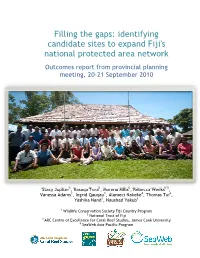
Filling the gaps: identifying candidate sites to expand Fiji's national protected area network Outcomes report from provincial planning meeting, 20-21 September 2010 Stacy Jupiter1, Kasaqa Tora2, Morena Mills3, Rebecca Weeks1,3, Vanessa Adams3, Ingrid Qauqau1, Alumeci Nakeke4, Thomas Tui4, Yashika Nand1, Naushad Yakub1 1 Wildlife Conservation Society Fiji Country Program 2 National Trust of Fiji 3 ARC Centre of Excellence for Coral Reef Studies, James Cook University 4 SeaWeb Asia-Pacific Program This work was supported by an Early Action Grant to the national Protected Area Committee from UNDP‐GEF and a grant to the Wildlife Conservation Society from the John D. and Catherine T. MacArthur Foundation (#10‐94985‐000‐GSS) © 2011 Wildlife Conservation Society This document to be cited as: Jupiter S, Tora K, Mills M, Weeks R, Adams V, Qauqau I, Nakeke A, Tui T, Nand Y, Yakub N (2011) Filling the gaps: identifying candidate sites to expand Fiji's national protected area network. Outcomes report from provincial planning meeting, 20‐21 September 2010. Wildlife Conservation Society, Suva, Fiji, 65 pp. Executive Summary The Fiji national Protected Area Committee (PAC) was established in 2008 under section 8(2) of Fiji's Environment Management Act 2005 in order to advance Fiji's commitments under the Convention on Biological Diversity (CBD)'s Programme of Work on Protected Areas (PoWPA). To date, the PAC has: established national targets for conservation and management; collated existing and new data on species and habitats; identified current protected area boundaries; and determined how much of Fiji's biodiversity is currently protected through terrestrial and marine gap analyses. -

4594 Supplement to The'london Gazette, 19 June, 1911
4594 SUPPLEMENT TO THE'LONDON GAZETTE, 19 JUNE, 1911. To be Ordinary Members of the. Third Class, Adam Shortt, Esq., M.A., Civil Service or Companions of the said Most Distinguished Commissioner,-Dominion of Canada. Order: — --Arthur French Sladen, Esq., Private Secretary to the Governor-General of the Captain Cecil Hamilton Armitage, Dominion of Canada. D.S.O., Chief Commissioner of the Northern George Smith, Esq., Colonial Secretary of Territories of the Gold Coast. * the Colony of Mauritius. Chewton Atchley, Esq., I.S.O., Librarian, 'Henry -Richard Wallis, Esq., Assistant Colonial Office. Deputy-Governor, Nyasaland Protectorate. • James William Barrett, Esq., M.D., . Reginald George Watson, Esq., British Member of the Council and Lecturer of the Resident, Selangor, Federated Malay States. University of Melbourne. The Honourable Frank Wilson, Premier Marcus Henry De la Poer Beresford, Esq., and Colonial Treasurer of the State of I.S/O., late Secretary to the Administration, Western Australia. Northern Nigeria. Temistocle Zammit, ^Esq., M.D., Govern - Arthur Wimbolt Brewin, Esq., Registrar- ment Analyst, Public Health Department of General of the Colony of Hong Kong. the Island of Malta. Henry William Frederick Nottingham Brodhurst, Esq.i Government A'Jjent, West- ern Province of the Island of Ceylon. Robert Gervase Bushe, Esq., Auditor General of the Colony -of Trinidad and Tobago. Lieutenant Herbert Alexander Child, R.N., Director of Marine, Southern Nigeria. | Chancery of the Order of Arthur Ernest Collins, Esq., Principal \ Saint Michael 'arid 'Saint George, Clerk, Colonial Office. Colonel Robert Joseph Collins, I.S.O., ; Downing Street, June 19, 1911. Comptroller and Auditor-General, Dominion I The KING has been graciously .pleased, on of New Zealand. -

Communal Division and Constitutional Changes in Colonial Fiji, 1959-1970 Donald D
Purdue University Purdue e-Pubs Open Access Theses Theses and Dissertations January 2015 Communal Division and Constitutional Changes in Colonial Fiji, 1959-1970 Donald D. Johnson Purdue University Follow this and additional works at: https://docs.lib.purdue.edu/open_access_theses Recommended Citation Johnson, Donald D., "Communal Division and Constitutional Changes in Colonial Fiji, 1959-1970" (2015). Open Access Theses. 1061. https://docs.lib.purdue.edu/open_access_theses/1061 This document has been made available through Purdue e-Pubs, a service of the Purdue University Libraries. Please contact epubs@purdue.edu for additional information. Graduate School Form 30 Updated 1/15/2015 PURDUE UNIVERSITY GRADUATE SCHOOL Thesis/Dissertation Acceptance This is to certify that the thesis/dissertation prepared By DONALD JOHNSON, III Entitled COMMUNAL DIVISION AND CONSTITUTIONAL CHANGES IN COLONIAL FIJI, 1959-1970 For the degree of Master of Arts Is approved by the final examining committee: JENNIFER FORAY Chair DAVID ATKINSON WILLIAM GRAY To the best of my knowledge and as understood by the student in the Thesis/Dissertation Agreement, Publication Delay, and Certification Disclaimer (Graduate School Form 32), this thesis/dissertation adheres to the provisions of Purdue University’s “Policy of Integrity in Research” and the use of copyright material. Approved by Major Professor(s): JENNIFER FORAY Approved by: Douglas Hurt December 2, 2015 Head of the Departmental Graduate Program Date i COMMUNAL DIVISION AND CONSTITUTIONAL CHANGES IN COLONIAL FIJI, 1959-1970 A Thesis Submitted to the Faculty of Purdue University by Donald Dwight Johnson, III In Partial Fulfillment of the Requirements for the Degree of Master of Arts i December 2015 Purdue University West Lafayette, Indiana ii TABLE OF CONTENTS Page DISCLAIMER .................................................................................................................. -

Theorizing Citizenship, Indirect Rule and Britain's Imperial Expansion Shanta S
CORE Metadata, citation and similar papers at core.ac.uk Provided by eGrove (Univ. of Mississippi) Accounting Historians Journal Volume 32 Article 4 Issue 2 December 2005 2005 Accounting's uses in exploitative human engineering: Theorizing citizenship, indirect rule and Britain's imperial expansion Shanta S. K. Davie Follow this and additional works at: https://egrove.olemiss.edu/aah_journal Part of the Accounting Commons, and the Taxation Commons Recommended Citation Davie, Shanta S. K. (2005) "Accounting's uses in exploitative human engineering: Theorizing citizenship, indirect rule and Britain's imperial expansion," Accounting Historians Journal: Vol. 32 : Iss. 2 , Article 4. Available at: https://egrove.olemiss.edu/aah_journal/vol32/iss2/4 This Article is brought to you for free and open access by the Archival Digital Accounting Collection at eGrove. It has been accepted for inclusion in Accounting Historians Journal by an authorized editor of eGrove. For more information, please contact egrove@olemiss.edu. Davie: Accounting's uses in exploitative human engineering: Theorizing citizenship, indirect rule and Britain's imperial expansion Accounting Historians Journal Vol. 32, No. 2 December 2005 Vangermeersch Manuscript Award Winner, 2003 Shanta S. K. Davie UNIVERSITY OF NEWCASTLE UPON TYNE ACCOUNTING’S USES IN EXPLOITATIVE HUMAN ENGINEERING: THEORIZING CITIZENSHIP, INDIRECT RULE AND BRITAIN’S IMPERIAL EXPANSION Abstract: This historical study starts from the argument that financial economic quantification using accounting concepts and analysis has always been an essential and integral part of effective policies and activities for Britain’s empire building. Theories of citizenship are used in particular to examine the close association between account- ing and imperial policies during British indirect rule in Fiji.