Hannah Arendt, "Franz Kafka, a Revaluation"
Total Page:16
File Type:pdf, Size:1020Kb
Load more
Recommended publications
-

European Literary Tradition in Roth's Kepesh Trilogy
CLCWeb: Comparative Literature and Culture ISSN 1481-4374 Purdue University Press ©Purdue University Volume 16 (2014) Issue 2 Article 8 European Literary Tradition in Roth's Kepesh Trilogy Gustavo Sánchez-Canales Autónoma University Madrid Follow this and additional works at: https://docs.lib.purdue.edu/clcweb Part of the American Studies Commons, Comparative Literature Commons, Education Commons, European Languages and Societies Commons, Feminist, Gender, and Sexuality Studies Commons, Jewish Studies Commons, Other Arts and Humanities Commons, Other Film and Media Studies Commons, Reading and Language Commons, Rhetoric and Composition Commons, Social and Behavioral Sciences Commons, Television Commons, and the Theatre and Performance Studies Commons Dedicated to the dissemination of scholarly and professional information, Purdue University Press selects, develops, and distributes quality resources in several key subject areas for which its parent university is famous, including business, technology, health, veterinary medicine, and other selected disciplines in the humanities and sciences. CLCWeb: Comparative Literature and Culture, the peer-reviewed, full-text, and open-access learned journal in the humanities and social sciences, publishes new scholarship following tenets of the discipline of comparative literature and the field of cultural studies designated as "comparative cultural studies." Publications in the journal are indexed in the Annual Bibliography of English Language and Literature (Chadwyck-Healey), the Arts and Humanities Citation Index (Thomson Reuters ISI), the Humanities Index (Wilson), Humanities International Complete (EBSCO), the International Bibliography of the Modern Language Association of America, and Scopus (Elsevier). The journal is affiliated with the Purdue University Press monograph series of Books in Comparative Cultural Studies. Contact: <clcweb@purdue.edu> Recommended Citation Sánchez-Canales, Gustavo. -
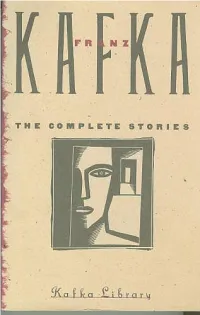
Complete Stories by Franz Kafka
The Complete Stories by Franz Kafka Back Cover: "An important book, valuable in itself and absolutely fascinating. The stories are dreamlike, allegorical, symbolic, parabolic, grotesque, ritualistic, nasty, lucent, extremely personal, ghoulishly detached, exquisitely comic. numinous and prophetic." -- New York Times "The Complete Stories is an encyclopedia of our insecurities and our brave attempts to oppose them." -- Anatole Broyard Franz Kafka wrote continuously and furiously throughout his short and intensely lived life, but only allowed a fraction of his work to be published during his lifetime. Shortly before his death at the age of forty, he instructed Max Brod, his friend and literary executor, to burn all his remaining works of fiction. Fortunately, Brod disobeyed. The Complete Stories brings together all of Kafka's stories, from the classic tales such as "The Metamorphosis," "In the Penal Colony" and "The Hunger Artist" to less-known, shorter pieces and fragments Brod released after Kafka's death; with the exception of his three novels, the whole of Kafka's narrative work is included in this volume. The remarkable depth and breadth of his brilliant and probing imagination become even more evident when these stories are seen as a whole. This edition also features a fascinating introduction by John Updike, a chronology of Kafka's life, and a selected bibliography of critical writings about Kafka. Copyright © 1971 by Schocken Books Inc. All rights reserved under International and Pan-American Copyright Conventions. Published in the United States by Schocken Books Inc., New York. Distributed by Pantheon Books, a division of Random House, Inc., New York. The foreword by John Updike was originally published in The New Yorker. -

Xerox University Microfilms 300 North Zeeb Road Ann Arbor, Michigan 48106 73-20,631
THE EFFORT TO ESCAPE FROM TEMPORAL CONSCIOUSNESS AS EXPRESSED IN THE THOUGHT AND WORK OF HERMAN HESSE, HANNAH ARENDT, AND KARL LOEWITH Item Type text; Dissertation-Reproduction (electronic) Authors Olsen, Gary Raymond, 1940- Publisher The University of Arizona. Rights Copyright © is held by the author. Digital access to this material is made possible by the University Libraries, University of Arizona. Further transmission, reproduction or presentation (such as public display or performance) of protected items is prohibited except with permission of the author. Download date 10/10/2021 18:13:22 Link to Item http://hdl.handle.net/10150/288040 INFORMATION TO USERS This material was produced from a microfilm copy of the original document. While the most advanced technological means to photograph and reproduce this document have been used, the quality is heavily dependent upon the quality of the original submitted. The following explanation of techniques is provided to help you understand markings or patterns which may appear on this reproduction. 1. The sign or "target" for pages apparently lacking from the document photographed is "Missing Paga(s)". If it was possible to obtain the missing page(s) or section, they are spliced into the film along with adjacent pages. This may have necessitated cutting thru an image and duplicating adjacent pages to insure you complete continuity. 2. When an image on the film is obliterated with a large round black mark, it is an indication that the photographer suspected that the copy may have moved during exposure and thus cause a blurred image. You will find a good image of the page in the adjacent frame. -
The Kafka Protagonist As Knight Errant and Scapegoat
tJBIa7I vAl, O7/ THE KAFKA PROTAGONIST AS KNIGHT ERRANT AND SCAPEGOAT THESIS Presented to the Graduate Council of the North Texas State University in Partial Fulfillment of the Requirements For the Degree of MASTER OF ARTS By Mary R. Scrogin, B. A. Denton, Texas August, 1975 10 Scrogin, Mary R., The Kafka Protagonist as night Errant and Scapegoat. Master of Arts (English), August, 1975, 136 pp., bibliography, 34 titles. This study presents an alternative approach to the novels of Franz Kafka through demonstrating that the Kafkan protagonist may be conceptualized in terms of mythic arche- types: the knight errant and the pharmakos. These complementary yet contending personalities animate the Kafkan victim-hero and account for his paradoxical nature. The widely varying fates of Karl Rossmann, Joseph K., and K. are foreshadowed and partially explained by their simultaneous kinship and uniqueness. The Kafka protagonist, like the hero of quest- romance, is engaged in a quest which symbolizes man's yearning to transcend sterile human existence. TABLE OF CONTENTS Chapter Page I. INTRODUCTION . .......... 1 II. THE SPARED SACRIFICE...-.-.................... 16 III. THE FAILED QUEST... .......... 49 IV. THE REDEMPTIVE QUEST........... .......... 91 BIBLIOGRAPHY.. --...........-.......-.-.-.-.-....... 134 iii CHAPTER I INTRODUCTION Speaking of the allegorical nature of much contemporary American fiction, Raymond Olderman states in Beyond the Waste Land that it "primarily reinforces the sense that contemporary fact is fabulous and may easily refer to meanings but never to any one simple Meaning." 1 A paraphrase of Olderman's comment may be appropriately applied to the writing of Franz Kafka: a Kafkan fable may easily refer to meanings but never to any one Meaning. -

The Castle and the Village: the Many Faces of Limited Access
01-7501-1 CH 1 10/28/08 5:17 PM Page 3 1 The Castle and the Village: The Many Faces of Limited Access jorrit de jong and gowher rizvi Access Denied No author in world literature has done more to give shape to the nightmarish challenges posed to access by modern bureaucracies than Franz Kafka. In his novel The Castle, “K.,” a land surveyor, arrives in a village ruled by a castle on a hill (see Kafka 1998). He is under the impression that he is to report for duty to a castle authority. As a result of a bureaucratic mix-up in communications between the cas- tle officials and the villagers, K. is stuck in the village at the foot of the hill and fails to gain access to the authorities. The villagers, who hold the castle officials in high regard, elaborately justify the rules and procedures to K. The more K. learns about the castle, its officials, and the way they relate to the village and its inhabitants, the less he understands his own position. The Byzantine codes and formalities gov- erning the exchanges between castle and village seem to have only one purpose: to exclude K. from the castle. Not only is there no way for him to reach the castle, but there is also no way for him to leave the village. The villagers tolerate him, but his tireless struggle to clarify his place there only emphasizes his quasi-legal status. Given K.’s belief that he had been summoned for an assignment by the authorities, he remains convinced that he has not only a right but also a duty to go to the cas- tle! How can a bureaucracy operate in direct opposition to its own stated pur- poses? How can a rule-driven institution be so unaccountable? And how can the “obedient subordinates” in the village wield so much power to act in their own self- 3 01-7501-1 CH 1 10/28/08 5:17 PM Page 4 4 jorrit de jong and gowher rizvi interest? But because everyone seems to find the castle bureaucracy flawless, it is K. -
Featuring Martin Kippenberger's the Happy
FONDAZIONE PRADA PRESENTS THE EXHIBITION “K” FEATURING MARTIN KIPPENBERGER’S THE HAPPY END OF FRANZ KAFKA’S ‘AMERIKA’ ACCOMPANIED BY ORSON WELLES’ FILM THE TRIAL AND TANGERINE DREAM’S ALBUM THE CASTLE, IN MILAN FROM 21 FEBRUARY TO 27 JULY 2020 Milan, 31 January 2020 – Fondazione Prada presents the exhibition “K” in its Milan venue from 21 February to 27 July 2020 (press preview on Wednesday 19 February). This project, featuring Martin Kippenberger’s legendary artworkThe Happy End of Franz Kafka’s “Amerika” accompanied by Orson Welles’ iconic film The Trial and Tangerine Dream’s late electronic album The Castle, is conceived by Udo Kittelmann as a coexisting trilogy. “K” is inspired by three uncompleted and seminal novels by Franz Kafka (1883-1924) ¾Amerika (America), Der Prozess (The Trial), and Das Schloss (The Castle)¾ posthumously published from 1925 to 1927. The unfinished nature of these books allows multiple and open readings and their adaptation into an exhibition project by visual artist Martin Kippenberger, film director Orson Welles, and electronic music band Tangerine Dream, who explored the novels’ subjects and atmospheres through allusions and interpretations. Visitors will be invited to experience three possible creative encounters with Kafka’s oeuvre through a simultaneous presentation of art, cinema and music works, respectively in the Podium, Cinema and Cisterna.“K” proves Fondazione Prada’s intention to cross the boundaries of contemporary art and embrace a vaste cultural sphere, that also comprises historical perspectives and interests in other languages, such as cinema, music, literature and their possible interconnections and exchanges. As underlined by Udo Kittelmann, “America, The Trial, and The Castle form a ‘trilogy of loneliness,’ according to Kafka’s executor Max Brod. -

The Hero As an Outsider in Franz Kafka's Novels
THE HERO AS AN OUTSIDER IN FRANZ KAFKA'S NOVELS: DER PROZESS AND DAS SChLOSS A THESIS SUBHITTED TO THE DEPARTl1ENT OF FOREIGN LANGUAGES AND THE GRADUATE COUNCIL OF THE KANSAS STATE TEAC HERS COLLEGE OF EMPORIA IN PARTIAL FULFILLMENT OF THE REQUI RE}1ENTS FOR THE DEGREE OF . 1'-1ASTER OF ARTS By RENATE KER~.,rICK August 1972 ~~?_'(~fV ~uem~~~dea ~or~W e~~ JOJ P~~ddV .1 r AC KNO\rJLEDGMENT The writer wishes to express sincere appreciation to Dr. David E. Travis, Chairman of the Department of Foreign Languages, Kansas State Teachers College, Emporia, without whose active interest and constructive criticism this study would not have been possible. R. K. PREFACE Many Kafka scholars have approached the study of his works with the preconception that the artist's own experiences, emotions, and sentiments must be reflected in the creations, thereby denying from the start that the author l.vas able to rai se his liJork above the personal level. Other critics were determined to discover in Kafka's works certain characteristics and weaknesses which they believed to have discerned in the artist him sell. One must allow these critics their own views. Perhaps they are correct in the assumption that it is impossible to separate Kafka's life from his works com pletely. For it is certainly true that, particularly in two of his novels, Der Prozess and Das Schloss, he continues to use variations on the same theme •. In both novels, the apparent concern is with man's attempt to integrate himself into the company of his fellowman. -

Journey to Japan Sleepover: Top Films
Top 10 Japanese flms Japanese cinema is among the most famous and celebrated in the world. It dates all the way back to 1897, when the Lumière Brothers’ cinematograph (a camera which could record, develop and project flm) arrived in Japan. However, moving pictures already existed in the form of Utsushi-e. This was a type of magic lantern show which used a projector to show colourful fgures moving on the screen as a storyteller narrated. Kagee (shadow puppets), emakimono (picture scrolls like the one above) and manga (graphic novels) were also developed in Japan and inspired modern Japanese anime (hand-drawn or computer animation). We’ve picked some of our favourite flms so snuggle up and get stuck in! All the flms on this list have a PG rating. Let us know if you watch any of our Saru no soshi emaki 猿草子絵 巻 (Tale of the Monkeys). Ink painting recommendations! You can email your reviews on paper, Japan, 1560–1570s. to youngfriends@britishmuseum.org 1 Spirited Away (2001) 千と千尋の神隠し This wonderful animated flm is written and directed by the famous Japanese director Hayao Miyazaki. It features the adventures of a 10-year-old girl called Chihiro. After accidentally discovering an abandoned theme park, she is soon swept into a world of magic, spirits and witches. Netfix 2 The Castle of Cagliostro (1979) ルパン三世 カリオストロの城 Part action, part comedy, this is the story of a charming thief who embarks on a quest to free a princess from an evil count. The main character, Arsène Lupin, was originally a character in a manga series called Lupin III! Netfix, Amazon Prime 3 My Neighbor Totoro (1988) となりのトトロ This is the story of two girls called Satsuke and Mei who move into an old house in the countryside. -
EXISTENTIAL CRISIS in FRANZ Kl~Fkl:T
EXISTENTIAL CRISIS IN FRANZ Kl~FKl:t. Thesis submitted to the University ofNor~b ~'!e:n~al for the award of the Degree of Doctor of Ph.Ho§'Ophy. By Miss Rosy Chamling Department of English University of North Bengal Dist. Darjeeling-7340 13 West Bengal 2010 gt)l.IN'tO rroit<. I • NlVERSITY OF NORTH BENGAL P.O. NORTH BENGAL UNIVERSITY, HEAD Raja Rammohunpur, Dist. Da~eeling, DEPARTMENT OF ENGLISH West Bengal, India, PIN- 734013. Phone: (0353) 2776 350 Ref No .................................................... Dated .....?.J..~ ..9 . .7.: ... ............. 20. /.~. TO WHOM IT MAY CONCERN This is to certify that Miss Rosy Cham!ing has completed her Research Work on •• Existential Crisis in Franz Kafka". As the thesis bears the marks of originality and analytic thinking, I recommend its submission for evaluation . \i~?~] j' {'f- f ~ . I) t' ( r . ~ . s amanta .) u, o:;.?o"" Supervis~r & Head Dept. of English, NBU .. Contents Page No. Preface ......................................................................................... 1-vn Acknowledgements ...................................................................... viii L1st. ot~A'b o -rev1at1ons . ................................................................... 1x. Chapter- I Introduction................................................... 1 1 Chapter- II The Critical Scene ......................................... 32-52 Chapter- HI Authority and the Individual. ........................ 53-110 Chapter- IV Tragic Humanism in Kafka........................... 111-17 5 Chapter- V Realism -

The Complete Stories
The Complete Stories by Franz Kafka a.b.e-book v3.0 / Notes at the end Back Cover : "An important book, valuable in itself and absolutely fascinating. The stories are dreamlike, allegorical, symbolic, parabolic, grotesque, ritualistic, nasty, lucent, extremely personal, ghoulishly detached, exquisitely comic. numinous and prophetic." -- New York Times "The Complete Stories is an encyclopedia of our insecurities and our brave attempts to oppose them." -- Anatole Broyard Franz Kafka wrote continuously and furiously throughout his short and intensely lived life, but only allowed a fraction of his work to be published during his lifetime. Shortly before his death at the age of forty, he instructed Max Brod, his friend and literary executor, to burn all his remaining works of fiction. Fortunately, Brod disobeyed. Page 1 The Complete Stories brings together all of Kafka's stories, from the classic tales such as "The Metamorphosis," "In the Penal Colony" and "The Hunger Artist" to less-known, shorter pieces and fragments Brod released after Kafka's death; with the exception of his three novels, the whole of Kafka's narrative work is included in this volume. The remarkable depth and breadth of his brilliant and probing imagination become even more evident when these stories are seen as a whole. This edition also features a fascinating introduction by John Updike, a chronology of Kafka's life, and a selected bibliography of critical writings about Kafka. Copyright © 1971 by Schocken Books Inc. All rights reserved under International and Pan-American Copyright Conventions. Published in the United States by Schocken Books Inc., New York. Distributed by Pantheon Books, a division of Random House, Inc., New York. -

Ebook Download the Art of Castle in the Sky Kindle
THE ART OF CASTLE IN THE SKY PDF, EPUB, EBOOK Hayao Miyazaki | 194 pages | 20 Oct 2016 | Viz Media, Subs. of Shogakukan Inc | 9781421582726 | English | San Francisco, United States The Art of Castle in the Sky PDF Book From the beginning, I thought about the sound and image to be acoustic. He achieved his trademark luminous color, seen here especially in the lake and trees, by building up layers of colored glazes on the surface of the painting. Sheeta, a girl who has the power to defy gravity, is on the run from pirates when she meets the young inventor Pazu. A promotional video featuring the key Studio Ghibli staff behind "Laputa". Tags: townsville, sunrise, castle hill, sky. It was a flop upon release. Additionally, this was the first film that featured the profile of Totoro in the opening, despite being released before " My Neighbor Totoro " November 5, Danica Davidson. Best Selling in Nonfiction See all. After " Princess Mononoke " flopped financially in the U. Wikipedia Cite this information. The medieval castle in the movie seems to be inspired by the European midth century painting of The Tower of Babel by Pieter Brueghel the Elder, with its giant circular base and the presence of highly rounded and arched doorways all the way around its perimeter. I think it was hard because Miya-san was saying good-bye to his mother, but I was glad that he was able to model her and draw her in the movie like that. Tags: castle, clouds, sky, peace, disney, waterfall, blue, mountain. Tags: castle, sunset, lavender field, lanscape, fantasy. -

Intervention and Parody in Contemporary Indigenous Photography
Unsettling the Archive: Intervention and Parody in Contemporary Indigenous Photography Reilley Bishop-Stall McGill University, Montreal December 2018 A thesis submitted to McGill University in partial fulfillment of the requirements of the degree of Doctor of Philosophy Department of Art History and Communication Studies Art History Program © Reilley Bishop-Stall, 2018 ACKNOWLEDGMENTS My doctoral research, which has spanned many years and undergone significant changes over time, would not have been possible without the support of numerous individuals and institutions. First and foremost, I am grateful to my supervisor, Prof. Christine Ross, for her guidance, encouragement, patience and advice. I have benefited immensely from Prof. Ross’s expertise in the study of contemporary art and broad theoretical knowledge, as well as from her openness and enthusiasm regarding my own research interests. I am forever grateful for the opportunity to have been mentored by Prof. Ross over these years. I owe my gratitude also to the rest of the faculty in McGill University’s Department of Art History and Communication Studies. In particular, I thank Prof. William Straw for the thoughtful and valuable feedback he has offered, acting as my second reader and internal examiner. I am grateful also to Prof. Angela Vanhaelen for her conversations, commentary and support over the years and to former faculty-member Dr. Amelia Jones for acting as second reader during my comprehensive exams. I owe a great debt of gratitude to the late Prof. Hajime Nakatani, my Master’s supervisor, whose mentorship, encouragement, and camaraderie in the earliest years of my graduate studies inspired and motivated me to pursue a doctoral degree.