Ethnobotany of Andhra Pradesh: a Review
Total Page:16
File Type:pdf, Size:1020Kb
Load more
Recommended publications
-

Grama/Ward Sachivalayam Recruitment (Sports Quota) 01/2020
Grama/Ward Sachivalayam Recruitment (Sports Quota) 01/2020 Provisional Priority list As per G.O.Ms.No. 74 YAT&C (Sports) Department, Government of A.P For the post :- Mahila Police Kurnool District Forms Genuinene DISCIPLINE Team/ Priority given Submitted ss HALL TICKET Name of the Remarks if S.No As per Level of Particiption and Backup Individual As per As per Confirmati NO Candidate any Annexure -I Annexure -II Annexure - on III (Yes/No) Participated in 29th National Senior Taekwondo Championship U-62 Weight Catagery held at District Sports Complex New Sarkanda, Vilaspur Chhattisgarh from 20th THUMMALA to 22th October 2010. 1 201101008041 PALLI TAEKWONDA I 27 Form-II Back up: Participated in 29th AP State Senior Inter District KRISHNAVENI Taekwondo Championship held at Sri Sri Function Hall Madhurawada, Visakhapatnam from 4th to 6th September 2010 Secured Gold Medal. Partcipated in 52nd Senior National Basketball Championships Men & Women held at Ludhina, Punjab from 5th to 12th March 2002. 2 201201000421 K SIREESHA BASKETBALL Back up: Participated in XXV AP Inter District Basketball T 27 Form - II Yes Championship Men & Women held at Anantapurmu from 05th to 08th December 2001 Secured Runners. For the post :- Mahila Police Kurnool District Forms Genuinene DISCIPLINE Team/ Priority given Submitted ss HALL TICKET Name of the Remarks if S.No As per Level of Particiption and Backup Individual As per As per Confirmati NO Candidate any Annexure -I Annexure -II Annexure - on III (Yes/No) Participated in 40th Senior Women National Handball Championship held at Delhi from 4th to 9th January 2012. State Back up: Participated in 41th AP State Senior Women Certificate DHARMAKARI Form - II & 3 201301022614 HANDBALL Handball Championship held at RGM Engineering College T 27 Yes genuinity INDRAJA IV Nandyal from 17th to 19th December 2011 Secured not Runners. -

03404349.Pdf
UA MIGRATION AND DEVELOPMENT STUDY GROUP Jagdish M. Bhagwati Nazli Choucri Wayne A. Cornelius John R. Harris Michael J. Piore Rosemarie S. Rogers Myron Weiner a ........ .................. ..... .......... C/77-5 INTERNAL MIGRATION POLICIES IN AN INDIAN STATE: A CASE STUDY OF THE MULKI RULES IN HYDERABAD AND ANDHRA K.V. Narayana Rao Migration and Development Study Group Center for International Studies Massachusetts Institute of Technology Cambridge, Massachusetts 02139 August 1977 Preface by Myron Weiner This study by Dr. K.V. Narayana Rao, a political scientist and Deputy Director of the National Institute of Community Development in Hyderabad who has specialized in the study of Andhra Pradesh politics, examines one of the earliest and most enduring attempts by a state government in India to influence the patterns of internal migration. The policy of intervention began in 1868 when the traditional ruler of Hyderabad State initiated steps to ensure that local people (or as they are called in Urdu, mulkis) would be given preferences in employment in the administrative services, a policy that continues, in a more complex form, to the present day. A high rate of population growth for the past two decades, a rapid expansion in education, and a low rate of industrial growth have combined to create a major problem of scarce employment opportunities in Andhra Pradesh as in most of India and, indeed, in many countries in the third world. It is not surprising therefore that there should be political pressures for controlling the labor market by those social classes in the urban areas that are best equipped to exercise political power. -

Committee on the Welfare of Scheduled Castes and Scheduled Tribes (2010-2011)
SCTC No. 737 COMMITTEE ON THE WELFARE OF SCHEDULED CASTES AND SCHEDULED TRIBES (2010-2011) (FIFTEENTH LOK SABHA) TWELFTH REPORT ON MINISTRY OF TRIBAL AFFAIRS Examination of Programmes for the Development of Particularly Vulnerable Tribal Groups (PTGs) Presented to Speaker, Lok Sabha on 30.04.2011 Presented to Lok Sabha on 06.09.2011 Laid in Rajya Sabha on 06.09.2011 LOK SABHA SECRETARIAT NEW DELHI April, 2011/, Vaisakha, 1933 (Saka) Price : ` 165.00 CONTENTS PAGE COMPOSITION OF THE COMMITTEE ................................................................. (iii) INTRODUCTION ............................................................................................ (v) Chapter I A Introductory ............................................................................ 1 B Objective ................................................................................. 5 C Activities undertaken by States for development of PTGs ..... 5 Chapter II—Implementation of Schemes for Development of PTGs A Programmes/Schemes for PTGs .............................................. 16 B Funding Pattern and CCD Plans.............................................. 20 C Amount Released to State Governments and NGOs ............... 21 D Details of Beneficiaries ............................................................ 26 Chapter III—Monitoring of Scheme A Administrative Structure ......................................................... 36 B Monitoring System ................................................................. 38 C Evaluation Study of PTG -
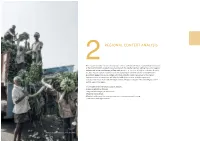
2Regional Context Analysis
5 2 REGIONAL CONTEXT ANALYSIS This chapter broadly reviews the regional context of Andhra Pradesh. Capital Region’s locati on at the heart of Andhra Pradesh and proximity with the nearby big cies; seng the Capital Region’s intrinsic role as the new Gateway of East India and also an access to all regions of Andhra Pradesh. Air, Rail, Road and water connec vity of the Capital region with the nearest landlocked ci es; give Capital Region the key advantage with trade poten al. To be a key player in the region, improvements to infrastructure will help Capital Region to realize its highest poten al. A study of the acvie s around the Region reveals the opportunity for the C apital Region to be a central node in the region. This chapter covers the following topics broadly: 1 Upcoming Na onal Projects 2 Regional Advantage Post Bifurca on 3 Regional Connec vity 4 Analysis with respect to landcover, key ci es, environment and heritage 5 Constraints and Opportuni es Workers loading bananas from the fi elds 2.1NATIONAL CONTEXT dedicated Freight Corridor along the 6 East Coast Economic Corridor which is 2.1.1 UPCOMING NA expected to be func onal by the end TIONAL PROJECTS of the decade. The large agricultural produce and the many ports along the Ýã ÊÝã ÊÄÊî ÊÙÙ®ÊÙ coastline; will facilitate in posi oning Andhra Pradesh as the gateway for The Government of India is developing Inland transac ons. Industrial Corridors across India as global manufacturing and investment «®¦« ÝÖ Ù®½ des na ons. These corridors are expected to drive the manufacturing High Speed Rail Corpora on of growth in India within the next decade. -

RIVER CRUISES APTDC Operates Over 25 Tour Packages, Including On-Demand Tours and River Cruises, Attracting Many Travellers Round the Year
PACKAGES RIVER CRUISES APTDC operates over 25 tour packages, including on-demand tours and river cruises, attracting many travellers round the year. There is also an option to book a houseboat to enjoy MARASA SAROVAR both riverfront and inland landscapes. PREMIERE `14,499 LEISURE PACKAGE Visakhapatnam-Bhadrachalam Road Cum River Cruise An on-demand tour of APTDC, Clockwise: Marasa Sarovar the Visakhapatnam-Bhadrachalam Premiere, Road Cum River Cruise goes as far Tirupati; a as Purushottapatnam by road. The houseboat in trip onwards to Papikondalu and Dindi; Gateway Pochavaram is by boat. The journey to Hotel Beach Road Bhadrachalam Temple and eventually Visakhapatnam; to Vizag is by road. The package a room in includes non-air-conditioned Hitech Coconut Coach transportation, boating charges, Country Resort, Dindi. breakfast, lunch and dinner. The cost of the package is `2,502 for an adult and SEASON’S FAVOURITES `2,002 for a child. HERE ARE SOME TOP OFFERS AND PACKAGES FROM APTDC AND Polavaram-Papikondalu AC Cruise HOTELS FOR THE MONTHS OF JANUARY TO MARCH. GATEWAY HOTEL This two-day tour from Rajahmundry to `11,999 Papikondalu covers Gandi Pochamma FAMILY GETAWAY Temple on the bank of the Godavari VIZAG-ARAKU RAIL CUM ROAD TOUR luxury coach. The journey begins at 7 am daily and ends at and Perantapalli, a quaint little village. Andhra Pradesh Tourism Development Corporation 8:30 pm. Taking the scenic route, the train delivers travellers The trip begins at 7 am and culminates (APTDC) o ers various packages from Vizag to Araku amazing views of Araku Valley and Borra Caves. -

GOVERNMENT of TELANGANA ABSTRACT Public Services
GOVERNMENT OF TELANGANA ABSTRACT Public Services – Formation /Reorganization of New Districts, Revenue Divisions and Mandals in Telangana State – Re-organization of Circles/Divisions/Sub- Divisions/Mandals in all cadres - Orders – Issued. PANCHAYAT RAJ & RURAL DEVELOPMENT (PR.I) DEPARTENT G.O.Ms.No.71 Dt:11.10.2016 Read the following:- 1. G.O.Ms.No.5, PR&RD(Estt.I) Dept. Dt:16.01.2015 and subsequent amendments, G.O.Ms.No.45, dt:23.5.2015, G.O.Ms.No.59, dt:31.7.2015 and G.O.Ms.No.6, dt:13.01.2016. 2. G.O.Ms.No.221 to 250, Revenue (DA-CMRF) Department, dt:11.10.2016 3. G.O.Ms.No.144, Finance (HRM.I) Department, dt:11.10.2016 4. From the E-in-C, PR, Hyderbad Letter No.B-II/Reorg.district/ 338/2016, Dt.17.9.2016, Dt:29.9.2016 & Dt:08.10.2016. ORDER: In the reference first read above Government have issued orders rationalising the PRI, PIU & Q C wings for effective implementation of works programme in PRED to achieve the targets of the Govt. 2. In the reference second read above Government of Telangana have issued notifications for formation/reorganization of Districts, Divisions and Mandals in the State of Telangana for better administration and development of areas concerned. 3. In the reference 3rd read above, Government have issued orders re- distributing cadre strength among (30) districts. 4. In the reference fourth read above the Engineer-in-Chief, PR has submitted proposals for re-organization of PRED to be co-terminus with the new districts jurisdiction and to change the nomenclature of Superintending Engineer, PR as Regional officer and Executive Engineer of the District Office as District Panchayat Raj Engineer (DPRE). -

List-Of-TO-STO-20200707191409.Pdf
Annual Review Report for the year 2018-19 Annexure 1.1 List of DTOs/ATOs/STOs in Andhra Pradesh (As referred to in para 1.1) Srikakulam District Vizianagaram District 1 DTO, Srikakulam 1 DTO, Vizianagaram 2 STO, Narasannapeta 2 STO, Bobbili 3 STO, Palakonda 3 STO, Gajapathinagaram 4 STO, Palasa 4 STO, Parvathipuram 5 STO, Ponduru 5 STO, Salur 6 STO, Rajam 6 STO, Srungavarapukota 7 STO, Sompeta 7 STO, Bhogapuram 8 STO, Tekkali 8 STO, Cheepurupalli 9 STO, Amudalavalasa 9 STO, Kothavalasa 10 STO, Itchapuram 10 STO, Kurupam 11 STO, Kotabommali 11 STO, Nellimarla 12 STO, Hiramandalam at Kothur 12 STO, Badangi at Therlam 13 STO, Pathapatnam 13 STO, Vizianagaram 14 STO, Srikakulam East Godavari District 15 STO, Ranasthalam 1 DTO, East Godavari Visakhapatnam District 2 STO, Alamuru 1 DTO, Visakhapatnam 3 STO, Amalapuram 2 STO, Anakapallli (E) 4 STO, Kakinada 3 STO, Bheemunipatnam 5 STO, Kothapeta 4 STO, Chodavaram 6 STO, Peddapuram 5 STO, Elamanchili 7 DTO, Rajahmundry 6 STO, Narsipatnam 8 STO, R.C.Puram 7 STO, Paderu 9 STO, Rampachodavaram 8 STO, Visakhapatnam 10 STO, Rayavaram 9 STO, Anakapalli(W) 11 STO, Razole 10 STO, Araku 12 STO, Addateegala 11 STO, Chintapalli 13 STO, Mummidivaram 12 STO, Kota Uratla 14 STO, Pithapuram 13 STO, Madugula 15 STO, Prathipadu 14 STO, Nakkapalli at Payakaraopeta 16 STO, Tuni West Godavari District 17 STO, Jaggampeta 1 DTO, West Godavari 18 STO, Korukonda 2 STO, Bhimavaram 19 STO, Anaparthy 3 STO, Chintalapudi 20 STO, Chintoor 4 STO, Gopalapuram Prakasam District 5 STO, Kovvur 1 ATO, Kandukuru 6 STO, Narasapuram -

Medicinal Plants Used by Ethnic People of Adilabad District, Andhra Pradesh, India
Research Article ISSN 2277-3657 Available online at www.ijpras.com International Journal of Pharmaceutical Research & Volume 3, issue 2 (2014),51-59 Allied Sciences Medicinal Plants Used By Ethnic People of Adilabad District, Andhra Pradesh, India Dr. N. Ramakrishna 1, Ch. Saidulu 2 1. Lecturer in Botany, Department of Botany, SAP College Vikarabad, Ranga Reddy Dist, Andhra Pradesh, India. 2. Research scholar, Department of Botany, Osmania University, Hyderabad, Andhra Pradesh, India . saidulu.chilumula@gmail.com , nagilla_ramakrishna@yahoo.co.in Subject: Biology Abstract Ethno botanical information of Tribal’s has been collected from Adilabad district of Andhra Pradesh, India during 2008 - 2011. A total of 42 plant species belonging to 37 genera and 30 families were used in traditional medicine to heal different diseases. The present work is an attempt to identify and conserve the medicinal plants in Adilabad district. The study shows a high degree of Ethno botanical novelty and the use of plants among the Tribals of the revival of interest in traditional folk culture. Key words : Ethno medicine, Tribals, Adilabad, Andhra Pradesh, India. Introduction Approximately two thirds of the biological diversity tribes of Andhra Pradesh, Kolams, Naikpods, of the world is found in tropical zones. India has the Pardhans, Gonds, Thotis, Chenchus and Mathuras of second largest tribal population in the world after Adilabad district. Of several natural forest Africa (Jagtap et al. , 2006). With enormously ecosystems in the district Tiryani, Adilabad, Nirmal, diversified living ethnic groups and rich biological Mancherial, Bellampalli, Kagaznagar and Jannaram resources, India represents one of the great emporia are known for their medicinal flora. -
![With Special Reference to Indian Tribal Society]](https://docslib.b-cdn.net/cover/1468/with-special-reference-to-indian-tribal-society-461468.webp)
With Special Reference to Indian Tribal Society]
© 2018 IJRAR July 2018, Volume 5, Issue 3 www.ijrar.org (E-ISSN 2348-1269, P- ISSN 2349-5138) BELIEF OF TRIBAL’S IN SUPERNATURAL POWER AND ITS RELATION WITH RELIGIOUS LIFE [WITH SPECIAL REFERENCE TO INDIAN TRIBAL SOCIETY] PROF. [Dr.] SUBHASISH CHATTERJEE, Principal-HOD Mr. RAHUL SHARMA, ASST.PROFESSOR Department of Management, Sumandeep Vidyapeeth [Deemed to be University] ABSTRACT Around seven percent of Indian population follows separate culture from rest of the populations of India. Those populations have been recognized as tribals. They believe in their self identity and altruistic attitude but it is restricted within their own sphere. Here researcher has tried to discuss about the relation of their religion with their daily life and their belief in supernatural power. This is simply an elementary study with a purpose to persist a broad research in future. Key words: Religion, Supernatural Power, Tribal, Rituals, Mana, Bonga, Animism, Animatisms, Immortality of soul, Faith in Rebirth, Magic & its faith and Totem and Taboo INTRODUCTION To stop the deviance of the social norms there is a requirement of supreme influences either through the government or any other resources. But in the tribal society they believe in supernatural power which has been influencing them since long. Since ages they have a fanatic belief on supernatural power within the tribal religion not only across India but also across the world. There are three indispensable elements i. Existence of superhuman and relationship with superhuman refers to the value system ii. Practices various rites and rituals lead to maintain relationship, to build up action system and to control the society. -
Unit-26 History and Geographical Spread
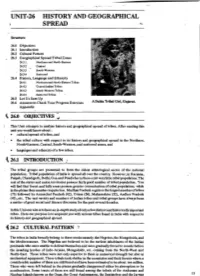
UNIT-26 HISTORY AND GEOGRAPHICAL SPREAD . Structure 26.0 Objectives 26.1 Introduction 26.2 Cultural Pattern . 26.3 Geographical Spread:Tribal Zones 263.1, Northern and North-Eastern 2633' Central _ 2633 . South-Western 263.4 . Scattered 26.4 History, Language and Ethnicity 26.4.1 Northern and North-eakern Tribes 26.42 Central Indian Tribes 26.43 South-Western Tribes 26.4.4 Scattered Tribes 265 Let Us Sum Up 26.6 Answers to Check Your Progress Exercises A DaMa Tribal Girl, Gqjarat. Appendix ( 26.0 OBJECTIVES ; i, This Unit attempts to analyse history and geographical spread of tribes. After reading this unit you uould know about : / cultural spread of tribes, and , the tribal culture with respect to its history and geographical spread in the Northern, NorthiEastem, Central, South-Westem, and scattered zones, and 1 languhges and ethnicity of a few tribes. { 26.1 INTRODUCTION -+ The tribal groups are presumed to form the oldest ethnological sector of the national population. Tribal population of India is spread all over the country. However, in Haryana, Punjab,Chandigarh, DeUli,Goa and Pondicherry there exist very little tribal population.The rest of the states and union territories possess fairly good number of tribal population. You wiU find that forest and hilly areas possess greater concentration of tribal population; while in the plains their number isquite less. Madhya Pradesh registers the largest number oftribes (73) followed by Anrnachal Pradesh (62), Orissa (56), Maharashtra (52), Andhra Pradesh (43), etc. The vast variety and numbers of Indian tribes and tribal groups have\always been a matter of great social and literary discourse for the past several decades. -

The Kuppam Kalanjia Samakhya Experience
Restoring Trust – The Kuppam Kalanjia Samakhya Experience - J.Dharmendra kumar, Managing Director, Kuppam kalanjia Samakhya Background of the location Chittoor district of Andhra Pradesh in Rayalaseema region was characterized by backwardness and poor performance in basic social indicators. Kuppam is one of the mandal in Chittor district, which is in the extreme corner of AP, surrounded by Tamilnadu on eastern and southern sides and on west by Karnataka. In order to strengthen the existing DWCRA groups and regularize the systems DRDA has approached DHAN Foundation and made an agreement in the month of Nov. 99. The main objective of this project was graduating the existing DWCRA groups in to savings and credit groups and promotion of mandal level federation. DHAN Foundation would act as an implementing agency and has agreed to implement the project. DRDA, chittoor would provide necessary guidance and promotional cost for implementing the project in installment on half-yearly basis. Dhan entered in the month of January 2000 with the objective of initiating a process of demonstrating successful establishment of savings and credit groups which will emerge in to a self managed federation to provide financial services to the poor. At present Kuppam Kalanjia Samakhya is working with 253 groups in 104 villages with 3536 and 10 restructured cluster development associations. The starting scenario Kuppam mandal is located in a very remote and backward area in Andhra Pradesh. The socio-economic status of the people, especially women is very low. Due to extreme poverty, people frequently required small loans. “However banks are unwilling to entertain these amounts. -

Police Matters: the Everyday State and Caste Politics in South India, 19001975 by Radha Kumar
PolICe atter P olice M a tte rs T he v eryday tate and aste Politics in South India, 1900–1975 • R a dha Kumar Cornell unIerIt Pre IthaCa an lonon Copyright 2021 by Cornell University The text of this book is licensed under a Creative Commons Attribution-NonCommercial-NoDerivatives 4.0 International License: https:creativecommons.orglicensesby-nc-nd4.0. To use this book, or parts of this book, in any way not covered by the license, please contact Cornell University Press, Sage House, 512 East State Street, Ithaca, New ork 14850. Visit our website at cornellpress.cornell.edu. First published 2021 by Cornell University Press Library of Congress Cataloging-in-Publication Data Names: Kumar, Radha, 1981 author. Title: Police matters: the everyday state and caste politics in south India, 19001975 by Radha Kumar. Description: Ithaca New ork: Cornell University Press, 2021 Includes bibliographical references and index. Identifiers: LCCN 2021005664 (print) LCCN 2021005665 (ebook) ISBN 9781501761065 (paperback) ISBN 9781501760860 (pdf) ISBN 9781501760877 (epub) Subjects: LCSH: Police—India—Tamil Nadu—History—20th century. Law enforcement—India—Tamil Nadu—History—20th century. Caste— Political aspects—India—Tamil Nadu—History. Police-community relations—India—Tamil Nadu—History—20th century. Caste-based discrimination—India—Tamil Nadu—History—20th century. Classification: LCC HV8249.T3 K86 2021 (print) LCC HV8249.T3 (ebook) DDC 363.20954820904—dc23 LC record available at https:lccn.loc.gov2021005664 LC ebook record available at https:lccn.loc.gov2021005665 Cover image: The Car en Route, Srivilliputtur, c. 1935. The British Library Board, Carleston Collection: Album of Snapshot Views in South India, Photo 6281 (40).