Muslim Politics & Democracy
Total Page:16
File Type:pdf, Size:1020Kb
Load more
Recommended publications
-
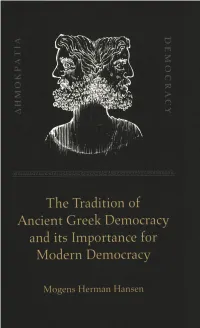
The Tradition of Ancient Greek Democracy and Its Importance for Modem Democracy
DEMOCRAC AHMOKPATI The Tradition of Ancient Greek Democracy and its Importance for Modern Democracy Mogens Herman Hansen The Tradition of Ancient Greek Democracy and its Importance for Modem Democracy B y M ogens H erman H ansen Historisk-filosofiske Meddelelser 93 Det Kongelige Danske Videnskabernes Selskab The Royal Danish Academy of Sciences and Letters Copenhagen 2005 Abstract The two studies printed here investigate to what extent there is a con nection between ancient and modem democracy. The first study treats the tradition of ancient Greek democracy, especially the tradition of Athenian democracy from ca. 1750 to the present day. It is argued that in ideology there is a remarkable resemblance between the Athenian democracy in the Classical period and the modem liberal democracy in the 19th and 20th centuries. On the other hand no direct tradition con nects modem liberal democracy with its ancient ancestor. Not one single Athenian institution has been copied by a modem democracy, and it is only from ca. 1850 onwards that the ideals cherished by the Athenian democrats were referred to approvingly by modem cham pions of democracy. It is in fact the IT technology and its potential for a return to a more direct form of democracy which has given rise to a hitherto unmatched interest in the Athenian democratic institutions. This is the topic of the second study in which it is argued that the focus of the contemporary interest is on the Athenian system of sortition and rotation rather than on the popular assembly. Contents The Tradition of Democracy from Antiquity to the Present Time ................................................................. -

Social Studies Grade 7 Week of 4-6-20 1. Log Onto Clever with Your
Social Studies Grade 7 Week of 4-6-20 1. Log onto Clever with your BPS username and password. 2. Log into Newsela 3. Copy and paste this link into your browser: https://newsela.com/subject/other/2000220316 4. Complete the readings and assignments listed. If you can’t access the articles through Newsela, they are saved as PDFs under the Grade 7 Social Studies folder on the BPSMA Learning Resources Site. They are: • Democracy: A New Idea in Ancient Greece • Ancient Greece: Democracy is Born • Green Influence on U.S. Demoracy Complete the following: Directions: Read the three articles in the text set. Remember, you can change the reading level to what is most comfortable for you. While reading, use the following protocols: Handling changes in your life is an important skill to gain, especially during these times. Use the following supports to help get the most out of these texts. Highlight in PINK any words in the text you do not understand. Highlight in BLUE anything that you have a question about. Write an annotation to ask your question. (You can highlight right in the article. Click on the word or text with your mouse. Once you let go of the mouse, the highlight/annotation box will appear on your right. You can choose the color of the highlight and write a note or question in the annotation box). Pre-Reading Activity: KWL: Complete the KWL Chart to keep your information organized. You may use the one below or create your own on a piece of paper. https://drive.google.com/file/d/1OUDVcJA6hjcteIhpA0f5ssvk28WNBhlK/view Post-Reading Activity: After reading the articles, complete a Venn diagram to compare and contrast the democracy of Ancient Greece and the United States. -
Measuring Polyarchy Across the Globe, 1900–2017
St Comp Int Dev https://doi.org/10.1007/s12116-018-9268-z Measuring Polyarchy Across the Globe, 1900–2017 Jan Teorell1 & Michael Coppedge2 & Staffan Lindberg3 & Svend-Erik Skaaning 4 # The Author(s) 2018 Abstract This paper presents a new measure polyarchy for a global sample of 182 countries from 1900 to 2017 based on the Varieties of Democracy (V-Dem) data, deriving from an expert survey of more than 3000 country experts from around the world, with on average 5 experts rating each indicator. By measuring the five compo- nents of Elected Officials, Clean Elections, Associational Autonomy, Inclusive Citi- zenship, and Freedom of Expression and Alternative Sources of Information separately, we anchor this new index directly in Dahl’s(1971) extremely influential theoretical framework. The paper describes how the five polyarchy components were measured and provides the rationale for how to aggregate them to the polyarchy scale. We find Previous versions of this paper were presented at the APSA Annual Meeting in Washington, DC, August 28- 31, 2014, at the Carlos III-Juan March Institute of Social Sciences, Madrid, November 28, 2014, and at the European University Institute, Fiesole, January 20, 2016. Any remaining omissions are the sole responsibility of the authors. Electronic supplementary material The online version of this article (https://doi.org/10.1007/s12116-018- 9268-z) contains supplementary material, which is available to authorized users. * Jan Teorell jan.teorell@svet.lu.se Michael Coppedge coppedge.1@nd.edu Staffan Lindberg staffan.i.lindberg@pol.gu.se -
DEMOPOLIS Democracy Before Liberalism in Theory and Practice
Trim: 228mm 152mm Top: 11.774mm Gutter: 18.98mm × CUUK3282-FM CUUK3282/Ober ISBN: 978 1 316 51036 0 April 18, 2017 12:53 DEMOPOLIS Democracy before Liberalism in Theory and Practice JOSIAH OBER Stanford University, California v Trim: 228mm 152mm Top: 11.774mm Gutter: 18.98mm × CUUK3282-FM CUUK3282/Ober ISBN: 978 1 316 51036 0 April 18, 2017 12:53 Contents List of Figures page xi List of Tables xii Preface: Democracy before Liberalism xiii Acknowledgments xvii Note on the Text xix 1 Basic Democracy 1 1.1 Political Theory 1 1.2 Why before Liberalism? 5 1.3 Normative Theory, Positive Theory, History 11 1.4 Sketch of the Argument 14 2 The Meaning of Democracy in Classical Athens 18 2.1 Athenian Political History 19 2.2 Original Greek Defnition 22 2.3 Mature Greek Defnition 29 3 Founding Demopolis 34 3.1 Founders and the Ends of the State 36 3.2 Authority and Citizenship 44 3.3 Participation 48 3.4 Legislation 50 3.5 Entrenchment 52 3.6 Exit, Entrance, Assent 54 3.7 Naming the Regime 57 4 Legitimacy and Civic Education 59 4.1 Material Goods and Democratic Goods 60 4.2 Limited-Access States 63 4.3 Hobbes’s Challenge 64 4.4 Civic Education 71 ix Trim: 228mm 152mm Top: 11.774mm Gutter: 18.98mm × CUUK3282-FM CUUK3282/Ober ISBN: 978 1 316 51036 0 April 18, 2017 12:53 x Contents 5 Human Capacities and Civic Participation 77 5.1 Sociability 79 5.2 Rationality 83 5.3 Communication 87 5.4 Exercise of Capacities as a Democratic Good 88 5.5 Free Exercise and Participatory Citizenship 93 5.6 From Capacities to Security and Prosperity 98 6 Civic Dignity -

Origins of Democracy the Word "Democracy," As Well As the Concept
Origins of Democracy The word "democracy," as well as the concept it represents, can be traced back to the area surrounding the Mediterranean Sea. The beginnings of democracy can be credited to the Greeks of the sixth century BC. The word comes from two Greek words: demos, meaning "the people," and kratein, meaning "to rule." These two words are joined together to form democracy, literally meaning "rule by the people" (Pious). The Greek system of government was perhaps closer to a true democracy or rule by the people than any other in history. The Greeks viewed dictatorship as the worst possible form of government, so their government evolved as the exact opposite. Their civilization was broken down into small city-states (never more than 10,000 citizens), and all the men voted on all issues of government. There were no representatives in the Greek system of government. Instead, they ruled themselves directly; each man was a life long member of the decision making body. This was almost a total democracy except for the fact that women and slaves (over 50% of the population) were not considered citizens and were not allowed to vote. Despite this, no other civilization has come as close to democracy as its creators, the Greeks, and many later civilizations have incorporated this Greek idea as part of the foundation for their government (Lee; Lefebvre). Ideas of democracy similar to that of the Greeks were used by the Romans, though not to the same extent. The Roman Empire (509-27 BC) took some of their governmental ideals from the Greeks. -

Taking Stock of Democracy – Still a Success Story Or Not Competitive Anymore?
Page 6 | Trilogue Salzburg 2018 Background Paper Taking Stock of Democracy – Still a Success Story or not Competitive Anymore? Jörg Habich | Verena Nowotny | Christina Tillmann Introduction Taking stock of democracy seems to be easy. Democracy doubtlessly was the most successful idea of the 20th century, in spite of its flaws and problems. Democracy is able to adapt to changing environments and has been able to cope with challenges and problems in most cases. As a consequence, the number of democracies has increased and many countries have moved from a non-democratic government to a democratic one over the years. The number has risen from 69 in 1989/1990 to 125 electoral democracies in 2016.1 Nowadays, the majority of countries are governed by democratic regimes. Democratic systems are characterized by a variety of criteria, such as an electoral process and pluralism, political participation, civil liberties, the functioning of government, constraints on the power of the executive, and political culture with a guarantee of civil liberties. The victory of the liberal democracies as the end point of mankind’s ideological evolution and the final form of human government as predicted by Fukuyama seemed theirs for the taking.2 1 Freedom House. Freedom in the World 2018 – Democracy in Crisis; https://freedomhouse.org/report/freedom- world/freedom-world-2018, retrieved July 16, 2018. 2 Francis Fukuyama. The end of history?. In: The National Interest. Summer 1989. Background Paper Trilogue Salzburg 2018 | Page 7 But the right to vote, political participation, freedom of press and media, and the rule of law are under pressure and in retreat globally. -

Governance, Democracy Peace
AND GOVERNANCE, DEMOCRACY PEACE HOW STATE CAPACITY AND REGIME TYPE INFLUENCE THE PROSPECTS FOR WAR AND PEACE David Cortright with Conor Seyle and Kristen Wall © 2013 One Earth Future Foundation The One Earth Future Foundation was founded in 2007 with the goal of supporting research and practice in the area of peace and governance. OEF believes that a world beyond war can be achieved by the development of new and effective systems of cooperation, coordination, and decision making. We believe that business and civil society have important roles to play in filling governance gaps in partnership with states. When states, business, and civil society coordinate their efforts, they can achieve effective, equitable solutions to global problems. As an operating foundation, we engage in research and practice that supports our overall mission. Research materials from OEF envision improved governance structures and policy options, analyze and document the performance of existing governance institutions, and provide intellectual support to the field operations of our implementation projects. Our active field projects apply our research outputs to existing governance challenges, particularly those causing threats to peace and security. ONE EARTH FUTURE FOUNDATION 525 Zang Street | Suite C Broomfield, CO 80021 USA Ph. +1.303.533.1715 | Fax +1 303.309.0386 ABOUT THE AUTHORS David Cortright is the director of Policy Studies at the Kroc Institute for International Peace Studies at the University of Notre Dame and chair of the board of directors of the Fourth Freedom Forum. He is the author of seventeen books, including the Adelphi volume Towards Nuclear Zero, with Raimo Vayrynen (Routledge, 2010) and Peace: A History of Movements and Ideas (Cambridge University Press, 2008). -
Situating Globalization
Situating Globalization. Views from Egypt 26.09.00 --- Projekt: transcript.nelson / Dokument: FAX ID 00c5267656838312|(S. 1 ) nelson.schmutztitel.p 267656838416 27.09.00 --- Projekt: transcript.nelson / Dokument: FAX ID 01b2267747145512|(S. 2 ) seite 2.p - Seite 2 267747145584 Cynthia Nelson Shahnaz Rouse (eds.) Situating Globalization Views from Egypt 26.09.00 --- Projekt: transcript.nelson / Dokument: FAX ID 00c5267656838312|(S. 3 ) nelson.title.p 267656838484 This work is licensed under a Creative Commons Attribution-NonCommercial-NoDerivatives 3.0 License. Die Deutsche Bibliothek – CIP-Einheitsaufnahme Situating Globalization : Views from Egypt / Cynthia Nelson ; Shahnaz Rouse (eds.). – Bielefeld : transcript Verl., 2000 ISBN 3-933127-61-0 © 2000 transcript Verlag, Bielefeld Typeset by: digitron GmbH, Bielefeld Printed by: Digital Print, Witten ISBN 3-933127-61-0 02.01.01 --- Projekt: transcript.nelson / Dokument: FAX ID 01e2276111746544|(S. 4 ) nelson.impressum.p 276111746552 Contents Preface 7 Cynthia Nelson and Shahnaz Rouse Prologue 9 Cynthia Nelson and Shahnaz Rouse Globalization, Islam and the Indigenization of Knowledge 15 Philip Marfleet The Islamization of Knowledge between Particularism and Globalization: Malaysia and Egypt 53 Mona Abaza Gendering Globalization: Alternative Languages of Modernity 97 Cynthia Nelson and Shahnaz Rouse Struggling and Surviving: The Trajectory of Sheikh Moubarak Abdu Fadl. A Historical Figure of the Egyptian Left 159 Didier Monciaud 5 26.09.00 --- Projekt: transcript.nelson / Dokument: FAX ID -
Democracy and Its Globail Roots Why Democratization Is Not the Same As Westernization
I - 25 OCTOBER 6, 2003 > THE NEW REPUBLIC In "You Thmred to Me," for instance, he disciplined writing-not his most dy- songs in a more tempered version of the; moves down the scale in C major, making namic (This Year's Model) nor his most mellow baritone into which he has shifted! impressive-sounding augmented chords imaginative (Imperial Bedroom), but his for ballads since he crooned "My Funny, with small variations on simple triads. most conversational, his simplest. Habit- Valentine" on the B-side of a single in Costello has gone all mushy for augment- ually verbose, Costello barely sounds like 1978. Some of his old fans have belittled ed chords, which sound jazzy and sophis- himself here. Each song on North has him for trying to be Frank Sinatra, but the. ticated, and he is nearly as charmed by fewer than half the words of a typical se- classic pop singer to whom he is most in-, I the Dorian mode, which can have an lection on any previous Elvis Costello al- debted is Billy Eckstine, the original mu-, eerie quality. His mastery of these devices bum, and they are employed with uncom- sically adventurous jazz-pop vocalist with' is still developing; at points Costello's mon restTaint. Only once does Costello a bad-boy reputation and a throbbing. harmony is arbitrarily complex, not yet use Tin Pan Alley cliches, in "I'm In vibrato. I know Costello is an admirer of organic. Compositionally, much of North the Mood Again," and he does so with a the late "Mr. -

The Secret History of Democracy the Secret History of Democracy
The Secret History of Democracy The Secret History of Democracy Edited by Benjamin Isakhan Research Fellow, Centre for Dialogue, La Trobe University, Australia Stephen Stockwell Professor of Journalism and Communication, School of Humanities, Griffith University, Australia Introduction, conclusion, editorial matter and selection © Benjamin Isakhan and Stephen Stockwell 2011 All remaining chapters © respective authors 2011 Softcover reprint of the hardcover 1st edition 2011 978-0-230-24421-4 All rights reserved. No reproduction, copy or transmission of this publication may be made without written permission. No portion of this publication may be reproduced, copied or transmitted save with written permission or in accordance with the provisions of the Copyright, Designs and Patents Act 1988, or under the terms of any licence permitting limited copying issued by the Copyright Licensing Agency, Saffron House, 6-10 Kirby Street, London EC1N 8TS. Any person who does any unauthorized act in relation to this publication may be liable to criminal prosecution and civil claims for damages. The authors have asserted their rights to be identified as the authors of this work in accordance with the Copyright, Designs and Patents Act 1988. First published 2011 by PALGRAVE MACMILLAN Palgrave Macmillan in the UK is an imprint of Macmillan Publishers Limited, registered in England, company number 785998, of Houndmills, Basingstoke, Hampshire RG21 6XS. Palgrave Macmillan in the US is a division of St Martin’s Press LLC, 175 Fifth Avenue, New York, NY 10010. Palgrave Macmillan is the global academic imprint of the above companies and has companies and representatives throughout the world. Palgrave® and Macmillan® are registered trademarks in the United States, the United Kingdom, Europe and other countries. -

The RISE of DEMOCRACY REVOLUTION, WAR and TRANSFORMATIONS in INTERNATIONAL POLITICS SINCE 1776
Macintosh HD:Users:Graham:Public:GRAHAM'S IMAC JOBS:15554 - EUP - HOBSON:HOBSON NEW 9780748692811 PRINT The RISE of DEMOCRACY REVOLUTION, WAR AND TRANSFORMATIONS IN INTERNATIONAL POLITICS SINCE 1776 CHRISTOPHER HOBSON Macintosh HD:Users:Graham:Public:GRAHAM'S IMAC JOBS:15554 - EUP - HOBSON:HOBSON NEW 9780748692811 PRINT THE RISE OF DEMOCRACY Macintosh HD:Users:Graham:Public:GRAHAM'S IMAC JOBS:15554 - EUP - HOBSON:HOBSON NEW 9780748692811 PRINT Macintosh HD:Users:Graham:Public:GRAHAM'S IMAC JOBS:15554 - EUP - HOBSON:HOBSON NEW 9780748692811 PRINT THE RISE OF DEMOCRACY Revolution, War and Transformations in International Politics since 1776 Christopher Hobson Macintosh HD:Users:Graham:Public:GRAHAM'S IMAC JOBS:15554 - EUP - HOBSON:HOBSON NEW 9780748692811 PRINT © Christopher Hobson, 2015 Edinburgh University Press Ltd The Tun – Holyrood Road 12 (2f) Jackson’s Entry Edinburgh EH8 8PJ www.euppublishing.com Typeset in 11 /13pt Monotype Baskerville by Servis Filmsetting Ltd, Stockport, Cheshire, and printed and bound in Great Britain by CPI Group (UK) Ltd, Croydon CR0 4YY A CIP record for this book is available from the British Library ISBN 978 0 7486 9281 1 (hardback) ISBN 978 0 7486 9282 8 (webready PDF) ISBN 978 0 7486 9283 5 (epub) The right of Christopher Hobson to be identified as author of this work has been asserted in accordance with the Copyright, Designs and Patents Act 1988 and the Copyright and Related Rights Regulations 2003 (SI No. 2498). Macintosh HD:Users:Graham:Public:GRAHAM'S IMAC JOBS:15554 - EUP - HOBSON:HOBSON NEW 9780748692811 -

The Church in the Square: Negotiations of Religion and Revolution at an Evangelical Church in Cairo, Egypt
The American University in Cairo School of Humanities and Social Sciences The Church in the Square: Negotiations of Religion and Revolution at an Evangelical Church in Cairo, Egypt A Thesis Submitted to The Department of Sociology, Anthropology, Psychology, and Egyptology In Partial Fulfillment of the Requirements For the Degree of Master of Arts In Sociology – Anthropology By Anna Jeannine Dowell Under the supervision of Dr John Schaefer May/ 2012 ABSTRACT The American University in Cairo Anna Jeannine Dowell “The Church in the Square: Negotiations of Religion and Revolution at an Evangelical Church in Cairo, Egypt” Supervised by Dr. John Schaefer In the wake of the Egyptian January 25, 2011 popular uprisings that deposed Hosni Mubarak from the presidency, youth and leaders from Kanisset Kasr el Dobara (KDEC) in Tahrir Square embarked on new and unpredictable political projects and activisms. This ethnographic study is an engagement with these new revolutionary negotiations on the part of the largest Protestant congregation in the Middle East. Using participant observation, focus groups, and interviews this research seeks to elucidate the ways that youth and leaders utilized institutionalized discourse, religious imagery, and relational networks in order to carve out a place in the Egyptian public sphere regarding public religion, national belonging, and the ideal citizen. Broadly this research seeks to understand how Evangelical Egyptians at KDEC navigated their colonial heritage and transnational character even as their leadership sought to ground the congregation in the Egyptian nation-state and in the emerging post-revolutionary political scene. I argue that these negotiations were built upon powerful paradoxes concerning liberal politics, secularism, and private versus public religion, which often implicated Evangelicals in the same questions being raised more broadly in the Egyptian political sphere concerning Islamist politics and religious minorities.