Pakistan National Election: 1990
Total Page:16
File Type:pdf, Size:1020Kb
Load more
Recommended publications
-
General Election 2018 Update-Ii - Fafen General Election 2018
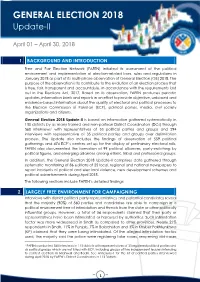
GENERAL ELECTION 2018 UPDATE-II - FAFEN GENERAL ELECTION 2018 Update-II April 01 – April 30, 2018 1. BACKGROUND AND INTRODUCTION Free and Fair Election Network (FAFEN) initiated its assessment of the political environment and implementation of election-related laws, rules and regulations in January 2018 as part of its multi-phase observation of General Election (GE) 2018. The purpose of the observation is to contribute to the evolution of an election process that is free, fair, transparent and accountable, in accordance with the requirements laid out in the Elections Act, 2017. Based on its observation, FAFEN produces periodic updates, information briefs and reports in an effort to provide objective, unbiased and evidence-based information about the quality of electoral and political processes to the Election Commission of Pakistan (ECP), political parties, media, civil society organizations and citizens. General Election 2018 Update-II is based on information gathered systematically in 130 districts by as many trained and non-partisan District Coordinators (DCs) through 560 interviews1 with representatives of 33 political parties and groups and 294 interviews with representative of 35 political parties and groups over delimitation process. The Update also includes the findings of observation of 559 political gatherings and 474 ECP’s centres set up for the display of preliminary electoral rolls. FAFEN also documented the formation of 99 political alliances, party-switching by political figures, and emerging alliances among ethnic, tribal and professional groups. In addition, the General Election 2018 Update-II comprises data gathered through systematic monitoring of 86 editions of 25 local, regional and national newspapers to report incidents of political and electoral violence, new development schemes and political advertisements during April 2018. -
Authoritarianism and Political Party Reforms in Pakistan
AUTHORITARIANISM AND POLITICAL PARTY REFORM IN PAKISTAN Asia Report N°102 – 28 September 2005 TABLE OF CONTENTS EXECUTIVE SUMMARY AND RECOMMENDATIONS................................................. i I. INTRODUCTION .......................................................................................................... 1 II. PARTIES BEFORE MUSHARRAF............................................................................. 2 A. AFTER INDEPENDENCE..........................................................................................................2 B. THE FIRST MILITARY GOVERNMENT.....................................................................................3 C. CIVILIAN RULE AND MILITARY INTERVENTION.....................................................................4 D. DISTORTED DEMOCRACY......................................................................................................5 III. POLITICAL PARTIES UNDER MUSHARRAF ...................................................... 6 A. CIVILIAN ALLIES...................................................................................................................6 B. MANIPULATING SEATS..........................................................................................................7 C. SETTING THE STAGE .............................................................................................................8 IV. A PARTY OVERVIEW ............................................................................................... 11 A. THE MAINSTREAM:.............................................................................................................11 -

Pakistan's Violence
Pakistan’s Violence Causes of Pakistan’s increasing violence since 2001 Anneloes Hansen July 2015 Master thesis Political Science: International Relations Word count: 21481 First reader: S. Rezaeiejan Second reader: P. Van Rooden Studentnumber: 10097953 1 Table of Contents List of Abbreviations and Acronyms List of figures, Maps and Tables Map of Pakistan Chapter 1. Introduction §1. The Case of Pakistan §2. Research Question §3. Relevance of the Research Chapter 2. Theoretical Framework §1. Causes of Violence §1.1. Rational Choice §1.2. Symbolic Action Theory §1.3. Terrorism §2. Regional Security Complex Theory §3. Colonization and the Rise of Institutions §4. Conclusion Chapter 3. Methodology §1. Variables §2. Operationalization §3. Data §4. Structure of the Thesis Chapter 4. Pakistan §1. Establishment of Pakistan §2. Creating a Nation State §3. Pakistan’s Political System §4. Ethnicity and Religion in Pakistan §5. Conflict and Violence in Pakistan 2 §5.1. History of Violence §5.2. Current Violence §5.2.1. Baluchistan §5.2.2. Muslim Extremism and Violence §5. Conclusion Chapter 5. Rational Choice in the Current Conflict §1. Weak State §2. Economy §3. Instability in the Political Centre §4. Alliances between Centre and Periphery §5. Conclusion Chapter 6. Emotions in Pakistan’s Conflict §1. Discrimination §2. Hatred towards Others §2.1. Political Parties §2.2 Extremist Organizations §3. Security Dilemma §4. Conclusion Chapter 7. International Influences §1. International Relations §1.1. United States – Pakistan Relations §1.2. China – -
Initial Appointment to Civil Posts (Relaxation of Upper Age Limit) Rules, 2008
1 GOVERNMENT OF 1[Khyber Pakhtunkhwa] ESTABLISHMENT & ADMINISTRATION DEPARTMENT (Establishment Wing) NOTIFICATION ST Dated 1 MARCH, 2008 NO.SOE-III(E&AD)2-1/2007, Dated 01-03--2008.---In pursuance of the powers granted under Section 26 of the 2[Khyber Pakhtunkhwa] Civil Servants Act, 1973 (3[Khyber Pakhtunkhwa] Act XVIII of 1973), the competent authority is pleased to make the following rules, namely: THE 4[Khyber Pakhtunkhwa] INITIAL APPOINTMENT TO CIVIL POSTS (RELAXATION OF UPPER AGE LIMIT RULES, 2008) PART — I GENERAL 1. (1) These rules may be called the Initial Appointment to Civil Posts (Relaxation of Upper Age Limit) Rules, 2008. (2) These shall come into force with immediate effect. 5[2. (1) Nothing in these rules shall apply to the appointment in BS-17 and the posts of Civil Judge-Cum-Judicial Magistrate / Illaqa Qazi, BS-18 to be filled through the competitive examination of the Public Service Commission, in which case two years optimum relaxation shall be allowed to: (a) Government servants with a minimum of 2 years continuous service; (b) Disabled persons; and (c) Candidates from backward areas. (2) For appointment to the post of Civil Judge-cum-Judicial Magistrate/Illaqa Qazi, the period which a Barrister or an Advocate of the High Court and /or the Courts subordinate thereto or a Pleader has practiced in the Bar, shall be excluded for the purpose of upper age limit subject to a maximum period of two years from his/her age.] PART — II GENERAL RELAXATION 1 Subs. by the Khyber Pakhtunkhwa Act No. IV of 2011 2 Subs. -
A Comparative Study of Directly Selected, In-Service Promoted and Online Selected Subject Specialists Regarding Teaching Effectiveness in Kohat Division, Pakistan
Journal of Education and Practice www.iiste.org ISSN 2222-1735 (Paper) ISSN 2222-288X (Online) Vol.6, No.10, 2015 A Comparative Study of Directly Selected, In-Service Promoted and Online Selected Subject Specialists Regarding Teaching Effectiveness in Kohat Division, Pakistan Qaiser Suleman PhD (Education) Scholar, Institute of Education & Research, Kohat University of Science & Technology Kohat, Khyber Pakhtunkhwa, (Pakistan) Email: Look_for_reality@yahoo.com Rizwana Gul M.Phil (Education) Scholar, Institute of Education & Research, Kohat University of Science & Technology Kohat, Khyber Pakhtunkhwa, (Pakistan) Abstract The main objective of the study was to compare the teaching effectiveness of directly selected, in-service promoted and online selected subject specialists teaching at higher secondary school level in Kohat Division, Pakistan. The target population of the study was the higher secondary school students in Kohat Division, Pakistan. A sample of 600 students randomly selected from 10 out of 20 higher secondary schools in Kohat Division was used in this study. The design of this research study was survey. A self-developed structured questionnaire was used a research instrument for data collection. Statistical tools i.e., mean, standard deviation, ANOVA and Post-hoc t-tests were used. After statistical analysis, it was concluded that the teaching performance of the directly selected subject specialists was highly appreciable and excellent. On the other hand, teaching performance of in-service promoted subject specialists was found satisfactory while teaching performance of online selected subject specialists was poor and unsatisfactory. Based on findings, it was recommended that at least 75% of the total subject specialists should be recruited through Khyber Pakhtunkhwa Public Service Commission only. -
Lashkar-E-Jhangvi Vs Hazara Community
©2020 International Transaction Journal of Engineering, Management, & Applied Sciences & Technologies International Transaction Journal of Engineering, Management, & Applied Sciences & Technologies http://TuEngr.com PAPER ID: 11A04E SECTARIANISM IN BALOCHISTAN: LASHKAR-E-JHANGVI VS HAZARA COMMUNITY a* a Naumana Kiran , Mohammad Iqbal Chawla a Department of History and Pakistan Studies, University of the Punjab, Lahore, PAKISTAN. A R T I C L E I N F O A B S T R A C T Article history: The study examines the factors, responsible for the spread of Received 28 June 2019 Received in revised form 08 sectarianism in Balochistan with a major concentration on the persecution November 2019 of the Hazara community by a Deoband sectarian outfit; Accepted 18 November 2019 Lashkar-e-Jhangvi (LeJ). The research is mostly analytical and Available online 05 December 2019 comparative; based on both qualitative and quantitative research Keywords: techniques. The research finds that protection to sectarian organizations Sectarianism; Pakistan; like LeJ by the military establishment and the State’s indifference had Lashkar-e-Jhangvi; intensified the issue. However, since the introduction of the National Hazara Shia; Migration; Action Plan (2014), some reasonable and effective measures have been persecution; Sectarian taken for the safety of Hazaras. Still, a lot is required to be done to violence; State’s policy. assimilate Hazaras in the society and to revive the culture of religious tolerance in Balochistan, Pakistan. Disciplinary: Multidisciplinary (Social Engineering, Peace and Conflict Studies, World Studies/History; Psychology). ©2020 INT TRANS J ENG MANAG SCI TECH. 1. INTRODUCTION This paper studies the phenomenon of sectarian violence in the province of Balochistan with a major emphasis on persecution of the Hazara community. -

Political Parties and Political Development in the Punjab 1988-1999
POLITICAL PARTIES AND POLITICAL DEVELOPMENT IN THE PUNJAB 1988-1999 Ph. D. Dissertation By Sajid Mahmood Awan Taxila Institute of Asian Civilizations Quaid-e-Azam University Islamabad, Pakistan 2008 DECLARATION I hereby declare that this dissertation is the product of my individual research, and it has not been submitted presently to any other university for any other degree. (Sajid Mahmood Awan) Taxila Institute of Asian Civilizations Quaid-e-Azam University, Islamabad I hereby recommend that the dissertation prepared under my supervision by Sajid Mahmood Awan titled “Political Parties and Political Development in the Punjab”, 1988-99, be accepted in partial fulfillment of the requirements for the Degree of Doctor of Philosophy. Dr. Ghani-ur-Rahman Supervisor Taxila Institute of Asian Civilizations Quaid-e-Azam University, Islamabad CERTIFICATE This is to certify that the dissertation submitted by Sajid Mahmood Awan, is of sufficient standard to justify its acceptance by the Taxila Institute of Asian Civilizations, Quaid-e-Azam University, Islamabad, for the award of Degree of Doctor of Philosophy. Dr. Ghani-ur-Rahman Supervisor External Examiners: 1. ________________________ 2._________________________ CONTENTS List of Contents List of Tables List of Figures Abbreviations Glossary Acknowledgements INTRODUCTION Chapter 1 POLITICAL PARTIES AND POLITICAL DEVELOPMENT 1.1 HISTORY OF POLITICAL PARTIES 1.2 PARTY SYESTEMS 1.3 POLITICAL DEVELOPMENT 1.4 APPROACHES OF POLITICAL DEVELOPMENT 1.5 LITERATURE REVIEW 1.5.1 Elitist Approach 1.5.2 Marxist Approach 1.5.3 Ideological Approach 1.5.4 Praetorian Approach 1.6 METHODOLOGY Chapter 2 POLITICAL PARTIES AND POLITICAL DEVELOPMENT IN PUNJAB 1849-1988 2.1 PRE-INDEPENDENCE EXPERIENCE 1849-1947 2.2 POST INDEPENDENCE EXPERIENCE 1947-1988 Chapter 3 POLITICAL PARTIES IN PUNJAB 1988-1999. -

Government of Khyber Pakhtunkhwa
GOVERNMENT OF KHYBER PAKHTUNKHWA Public Disclosure Authorized Public Disclosure Authorized Qabail Led Community Support Project (QLCSP) Environmental and Social Management Framework (ESMF) Public Disclosure Authorized December 21, 2019 To be executed By Planning & Development Department (GoKP) Through Public Disclosure Authorized Directorate of Projects under the Merged Areas Secretariat (MAS) EXECUTIVE SUMMARY Introduction The Government of Khyber Pakhtunkhwa (GoKP), through Directorate of Projects Planning & Development Department (DP&DD), intends to implement “Qabail Led Community Support Program (QLCSP”) in Khyber district of merged areas (MA) – the erstwhile Federally Administered Tribal Areas (FATA)1 – and Peshawar and Nowshera districts of KP with the proposed assistance of the World Bank (WB).2 This Environmental and Social Management Framework (ESMF) has been prepared to meet requirements of national legislation of Pakistan and World Bank environmental and social policy requirements to address potential negative impacts from the proposed project. Project Overview Background The Central Asia-South Asia Electricity Transmission and Trade Project (CASA1000) aims to facilitate electricity trade between Central Asia and countries in South Asia by putting in place transmission infrastructure. As part of CASA1000 project, each participating country3 is implementing Community Support Programs (CSPs) to share the benefits associated with the project and to generate support among local communities. Project Area In Pakistan, the CASA1000 transmission line (TL) will pass through approximately 100 kilometer long territory passing through various parts of KP province. The project area accordingly lies in/includes Peshawar and Nowshera districts and Khyber district4 of merged areas (MA). Project Components The Project has four components as briefly described below; and its Project Development Objective (PDO) is “improve access to local infrastructure and strengthen community engagement in the project areas”. -

Fafen Election
FAFEN ELECTION . 169 NA and PA constituencies with Margin of Victory less than potentially Rejected Ballots August 3, 2018 The number of ballot papers excluded increase. In Islamabad Capital Territory, from the count in General Elections 2018 the number of ballots excluded from the surpassed the number of ballots rejected count are more than double the in General Elections 2013. Nearly 1.67 rejected ballots in the region in GE-2013. million ballots were excluded from the Around 40% increase in the number of count in GE-2018. This number may ballots excluded from the count was slightly vary after the final consolidated observed in Balochistan, 30.6 % increase result is released by the Election in Khyber Pakhtunkhwa including Commission of Pakistan (ECP) as the Federally Administered Tribal Areas ballots excluded from the count at the (FATA), 7% increase in Sindh and 6.6% polling station level by Presiding Officers increase in Punjab. are to be reviewed by the Returning The following table provides a Officers during the consolidation comparison of the number of rejected proceedings, who can either reject them National Assembly ballot papers in each or count them in favor of a candidate if province/region during each of the past excluded wrongly. four General Elections in 2002, 2008, 2013 The increase in the number of ballots and 2018. Although the rejected ballots excluded from the count was a have consistently increase over the past ubiquitous phenomenon observed in all four general elections, the increase was provinces and Islamabad Capital significantly higher in 2013 than 2008 Territory with nearly 11.7% overall (54.3%). -

Pakistan National Election: 1997
Gilanis’ Index of © ELECTORAL RECORD 1970-2013 Volume 6 PAKISTAN NATIONAL ELECTION: 1997 An 10 Volume Study prepared by Gallup Election studies team head by Bilal Gilani, Executive Director, Gallup Pakistan Prepared on April 30, 2013 Disclaimer: Gallup Pakistan is not related to Gallup Inc. headquartered in Washington D.C. USA. We require that our surveys be credited fully as Gallup Pakistan (not Gallup or Gallup Poll). We disclaim any responsibility for surveys pertaining to Pakistani public opinion except those carried out by Gallup Pakistan, the Pakistani affiliate of Gallup International Association. For details on Gallup International Association see website: www.gallup- international.comand www.gallup.com.pk Gilani’s Index of Electoral Record: 1970-2013 (An 10 Volume Study) C o n t e n t s Volume 6 Index of Electoral Record: 1997 Page # Table 1: Code List 105 Table 2: Turn Out 106 Table 3: Party Position: All Pakistan 107 Table 4: Party Position: Province-wise 108 Table 5: Party Position: Division-wise 112 Table 6: Party Position: 11 Electoral Territory 121 Basic Code List 1997 2 Awami Ittehad 4 Awami Inqilabi Mahaz Pakistan 5 Awami National Party 8 Awami Qiadat Party 9 Awami Tehreek 16 Balochistan National Movement 17 Balochistan National Party 30 Haq Parast Group 33 Independent 39 Independent 46 Jamhoori Wattan Party 47 Jamiat Ulema e Islam (Sami ul Haq Group) 49 Jamot Qaumi Movement 54 Jamat e Islami Pakistan 55 Jamiat Ulema e Islam (Fazl ur Rahman Group) 56 Jinnah Muslim League 57 Jamiat Mashaikh Pakistan 59 Jamat Ulema e Islam -

Archaeological Survey of District Mardan in the North-West Frontier Province of Pakistan
55 Ancient Pakistan, Vol. XIV Archaeological Survey of District Mardan in the North-West Frontier Province of Pakistan TAJ ALI Contents Introduction 56 Aims and Objectives of the Survey 56 Geography and Land Economy 57 Historical and Archaeological Perspective 58 Early Surveys, Explorations and Excavations 60 List of Protected Sites and Monuments 61 Inventory of Archaeological Sites Recorded in the Current Survey 62 Analysis of Archaeological Data from the Surface Collection 98 Small Finds 121 Conclusion 126 Sites Recommended for Excavation, Conservation and Protection 128 List of Historic I Settlement Sites 130 Acknowledgements 134 Notes 134 Bibliographic References 135 Map 136 Figures 137 Plates 160 56 Ancient Pakistan, Vol. XIV Archaeological Survey of District Mardan in the North-West Frontier Province of Pakistan TAJ ALI Introduction The Department of Archaeology, University of Peshawar, (hereafter the Department) in collaboration with the Department of Archaeology and Museums, Government of Pakistan, (hereafter the Federal Department) initiated a project of surveying and documenting archaeological sites and historical monuments in the North-West Frontier Province (NWFP). The primary objectives of the project were to formulate plans for future research, highlight and project the cultural heritage of the Province and to promote cultural tourism for sustainable development. The Department started the project in 1993 and since then has published two survey reports of the Charsadda and Swabi Districts. 1 Dr. Abdur Rahman conducted survey of the Peshawar and Nowshera Districts and he will publish the report after analysis of the data. 2 Conducted by the present author, the current report is focussed on the archaeological survey of the Mardan District, also referred to as the Yusafzai Plain or District. -
DFG Part-L Development Settled
DEMANDS FOR GRANTS DEVELOPMENTAL EXPENDITURE FOR 2020–21 VOL-III (PART-L) GOVERNMENT OF KHYBER PAKHTUNKHWA FINANCE DEPARTMENT REFERENCE TO PAGES DFG PART- L GRANT # GRANT NAME PAGE # - SUMMARY 01 – 23 50 DEVELOPMENT 24 – 177 51 RURAL AND URBAN DEVELOPMENT 178 – 228 52 PUBLIC HEALTH ENGINEERING 229 – 246 53 EDUCATION AND TRAINING 247 – 291 54 HEALTH SERVICES 292 – 337 55 CONSTRUCTION OF IRRIGATION 338 – 385 CONSTRUCTION OF ROADS, 56 386 – 456 HIGHWAYS AND BRIDGES 57 SPECIAL PROGRAMME 457 – 475 58 DISTRICT PROGRAMME 476 59 FOREIGN AIDED PROJECTS 477 – 519 ( i ) GENERAL ABSTRACT OF DISBURSEMENT (SETTLED) BUDGET REVISED BUDGET DEMAND MAJOR HEADS ESTIMATES ESTIMATES ESTIMATES NO.