Tourism As a Justification for the German Autobahn Project 1933-1939
Total Page:16
File Type:pdf, Size:1020Kb
Load more
Recommended publications
-
Open Etoth Dissertation Corrected.Pdf
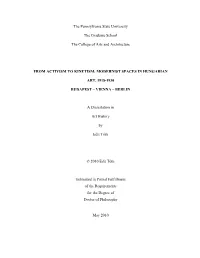
The Pennsylvania State University The Graduate School The College of Arts and Architecture FROM ACTIVISM TO KIETISM: MODERIST SPACES I HUGARIA ART, 1918-1930 BUDAPEST – VIEA – BERLI A Dissertation in Art History by Edit Tóth © 2010 Edit Tóth Submitted in Partial Fulfillment of the Requirements for the Degree of Doctor of Philosophy May 2010 The dissertation of Edit Tóth was reviewed and approved* by the following: Nancy Locke Associate Professor of Art History Dissertation Adviser Chair of Committee Sarah K. Rich Associate Professor of Art History Craig Zabel Head of the Department of Art History Michael Bernhard Associate Professor of Political Science *Signatures are on file in the Graduate School ii ABSTRACT From Activism to Kinetism: Modernist Spaces in Hungarian Art, 1918-1930. Budapest – Vienna – Berlin investigates modernist art created in Central Europe of that period, as it responded to the shock effects of modernity. In this endeavor it takes artists directly or indirectly associated with the MA (“Today,” 1916-1925) Hungarian artistic and literary circle and periodical as paradigmatic of this response. From the loose association of artists and literary men, connected more by their ideas than by a distinct style, I single out works by Lajos Kassák – writer, poet, artist, editor, and the main mover and guiding star of MA , – the painter Sándor Bortnyik, the polymath László Moholy- Nagy, and the designer Marcel Breuer. This exclusive selection is based on a particular agenda. First, it considers how the failure of a revolutionary reorganization of society during the Hungarian Soviet Republic (April 23 – August 1, 1919) at the end of World War I prompted the Hungarian Activists to reassess their lofty political ideals in exile and make compromises if they wanted to remain in the vanguard of modernity. -

The Monita Secreta Or, As It Was Also Known As, The
James Bernauer, S.J. Boston College From European Anti-Jesuitism to German Anti-Jewishness: A Tale of Two Texts “Jews and Jesuits will move heaven and hell against you.” --Kurt Lüdecke, in conversation with Adolf Hitleri A Presentation at the Conference “Honoring Stanislaw Musial” Jagiellonian University, Krakow, Poland (March 5, 2009) The current intense debate about the significance of “political religion” as a mode of analyzing fascism leads us to the core of the crisis in understanding the Holocaust.ii Saul Friedländer has written of an “historian‟s paralysis” that “arises from the simultaneity and the interaction of entirely heterogeneous phenomena: messianic fanaticism and bureaucratic structures, pathological impulses and administrative decrees, archaic attitudes within an advanced industrial society.”iii Despite the conflicting voices in the discussion of political religion, the debate does acknowledge two relevant facts: the obvious intermingling in Nazism of religious and secular phenomena; secondly, the underestimated role exercised by Munich Catholicism in the early life of the Nazi party.iv My essay is an effort to illumine one thread in this complex territory of political religion and Nazism and my title conveys its hypotheses. First, that the centuries long polemic against the Roman Catholic religious order the Jesuits, namely, its fabrication of the Jesuit image as cynical corrupter of Christianity and European culture, provided an important template for the Nazi imagining of Jewry after its emancipation.v This claim will be exhibited in a consideration of two historically influential texts: the Monita 1 secreta which demonized the Jesuits and the Protocols of the Sages of Zion which diabolized the Jews.vi In the light of this examination, I shall claim that an intermingled rhetoric of Jesuit and Jewish wills to power operated in the imagination of some within the Nazi leadership, the most important of whom was Adolf Hitler himself. -

Zugbildungen Deutsche Reichsbahn, Ep. III/IV
Deutsche Reichsbahn, Ep. III/IV Zugbildungen Eilzug der 1950er Jahre: Eilzüge verkehrten über mittelgroße Entfernungen (meist zwischen zwei Ballungsräumen) und hielten nur in den wichtigeren Bahnhöfen. (Art. 02100 – 01563 – 13160) Personenzug Nahverkehr: Typischer Nebenbahnpersonenzug der 1980er Jahre. (Art. 04586 – 01561) D-Zug der 1960er Jahre. (Art. 02145 – 13896 – 16920 – 16900 – 16970 – 16940) Nahgüterzug: Die V 36 übernahm teilweise auch den leichten Streckendienst. (Art. 04630 – 13421 – 14125 – 01586 – 15611) D-Zug Mitte Epoche IV: Kombinierter Zug mit Reisezugwagen der frühen Ep. IV (schwarze Längsträger) und Speisewagen der späten Epoche IV. (Art. 02450 – 01570 – 16750 – 16340) Militärtransport der NVA (Art. 02673 – 01592 – 01593) Städteexpress für den hochwertigen Fernverkehr der 1980er Jahre (Art. 02337 – 01602 – 01603) Deutsche Bundesbahn, Ep. III/IV Zugbildungen Personenzug mit Güterbeförderung: Gebildet aus Personen- und Güterwagen. (Art. Lok aus 01585 – 13003 – 13013 – 13006 – 01574) Nahgüterzug der 1980er Jahre. (Art. 04634 – 15241 – 01582 – 14479 – 15610) Intercity der Ep. IV. (Art. 02431 – 13530 – 13697 – 3 x 16500) Durchgangsgüterzug der 1960er Jahre: Loks mit Kabinentender machten den Packwagen für den Aufenthalt des Güterzug-Begleitpersonals entbehrlich. (Art. 02093 – 01587 – 14576 – 2 x 17150) Schnellzug Anfang der Epoche IV. (Art. 02451 – 2 x 16941 – 16971 – 16901 – 16921) Internationaler Schnellgüterzug TEEM (Trans Europ Express Marchandises): Diese Züge – meist bestehend aus gedeckten Wagen – fuhren in festen Relationen durch mehrere europäische Länder. (Art. 02500 – 17152 – 17151 – 14691 – 15830 – 15495) Schnellzug der 1980er Jahre. (Art. 02382 – 13676 – 13677 – 13677 – 13678 – 13517) Deutsche Bahn AG Zugbildungen InterCity (IC): Als IC verkehren bei der DB AG schnellfahrende Fernverkehrszüge, die aus höherwertigem Wagenmaterial zusammengestellt sind. In der Übergangszeit zwischen alter und neuer IC-Lackierung wurden häufig Fahrzeuge beider Farbschemen miteinander kombiniert. -

Prinz Max Von Baden Und Houston Steward Chamberlain. Aus Dem
121 Dieser Quellenfund führt zwei historische Persönlichkeiten zusammen, die man gewöhnlich nicht miteinander in Verbindung bringt: Prinz Max von Baden und Houston Steward Chamberlain, den scheinbar liberalen Prinzen, der im Herbst 1918 den Ersten Weltkrieg zu beenden half, und den Protagonisten eines radikalen Antisemitismus', der auch zu Hitlers Ideengeber wurde. Die Korrespondenz dieser beiden unterschiedlichen Figuren eröffnet viele neue Einsichten: in einem ganz neuen Licht erscheint nicht nur der Prinz; deutlich wird auch, welch große Wirkung die Schriften Chamberlains hatten. Karina Urbach/Bernd Buchner Prinz Max von Baden und Houston Stewart Chamberlain Aus dem Briefwechsel 1909-1919 „Wie der Prinz Max steht, weiß keiner", stellte der sozialdemokratische Parteifüh rer Friedrich Ebert gegen Ende des Ersten Weltkriegs resigniert fest1. Bis heute hat sich an dieser Einschätzung wenig geändert. Das ist insofern erstaunlich, als die fünfwöchige Reichskanzlerschaft des badischen Prinzen von Anfang Oktober bis zum 9. November 1918 - mithin die Zeit zwischen Waffenstillstandsangebot und Kriegsende, zwischen Parlamentarisierung und Novemberrevolution - zu den entscheidenden Wendepunkten in der neueren deutschen Geschichte gerechnet wird. Die Regierung des Prinzen ist zwar in den 1960er Jahren von Erich Matthias und Rudolf Morsey ausführlich dokumentiert und kommentiert worden2, doch Max selbst blieb stets eine blasse historische Figur. War er der von Golo Mann hagiographisch gefeierte deutsche Whig3, ein typisch süddeutsch legerer Grandseigneur, -

Alwin Seifert and Nazi Environmentalism
Marquette University e-Publications@Marquette History Faculty Research and Publications History, Department of 5-2020 Advocates for the Landscape: Alwin Seifert and Nazi Environmentalism Peter Staudenmaier Follow this and additional works at: https://epublications.marquette.edu/hist_fac Part of the History Commons Marquette University e-Publications@Marquette History Faculty Research and Publications/College of Arts and Sciences This paper is NOT THE PUBLISHED VERSION; but the author’s final, peer-reviewed manuscript. The published version may be accessed by following the link in the citation below. German Studies Review, Vol. 43, No. 2 (May 2020): 271-290. DOI. This article is © Johns Hopkins University Press and permission has been granted for this version to appear in e- Publications@Marquette. Johns Hopkins University Press does not grant permission for this article to be further copied/distributed or hosted elsewhere without the express permission from Johns Hopkins University Press. Advocates for the Landscape: Alwin Seifert and Nazi Environmentalism Peter Staudenmaier ABSTRACT Reexamining debates on ostensibly green facets of Nazism, this article offers a case study of the "landscape advocates" led by Alwin Seifert from 1934 to 1945. In contrast to previous accounts focused on the role of the landscape advocates in the construction of the Autobahn, the article assesses their work on a wide range of projects in Nazi Germany and across occupied Europe. It argues that existing scholarship has not fully recognized the extent of the landscape advocates' involvement in Nazi structures and has sometimes misunderstood the relationship between their environmental activities and blood and soil ideology. Seven decades after the defeat of Hitler's dictatorship, the European landscape still bears the scars of war and genocide. -

Wortschatz Bahntechnik/Transportwesen Deutsch-Englisch-Deutsch (Skript 0-7)
Fakultät für Architektur, Bauingenieurwesen und Stadtplanung Lehrstuhl Eisenbahnwesen Wortschatz Bahntechnik/Transportwesen Deutsch-Englisch-Deutsch (Skript 0-7) Stand 15.12.17 Zusammengestellt von Prof. Dr.-Ing. Thiel Literaturhinweise: Boshart, August u. a.: Eisenbahnbau und Eisenbahnbetrieb in sechs Sprachen. 884 S., ca. 4700 Begriffe, 2147 Abbildungen und Formeln. Reihe Illustrierte Technische Wör- terbücher (I.T.W.), Band 5. 1909, München/Berlin, R. Oldenburg Verlag. Brosius, Ignaz: Wörterbuch der Eisenbahn-Materialien für Oberbau, Werkstätten, Betrieb und Telegraphie, deren Vorkommen, Gewinnung, Eigenschaften, Fehler und Fälschungen, Prüfung u. Abnahme, Lagerung, Verwendung, Gewichte, Preise ; Handbuch für Eisen- bahnbeamte, Studirende technischer Lehranstalten und Lieferanten von Eisenbahnbe- darf. Wiesbaden, Verlag Bergmann, 1887 Dannehl, Adolf [Hrsg.]: Eisenbahn. englisch, deutsch, französisch, russisch ; mit etwa 13000 Wortstellen. Technik-Wörterbuch, 1. Aufl., Berlin. M. Verlag Technik, 1983 Lange, Ernst: Wörterbuch des Eisenbahnwesens. englisch - deutsch. 1. Aufl., Bielefeld, Reichsbahngeneraldirektion, 1947 Schlomann, Alfred (Hrsg.): Eisenbahnmaschinenwesen in sechs Sprachen. Reihe Illustrierte technische Wörterbücher (I.T.W.), Band 6. 2. Auflage. München/Berlin, R. Oldenburg Verlag. UIC Union Internationale des Chemins de Fer: UIC RailLexic 5.0 Dictionary in 22 Sprachen. 2015 Achtung! Diese Sammlung darf nur zu privaten Zwecken genutzt werden. Jegliche Einbindung in kommerzielle Produkte (Druckschriften, Vorträge, elektronische -

Inhaltsverzeichnis
Inhaltsverzeichnis Hinweis 9 Das Theater der Republik 11 Weimar und der Expressionismus 11 Die Väter und die Söhne 12 Die Zerstörung des Dramas 14 Die neuen Schauspieler 16 Die Provinz regt sich 18 Los von Berlin - Los von Reinhardt 20 Berlin und Wien 22 Zersetzter Expressionismus 24 Die große Veränderung 25 Brecht und Piscator 27 Wirklichkeit! Wirklichkeit! 30 Hitler an der Rampe 33 Der große Rest *35 Wieviel wert ist die Kritik? 37 Alte und neue Grundsätze 38 Selbstverständnis und Auseinandersetzungen 41 Die Macht und die Güte 44 *9*7 47 Rene Schickele, Hans im Schnakenloch 48 rb., Frankfurter Zeitung 48 Alfred Kerr, Der Tag, Berlin 50 Siegfried Jacobsohn, Die Schaubühne, Berlin 52 Georg Kaiser, Die Bürger von Calais 53 Kasimir Edschmid, Neue Zürcher Zeitung 54 Heinrich Simon, Frankfurter Zeitung 55 Alfred Polgar, Vossische Zeitung, Berlin 56 Georg Kaiser, Von Morgens bis Mitternachts 57 Richard Elchinger, Münchner Neueste Nachrichten 58 Richard Braungart, Münchener Zeitung 60 P. S., Frankfurter Zeitung 61 Richard Specht, Berliner Börsen-Courier 62 Oskar Kokoschka, Mörder, Hoffnung der Frauen - Hiob - Der bren nende Dornbusch 63 Robert Breuer, Die Schaubühne, Berlin 64 Bernhard Diebold, Frankfurter Zeitung 66 Alfred Kerr, Der Tag, Berlin 69 Gerhart Hauptmann, Winterballade .. 72 Siegfried Jacobsohn, Die Schaubühne, Berlin 73 Julius Hart, Der Tag, Berlin 75 Emil Faktor, Berliner Börsen-Courier 77 1248 http://d-nb.info/207309981 Georg Kaiser, Die Koralle 79 Bernhard Diebold, Frankfurter Zeitung 79 Kasimir Edschmid, Vossische Zeitung, Berlin, und Neue Zürcher Zei tung 82 Emil Faktor, Berliner Börsen-Courier 83 Alfred Kerr, Der Tag, Berlin 84 Hanns Johst, Der Einsame, ein Menschenuntergang 86 Artur Kutscher, Berliner Tageblatt . -

Hitler and Nazi Germany
HITLER AND NAZI GERMANY CHAPTER 28.3 HISTORICAL THEORIES ON HITLER Hitler did not The Germans were convince the Hitler’s first victims. Germans as much as the Germans elevated Hitler HITLER AND NAZISM • Core of Hitler’s political ideas: racism, anti-Semitism, ultranationalism • Fought in WWI, believed Jews were reason why Germany lost • After WWI, Hitler joined a right-wing ultranationalist party, the German Worker’s Party – Hitler soon controlled the party; renamed to National Socialist German Worker’s Party, or Nazi Party – Nazi Party had its own militia • Hitler writes Mein Kampf from prison after attempting to seize power of German gov’t “If we pass all the causes of the German collapse in review, the ultimate and most decisive remains the failure to recognize the racial problem and especially the Jewish menace.” Protocols of the Elders of Zion “To what an extent the whole existence of this people is based on a continuous lie is shown incomparably by the Protocols of the Elders of Zion, so infinitely hated by the Jews. They are based on a forgery, the Frankfurter Zeitung moans and screams once every week: the best proof that they are authentic ... For once this book has become the common property of a people, the Jewish menace may be considered as broken.” “All propaganda must be popular and its intellectual level must be adjusted to the most limited intelligence among those it is addressed to. Consequently, the greater the mass it is intended to reach, the lower its purely intellectual level will have to be. But if, as in propaganda for sticking out a war, the aim is to influence a whole people, we must avoid excessive intellectual demands on our public, and too much caution cannot be extended in this direction…” “…The receptivity of the great masses is very limited, their intelligence is small, but their power of forgetting is enormous. -

European Train Names: a Historic Outline Christian Weyers
ONOMÀSTICA BIBLIOTECA TÈCNICA DE POLÍTICA LINGÜÍSTICA European Train Names: a Historic Outline* Christian Weyers DOI: 10.2436/15.8040.01.201 Abstract This paper gives a first overview of the onomastic category of train names, searches to classify the corpus and reviews different stages of their productivity. Apart from geographical names (toponyms, choronyms, compass directions) generally indicating points of origin and destination of the trains in question, a considerable number of personal names have entered this category, of classical literary authors, musicians and scientists, but also of many fictional or non-fictional characters taken from literature or legendary traditions. In some cases also certain symbolic attributes of these persons and finally even heraldic figures have given their names to trains. In terms of their functionality, train names originally were an indicator of exclusiveness and high grade of travel quality, but they developed gradually, as they dispersed over the European continent, into a rather unspecific, generalized appellation, also for regional and local trains. After two periods of prosperity after 1950, the privatisation of railway companies starting in the 1990s had again a very positive effect on the category, as the number of named trains initially reached a new record in this decade. ***** The first train names appeared in England in the 1860s in addition to names for steam locomotives, and on two different levels. The Special Scotch Express between London King’s Cross and Edinburgh (inaugurated in 1862) was called by the public The Flying Scotsman from the 1870s, but it succeeded as the official name not before 1924. Also the names of the German diesel trainsets Der Fliegende Hamburger and Der Fliegende Kölner were colloquial name creations, as were the Train Bleu and the Settebello operated from 1922 and 1953 but officially named in 1947 and 1958, respectively. -

Teddie and Friedel: Theodor W. Adorno, Siegfried Kracauer, and the Erotics of Friendship
Teddie and Friedel: Theodor W. Adorno, Siegfried Kracauer, and the Erotics of Friendship Johannes von Moltke Criticism, Volume 51, Number 4, Fall 2010, pp. 683-694 (Article) Published by Wayne State University Press For additional information about this article http://muse.jhu.edu/journals/crt/summary/v051/51.4.von-moltke.html Access Provided by University of Michigan @ Ann Arbor at 02/26/11 3:33PM GMT TEDDIE AND My dear Teddie, my dear friend! FRIEDEL: I arrived at noon today all THEODOR W. torn, wrapped up. Now I ADORNO, want to write straight away. SIEGFRIED During these two days, I again KRACAUER, AND felt such an agonizing love for you that it seems to me as if I THE EROTICS OF could not endure alone. Sev- FRIENDSHIP ered from you, my existence Johannes von Moltke is stale, I don’t know how this can go on.1 The letter is dated 5 April 1923 “Der Riß der Welt geht auch durch and, under the letterhead of the mich”: Briefwechsel 1923–1966 by prestigious Frankfurter Zeitung (was Theodor W. Adorno and Siegfried this written surreptitiously at the Kracauer, volume 7 of Briefe und office?!), its sender—Friedel— Briefwechsel, by Theodor W. Ador- implores Teddie to “please read no, edited by Wolfgang Schopf. alone!” (B 9, emphasis in original). Frankfurt am Main: Suhrkamp, So tortured, so steamy is this love 2008. Pp. 772. 52.50 euros, cloth; letter that Friedel asks Teddie to 32.00 euros, paper. destroy it: “[I]n any case, no word of it, this is secret, who could be al- lowed to see me thus in my true gestalt?” (B 11). -

Von Der Ludwigsbahn Zum Integralen Taktfahrplan Teil 2
Fritz Engbarth Von der Ludwigsbahn zum Integralen Taktfahrplan 160 Jahre Eisenbahnverkehr in der Pfalz Teil 2 Hrsg.: Zweckverband SPNV Rheinland-Pfalz Süd Ein Land spart Zeit – Neue Mobilität mit dem Rheinland-Pfalz-Takt Ein Land spart Zeit – Neue Mobilität mit dem Rheinland-Pfalz-Takt Ein Land spart Zeit – Neue Mobilität mit dem Rheinland-Pfalz-Takt Nach vielen Streckenstilllegungen Wir erinnern uns: Ab Mitte der 1970er Jahre erreichte die Stilllegungswelle auch in startete 1994 in der Pfalz ein neues Rheinland-Pfalz einen Höhepunkt. An den verlassenen Bahnsteigen ehemaliger Bahnzeitalter. Statt der Verab- Schnellzugstrecken wie Germersheim – Landau oder Monsheim – Langmeil wuchs schiedung des letzten Zuges wurde das Unkraut. Die landesweite Netzdichte erreichte 1990 einen Wert von lediglich mit der Linie Grünstadt – Eisenberg 0,069 km/qkm Fläche – grobmaschiger war Als Start in die neue Epoche kann der Einsatz der VT 628 gewertet werden. Bei einer Vorstellungsfahrt im Jahr 1987 traf er auf das Streckennetz nur noch in Schleswig- seinen Vorgänger, den ebenso robusten Schienenbus. erstmals abseits eines Verdichtungs- Holstein. Vereinbarung aufgenommen. Obwohl im schäftsführers des VRN, Werner Schreiner – raumes der Personenzugverkehr auf Mit der „Vereinbarung zwischen dem Land Norden des Landes die Eifelquerbahn noch mit dem Bau des Haltepunktes Neustadt- Rheinland-Pfalz und der Deutschen Bundes- im Januar 1991 den Personenverkehr verlor, Böbig der Schülerverkehr von der Straße auf einer zuvor stillgelegten Strecke bahn über die zukünftige Gestaltung des stellte die Vereinbarung einen wichtigen die Schiene verlagert. Im Jahre 1991 machte Öffentlichen Personennahverkehrs“ vom Schritt zur Erhaltung des Schienenverkehrs diese Bahnstrecke dann nochmals von sich wieder eingeführt. Fortan machte 9. Juni 1986 griff das Land nach dem Vorbild im ländlichen Raum dar. -

89 Seiten, Größe Ca. 3,6 MB
=== VD -T === Der Virtuelle Deutschland-Takt = Strecken 360 - 427 + 482 - 499 = SUEDNIEDER SACHSEN + OSTWESTFALEN Hamburg Bremen Hannover Dortm. Le ipz Köln Frankfurt Ein Integraler Taktfahrplan von Jörg Schäfer Übersichtskarte mit den VD-T- Kursbuchnummern Lila hervorgehoben sind die wichtigsten Verbes- serungen seit 1990. Franken in Takt (FiT), 830 - 869 Oberfranken-Ost und Oberpfalz - Seite 2 Grafischer Fahrplan der Normalverkehrszeit: Jede Linie ist eine Zugfahrt im Stundentakt Franken in Takt (FiT), www.franken-in-takt.de , © Jörg Schäfer, Juni 2016 - Seite 3 Der Virtuelle Deutschland-Takt (VD-T), Strecken-Nr. 600 - 634 = HESSEN - Seite 4 Schnellfahrstrecke Hannover - Göttingen (- Kassel) Beim VD-T wäre die Schnellfahrtstrecke (SFS) von Hannover bis Kassel-Wilhelms- höhe in den 1980er Jahren wie in der Re- alität gebaut worden. Die Zahl der stündli- chen ICE-Linien wäre dann in der Folgezeit dank der besseren Rahmenbedingungen und der größeren Nachfrage noch stärker als in der Realität gewachsen. Für die 120.000 Einwohner von Göttingen sind mehr als zwei ICE-Stopps pro Stunde und Richtung aber nicht erforderlich. Daher baut der VD-T 20 km weiter nördlich den Almstedt Bahnhof Northeim (30.000 Einwohner) so aus, dass die „weiße Flotte“ auch dort halten kann. Der Fahrplan der ICE-Linie 4 ist so günstig, dass sich deren Züge zur Minute 00 in Northeim begegnen und optimale Anschlüsse ins Umland bieten. Auf den später gebauten Neubaustrecken Köln - Frankfurt und Stuttgart - Ulm sollen Kreiensen beim VD-T 200 km/h schnelle IRE auch kleinere Städte bedienen. Das würde auch zwischen Hannover und Göttingen Begehr- lichkeiten wecken, denn der IC braucht auf Northeim der Altstrecke für die 110 km 67 Minuten.