Insect Identification Laboratory Annual Report – 2009
Total Page:16
File Type:pdf, Size:1020Kb
Load more
Recommended publications
-

Lepidoptera of North America 5
Lepidoptera of North America 5. Contributions to the Knowledge of Southern West Virginia Lepidoptera Contributions of the C.P. Gillette Museum of Arthropod Diversity Colorado State University Lepidoptera of North America 5. Contributions to the Knowledge of Southern West Virginia Lepidoptera by Valerio Albu, 1411 E. Sweetbriar Drive Fresno, CA 93720 and Eric Metzler, 1241 Kildale Square North Columbus, OH 43229 April 30, 2004 Contributions of the C.P. Gillette Museum of Arthropod Diversity Colorado State University Cover illustration: Blueberry Sphinx (Paonias astylus (Drury)], an eastern endemic. Photo by Valeriu Albu. ISBN 1084-8819 This publication and others in the series may be ordered from the C.P. Gillette Museum of Arthropod Diversity, Department of Bioagricultural Sciences and Pest Management Colorado State University, Fort Collins, CO 80523 Abstract A list of 1531 species ofLepidoptera is presented, collected over 15 years (1988 to 2002), in eleven southern West Virginia counties. A variety of collecting methods was used, including netting, light attracting, light trapping and pheromone trapping. The specimens were identified by the currently available pictorial sources and determination keys. Many were also sent to specialists for confirmation or identification. The majority of the data was from Kanawha County, reflecting the area of more intensive sampling effort by the senior author. This imbalance of data between Kanawha County and other counties should even out with further sampling of the area. Key Words: Appalachian Mountains, -

Insect Survey of Four Longleaf Pine Preserves
A SURVEY OF THE MOTHS, BUTTERFLIES, AND GRASSHOPPERS OF FOUR NATURE CONSERVANCY PRESERVES IN SOUTHEASTERN NORTH CAROLINA Stephen P. Hall and Dale F. Schweitzer November 15, 1993 ABSTRACT Moths, butterflies, and grasshoppers were surveyed within four longleaf pine preserves owned by the North Carolina Nature Conservancy during the growing season of 1991 and 1992. Over 7,000 specimens (either collected or seen in the field) were identified, representing 512 different species and 28 families. Forty-one of these we consider to be distinctive of the two fire- maintained communities principally under investigation, the longleaf pine savannas and flatwoods. An additional 14 species we consider distinctive of the pocosins that occur in close association with the savannas and flatwoods. Twenty nine species appear to be rare enough to be included on the list of elements monitored by the North Carolina Natural Heritage Program (eight others in this category have been reported from one of these sites, the Green Swamp, but were not observed in this study). Two of the moths collected, Spartiniphaga carterae and Agrotis buchholzi, are currently candidates for federal listing as Threatened or Endangered species. Another species, Hemipachnobia s. subporphyrea, appears to be endemic to North Carolina and should also be considered for federal candidate status. With few exceptions, even the species that seem to be most closely associated with savannas and flatwoods show few direct defenses against fire, the primary force responsible for maintaining these communities. Instead, the majority of these insects probably survive within this region due to their ability to rapidly re-colonize recently burned areas from small, well-dispersed refugia. -
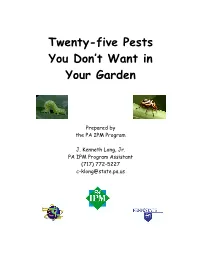
Twenty-Five Pests You Don't Want in Your Garden
Twenty-five Pests You Don’t Want in Your Garden Prepared by the PA IPM Program J. Kenneth Long, Jr. PA IPM Program Assistant (717) 772-5227 c-klong@state.pa.us Pest Pest Sheet Aphid 1 Asparagus Beetle 2 Bean Leaf Beetle 3 Cabbage Looper 4 Cabbage Maggot 5 Colorado Potato Beetle 6 Corn Earworm (Tomato Fruitworm) 7 Cutworm 8 Diamondback Moth 9 European Corn Borer 10 Flea Beetle 11 Imported Cabbageworm 12 Japanese Beetle 13 Mexican Bean Beetle 14 Northern Corn Rootworm 15 Potato Leafhopper 16 Slug 17 Spotted Cucumber Beetle (Southern Corn Rootworm) 18 Squash Bug 19 Squash Vine Borer 20 Stink Bug 21 Striped Cucumber Beetle 22 Tarnished Plant Bug 23 Tomato Hornworm 24 Wireworm 25 PA IPM Program Pest Sheet 1 Aphids Many species (Homoptera: Aphididae) (Origin: Native) Insect Description: 1 Adults: About /8” long; soft-bodied; light to dark green; may be winged or wingless. Cornicles, paired tubular structures on abdomen, are helpful in identification. Nymph: Daughters are born alive contain- ing partly formed daughters inside their bodies. (See life history below). Soybean Aphids Eggs: Laid in protected places only near the end of the growing season. Primary Host: Many vegetable crops. Life History: Females lay eggs near the end Damage: Adults and immatures suck sap from of the growing season in protected places on plants, reducing vigor and growth of plant. host plants. In spring, plump “stem Produce “honeydew” (sticky liquid) on which a mothers” emerge from these eggs, and give black fungus can grow. live birth to daughters, and theygive birth Management: Hide under leaves. -

Coleoptera) (Excluding Anthribidae
A FAUNAL SURVEY AND ZOOGEOGRAPHIC ANALYSIS OF THE CURCULIONOIDEA (COLEOPTERA) (EXCLUDING ANTHRIBIDAE, PLATPODINAE. AND SCOLYTINAE) OF THE LOWER RIO GRANDE VALLEY OF TEXAS A Thesis TAMI ANNE CARLOW Submitted to the Office of Graduate Studies of Texas A&M University in partial fulfillment of the requirements for the degree of MASTER OF SCIENCE August 1997 Major Subject; Entomology A FAUNAL SURVEY AND ZOOGEOGRAPHIC ANALYSIS OF THE CURCVLIONOIDEA (COLEOPTERA) (EXCLUDING ANTHRIBIDAE, PLATYPODINAE. AND SCOLYTINAE) OF THE LOWER RIO GRANDE VALLEY OF TEXAS A Thesis by TAMI ANNE CARLOW Submitted to Texas AgcM University in partial fulltllment of the requirements for the degree of MASTER OF SCIENCE Approved as to style and content by: Horace R. Burke (Chair of Committee) James B. Woolley ay, Frisbie (Member) (Head of Department) Gilbert L. Schroeter (Member) August 1997 Major Subject: Entomology A Faunal Survey and Zoogeographic Analysis of the Curculionoidea (Coleoptera) (Excluding Anthribidae, Platypodinae, and Scolytinae) of the Lower Rio Grande Valley of Texas. (August 1997) Tami Anne Carlow. B.S. , Cornell University Chair of Advisory Committee: Dr. Horace R. Burke An annotated list of the Curculionoidea (Coleoptem) (excluding Anthribidae, Platypodinae, and Scolytinae) is presented for the Lower Rio Grande Valley (LRGV) of Texas. The list includes species that occur in Cameron, Hidalgo, Starr, and Wigacy counties. Each of the 23S species in 97 genera is tteated according to its geographical range. Lower Rio Grande distribution, seasonal activity, plant associations, and biology. The taxonomic atTangement follows O' Brien &, Wibmer (I og2). A table of the species occuning in patxicular areas of the Lower Rio Grande Valley, such as the Boca Chica Beach area, the Sabal Palm Grove Sanctuary, Bentsen-Rio Grande State Park, and the Falcon Dam area is included. -

Conservation and Management of Eastern Big-Eared Bats a Symposium
Conservation and Management of Eastern Big-eared Bats A Symposium y Edited b Susan C. Loeb, Michael J. Lacki, and Darren A. Miller U.S. Department of Agriculture Forest Service Southern Research Station General Technical Report SRS-145 DISCLAIMER The use of trade or firm names in this publication is for reader information and does not imply endorsement by the U.S. Department of Agriculture of any product or service. Papers published in these proceedings were submitted by authors in electronic media. Some editing was done to ensure a consistent format. Authors are responsible for content and accuracy of their individual papers and the quality of illustrative materials. Cover photos: Large photo: Craig W. Stihler; small left photo: Joseph S. Johnson; small middle photo: Craig W. Stihler; small right photo: Matthew J. Clement. December 2011 Southern Research Station 200 W.T. Weaver Blvd. Asheville, NC 28804 Conservation and Management of Eastern Big-eared Bats: A Symposium Athens, Georgia March 9–10, 2010 Edited by: Susan C. Loeb U.S Department of Agriculture Forest Service Southern Research Station Michael J. Lacki University of Kentucky Darren A. Miller Weyerhaeuser NR Company Sponsored by: Forest Service Bat Conservation International National Council for Air and Stream Improvement (NCASI) Warnell School of Forestry and Natural Resources Offield Family Foundation ContEntS Preface . v Conservation and Management of Eastern Big-Eared Bats: An Introduction . 1 Susan C. Loeb, Michael J. Lacki, and Darren A. Miller Distribution and Status of Eastern Big-eared Bats (Corynorhinus Spp .) . 13 Mylea L. Bayless, Mary Kay Clark, Richard C. Stark, Barbara S. -
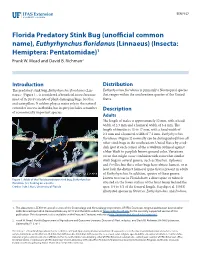
Florida Predatory Stink Bug (Unofficial Common Name), Euthyrhynchus Floridanus(Linnaeus) (Insecta: Hemiptera: Pentatomidae)1 Frank W
EENY157 Florida Predatory Stink Bug (unofficial common name), Euthyrhynchus floridanus (Linnaeus) (Insecta: Hemiptera: Pentatomidae)1 Frank W. Mead and David B. Richman2 Introduction Distribution The predatory stink bug, Euthyrhynchus floridanus (Lin- Euthyrhynchus floridanus is primarily a Neotropical species naeus) (Figure 1), is considered a beneficial insect because that ranges within the southeastern quarter of the United most of its prey consists of plant-damaging bugs, beetles, States. and caterpillars. It seldom plays a major role in the natural control of insects in Florida, but its prey includes a number Description of economically important species. Adults The length of males is approximately 12 mm, with a head width of 2.3 mm and a humeral width of 6.4 mm. The length of females is 12 to 17 mm, with a head width of 2.4 mm and a humeral width of 7.2 mm. Euthyrhynchus floridanus (Figure 2) normally can be distinguished from all other stink bugs in the southeastern United States by a red- dish spot at each corner of the scutellum outlined against a blue-black to purplish-brown ground color. Variations occur that might cause confusion with somewhat similar stink bugs in several genera, such as Stiretrus, Oplomus, and Perillus, but these other bugs have obtuse humeri, or at least lack the distinct humeral spine that is present in adults of Euthyrhynchus. In addition, species of these genera Figure 1. Adult of the Florida predatory stink bug, Euthyrhynchus known to occur in Florida have a short spine or tubercle floridanus (L.), feeding on a beetle. situated on the lower surface of the front femur behind the Credits: Lyle J. -

In Mississippi
Biodiversity of Bariditae (Coleoptera: Curculionidae: Conoderinae) in Mississippi By TITLE PAGE Ryan J. Whitehouse Approved by: Richard L. Brown (Major Professor) Robert S. Anderson Gerald T. Baker Kenneth Willeford (Graduate Coordinator) George M. Hopper (Dean, College of Agriculture and Life Sciences) A Thesis Submitted to the Faculty of Mississippi State University in Partial Fulfillment of the Requirements for the Degree of Master of Science in Agricultural Life Sciences in the Department of Biochemistry, Molecular Biology, Entomology & Plant Pathology Mississippi State, Mississippi May 2020 Copyright by COPYRIGHT PAGE Ryan J. Whitehouse 2020 Name: Ryan J. Whitehouse ABSTRACT Date of Degree: May 1, 2020 Institution: Mississippi State University Major Field: Agricultural Life Sciences Major Professor: Richard L. Brown Title of Study: Biodiversity of Bariditae (Coleoptera: Curculionidae: Conoderinae) in Mississippi Pages in Study: 262 Candidate for Degree of Master of Science A survey of Bariditae in Mississippi resulted in records of 75 species in 32 genera and included two undescribed species and 36 new state records. An additional two species were recognized as possibly occurring in Mississippi as well. Diagnoses for all of the genera and species in the state are provided and keys to the genera as well as all of the species were made. Species were found in every county within Mississippi and are representative of the Bariditae fauna of the southeastern United States. Open, prairie-like habitats and aquatic wetland habitats were the habitats with the highest biodiversity of Bariditae in the state. Species of Baris, Geraeus, Linogeraeus, and Odontocorynus, were found in the highest numbers and Linogeraeus and Sibariops were found to be the most speciose genera in the state. -

Contributions Toward a Lepidoptera (Psychidae, Yponomeutidae, Sesiidae, Cossidae, Zygaenoidea, Thyrididae, Drepanoidea, Geometro
Contributions Toward a Lepidoptera (Psychidae, Yponomeutidae, Sesiidae, Cossidae, Zygaenoidea, Thyrididae, Drepanoidea, Geometroidea, Mimalonoidea, Bombycoidea, Sphingoidea, & Noctuoidea) Biodiversity Inventory of the University of Florida Natural Area Teaching Lab Hugo L. Kons Jr. Last Update: June 2001 Abstract A systematic check list of 489 species of Lepidoptera collected in the University of Florida Natural Area Teaching Lab is presented, including 464 species in the superfamilies Drepanoidea, Geometroidea, Mimalonoidea, Bombycoidea, Sphingoidea, and Noctuoidea. Taxa recorded in Psychidae, Yponomeutidae, Sesiidae, Cossidae, Zygaenoidea, and Thyrididae are also included. Moth taxa were collected at ultraviolet lights, bait, introduced Bahiagrass (Paspalum notatum), and by netting specimens. A list of taxa recorded feeding on P. notatum is presented. Introduction The University of Florida Natural Area Teaching Laboratory (NATL) contains 40 acres of natural habitats maintained for scientific research, conservation, and teaching purposes. Habitat types present include hammock, upland pine, disturbed open field, cat tail marsh, and shallow pond. An active management plan has been developed for this area, including prescribed burning to restore the upland pine community and establishment of plots to study succession (http://csssrvr.entnem.ufl.edu/~walker/natl.htm). The site is a popular collecting locality for student and scientific collections. The author has done extensive collecting and field work at NATL, and two previous reports have resulted from this work, including: a biodiversity inventory of the butterflies (Lepidoptera: Hesperioidea & Papilionoidea) of NATL (Kons 1999), and an ecological study of Hermeuptychia hermes (F.) and Megisto cymela (Cram.) in NATL habitats (Kons 1998). Other workers have posted NATL check lists for Ichneumonidae, Sphecidae, Tettigoniidae, and Gryllidae (http://csssrvr.entnem.ufl.edu/~walker/insect.htm). -

Mexican Bean Beetle (Suggested Common Name), Epilachna Varivestis Mulsant (Insecta: Coleoptera: Coccinellidae)1 H
EENY-015 Mexican Bean Beetle (suggested common name), Epilachna varivestis Mulsant (Insecta: Coleoptera: Coccinellidae)1 H. Sanchez-Arroyo2 Introduction apparently eradicated from Florida in 1933, but was found again in 1938 and by 1942 was firmly established. The family Coccinellidae, or ladybird beetles, is in the order Coleoptera. This family is very important economically because it includes some highly beneficial insects as well as Description two serious pests: the squash lady beetle, Epilachna borealis Eggs Fabricius, and the Mexican bean beetle, Epilachna varivestis Eggs are approximately 1.3 mm in length and 0.6 mm in Mulsant. width, and are pale yellow to orange-yellow in color. They are typically found in clusters of 40 to 75 on the undersides The Mexican bean beetle has a complete metamorphosis of bean leaves. with distinct egg, larval, pupal, and adult stages. Unlike most of the Coccinellidae, which are carnivorous and feed upon aphids, scales, and other small insects, this species attacks plants. Distribution The Mexican bean beetle is believed to be native to the plateau region of southern Mexico. This insect is found in the United States (in most states east of the Rocky Moun- tains) and Mexico. In eastern regions, the pest is present wherever beans are grown, while western infestations are in isolated areas, depending upon the local environment and precipitation. The insect is not a serious pest in Guatemala and Mexico, but is very abundant in several areas in the western United States. The southern limit of the known distribution is in Guatemala and the northern limit is Figure 1. -
Checklist of Lithuanian Diptera
Acta Zoologica Lituanica. 2000. Volumen 10. Numerus 1 3 ISSN 1392-1657 CHECKLIST OF LITHUANIAN DIPTERA Saulius PAKALNIÐKIS1, Jolanta RIMÐAITË1, Rasa SPRANGAUSKAITË-BERNOTIENË1, Rasa BUTAUTAITË2, Sigitas PODËNAS2 1 Institute of Ecology, Akademijos 2, 2600 Vilnius, Lithuania 2 Department of Zoology, Vilnius University, M.K. Èiurlionio 21/27, 2009 Vilnius, Lithuania Abstract. The list of 2283 Lithuanian Diptera species of 78 families is based on 224 literary sources. Key words: Diptera, Acroceridae, Agromyzidae, Anisopodidae, Anthomyiidae, Anthomyzidae, Asilidae, Athericidae, Bibionidae, Bombyliidae, Calliphoridae, Cecidomyiidae, Ceratopogonidae, Chama- emyiidae, Chaoboridae, Chironomidae, Chloropidae, Coelopidae, Conopidae, Culicidae, Cylindroto- midae, Diastatidae, Ditomyiidae, Dixidae, Dolichopodidae, Drosophilidae, Dryomyzidae, Empididae, Ephydridae, Fanniidae, Gasterophilidae, Helcomyzidae, Heleomyzidae, Hippoboscidae, Hybotidae, Hypodermatidae, Lauxaniidae, Limoniidae, Lonchaeidae, Lonchopteridae, Macroceridae, Megamerinidae, Micropezidae, Microphoridae, Muscidae, Mycetophilidae, Neottiophilidae, Odiniidae, Oestridae, Opo- myzidae, Otitidae, Pallopteridae, Pediciidae, Phoridae, Pipunculidae, Platypezidae, Psilidae, Psychod- idae, Ptychopteridae, Rhagionidae, Sarcophagidae, Scathophagidae, Scatopsidae, Scenopinidae, Sciaridae, Sciomyzidae, Sepsidae, Simuliidae, Sphaeroceridae, Stratiomyidae, Syrphidae, Tabanidae, Tachinidae, Tephritidae, Therevidae, Tipulidae, Trichoceridae, Xylomyidae, Xylophagidae, checklist, Lithuania INTRODUCTION -

Weevils) of the George Washington Memorial Parkway, Virginia
September 2020 The Maryland Entomologist Volume 7, Number 4 The Maryland Entomologist 7(4):43–62 The Curculionoidea (Weevils) of the George Washington Memorial Parkway, Virginia Brent W. Steury1*, Robert S. Anderson2, and Arthur V. Evans3 1U.S. National Park Service, 700 George Washington Memorial Parkway, Turkey Run Park Headquarters, McLean, Virginia 22101; brent_steury@nps.gov *Corresponding author 2The Beaty Centre for Species Discovery, Research and Collection Division, Canadian Museum of Nature, PO Box 3443, Station D, Ottawa, ON. K1P 6P4, CANADA;randerson@mus-nature.ca 3Department of Recent Invertebrates, Virginia Museum of Natural History, 21 Starling Avenue, Martinsville, Virginia 24112; arthurevans@verizon.net ABSTRACT: One-hundred thirty-five taxa (130 identified to species), in at least 97 genera, of weevils (superfamily Curculionoidea) were documented during a 21-year field survey (1998–2018) of the George Washington Memorial Parkway national park site that spans parts of Fairfax and Arlington Counties in Virginia. Twenty-three species documented from the parkway are first records for the state. Of the nine capture methods used during the survey, Malaise traps were the most successful. Periods of adult activity, based on dates of capture, are given for each species. Relative abundance is noted for each species based on the number of captures. Sixteen species adventive to North America are documented from the parkway, including three species documented for the first time in the state. Range extensions are documented for two species. Images of five species new to Virginia are provided. Keywords: beetles, biodiversity, Malaise traps, national parks, new state records, Potomac Gorge. INTRODUCTION This study provides a preliminary list of the weevils of the superfamily Curculionoidea within the George Washington Memorial Parkway (GWMP) national park site in northern Virginia. -

Swarth, C. Et Al. the 2007 Jug Bay Bioblitz Reliort. 2008
2007 Jug Bay BioBlitz Report Christopher Swarth, Lindsay Hollister, Elaine Friebele, Karyn Molines and Susan Matthews Jug Bay Wetlands Sanctuary December 2008 Introduction A BioBlitz is a 24-hour field survey and inventory of organisms in a well-defined area such as a park or other natural area. The objective of this intensive survey is to generate a catalog or list of all species that are identified or collected during the brief survey period. The first BioBlitz in the United States was conducted in 1996 in Washington, DC. Today dozens of BioBlitzes are held annually in the United States (see Wikipedia Encyclopedia; http://en.wikipedia.org/wiki/BioBlitz. A BioBlitz increases local knowledge of biodiversity and involves local naturalists and the public in coordinated fieldwork and observation. The surveys raise the awareness among the general public about the natural world and the importance of biodiversity. The species distribution and occurrence information that is obtained from a BioBlitz also provides resource managers with a deeper understanding of the natural lands under their management, thus enabling improved habitat stewardship. The 2007 Jug Bay BioBlitz took place at the Jug Bay Wetlands Sanctuary over a 24-hour period, from 12:00 (noon) on 15 September to 12:00 on 16 September. We organized this event in order to take advantage of the growing interest in biodiversity by the public and to tap in to the community of active, highly skilled naturalists in the Washington DC/Baltimore area. For this first-time effort we concentrated the field surveys on groups of organisms for which local biogeographical information was poor or incomplete (for example, ants, ground bees, spiders and zooplankton), rather than on the groups for which our knowledge on distribution was relatively thorough such as birds and herps.