German City, Jewish Memory
Total Page:16
File Type:pdf, Size:1020Kb
Load more
Recommended publications
-

TALMUDIC STUDIES Ephraim Kanarfogel
chapter 22 TALMUDIC STUDIES ephraim kanarfogel TRANSITIONS FROM THE EAST, AND THE NASCENT CENTERS IN NORTH AFRICA, SPAIN, AND ITALY The history and development of the study of the Oral Law following the completion of the Babylonian Talmud remain shrouded in mystery. Although significant Geonim from Babylonia and Palestine during the eighth and ninth centuries have been identified, the extent to which their writings reached Europe, and the channels through which they passed, remain somewhat unclear. A fragile consensus suggests that, at least initi- ally, rabbinic teachings and rulings from Eretz Israel traveled most directly to centers in Italy and later to Germany (Ashkenaz), while those of Babylonia emerged predominantly in the western Sephardic milieu of Spain and North Africa.1 To be sure, leading Sephardic talmudists prior to, and even during, the eleventh century were not yet to be found primarily within Europe. Hai ben Sherira Gaon (d. 1038), who penned an array of talmudic commen- taries in addition to his protean output of responsa and halakhic mono- graphs, was the last of the Geonim who flourished in Baghdad.2 The family 1 See Avraham Grossman, “Zik˙atah shel Yahadut Ashkenaz ‘el Erets Yisra’el,” Shalem 3 (1981), 57–92; Grossman, “When Did the Hegemony of Eretz Yisra’el Cease in Italy?” in E. Fleischer, M. A. Friedman, and Joel Kraemer, eds., Mas’at Mosheh: Studies in Jewish and Moslem Culture Presented to Moshe Gil [Hebrew] (Jerusalem, 1998), 143–57; Israel Ta- Shma’s review essays in K˙ ryat Sefer 56 (1981), 344–52, and Zion 61 (1996), 231–7; Ta-Shma, Kneset Mehkarim, vol. -

From Cernovcy to Czernowitz Author(S): Verena Dohrn Source: European Judaism: a Journal for the New Europe, Vol
Berghahn Books From Cernovcy to Czernowitz Author(s): Verena Dohrn Source: European Judaism: A Journal for the New Europe, Vol. 23, No. 2, EUROPE'S HIDDEN LEGACY (Autumn 90), pp. 29-34 Published by: Berghahn Books Stable URL: http://www.jstor.org/stable/41443028 . Accessed: 25/06/2014 06:13 Your use of the JSTOR archive indicates your acceptance of the Terms & Conditions of Use, available at . http://www.jstor.org/page/info/about/policies/terms.jsp . JSTOR is a not-for-profit service that helps scholars, researchers, and students discover, use, and build upon a wide range of content in a trusted digital archive. We use information technology and tools to increase productivity and facilitate new forms of scholarship. For more information about JSTOR, please contact support@jstor.org. Berghahn Books is collaborating with JSTOR to digitize, preserve and extend access to European Judaism: A Journal for the New Europe. http://www.jstor.org This content downloaded from 195.34.79.101 on Wed, 25 Jun 2014 06:13:40 AM All use subject to JSTOR Terms and Conditions FromCernovcy to Czernowitz thesum for his return to pursecontaining journey From Cernovcy to Czernowitz* Pultuzk. When the hasidim got wind of this outragethey forced the issue and elected Rabbi Eliezer as theirspiritual leader. However,Plock Verena Dohm t had a terriblereputation as "a devourerof the clergy",and Rabbi Eliezer's termof officewas brief. relatively of a Mr Ashkenazi out the house on the Cernovcy was the last station journey pointed thatthe old whichhad been the residenceof another throughthe WestUkraine. They say rynek the the ultimatestandard famoushasidic Rabbi Czernowitzwas crown, figure, HayyimShapira. -

D'antonio, Michael Senior Thesis.Pdf
Before the Storm German Big Business and the Rise of the NSDAP by Michael D’Antonio A thesis submitted to the Faculty of the University of Delaware in partial fulfillment of the requirements for the degree of Honors Degree in History with Distinction Spring 2016 © 2016 Michael D’Antonio All Rights Reserved Before the Storm German Big Business and the Rise of the NSDAP by Michael D’Antonio Approved: ____________________________________________________________ Dr. James Brophy Professor in charge of thesis on behalf of the Advisory Committee Approved: ____________________________________________________________ Dr. David Shearer Committee member from the Department of History Approved: ____________________________________________________________ Dr. Barbara Settles Committee member from the Board of Senior Thesis Readers Approved: ____________________________________________________________ Michael Arnold, Ph.D. Director, University Honors Program ACKNOWLEDGMENTS This senior thesis would not have been possible without the assistance of Dr. James Brophy of the University of Delaware history department. His guidance in research, focused critique, and continued encouragement were instrumental in the project’s formation and completion. The University of Delaware Office of Undergraduate Research also deserves a special thanks, for its continued support of both this work and the work of countless other students. iii TABLE OF CONTENTS ABSTRACT .................................................................................................................. -

The Role of Private Property in the Nazi Economy: the Case of Industry
The Role of Private Property in the Nazi Economy: The Case of Industry Christoph Buchheim and Jonas Scherner, University of Mannheim, Germany Prof. Dr. Christoph Buchheim Dr. Jonas Scherner Chair of Economic History Seminar of Economic and Social History University of Mannheim University of Mannheim L 7,3-5 L7, 3-5 D-68131 Mannheim D-68131 Mannheim Germany Germany e-Mail: buchheim@rumms.uni-mannheim.de e-Mail: scherner@rumms.uni-mannheim.de The Role of Private Property in the Nazi Economy: The Case of Industry Abstract. Private property in the industry of the Third Reich is often considered a mere formal provision without much substance. However, that is not correct, because firms, despite the rationing and licensing activities of the state, still had ample scope to devise their own production and investment patterns. Even regarding war-related projects freedom of contract was generally respected and, instead of using power, the state offered firms a bundle of contract options to choose from. There were several motives behind this attitude of the regime, among them the conviction that private property provided important incentives for increasing efficiency. I. The Nazi regime did not have any scruples to apply force and terror, if that was judged useful to attain its aims. And in economic policy it did not abstain from numerous regulations and interventions in markets, in order to further rearmament and autarky as far as possible. Thus the regime, by promulgating Schacht’s so-called “New Plan” in 1934, very much strengthened its influence on foreign exchange as well as on raw materials’ allocation, in order to enforce state priorities. -

Der Erinnerung Namen Geben
Titel_Erinnerung:druck 21.07.14 16:14 Seite 1 Karl Klemm / Volker Ochs DER ERINNERUNG NAMEN GEBEN Verfolgung in Lampertheim während der Zeit des Nationalsozialismus 1933-1945 Karl Klemm / Volker Ochs DER ERINNERUNG NAMEN GEBEN Verfolgung in Lampertheim während der Zeit des Nationalsozialismus 1933-1945 Herausgeber: DGB Region Südhessen, Rheinstraße 50, 64283 Darmstadt Geschäftsführer Jürgen Planert Autoren: Karl Klemm, Lampertheim Volker Ochs, Saarbrücken Gestaltung: kus-design, Mannheim Titelfoto: Hannelore Nowacki / TIP Verlag Druck: alpha print medien AG, Darmstadt, Juli 2014 Als die Nazis die Kommunisten holten, habe ich geschwiegen; ich war ja kein Kommunist. Als sie die Sozialdemokraten einsperrten, habe ich geschwiegen; ich war ja kein Sozialdemokrat. Als sie die Katholiken holten, habe ich nicht protestiert; ich war ja kein Katholik. Als sie mich holten, gab es keinen mehr, der protestieren konnte. Martin Niemöller 3 4 Inhaltsverzeichnis Grußworte 7 Vorwort 9 I. Einleitung: Lampertheim vor 1933 12 I.1 Arbeiterparteien und Gewerkschaften in Lampertheim 13 I.2 Die NSDAP in Lampertheim 16 I.3 Die „Boxheimer Dokumente“ 18 I.4 Lampertheimer Verhältnisse 1931-1932 19 II. Lampertheim ab 1933 22 II.1 Die Ausschaltung des politischen Gegners 23 II.2 Das KZ Osthofen 31 II.3 Von Boykott und Diskriminierung jüdischer Mitbürger bis zur Vernichtung 35 II.4 Von der Rassenhygiene zur „Euthanasie“: Die Vernichtung „lebensunwerten“ Lebens 40 II.5 Ausländische Zivilarbeiter, Kriegsgefangene und Zwangsarbeiter 44 II.6 Konzentrationslager: II.6a Das KZ-System; II.6b Außenlager und Strafgefangenenlager in der Umgebung von Lampertheim 47 II.7 Verschleppte Menschen am Ende des Krieges: Displaced Persons in Lampertheim 49 III. Biographien: 53 III.1 Politisch Verfolgte 53 III.2 Rassistisch Verfolgte 83 III.3 Religiös Verfolgte 106 III.4 Sonstige Verfolgte 111 III.5 Sterilisations- und Euthanasieopfer 120 III.6 Zwangsarbeiter 127 IV. -

Herzlich Willkommen
Welcome Paul Bomke Chief Executive Officer (CEO) Pfalzklinikum Agenda The special status… …who we are… …what is important for us and how it continues? Our mission… Mental health services in the Palatinate, Germany …the special status difficult conditions for taboos stigmatization social exclusion prevention information of the public Who we are community services/ inclusion as a mission patient resident inpatient outpatient and day- services people care services client guest participation, rehabilitation and work Where we are Rockenhausen Kusel Kaiserslautern Maikammer Speyer Rodalben Annweiler Pirmasens Landau Bellheim Dahn Klingenmünster Bad Bergzabern Wörth Numbers and facts: 2199 employees, turnover 110,8 Mio. € (2017), 1.134 beds and places Mental health services and prevention departments psychiatry, psychotherapy, psychosomatics (children, adolescents, adults) neurology, forensic treatment for psychiatric offenders, outpatient services, psychiatric community services, “The Palatinate makes itself/you strong – ways to resilience”) status as of 06/2018 Our services of psychiatry, psychotherapy, psychosomatics and neurology in the Palatinate Kusel Day-care clinic and psychiatric institutional outpatients' department (PIA), mental health group North-West Palatinate; outpatient psychiatric care Rockenhausen Rockenhausen (Day-care) clinic and psychiatric institutional outpatients' department (PIA), mental health group Kusel North-West Palatinate; outpatient psychiatric care Kaiserslautern (Day-care) clinic and psychiatric institutional -

Positionings of Jewish Self
“SCHREIBEN WAS HIER WAR” BEYOND THE HOLOCAUST-PARADIGM: (RE)POSITIONINGS OF JEWISH SELF-IDENTITY IN GERMAN-JEWISH NARRATIVES PAST AND PRESENT by Martina Wells B.A equivalent, English and History, University of Mainz, Germany 1985 M.A., German Studies, University of Pittsburgh, 2008 Submitted to the Graduate Faculty of The Kenneth P. Dietrich School of Arts & Sciences in partial fulfillment of the requirements for the degree of Doctor of Philosophy University of Pittsburgh 2015 UNIVERSITY OF PITTSBURGH THE KENNETH P. DIETRICH SCHOOL OF ARTS & SCIENCES This dissertation was presented by Martina Wells It was defended on March 31, 2015 and approved by Randall Halle, Klaus W. Jonas Professor of German Film and Cultural Studies, Department of German John B. Lyon, Associate Professor, Department of German Lina Insana, Associate Professor, Department of French & Italian Languages and Literatures Dissertation Advisor: Sabine von Dirke, Associate Professor, Department of German ii Copyright © by Martina Wells 2015 iii “SCHREIBEN WAS HIER WAR” BEYOND THE HOLOCAUST-PARADIGM: (RE)POSITIONINGS OF JEWISH SELF-IDENTITY IN GERMAN-JEWISH NARRATIVES PAST AND PRESENT Martina Wells, PhD University of Pittsburgh, 2015 This dissertation examines the stakes of self-Orientalizing in literary and cinematographic texts of German-Jewish cultural producers in the context of Jewish emancipation and modernization. Positing Jewish emancipation as a trans-historical and cultural process, my study traces the poetic journey of a particular set of Orientalist tropes from 19th century ghetto stories to contemporary writings and film at the turn of the millennium to address a twofold question: what could this problematic method of representation accomplish for Germany’s Jewish minority in the past, and how do we understand its re-appropriation by Germany’s “new Jewry” today. -

Immigrants I Through K
I Iager, John, Switzerland, came to the county in 1865, in Newton County 1882 Atlas, patrons, from Missouri Pioneers Volume XVI Iberg, Jacob, Switzerland, 81, in the 1900 Federal Census of Newton CO, MO, Neosho Township Iburg, Herman C., Germany, 54, in the 1910 Federal Census of St. Clair CO, MO, Jackson Township. Also, Herman C. Iburg, Oenhousen [Oeynhausen ?], Germany, born February 23, 1855 [MO death certificate] died October 3, 1910, in St. Clair County, father John Iburg, mother Christina Daniels, informant Mrs. Herman C. Iburg Ihde, William, Petersdorf Cris Templen, Germany, from a 1915 petition for naturalization, McDonald County, Missouri, from Missouri Pioneers Volume XXVIII. Also, William Ihde, Germany, 59, in the 1920 Federal Census of McDonald CO, MO, Cyclone Ikenruth, Adam, Germany, 52, in the 1910 Federal Census of Cedar CO, MO, Linn Township Iker, Joseph, Baden, Germany, 37, in the 1870 Federal Census of Hickory CO, MO, Montgomery Township Iles, Thomas, England, 60, in the 1910 Federal Census of Dade CO, MO, Grant Township. [On son William Carl Iles’ MO death certificate from Dade County father is listed as Thomas Iles born in England and mother Ellen Perr__man[?] ] Imme, Adolph, Germany, 55, in the 1900 Federal Census of Jasper CO, MO, Webb City Immel, John, Germany, born January 28, 1834 [MO death certificate] died August 24, 1917, in Joplin, Jasper County. And, 68, in the 1900 Federal Census of Jasper CO, MO, Joplin Immel, Mrs. Katherine, Germany, born October 7, 1849 [MO death certificate] died June 1, 1933, in Joplin, Jasper County, father Christian Miller, mother Marie Hoffman, husband [deceased] John Immel Inch, Jack, England, 32, born May, 1868, in the 1900 Federal Census of Lawrence CO, MO, Vineyard Township Indermuehle, Gottlieb, Canton Bern, Switzerland, born March 14, 1830 [MO death certificate] died March 4, 1912, in Laclede County, father Christain Indermuehle, informant J. -
What's a Palatine Anyway?
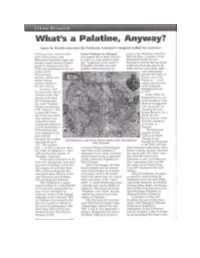
~~. ---,. ~-~,.,,}.',, ,, ,., ,. ~........... ~ ... --. ·-~ ~\.,---~- - . ~.- -~ ;-~~ - -- ---~~- -----~......-- . .--------. Ethnic Research · What's a Palatine, Anyvvay? James M. Beidler examines the Palatinate, Germany's emigrant hotbed for centuries. THE PALATINATE, which is now 'Comis Pala tinus ' to 'Pfalzgraf' today as the Palatinate. Less than part of the German state The original title of these courtiers 300 years later, a member of the Rhineland-Palatinate, began sup in Latin was comis palatinus (liter Wittlesbach family became plying a steady stream of immi ally, "companion of the palace"). Pfalzgraf as well as Herzog (duke) grants to America in the late 1n English, this title was count of Bavaria. From this date in the 1600s and contributed to the for palatine while in German the 1200s until the early 1800s, there mation of the was a relationship Pennsylvania between the rulers of German culture and Bavaria and of the dialect among Palatinate - culmi German ethnics in nating with the ruler the New World. of the Palatinak So many of the inheriting Bavaria Germans who left for in 1777. America in the 18th In the l 300s, the century were from Pfalzgraf became one the Palatinate that of the members of the the word "Palatine" Electoral College that became synonymous was responsible for with "German". This choosing the Holy is especially borne Roman Emperor. As a out in the case of the result, the area ship captains who became known as the transported these Electora I Pa la tinate, immigrants (primari or Kurpfalz in ly from Rotterdam to German. Philadelphia) and The Reformed were required to file religion of John lists with the Calvin and Ulrich Pennsylvania author Zwingli swept 11,e Palatitrate as depicted in William Blaeu's 1645 atlas Theatrum ities beginning in Orbis Terrarum. -
J Ewish Community and Civic Commune In
Jewish community and civic commune in the high Middle Ages'' CHRISTOPH CLUSE 1. The following observations do not aim to provide a comprehensive phe nomenology of the J ewish community during the high and late medieval periods. Rather 1 wish to present the outlines of a model which describes the status of the Jewish community within the medieval town or city, and to ask how the concepts of >inclusion< and >exclusion< can serve to de scribe that status. Using a number of selected examples, almost exclusively drawn from the western regions of the medieval German empire, 1 will concentrate, first, on a comparison betweenJewish communities and other corporate bodies (>universitates<) during the high medieval period, and, secondly, on the means by which Jews and Jewish communities were included in the urban civic corporations of the later Middle Ages. To begin with, 1 should point out that the study of the medieval Jewish community and its various historical settings cannot draw on an overly rich tradition in German historical research. 1 The >general <historiography of towns and cities that originated in the nineteenth century accorded only sporadic attention to the J ews. Still, as early as 1866 the legal historian Otto Stobbe had paid attention to the relationship between the Jewish ::- The present article first appeared in a slightly longer German version entitled Die mittelalterliche jüdische Gemeinde als »Sondergemeinde« - eine Skizze. In: J OHANEK, Peter (ed. ): Sondergemeinden und Sonderbezirke in der Stadt der Vormoderne (Städteforschung, ser. A, vol. 52). Köln [et al.] 2005, pp. 29-51. Translations from the German research literature cited are my own. -

Heppenheim Gültig Ab 09.12.2018 Liniennetzplan Nördliche Bergstraße – Heppenheim
www.vrn.de Fahrplan Nördliche Bergstraße – Heppenheim gültig ab 09.12.2018 Liniennetzplan Nördliche Bergstraße – Heppenheim Heppenheim - Lampertheim Heppenheim - Lorsch - Bürstadt Heppenheim - Fürth - Grasellenbach Heppenheim - Bensheim - Zwingenberg - Alsbach Bahnhof - Gunderslache - Nordstadt - Bahnhof Bahnhof – Graben - Kreis- krankenhaus – Weststadt Heppenheim - Erbach - Juhöhe Heppenheim - Laudenbach - Ober-Laudenbach Heppenheim - Hambach - Ober-Hambach Heppenheim - Rimbach - Fürth 6967 Heppenheim – Kirschhausen – Sonderbach Stand: 12/2018 | Stand: 6986 Heppenheim - Erbach 6987 Heppenheim - Lau- denbach – Ober-Laudenbach 6991 Heppenheim - Hambach - Ober-Hambach 6968 Heppenheim - Mit- tershausen – Scheuerberg Legende Haltestelle Haltestelle nur in eine Richtung Bahn Endstation Umsteigemöglichkeiten Schulverkehr Liniennummer Liniennetzplan Nördliche Bergstraße – Heppenheim Heppenheim - Lampertheim Heppenheim - Lorsch - Bürstadt Heppenheim - Fürth - Grasellenbach Heppenheim - Bensheim - Zwingenberg - Alsbach Bahnhof - Gunderslache - Nordstadt - Bahnhof Bahnhof – Graben - Kreis- krankenhaus – Weststadt Heppenheim - Erbach - Juhöhe Heppenheim - Laudenbach - Ober-Laudenbach Heppenheim - Hambach - Ober-Hambach Heppenheim - Rimbach - Fürth 6967 Heppenheim – Kirschhausen – Sonderbach Stand: 12/2018 | Stand: 6986 Heppenheim - Erbach 6987 Heppenheim - Lau- denbach – Ober-Laudenbach 6991 Heppenheim - Hambach - Ober-Hambach 6968 Heppenheim - Mit- tershausen – Scheuerberg Legende Haltestelle Haltestelle nur in eine Richtung Bahn Endstation Umsteigemöglichkeiten -
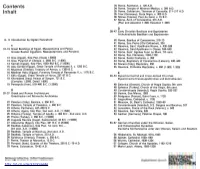
Contents Inhalt
34 Rome, Pantheon, c. 120 A.D. Contents 34 Rome, Temple of Minerva Medica, c. 300 A.D. 35 Rome, Calidarium, Thermae of Caracalla, 211-217 A.D. Inhalt 35 Trier (Germany), Porta Nigra, c. 300 A.D. 36 NTmes (France), Pont du Gard, c. 15 B.C. 37 Rome, Arch of Constantine, 315 A.D. (Plan and elevation 1:800, Elevation 1:200) 38-47 Early Christian Basilicas and Baptisteries Frühchristliche Basiliken und Baptisterien 8- 9 Introduction by Ogden Hannaford 40 Rome, Basilica of Constantine, 310-13 41 Rome, San Pietro (Old Cathedral), 324 42 Ravenna, Sant' Apollinare Nuovo, c. 430-526 10-19 Great Buildings of Egypt, Mesopotamia and Persia 42 Ravenna, Sant'Apollinare in Classe, 534-549 Grosse Bauten Ägyptens, Mesopotamiens und Persiens 43 Rome, Sant' Agnese Fuori Le Mura, 7th cent. 43 Rome, San Clemente, 1084-1108 12 Giza (Egypt), Site Plan (Scale 1:5000) 44 Rome, Santa Costanza, c. 350 13 Giza, Pyramid of Cheops, c. 2550 B.C. (1:800) 44 Rome, Baptistery of Constantine (Lateran), 430-440 14 Karnak (Egypt), Site Plan, 1550-942 B.C. (1:5000) 44 Nocera (Italy), Baptistery, 450 15 Abu-Simbel (Egypt), Great Temple of Ramesses II, c. 1250 B.C. 45 Ravenna, Orthodox Baptistery, c. 450 (1:800, 1:200) 15 Mycenae (Greece), Treasury of Atreus, c. 1350 B.C. 16 Medinet Habu (Egypt), Funerary Temple of Ramesses II, c. 1175 B.C. 17 Edfu (Egypt), Great Temple of Horus, 237-57 B.C. 46-53 Byzantine Central and Cross-domed Churches 18 Khorsabad (Iraq), Palace of Sargon, 721 B.C.