United States: Polarization and Violent Extremism
Total Page:16
File Type:pdf, Size:1020Kb
Load more
Recommended publications
-

AMERICAN P VERSIGHT
AMERICAN p VERSIGHT January11,2021 VIA ONLINE PORTAL DouglasHibbard Chief,InitialRequestStaff OfficeofInform ationPolicy DepartmentofJustice 441GStNW,6thFloor Washington,DC20530 ViaOnlinePortal Re: Expedited Freedom of Information Act Request DearFOIAOfficer: PursuanttotheFreedomof InformationAct(FOIA),5U.S.C.§552,andthe implem entingregulationsof youragency,Am ericanOversightmakesthefollowing requestforrecords. OnJanuary6,2021,PresidentTrumpinciteda mtoob attackCongresswhile mbers em werecertifyingtheelectionforPresident-electJoeBiden. 1 Theapparent insurrectionistsattackedtheCapitolBuilding,forcedtheirwaypastreportedly understaffedCapitolPolice,andultim atelydelayedtheCongressionalsessionbyforcing lawmakersandtheirstaffstoflee. 2 Fourpeoplediedduringthisassaultandafifth person,aCapitolPoliceofficer,diedthefollowingdayfrominjuriesincurredwhile engagingwithrioters. 3 Whilem ilitia mbers em roamedthehallsofCongress,Trum preportedlyfoughtagainst deployingtheD.C.NationalGuard, 4 andtheDefenseDepartm entreportedlyinitially 1 PressRelease,OfficeofSen.MittRom ney,Rom neyCondemInsurrectionatU.S. ns Capitol, Jan.6,2021, https://www.romney.senate.gov/rom ney-condem ns-insurrection- us-capitol. 2 RebeccaTan,etal., TrumpSupportersStormU.S.Capitol,WithOneWomanKilledand TearGasFired, Wash.Post(Jan.7,2021,12:30AM), https://www.washingtonpost.com/local/trum p-supporters-storm -capitol- dc/2021/01/06/58afc0b8-504b-11eb-83e3-322644d82356 story.html. 3 EricLevenson, WhatWeKnowAboutthe5DeathsinthePro-TrumpMobthatStormedthe Capitol, CNN(Jan.8,2021,5:29PM), -
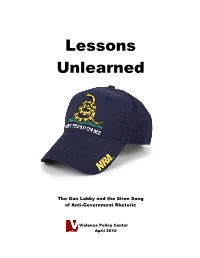
Lessons Unlearned—The Gun Lobby and the Siren Song of Anti
Lessons Unlearned The Gun Lobby and the Siren Song of Anti-Government Rhetoric Violence Policy Center April 2010 The Violence Policy Center (VPC) is a national non-profit educational organization that conducts research and public education on violence in America and provides information and analysis to policymakers, journalists, advocates, and the general public. This report was authored by VPC Executive Director Josh Sugarmann and VPC Policy Analyst Marty Langley. The study was funded in part with the support of the David Bohnett Foundation, The Joyce Foundation, and the Public Welfare Foundation. Past studies released by the VPC include: ! Target: Law Enforcement—Assault Weapons in the News (February 2010) ! Black Homicide Victimization in the United States: An Analysis of 2007 Homicide Data (January 2010) ! When Men Murder Women—An Analysis of 2007 Homicide Data (September 2009) ! Law Enforcement and Private Citizens Killed by Concealed Handgun Permit Holders—An Analysis of News Reports, May 2007 to April 2009 (July 2009) ! Indicted: Types of Firearms and Methods of Gun Trafficking from the United States to Mexico as Revealed in U.S. Court Documents (April 2009) ! Iron River: Gun Violence and Illegal Firearms Trafficking on the U.S.-Mexico Border (March 2009) ! Youth Gang Violence and Guns: Data Collection in California (February 2009) ! “Big Boomers”—Rifle Power Designed Into Handguns (December 2008) ! American Roulette: Murder-Suicide in the United States (April 2008) ! An Analysis of the Decline in Gun Dealers: 1994 to 2007 (August -

How White Supremacy Returned to Mainstream Politics
GETTY CORUM IMAGES/SAMUEL How White Supremacy Returned to Mainstream Politics By Simon Clark July 2020 WWW.AMERICANPROGRESS.ORG How White Supremacy Returned to Mainstream Politics By Simon Clark July 2020 Contents 1 Introduction and summary 4 Tracing the origins of white supremacist ideas 13 How did this start, and how can it end? 16 Conclusion 17 About the author and acknowledgments 18 Endnotes Introduction and summary The United States is living through a moment of profound and positive change in attitudes toward race, with a large majority of citizens1 coming to grips with the deeply embedded historical legacy of racist structures and ideas. The recent protests and public reaction to George Floyd’s murder are a testament to many individu- als’ deep commitment to renewing the founding ideals of the republic. But there is another, more dangerous, side to this debate—one that seeks to rehabilitate toxic political notions of racial superiority, stokes fear of immigrants and minorities to inflame grievances for political ends, and attempts to build a notion of an embat- tled white majority which has to defend its power by any means necessary. These notions, once the preserve of fringe white nationalist groups, have increasingly infiltrated the mainstream of American political and cultural discussion, with poi- sonous results. For a starting point, one must look no further than President Donald Trump’s senior adviser for policy and chief speechwriter, Stephen Miller. In December 2019, the Southern Poverty Law Center’s Hatewatch published a cache of more than 900 emails2 Miller wrote to his contacts at Breitbart News before the 2016 presidential election. -
Military Guide to Terrorism in the Twenty-First Century
US Army TRADOC TRADOC G2 Handbook No. 1 AA MilitaryMilitary GuideGuide toto TerrorismTerrorism in the Twenty-First Century US Army Training and Doctrine Command TRADOC G2 TRADOC Intelligence Support Activity - Threats Fort Leavenworth, Kansas 15 August 2007 DISTRIBUTION RESTRICTION: Approved for Public Release; Distribution Unlimited. 1 Summary of Change U.S. Army TRADOC G2 Handbook No. 1 (Version 5.0) A Military Guide to Terrorism in the Twenty-First Century Specifically, this handbook dated 15 August 2007 • Provides an information update since the DCSINT Handbook No. 1, A Military Guide to Terrorism in the Twenty-First Century, publication dated 10 August 2006 (Version 4.0). • References the U.S. Department of State, Office of the Coordinator for Counterterrorism, Country Reports on Terrorism 2006 dated April 2007. • References the National Counterterrorism Center (NCTC), Reports on Terrorist Incidents - 2006, dated 30 April 2007. • Deletes Appendix A, Terrorist Threat to Combatant Commands. By country assessments are available in U.S. Department of State, Office of the Coordinator for Counterterrorism, Country Reports on Terrorism 2006 dated April 2007. • Deletes Appendix C, Terrorist Operations and Tactics. These topics are covered in chapter 4 of the 2007 handbook. Emerging patterns and trends are addressed in chapter 5 of the 2007 handbook. • Deletes Appendix F, Weapons of Mass Destruction. See TRADOC G2 Handbook No.1.04. • Refers to updated 2007 Supplemental TRADOC G2 Handbook No.1.01, Terror Operations: Case Studies in Terror, dated 25 July 2007. • Refers to Supplemental DCSINT Handbook No. 1.02, Critical Infrastructure Threats and Terrorism, dated 10 August 2006. • Refers to Supplemental DCSINT Handbook No. -

The Linguistic Features and Persuasion Techniques in Marlboro Cigarette Advertisement Slogans
PLAGIAT MERUPAKAN TINDAKAN TIDAK TERPUJI THE LINGUISTIC FEATURES AND PERSUASION TECHNIQUES IN MARLBORO CIGARETTE ADVERTISEMENT SLOGANS A SARJANA PENDIDIKAN THESIS Presented as Partial Fulfillment of the Requirements to Obtain the Sarjana Pendidikan Degree in English Language Education By Astriyani Sulistyowati Student Number: 111214161 ENGLISH LANGUAGE EDUCATION STUDY PROGRAM DEPARTMENT OF LANGUAGE AND ARTS EDUCATION FACULTY OF TEACHERS TRAINING AND EDUCATION SANATA DHARMA UNIVERSITY YOGYAKARTA 2017 PLAGIAT MERUPAKAN TINDAKAN TIDAK TERPUJI THE LINGUISTIC FEATURES AND PERSUASION TECHNIQUES IN MARLBORO CIGARETTE ADVERTISEMENT SLOGANS A SARJANA PENDIDIKAN THESIS Presented as Partial Fulfillment of the Requirements to Obtain the Sarjana Pendidikan Degree in English Language Education By Astriyani Sulistyowati Student Number: 111214161 ENGLISH LANGUAGE EDUCATION STUDY PROGRAM DEPARTMENT OF LANGUAGE AND ARTS EDUCATION FACULTY OF TEACHERS TRAINING AND EDUCATION SANATA DHARMA UNIVERSITY YOGYAKARTA 2017 i PLAGIAT MERUPAKAN TINDAKAN TIDAK TERPUJI ヽ И Sαげα4α Pθ ″グ′どJttη″Thcsis On THE LINGUISTIC FEATURES AND PERSUAS10N TECHNIQUESIN MARLBORO CIGARETT逸 ADVERTISEMENT SLOGANS By Astriyani Sulistyowati Student Number: 11121416l Approved by Carla Sih Prabandtti,S.Pd.,M.Hum. Date: 10 May 2AI7 ― ― ― PLAGIAT MERUPAKAN TINDAKAN TIDAK TERPUJI PLAGIAT MERUPAKAN TINDAKAN TIDAK TERPUJI DEDICATION PAGE Success is not the key to happiness. Happiness is the key to success. If you love what you are doing, you will be successful. (Herman Cain) If there is no struggle, there is no progress. (Frederick Douglass) We all make mistakes, have struggles, and even regret things in our past. But you’re not your mistakes, you’re not your struggles, and you are here right now with the power to shape your day and your future. -
Charlottesville: One Year Later
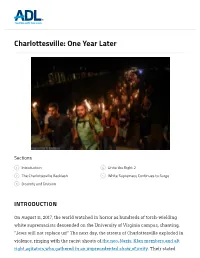
Charlottesville: One Year Later Sections 1 Introduction 4 Unite the Right 2 2 The Charlottesville Backlash 5 White Supremacy Continues to Surge 3 Disunity and Division INTRODUCTION On August 11, 2017, the world watched in horror as hundreds of torch-wielding white supremacists descended on the University of Virginia campus, chanting, “Jews will not replace us!” The next day, the streets of Charlottesville exploded in violence, ringing with the racist shouts of th thththththeeee n nnneo-Nazis,eo-Nazis,eo-Nazis,eo-Nazis, Klan KlanKlanKlan m mmmembersembersembersembers an ananandddd alt altaltalt rightrightrightright agitat agitatagitatagitatorsorsorsors wh whwhwhoooo gath gathgathgathererereredededed in ininin an ananan unpr unprunprunprecedentedecedentedecedentedecedented sh shshshowowowow of ofofof unity unityunityunity. Their stated 1 / 9 common cause: To protest the removal of a Confederate statue from a local park. Their true purpose: To show to the world the strength and defiance of the white supremacist movement. The promise of Unite the Right, organized primarily by alt right activist Jason Kessler, brought white supremacists of all stripesstripesstripesstripes t tttogethogethogethogetherererer for forforfor a aaa week weekweekweekenenenendddd of ofofof prprprprotestotestotestotest that thatthatthat quickly quicklyquicklyquickly turn turnturnturnedededed t tttoooo vio viovioviolenlenlenlence,ce,ce,ce, culminating in the brutal murder of anti- racist counter-protester Heather Heyer. The white supremacist mayhem prevented the Saturday rally itself from actually occurring, as local and state police converged on the chaotic scene, urging everyone off the streets and away from the parks. Virginia Governor Terry McAuliffe declared a state of emergency and authorities shut down Unite the Right. Despite this, high profile white supremacists like Richard Spencer and David Duke declardeclardeclardeclaredededed Unite UniteUniteUnite th thththeeee Right RightRightRight an ananan o ooovvvverallerallerallerall vict victvictvictororororyyyy..... -

Trumpism on College Campuses
UC San Diego UC San Diego Previously Published Works Title Trumpism on College Campuses Permalink https://escholarship.org/uc/item/1d51s5hk Journal QUALITATIVE SOCIOLOGY, 43(2) ISSN 0162-0436 Authors Kidder, Jeffrey L Binder, Amy J Publication Date 2020-06-01 DOI 10.1007/s11133-020-09446-z Peer reviewed eScholarship.org Powered by the California Digital Library University of California Qualitative Sociology (2020) 43:145–163 https://doi.org/10.1007/s11133-020-09446-z Trumpism on College Campuses Jeffrey L. Kidder1 & Amy J. Binder 2 Published online: 1 February 2020 # Springer Science+Business Media, LLC, part of Springer Nature 2020 Abstract In this paper, we report data from interviews with members of conservative political clubs at four flagship public universities. First, we categorize these students into three analytically distinct orientations regarding Donald Trump and his presidency (or what we call Trumpism). There are principled rejecters, true believers, and satisficed partisans. We argue that Trumpism is a disunifying symbol in our respondents’ self- narratives. Specifically, right-leaning collegians use Trumpism to draw distinctions over the appropriate meaning of conservatism. Second, we show how political clubs sort and shape orientations to Trumpism. As such, our work reveals how student-led groups can play a significant role in making different political discourses available on campuses and shaping the types of activism pursued by club members—both of which have potentially serious implications for the content and character of American democracy moving forward. Keywords Americanpolitics.Conservatism.Culture.Highereducation.Identity.Organizations Introduction Donald Trump, first as a candidate and now as the president, has been an exceptionally divisive force in American politics, even among conservatives who typically vote Republican. -

Opinion Talk Radio Is Turning Million...Nto Conservatives
https://nyti.ms/2SFJqYc Talk Radio Is Turning Millions of Americans Into Conservatives The medium is at the heart of Trumpism. By Paul Matzko Dr. Matzko is the author of “The Radio Right: How a Band of Broadcasters Took on the Federal Government and Built the Modern Conservative Movement.” Oct. 9, 2020 At least 15 million Americans every week tune into one of the top 15 talk radio programs. They are not monolithically conservative, but they are overwhelmingly so. A dozen of the top 15 shows feature conservative or libertarian hosts — with devoted followings like Rush Limbaugh’s “Dittoheads” or Michael Savage’s “Savage Nation” — and only one leans left. Talk radio may face an aging audience, a decline in ad revenue and competition from new mass media forms like podcasts, but there are still millions of Americans whose politics are shaped by what they listen to on talk radio all day, every day. Fox News gets more of the attention for shaping conservative opinion and for its influence on the Trump administration, but we shouldn’t overlook the power of conservative talk radio. The conservatism of talk radio only partly overlaps with institutional conservatism, that of right-wing Washington think tanks, magazines and the Republican Party itself. By the early 2000s, it had embraced a version of conservatism that is less focused on free markets and small government and more focused on ethnonationalism and populism. It is, in short, the core of Trumpism — now and in the future, with or without a President Trump. Talk radio’s power is rooted in the sheer volume of content being produced each week. -

A Schema of Right-Wing Extremism in the United States
ICCT Policy Brief October 2019 DOI: 10.19165/2019.2.06 ISSN: 2468-0486 A Schema of Right-Wing Extremism in the United States Author: Sam Jackson Over the past two years, and in the wake of deadly attacks in Charlottesville and Pittsburgh, attention paid to right-wing extremism in the United States has grown. Most of this attention focuses on racist extremism, overlooking other forms of right-wing extremism. This article presents a schema of three main forms of right-wing extremism in the United States in order to more clearly understand the landscape: racist extremism, nativist extremism, and anti-government extremism. Additionally, it describes the two primary subcategories of anti-government extremism: the patriot/militia movement and sovereign citizens. Finally, it discusses whether this schema can be applied to right-wing extremism in non-U.S. contexts. Key words: right-wing extremism, racism, nativism, anti-government A Schema of Right-Wing Extremism in the United States Introduction Since the public emergence of the so-called “alt-right” in the United States—seen most dramatically at the “Unite the Right” rally in Charlottesville, Virginia, in August 2017—there has been increasing attention paid to right-wing extremism (RWE) in the United States, particularly racist right-wing extremism.1 Violent incidents like Robert Bowers’ attack on the Tree of Life synagogue in Pittsburgh, Pennsylvania in October 2018; the mosque shooting in Christchurch, New Zealand in March 2019; and the mass shooting at a Walmart in El Paso, Texas in August -
Coming to Grips with Life in the Disinformation Age
Coming to Grips with Life in the Disinformation Age “The Information Age” is the term given to post-World War II contemporary society, particularly from the Sixties, onward, when we were coming to the realization that our ability to publish information of all kinds, fact and fiction, was increasing at an exponential rate so as to make librarians worry that they would soon run out of storage space. Their storage worries were temporarily allayed by the advent of the common use of microform analog photography of printed materials, and eventually further by digital technology and nanotechnology. It is noted that in this era, similar to other past eras of great growth in communications technology such as written language, the printing press, analog recording, and telecommunication, dramatic changes occurred as well in human thinking and socialness. More ready archiving negatively impacted our disposition to remember things by rote, including, in recent times, our own phone numbers. Moreover, many opportunities for routine socializing were lost, particularly those involving public speech and readings, live music and theater, live visits to neighbors and friends, etc. The recognition that there had been a significant tradeoff from which there seemed to be no turning back evoked discussion of how to come to grips with “life in the Information Age”. Perhaps we could discover new social and intellectual opportunities from our technological advances to replace the old ones lost, ways made available by new technology. Today we are facing a new challenge, also brought on largely by new technology: that of coming to grips with life in the “Disinformation Age”. -

Testimony of Lecia Brooks Chief of Staff, Southern Poverty Law Center
Testimony of Lecia Brooks Chief of Staff, Southern Poverty Law Center before the Subcommittee on National Security, International Development and Monetary Policy Committee on Financial Services United States House of Representatives Dollars against Democracy: Domestic Terrorist Financing in the Aftermath of Insurrection February 25, 2021 My name is Lecia Brooks. I am chief of staff of the Southern Poverty Law Center (SPLC). Now in our 50th year, the SPLC is a catalyst for racial justice in the South and beyond, working in partnership with communities to dismantle white supremacy, strengthen intersectional movements, and advance the human rights of all people. SPLC lawyers have worked to shut down some of the nation’s most violent white supremacist groups by winning crushing, multimillion-dollar jury verdicts on behalf of their victims. We have helped dismantle vestiges of Jim Crow, reformed juvenile justice practices, shattered barriers to equality for women, children, the LGBTQ+ community, and the disabled, and worked to protect low-wage immigrant workers from exploitation. The SPLC began tracking white supremacist activity in the 1980s, during a resurgence of the Ku Klux Klan and other organized extremist hate groups. Today, the SPLC is the premier U.S. nonprofit organization monitoring the activities of domestic hate groups and other extremists. In the early 1990s, the SPLC launched its pioneering Teaching Tolerance program to provide educators with free, anti-bias classroom resources, such as classroom documentaries and lesson plans. Now renamed Learning For Justice, our program reaches millions of schoolchildren with award-winning curricula and other materials that promote understanding of our nation’s history and respect for others, helping educators create inclusive, equitable school environments. -

Transnational Neo-Nazism in the Usa, United Kingdom and Australia
TRANSNATIONAL NEO-NAZISM IN THE USA, UNITED KINGDOM AND AUSTRALIA PAUL JACKSON February 2020 JACKSON | PROGRAM ON EXTREMISM About the Program on About the Author Extremism Dr Paul Jackson is a historian of twentieth century and contemporary history, and his main teaching The Program on Extremism at George and research interests focus on understanding the Washington University provides impact of radical and extreme ideologies on wider analysis on issues related to violent and societies. Dr. Jackson’s research currently focuses non-violent extremism. The Program on the dynamics of neo-Nazi, and other, extreme spearheads innovative and thoughtful right ideologies, in Britain and Europe in the post- academic inquiry, producing empirical war period. He is also interested in researching the work that strengthens extremism longer history of radical ideologies and cultures in research as a distinct field of study. The Britain too, especially those linked in some way to Program aims to develop pragmatic the extreme right. policy solutions that resonate with Dr. Jackson’s teaching engages with wider themes policymakers, civic leaders, and the related to the history of fascism, genocide, general public. totalitarian politics and revolutionary ideologies. Dr. Jackson teaches modules on the Holocaust, as well as the history of Communism and fascism. Dr. Jackson regularly writes for the magazine Searchlight on issues related to contemporary extreme right politics. He is a co-editor of the Wiley- Blackwell journal Religion Compass: Modern Ideologies and Faith. Dr. Jackson is also the Editor of the Bloomsbury book series A Modern History of Politics and Violence. The views expressed in this paper are solely those of the author, and not necessarily those of the Program on Extremism or the George Washington University.