Islamic State” Jalal Zain Aldin
Total Page:16
File Type:pdf, Size:1020Kb
Load more
Recommended publications
-

ISIS Propaganda and United States Countermeasures
BearWorks MSU Graduate Theses Fall 2015 ISIS Propaganda and United States Countermeasures Daniel Lincoln Stevens As with any intellectual project, the content and views expressed in this thesis may be considered objectionable by some readers. However, this student-scholar’s work has been judged to have academic value by the student’s thesis committee members trained in the discipline. The content and views expressed in this thesis are those of the student-scholar and are not endorsed by Missouri State University, its Graduate College, or its employees. Follow this and additional works at: https://bearworks.missouristate.edu/theses Part of the Defense and Security Studies Commons Recommended Citation Stevens, Daniel Lincoln, "ISIS Propaganda and United States Countermeasures" (2015). MSU Graduate Theses. 1503. https://bearworks.missouristate.edu/theses/1503 This article or document was made available through BearWorks, the institutional repository of Missouri State University. The work contained in it may be protected by copyright and require permission of the copyright holder for reuse or redistribution. For more information, please contact BearWorks@library.missouristate.edu. ISIS PROPAGANDA AND UNITED STATES COUNTERMEASURES A Masters Thesis Presented to The Graduate College of Missouri State University In Partial Fulfillment Of the Requirements for the Degree Master of Science, Defense and Strategic Studies By Daniel Stevens December 2015 Copyright 2015 by Daniel Lincoln Stevens ii ISIS PROPAGANDA AND UNITED STATES COUNTERMEASURES Defense and Strategic studies Missouri State University, December 2015 Master of Science Daniel Stevens ABSTRACT The purpose of this study is threefold: 1. Examine the use of propaganda by the Islamic State in Iraq and al Sham (ISIS) and how its propaganda enables ISIS to achieve its objectives; 2. -

Policy Notes for the Trump Notes Administration the Washington Institute for Near East Policy ■ 2018 ■ Pn55
TRANSITION 2017 POLICYPOLICY NOTES FOR THE TRUMP NOTES ADMINISTRATION THE WASHINGTON INSTITUTE FOR NEAR EAST POLICY ■ 2018 ■ PN55 TUNISIAN FOREIGN FIGHTERS IN IRAQ AND SYRIA AARON Y. ZELIN Tunisia should really open its embassy in Raqqa, not Damascus. That’s where its people are. —ABU KHALED, AN ISLAMIC STATE SPY1 THE PAST FEW YEARS have seen rising interest in foreign fighting as a general phenomenon and in fighters joining jihadist groups in particular. Tunisians figure disproportionately among the foreign jihadist cohort, yet their ubiquity is somewhat confounding. Why Tunisians? This study aims to bring clarity to this question by examining Tunisia’s foreign fighter networks mobilized to Syria and Iraq since 2011, when insurgencies shook those two countries amid the broader Arab Spring uprisings. ©2018 THE WASHINGTON INSTITUTE FOR NEAR EAST POLICY. ALL RIGHTS RESERVED. THE WASHINGTON INSTITUTE FOR NEAR EAST POLICY ■ NO. 30 ■ JANUARY 2017 AARON Y. ZELIN Along with seeking to determine what motivated Evolution of Tunisian Participation these individuals, it endeavors to reconcile estimated in the Iraq Jihad numbers of Tunisians who actually traveled, who were killed in theater, and who returned home. The find- Although the involvement of Tunisians in foreign jihad ings are based on a wide range of sources in multiple campaigns predates the 2003 Iraq war, that conflict languages as well as data sets created by the author inspired a new generation of recruits whose effects since 2011. Another way of framing the discussion will lasted into the aftermath of the Tunisian revolution. center on Tunisians who participated in the jihad fol- These individuals fought in groups such as Abu Musab lowing the 2003 U.S. -

Rojavadevrimi+Full+75Dpi.Pdf
Kitaba ilişkin bilinmesi gerekenler Elinizdeki kitabın orijinali 2014 ve 2015 yıllarında Almanca dilinde üç yazar tarafından yazıldı ve Rosa Lüksemburg Vakfı’nın desteğiyle “VSA Verlag” adlı yayınevi tarafından Almanya’da yayınlandı. 2018 yılında Almanca dilinde 4. baskısı güncellenip basılarak önemli ilgi gören bu kitap, 2016 Ekim ayında “Pluto Press” adlı yayınevi tarafından İngilizce dilinde Birleşik Krallık ‘ta yayınlandı. Bu kitabın İngilizce çevirisi ABD’de yaşayan yazar ve aktivist Janet Biehl tarafından yapıldı ve sonrasında üç yazar tarafından 2016 ilkbaharında güncellendi. En başından beri kitabın Türkçe dilinde de basılıp yayınlanası için bir planlama yapıldı. Bu amaçla bir grup gönüllü İngilizce versiyonu temel alarak Türkçe çevirisini yaptı. Türkiye’deki siyasal gelişme ve zorluklardan dolayı gecikmeler ortaya çıkınca yazarlar kitabın basılmasını 2016 yılından daha ileri bir tarihe alma kararını aldı. Bu sırada tekrar Rojava’ya giden yazarlar, elde ettikleri bilgilerle Türkçe çeviriyi doğrudan Türkçe dilinde 2017 ve 2018 yıllarında güncelleyip genişletti. Bu gelişmelere redaksiyon çalışmaları da eklenince kitabın Türkçe dilinde yayınlanması 2018 yılında olması gerekirken 2019 yılına sarktı. 2016 yılından beri kitap ayrıca Farsça, Rusça, Yunanca, İtalyanca, İsveççe, Polonca, Slovence, İspanyolca dillerine çevrilip yayınlandı. Arapça ve Kürtçe çeviriler devam etmektedir. Kitap Ağustos 2019’da yayınlandı. Ancak kitapta en son Eylül 2018’de içeriksel güncellenmeler yapıldı. 2018 yazın durum ve atmosferine göre yazıldı. Kitapta kullanılan resimlerde eğer kaynak belirtilmemişse, resimler yazarlara aittir. Aksi durumda her resmin altında resimlerin sahibi belirtilmektedir. Kapaktaki resim Rojava’da kurulmuş kadın köyü Jinwar’ı göstermekte ve Özgür Rojava Kadın Vakfı’na (WJAR) aittir. Bu kitap herhangi bir yayınevi tarafından yayınlanmamaktadır. Herkes bu kitaba erişimde serbesttir. Kitabı elektronik ve basılı olarak istediğiniz gibi yayabilirsiniz, ancak bu kitaptan gelir ve para elde etmek yazarlar tarafından izin verilmemektedir. -

The Criminal-Jihadist: Insights Into Modern Terrorist Financing
AUGUST 2016 No. 10 STRATEGIC SECURITY ANALYSIS The Criminal-Jihadist: Insights into Modern Terrorist Financing by Dr Christina Schori Liang STRATEGIC SECURITY ANALYSIS GCSP - THE CRIMINAL JIHADIST: INSIGHTS INTO MODERN TERRORIST FINANCING Introduction KEY POINTS Terrorism is proving to be This paper provides a snapshot an enduring global security of how modern terrorist groups • Criminal-terrorist networks are threat. Since the late 1990s finance their organisations and weakening states by eroding state terrorist groups have become operations. It will identify the structures, undermining the rule more lethal, networked, and key issues that are driving the of law, and creating illegitimate technologically savvy. The growing nexus of terrorism governments. They rule over large world is currently dealing with and organised crime. The swathes of territory, where they are two global terrorist groups – paper will also explore the able to govern with impunity. al-Qaeda and IS – that have various working relationships recruited affiliates across the between terrorist and criminal • Criminal-terrorist networks and globe. In 2014 the lives lost groups, outlining under what relationships have enabled due to terrorism around the conditions and to what extent al-Qaeda and the Islamic State world increased by 80 per cent they cooperate. This will help to (IS) to broaden the scope of their compared to the previous year.1 identify existing and potentially power by increasing the numbers of new countermeasures to dry their affiliates and partners across Several terrorist groups currently up terrorist funding, and to parts of West, East, and North have the ability to control land dismantle and destroy terrorist- Africa and Southeast Asia. -

Foreign Terrorist Organizations
Order Code RL32223 CRS Report for Congress Received through the CRS Web Foreign Terrorist Organizations February 6, 2004 Audrey Kurth Cronin Specialist in Terrorism Foreign Affairs, Defense, and Trade Division Huda Aden, Adam Frost, and Benjamin Jones Research Associates Foreign Affairs, Defense, and Trade Division Congressional Research Service ˜ The Library of Congress Foreign Terrorist Organizations Summary This report analyzes the status of many of the major foreign terrorist organizations that are a threat to the United States, placing special emphasis on issues of potential concern to Congress. The terrorist organizations included are those designated and listed by the Secretary of State as “Foreign Terrorist Organizations.” (For analysis of the operation and effectiveness of this list overall, see also The ‘FTO List’ and Congress: Sanctioning Designated Foreign Terrorist Organizations, CRS Report RL32120.) The designated terrorist groups described in this report are: Abu Nidal Organization (ANO) Abu Sayyaf Group (ASG) Al-Aqsa Martyrs Brigade Armed Islamic Group (GIA) ‘Asbat al-Ansar Aum Supreme Truth (Aum) Aum Shinrikyo, Aleph Basque Fatherland and Liberty (ETA) Communist Party of Philippines/New People’s Army (CPP/NPA) Al-Gama’a al-Islamiyya (Islamic Group, IG) HAMAS (Islamic Resistance Movement) Harakat ul-Mujahidin (HUM) Hizballah (Party of God) Islamic Movement of Uzbekistan (IMU) Jaish-e-Mohammed (JEM) Jemaah Islamiya (JI) Al-Jihad (Egyptian Islamic Jihad) Kahane Chai (Kach) Kurdistan Workers’ Party (PKK, KADEK) Lashkar-e-Tayyiba -

Istanbul Technical University Graduate School of Arts
ISTANBUL TECHNICAL UNIVERSITY GRADUATE SCHOOL OF ARTS AND SOCIAL SCIENCES TRANSFORMATIONS OF KURDISH MUSIC IN SYRIA: SOCIAL AND POLITICAL FACTORS M.A. THESIS Hussain HAJJ Department of Musicology and Music Theory Musicology M.A. Programme JUNE 2018 ISTANBUL TECHNICAL UNIVERSITY GRADUATE SCHOOL OF ARTS AND SOCIAL SCIENCES TRANSFORMATIONS OF KURDISH MUSIC IN SYRIA: SOCIAL AND POLITICAL FACTORS M.A. THESIS Hussain HAJJ (404141007) Department of Musicology and Music Theory Musicology Programme Thesis Advisor: Assoc. Prof. Dr. F. Belma KURTİŞOĞLU JUNE 2018 İSTANBUL TEKNİK ÜNİVERSİTESİ SOSYAL BİLİMLER ENSTİTÜSÜ SURİYE’DE KÜRT MÜZİĞİNİN DÖNÜŞÜMÜ: SOSYAL VE POLİTİK ETKENLER YÜKSEK LİSANS TEZİ Hussain HAJJ (404141007) Müzikoloji ve Müzik Teorisi Anabilim Dalı Müzikoloji Yüksek Lisans Programı Tez Danışmanı: Doç. Dr. F. Belma KURTİŞOĞLU HAZİRAN 2018 Date of Submission : 7 May 2018 Date of Defense : 4 June 2018 v vi To the memory of my father, to my dear mother and Neslihan Güngör; thanks for always being there for me. vii viii FOREWORD When I started studying Musicology, a musician friend from Syrian Kurds told me that I am leaving my seat as an active musician and starting a life of academic researches, and that he will make music and I will research the music he makes. It was really an interesting statement to me; it made me think of two things, the first one is the intention behind this statement, while the second was the attitude of Kurds, especially Kurd musicians, towards researchers and researching. As for the first thing, I felt that there was a problem, maybe a social or psychological, of the Kurdish people in general, and the musicians in particular. -

Mcallister Bradley J 201105 P
REVOLUTIONARY NETWORKS? AN ANALYSIS OF ORGANIZATIONAL DESIGN IN TERRORIST GROUPS by Bradley J. McAllister (Under the Direction of Sherry Lowrance) ABSTRACT This dissertation is simultaneously an exercise in theory testing and theory generation. Firstly, it is an empirical test of the means-oriented netwar theory, which asserts that distributed networks represent superior organizational designs for violent activists than do classic hierarchies. Secondly, this piece uses the ends-oriented theory of revolutionary terror to generate an alternative means-oriented theory of terrorist organization, which emphasizes the need of terrorist groups to centralize their operations. By focusing on the ends of terrorism, this study is able to generate a series of metrics of organizational performance against which the competing theories of organizational design can be measured. The findings show that terrorist groups that decentralize their operations continually lose ground, not only to government counter-terror and counter-insurgent campaigns, but also to rival organizations that are better able to take advantage of their respective operational environments. However, evidence also suggests that groups facing decline due to decentralization can offset their inability to perform complex tasks by emphasizing the material benefits of radical activism. INDEX WORDS: Terrorism, Organized Crime, Counter-Terrorism, Counter-Insurgency, Networks, Netwar, Revolution, al-Qaeda in Iraq, Mahdi Army, Abu Sayyaf, Iraq, Philippines REVOLUTIONARY NETWORK0S? AN ANALYSIS OF ORGANIZATIONAL DESIGN IN TERRORIST GROUPS by BRADLEY J MCALLISTER B.A., Southwestern University, 1999 M.A., The University of Leeds, United Kingdom, 2003 A Dissertation Submitted to the Graduate Faculty of the University of Georgia in Partial Fulfillment of the Requirements for the Degree DOCTOR OF PHILOSPHY ATHENS, GA 2011 2011 Bradley J. -

Conflicts and Religious Radicalisation in the Middle East 168
Unmasking ‘Religious’ Conflicts and Religious Radicalisation in the Middle East 168 8 Unmasking ‘Religious’ Conflicts and Religious Radicalisation in the Middle East BETTINA KOCH Whether it is ‘Muslim-Hindu’ violence in India, ‘Christian-Muslim’ violence in Indonesia, ‘Buddhist-Muslim’ violence in Sri Lanka, ‘Sunni-Shia’ violence in Iraq, or, indeed, ‘Islamic terrorism’, the advertent follower of the news or reader of academic journals instantly encounters numerous references to contemporary or more recent conflicts that are deemed ‘religious’ or ‘sectarian’. The marker ‘religious conflict’ instantly implies a conflict has religious root causes, a conflict is fought in the name of and over religious causes. Thus, the qualifier ‘religious’ serves simultaneously as a description and as an analysis; although, too often, it is not obvious what an author means when they attach the qualifier ‘religious’ to a conflict.1 Moreover, reports of the number of religiously motivated casualties must be approached with caution; frequently, news reports suggest religious motives even in conflicts that are fought along ethnic or tribal lines, while the conflicting parties share similar religious outlooks (BBC News 2013). Consequently, whenever one aims at discussing conflicts that have a potentially religious background, it is mandatory to raise the question when and under what circumstances does a conflict qualify as a ‘religious’ or ‘sectarian’ conflict? Is it sufficient that at least one party in a conflict has a distinctively religious outlook or identity? Is it sufficient to have ‘religious’ language involved? Or is it essential that the conflict, in order to qualify as a religious conflict, is fought a) by using religious justification or b) over 1 This is even the case for the widely praised study by Brian and Finke (2011). -

The Jihadi Industry: Assessing the Organizational, Leadership And
The Jihadi Industry: Assessing the Organizational, Leadership, and Cyber Profiles Report to the Office of University Programs, Science and Technology Directorate, U.S. Department of Homeland Security July 2017 National Consortium for the Study of Terrorism and Responses to Terrorism A Department of Homeland Security Science and Technology Center of Excellence Led by the University of Maryland 8400 Baltimore Ave., Suite 250 • College Park, MD 20742 • 301.405.6600 www.start.umd.edu National Consortium for the Study of Terrorism and Responses to Terrorism A Department of Homeland Security Science and Technology Center of Excellence About This Report The authors of this report are Gina Ligon, Michael Logan, Margeret Hall, Douglas C. Derrick, Julia Fuller, and Sam Church at the University of Nebraska, Omaha. Questions about this report should be directed to Dr. Gina Ligon at gligon@unomaha.edu. This report is part of the National Consortium for the Study of Terrorism and Responses to Terrorism (START) project, “The Jihadi Industry: Assessing the Organizational, Leadership, and Cyber Profiles” led by Principal Investigator Gina Ligon. This research was supported by the Department of Homeland Security Science and Technology Directorate’s Office of University Programs through Award Number #2012-ST-061-CS0001, Center for the Study of Terrorism and Behavior (CSTAB 1.12) made to START to investigate the role of social, behavioral, cultural, and economic factors on radicalization and violent extremism. The views and conclusions contained in this document are those of the authors and should not be interpreted as necessarily representing the official policies, either expressed or implied, of the U.S. -

Islamic State of Iraq and the Levant (ISIL), Or Simply the Islamic State, Has Carried out Deadly Terrorist Attacks
BACKGROUND REPORT Patterns of Islamic State-Related Terrorism, 2002--2015 For more than a decade, the organization now known as the Islamic State of Iraq and the Levant (ISIL), or simply the Islamic State, has carried out deadly terrorist attacks. Beginning as a small network led by Jordanian Abu Musab al-Zarqawi, the first terrorist attack attributed to this group was the assassination of American diplomat Laurence Foley in Amman, Jordan in October 2002. Since then, the group initially known as Tawhid and Jihad (Jama’at al-Tawhid w’al-Jihad (the Party of Monotheism and Jihad)) has undergone a complex evolution, including name changes, leadership changes, and shifts in allegiance to other Salafi-jihadist organizations, most notably al-Qaida. In addition, the reach of ISIL’s violence surpasses its own membership, to include attacks carried out by other groups and individuals who have pledged allegiance to ISIL regardless of whether or not formal ties exist. This complexity makes it difficult to comprehensively and systematically place into context the violence of one of the most active and deadly terrorist organizations in recent history. For the purpose of this report, we have classified the terrorist attacks in the Global Terrorism Database (GTD) into four ISIL-related perpetrator categories: ISIL Predecessor: attacks by organizations that were part of the ISIL lineage prior to adoption of the ISIL name in 2013 ISIL: attacks by operatives of the “core” of the organization, based in and primarily active in Iraq and Syria ISIL Affiliate: attacks by organizations that have declared allegiance to ISIL1 ISIL-Inspired: attacks by individuals who have indicated that they were motivated by allegiance to ISIL ISIL-Related: any of the above This report presents data that illustrate the dynamics of ISIL-related terrorism over time and place, from 2002 to 2015. -
ISIS in Libya: a Major Regional and International Threat
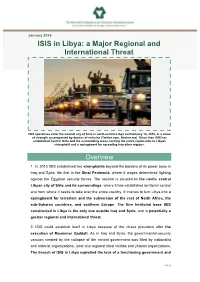
המרכז למורשת המודיעין (מל"מ) מרכז המידע למודיעין ולטרור January 2016 ISIS in Libya: a Major Regional and International Threat ISIS operatives enter the coastal city of Sirte in north-central Libya on February 18, 2015, in a show of strength accompanied by dozens of vehicles (Twitter.com, Nasher.me). Since then ISIS has established itself in Sirte and the surrounding areas, turning the entire region into its Libyan stronghold and a springboard for spreading into other regions. Overview 1. In 2015 ISIS established two strongholds beyond the borders of its power base in Iraq and Syria: the first in the Sinai Peninsula, where it wages determined fighting against the Egyptian security forces. The second is situated in the north- central Libyan city of Sirte and its surroundings, where it has established territorial control and from where it seeks to take over the entire country. It intends to turn Libya into a springboard for terrorism and the subversion of the rest of North Africa, the sub-Saharan countries, and southern Europe. The firm territorial base ISIS constructed in Libya is the only one outside IraQ and Syria, and is potentially a greater regional and international threat. 2. ISIS could establish itself in Libya because of the chaos prevalent after the execution of Muammar Qaddafi. As in Iraq and Syria, the governmental-security vacuum created by the collapse of the central government was filled by nationalist and Islamist organizations, local and regional tribal militias and jihadist organizations. The branch of ISIS in Libya exploited the lack of a functioning government and 209-15 2 the absence of international intervention to establish itself in the region around Sirte and from there to aspire to spread throughout Libya. -

Analyzing the Islamic State in Syria and Iraq
University of Mississippi eGrove Honors College (Sally McDonnell Barksdale Honors Theses Honors College) 2015 To be, or not to be-Statehood is the Question: Analyzing the Islamic State in Syria and Iraq Leigh Anne Zook University of Mississippi. Sally McDonnell Barksdale Honors College Follow this and additional works at: https://egrove.olemiss.edu/hon_thesis Part of the History Commons Recommended Citation Zook, Leigh Anne, "To be, or not to be-Statehood is the Question: Analyzing the Islamic State in Syria and Iraq" (2015). Honors Theses. 580. https://egrove.olemiss.edu/hon_thesis/580 This Undergraduate Thesis is brought to you for free and open access by the Honors College (Sally McDonnell Barksdale Honors College) at eGrove. It has been accepted for inclusion in Honors Theses by an authorized administrator of eGrove. For more information, please contact egrove@olemiss.edu. TO BE, OR NOT TO BE——STATEHOOD IS THE QUESTION: ANALYZING THE ISLAMIC STATE IN SYRIA AND IRAQ by Leigh Anne Zook A thesis presented in partial fulfillment of the requirements for completion of the Bachelor of Arts degree in International Studies Croft Institute of International Studies Sally McDonnell Barksdale Honors College The University of Mississippi Oxford, Mississippi April 2015 Approved _________________ Advisor: Dr. Vivian Ibrahim _________________ Reader: Dr. Kees Gispen _________________ Reader: Dr. Benjamin Jones _________________ Reader: Melissa Graves ©2015 Leigh Anne Zook ALL RIGHTS RESERVED 2 ABSTRACT To be, or not to be——Statehood is the Question: Analyzing the Islamic State in Syria and Iraq On June 29, 2014, Abu Bakr al-Baghdadi officially declared the Islamic State in the Sham (ISIS) as an Islamic Caliphate, and consequently renamed his organization the Islamic State (IS).