DOWNTOWN INDIANAPOLIS RESTAURANTS Marriott 63 117 Michigan St
Total Page:16
File Type:pdf, Size:1020Kb
Load more
Recommended publications
-

Going Green Dining Options
FIRST AID WHITE RIVER GIFT SHOP RESTROOM FAMILY RESTROOM WHITE RHINO 7 KOMBO STROLLER RENTAL GIRAFFE & COASTER 8 ADDRA GAZELLE 4 SKYLINE WHEELCHAIR RENTAL MEERKAT, ATM REPTILE, PRESENTATION ENTRANCE & SNAKE ST. VINCENT DOLPHIN PAVILION RIDE & FEED TICKETS TRAIN RIDE PICNIC AREA SIMON SKJODT BABOON 6 INTERNATIONAL NURSING MOMS NEST LION 5 ORANGUTAN NEW! SHARING ONE presented by ZEBRA, KUDU, SNACK CENTER WORLD: LONG-TAILED SHOP DESERTS WILDEBEEST & OSTRICH CHAT MACAQUES UNDERWATER WALRUS VIEWING DOME a gift of John and Cynde Barnes HAND SANITIZER STATIONS EAST OASIS compliments of CAFÉ ON VIEWING WEST THE COMMONS WESTSIDE OASIS RING-TAILED The Indianapolis Zoo is a smoke-free CAFÉ 2 LEMUR facility including vape and e-cigarettes. 6 COW-NOSE RAY SHARK TOUCH POOL FLAMINGO 5 & PENGUIN PEDESTRIAN BRIDGE TO CHEETAH CAROUSEL CHAT 3 NANA’s CHEETAH NEW! 4 SEA LION RACE-A-CHEETAH FLAMINGO FEED KITCHEN ENTRANCE BUDGIE NEW! WARTHOG MISTery EAST AFRICAN 1 2 BALD THE & PORCUPINE PARK EAGLE PERCH CROWNED CRANE 3 LORIKEET RED PANDA BICENTENNIAL PAVILION SOUTHERN ENTRY AFRICAN ELEPHANT HORNBILL ARENA GIBBON GATE HEARTH PAVILION 1 RENTAL HULMAN RIVERHOUSE BROWN AMUR TIGER CAF BEAR É GIFT SHOP HIX INSTITUTE MACAW FAMILY NATURE CENTER GENERAL ADMISSION FORESTS ENTRY PLAZA HILBERT CONSERVATORY The Indianapolis Zoo participates in the Species Survival Plan (SSP), a registered program of the Association of Zoos and Aquariums. PARKING LOT DINING OPTIONS INCLUDED WITH ZOO ADMISSION FEATURED ATTRACTIONS Café on the Commons is open year-round. All other venues are seasonal. BUTTERFLY KALEIDOSCOPE presented by FAMILY NATURE CENTER 1 PAVILION CAFÉ - Smoked BBQ, specialty tacos, nachos, Indy street corn SHARK TOUCH POOL 2 CAFÉ ON THE COMMONS - Chicken, salads, hot/cold sandwiches March 16-Sept. -

The Urban Frontier in Pioneer Indiana ROBERT G
The Urban Frontier in Pioneer Indiana ROBERT G. BARROWS AND LEIGH DARBEE ne of the central themes of Richard Wade’s The Urban Frontier— Othat the “growth of urbanism was an important part of the occupa- tion of the West”—has been reflected in Indiana historiography only occasionally. Donald F. Carmony’s examination of the state from 1816 to mid-century is definitive on constitutional, financial, political, and transportation topics, but is much less informative concerning social and urban history; indeed, Wade’s book does not appear in Carmony’s bibliography. In his one-volume history of the state, The Indiana Way, James H. Madison echoes Wade when he writes: “Towns were an essen- tial part of frontier development . providing essential services to the rural and agricultural majority of Indiana’s population.”1 When one con- siders the history of cities and towns in pioneer Indiana in relation to Wade’s classic work, a “generation gap” becomes readily apparent. Developments in Indiana (and, notably, in Indianapolis, the closest comparison to the cities Wade examined) run two or three decades behind his discussion of urbanism in the Ohio Valley. Wade begins his __________________________ Robert G. Barrows is chair of the Department of History at Indiana University-Purdue University Indianapolis and co-editor, with David Bodenhamer, of The Encyclopedia of Indianapolis (1994). Leigh Darbee is executive assistant at the Indiana Rail Road Company, Indianapolis, and the author of A Guide to Early Imprints at the Indiana Historical Society, 1619- 1840 (2001). 1Richard C. Wade, The Urban Frontier: The Rise of Western Cities, 1790-1830 (Cambridge, Mass., 1959), 2; Donald F. -

Culturaldistrict 2012 Layout 1
INDIANA INDIANA UNIVERSITY PUBLIC POLICY INSTITUTE PUBLIC POLICY RESEARCH FOR INDIANA JULY 2012 Indianapolis Cultural Trail sees thousands of users during Super Bowl The Indianapolis Cultural Trail: A Legacy of Gene and Marilyn data for the Indy Greenways trail network. PPI began counting Glick (Cultural Trail) started with a vision of an urban trail net- trail traffic at four locations along the Monon Trail in February work that would highlight the many culturally rich neighbor- 2001, and is currently monitoring a network of 19 locations on hoods and promote the walkability of the city of Indianapolis. seven trails in Indianapolis including the Monon, Fall Creek, Based upon the success of the Monon Trail and the Indy Canal Towpath, Eagle Creek, White River, Pennsy, and Pleasant Greenways system, the Cultural Trail was designed to connect the Run trails. There were two primary goals for setting up counters five Indianapolis cultural districts (the Wholesale District, Indiana along the Cultural Trail: first, to show the benefit and potential Avenue, the Canal & White River State Park, Fountain Square, uses of trail data, and second, to analyze the impact of a large and Mass Ave) and Broad Ripple Village. While each cultural dis- downtown event like the Super Bowl. trict exhibits unique characteristics and offers much to visitors This report presents data collected at two points along the and residents alike, connecting the districts offers greater poten- Cultural Trail (Alabama Street and Glick Peace Walk) during a tial to leverage the cities’ assets and promote its walkability. The three-week period around the 2012 Super Bowl festivities. -

Downtown Indianapolis
DOWNTOWN INDIANAPOLIS Martin Luther King Memorial Park 17th St. INTERSTATE MARTINDALE HERRON BRIGHTWOOD 65 MORTON 16th St. 16th St . 16th St. Fall Creek L 15th St. 15th St. I , o g a c 14th St. 14th St. i . h . C ve. INTERSTATE 13th St. 13th St. KENNEDY KING 70 Benjamin Morris-Butler Meridian St. Pennsylvania St. Pennsylvania Delaware St Delaware Capitol Ave. Illinois St Illinois Central A Central Alabama St. Alabama 16 TECH Senate Ave. Harrison OLD NORTHSIDE House H College Ave. College O Presidential , Dr. Martin Luther King St. Dr. NEAR s u l b i NORTH 12th St. Site 12th St. lum CRISPUS ATTUCKS Co onon Tra INTERSTATE Monon Trail M WINDSOR PARK Crispus Attucks Museum 65 11th St. 11th St. HAUGHVILLE P 10th St. 10th St. h St. 10t Central Canal P ST. JOSEPH ST. Indiana Ave. CHATHAM ARCH RANSOM PLACE 9th St. Central Library P St. Clair St . yne Ave. P Madame Riley Hospital Walker Fort Wa for Children Walnut St. Theatre Center American Walnut St. Legion P Mall Scottish P Rite COTTAGE HOME Cathedral North St. IU Health North St. University Hospital Veterans Old Memorial National P Plaza Centre Blake St. Michigan St. Michigan St. Michigan St. P P Indiana P World Indiana University War Massachusetts Ave. HOLY CROSS Purdue University Memorial Vermont St. P LOCKERBIE Vermont St. Indianapolis Courtyard SQUARE by Marriott University P Meridian St. West St. West Pennsylvania St. Delaware St. East St. College Ave. Senate Ave. Capitol Ave. Illinois St. New Jersey St. Residence Alabama St. (IUPUI) Inn by Park Blackford St. -
Architectural Significance
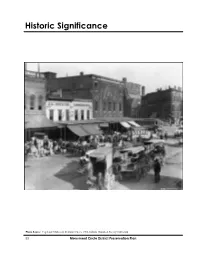
Historic Significance Photo Source: Vegetable Market on Delaware Street, 1905, Indiana Historical Society Collection 33 Monument Circle District Preservation Plan 34 Monument Circle District Preservation Plan HISTORIC SIGNIFICANCE City Planning and Development Carved out of the Northwest Territory, Indiana entered the Union as the nineteenth state in 1816. The city of Indianapolis was founded in 1821 as the state capital, when the Indiana State Legisla- ture sought a central location for the city and appointed a committee to choose the site. Once the site was chosen surveyors Alexander Ralston and Elias Fordham were hired to lay out the city, which was proposed as a grid of north-south and east-west streets in a mile square plat. This plat was influenced by the Pierre L’Enfant plan for Washington, D.C., which in turn was in- spired by the royal residence of Versailles. Since Indianapolis was planned as a state capital, the plat sited the State House Square and the Court House Square equidistant from Circle Street (now Monument Circle), located in the center of the Mile Square. The Governor’s house was to be situ- ated in the circular lot framed by Circle Street, and the four city blocks framing the Circle were known as the “Governor’s Square.” Four diagonal streets radiated out from the far corners of the four blocks framing the circle. All streets of the Mile Square were 90 feet wide with the exception of Washington Street, which was 120 feet wide to accommodate its intended use as the capital’s main street. The sale of lots in the new capital city on October 8, 1821 reveal the street’s importance, as lots fronting it com- manded the highest prices. -
National Register of Historic Places Inventory—Nomination Form 1
NPS Form 10-900 OMB No. 1024-OO18 Exp. 10-31-84 United States Department off the Interior National Park Service National Register of Historic Places Inventory—Nomination Form See instructions in How to Complete National Register Forms Type aM entries—complete applicable sections_______________ 1. Name historic n.a. and/or common Main Street Historic District 2. Location 5 street & number___please see map and inventory forms not for publication city, town Fort Atkinson vicinity of state WI code 55 county Jefferson code 055 3. Classification Category Ownership Status Present Use X district public X occupied agriculture museum building(s) private unoccupied _ X_ commercial _X_park structure X both work in progress _ y- educational X private residence __ site Public Acquisition Accessible entertainment religious object in process X yes: restricted X government scientific being considered yes: unrestricted _X_ industrial transportation X not applicable no military other: 4. Owner of Property name please see inventory forms street & number • n.a. city, town n.a. vicinity of state n.a, courthouse, registry of deeds, etc. Jefferson County Courthouse street & number 320 S. Main Street city, town Jefferson state WI 53540, 6. Representation in Existing Surveys Wisconsin Inventory of title Historic Places nas tnis property been determined eligible? __ yes x no date 1975 federal X state __ county __ local depository for survey records State Historical Society of Wisconsin city, town Madison state WI 53706 7. Description Condition Check one Check one excellent deteriorated unaltered X original site _X_good ruins _JL_ altered moved date fair unexposed Describe the present and original (if known) physical appearance Note: The current district has 60 buildings. -

Restaurant Trends App
RESTAURANT TRENDS APP For any restaurant, Understanding the competitive landscape of your trade are is key when making location-based real estate and marketing decision. eSite has partnered with Restaurant Trends to develop a quick and easy to use tool, that allows restaurants to analyze how other restaurants in a study trade area of performing. The tool provides users with sales data and other performance indicators. The tool uses Restaurant Trends data which is the only continuous store-level research effort, tracking all major QSR (Quick Service) and FSR (Full Service) restaurant chains. Restaurant Trends has intelligence on over 190,000 stores in over 500 brands in every market in the United States. APP SPECIFICS: • Input: Select a point on the map or input an address, define the trade area in minute or miles (cannot exceed 3 miles or 6 minutes), and the restaurant • Output: List of chains within that category and trade area. List includes chain name, address, annual sales, market index, and national index. Additionally, a map is provided which displays the trade area and location of the chains within the category and trade area PRICE: • Option 1 – Transaction: $300/Report • Option 2 – Subscription: $15,000/License per year with unlimited reporting SAMPLE OUTPUT: CATEGORIES & BRANDS AVAILABLE: Asian Flame Broiler Chicken Wing Zone Asian honeygrow Chicken Wings To Go Asian Pei Wei Chicken Wingstop Asian Teriyaki Madness Chicken Zaxby's Asian Waba Grill Donuts/Bakery Dunkin' Donuts Chicken Big Chic Donuts/Bakery Tim Horton's Chicken -

Assessment of the Impact of the Indianapolis Cultural Trail: a Legacy of Gene and Marilyn Glick
Assessment of the Impact of the Indianapolis Cultural Trail: A Legacy of Gene and Marilyn Glick 334 N. Senate Avenue, Suite 300 Indianapolis, IN 46204 Assessment of the Impact of the Indianapolis Cultural Trail: A Legacy of Gene and Marilyn Glick March 2015 15-C02 Authors List of Tables .......................................................................................................................... iii Jessica Majors List of Maps ............................................................................................................................ iii Graduate Assistant List of Figures ......................................................................................................................... iv IU Public Policy Institute Executive Summary ................................................................................................................ 1 Key findings ....................................................................................................................... 1 Sue Burow An eye on the future .......................................................................................................... 2 Senior Policy Analyst Introduction ............................................................................................................................. 3 IU Public Policy Institute Background ....................................................................................................................... 3 Measuring the Use of the Indianapolis Cultural Trail: A Legacy of Gene -

Clifton Chronicle
SUMMER 2012 Volume Twenty-Two Number One CA Publicationlifton of Clifton Town Meeting C You Dohronicle It You Write It We Print It Cincinnati, Ohio 45220 Box 20067 P.O. Clifton Chronicle Clifton Home Composite—You will not be touring this home any time soon, made up of the homes on Evanswood Place by Bruce Ryan, former resident and producer of yearly Evanswood block party invitation where this illustration first appeared. Clifton House Tour this Mother’s Day By Eric Clark Every third year on Mother’s are like stepping back in time to the sored them throughout the ‘70s and Day, a group of Clifton homeowners period in which they were built. ‘80s, taking a hiatus between 1988 open their doors to greater Cincinnati Although we do not disclose and 1997. Since the resumption and say, “Come on in and have a look pictures or the addresses of the of the tours, the event has drawn around!” So, mark your calendars for homes until the day of the tour. We people from all over Cincinnati and Mother’s Day, May 13, 2012. are confident that if you have an ap- has been a great way to spend part Clifton Town Meeting has lined preciation for architecture or interior of Mother’s Day. up some great houses for the 2012 design, or if you just enjoy touring Tickets are $17.50 in advance tour and it includes something for beautiful Clifton homes, you will and $22.50 the day of the tour. Tick- everyone with a wide and eclectic NOT be disappointed. -

540 Virginia Ave. Indianapolis, IN
Fletcher Place www.fletcherplace.org May / June 2009 Infrastructure work The dirt on the Garden Committee The Fletcher Place moves forward Garden Committee, led A stroll along by Rhonda Peffer, has East Street in planned two opportunities front of the Vil- for neighbors to become laggio won’t be involved, with other events perilous any- to be announced. more thanks to First up is Adopt-A- the improve- Block through Keep India- ments made by napolis Beautiful, KIB. A DPW. Fletcher volunteer block coordina- Place’s “worst tor is given tools and trash sidewalk” is bags that can be used to now its best. The keep his/her assigned Fletcher Place block free of trash and Neighborhood debris. KIB will monitor Association’s and score blocks monthly and offer advice and sug- and David Edy at 526 S. Infrastructure through October, and will gestions. If you have plants Pine St. C o m m i t t e e , award high-scoring blocks that need thinning or split- For information on the comprised of with plantings, trees, mini ting, bring them to share. Garden Committee, to Adopt- Robb Biddinger, grants, and other goodies No reservations needed, A-Block, or share your sug- Rick McQuery Attention everyone, it’s okay to walk on to help with neighbor- just join us! gestions for garden events, and Jeff Miller, the sidewalk at Villaggio now. hood beautification. Thank Our second visit will contact Rhonda Peffer at helped identify the areas you to FP neighbors who be June 7 at 4 p.m. at the rlpeffer@sbcglobal.net. -

A 13-Day Classic Wildlife Safari
58-25 Queens Blvd., Woodside, NY 11377 T: (718) 204-7077; (800) 627-1244 F: (718) 204-4726 E: info@classicescapes.com W: www.classicescapes.com Nature & Cultural Journeys for the Discerning Traveler THE INDIANAPOLIS ZOO CORDIALLY INVITES YOU ON AN EXCLUSIVE WILDLIFE SAFARI TO ZAMBIA AFRICA’S LESS DISCOVERED WILDERNESS NOVEMBER 2 TO 12, 2019 . Schedules, accommodations and prices are accurate at the time of writing. They are subject to change COUNTRY OVERVIEW ~ ZAMBIA Lions, leopards and hippos – oh my! On safari in Zambia, discover a wilderness of plains and rivers called home by some of the most impressive wildlife in the world. From zebra to warthog and the countless number of bird species in the sky and along the river banks, your daily wildlife-viewing by foot, 4x4 open land cruiser, boat and canoe gives you rare access to this untamed part of the world. Experience the unparalleled excitement of tracking leopard and lion on foot in South Luangwa National Park and discover the wealth of wildlife that inhabit the banks and islands of the Lower Zambezi National Park. At night, return to the safari chic comfort of your beautiful lodges where you can view elephant and antelope drinking from the river. YOUR SPECIALIST/GUIDE: GRAHAM JOHANSSON Graham Johansson is a Professional Guide and an accomplished wildlife photographer. He has been leading private and specialist photographic tours and safaris since 1994 in Botswana, his first love and an area he knows intimately–Namibia, South Africa, Zambia and Zimbabwe. Graham was born and raised on a farm in Zambia, educated in Zimbabwe, and moved to South Africa to further his studies, train and pursue a career in tourism. -

Population Analysis & Breeding and Transfer Plan Cheetah
Draft for Institutional Representative Review – Please Respond by 3 March 2017 Population Analysis & Breeding and Transfer Plan Cheetah (Acinonyx jubatus) AZA Species Survival Plan® Yellow Program AZA Species Survival Plan® Coordinator Adrienne Crosier, PhD, Smithsonian’s Conservation Biology Institute – Center for Species Survival, (CrosierA@si.edu) & AZA Studbook Keeper Erin Moloney, Busch Gardens, (Erin.Moloney@BuschGardens.com) AZA Population Advisor John Andrews, Population Management Center (jandrews@lpzoo.org) 1 February 2017 Draft for Institutional Representative Review – Please Respond by 3 March 2017 Executive Summary 2017 Species Survival Plan® for the Cheetah (Acinonyx jubatus) The Cheetah SSP population currently consists of 315 cats (151 males, 164 females) at 59 facilities (55 AZA, 4 non- AZA) as of 18 January 2017. Currently, there are thirteen cheetahs (9.4) held at non-AZA facilities. The target population size set by the Felid Taxon Advisory Group is 300 in the 2009 Regional Collection Plan. The population currently qualifies as a Yellow SSP Program. Current gene diversity for the managed population is 97.27% and is equivalent to the genetic diversity of a population descended from approximately 18 founders (FGE = 18.34). The standard genetic goal for AZA managed populations is to maintain 90% gene diversity for 100 years. When gene diversity falls below 90% (and average inbreeding increases), it is expected that reproduction will be increasingly compromised by, among other factors, lower birth weights, smaller litter sizes, and greater neonatal mortality. Under potential conditions, with a growth rate of 0% (lambda = 1.00), gene diversity can be maintained at or above 90% gene diversity for at least 50 years.