2012 Costa Rica Tour
Total Page:16
File Type:pdf, Size:1020Kb
Load more
Recommended publications
-
Costa Rica 2020
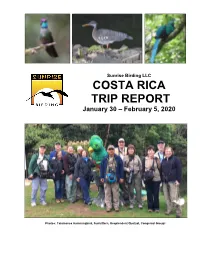
Sunrise Birding LLC COSTA RICA TRIP REPORT January 30 – February 5, 2020 Photos: Talamanca Hummingbird, Sunbittern, Resplendent Quetzal, Congenial Group! Sunrise Birding LLC COSTA RICA TRIP REPORT January 30 – February 5, 2020 Leaders: Frank Mantlik & Vernon Campos Report and photos by Frank Mantlik Highlights and top sightings of the trip as voted by participants Resplendent Quetzals, multi 20 species of hummingbirds Spectacled Owl 2 CR & 32 Regional Endemics Bare-shanked Screech Owl 4 species Owls seen in 70 Black-and-white Owl minutes Suzy the “owling” dog Russet-naped Wood-Rail Keel-billed Toucan Great Potoo Tayra!!! Long-tailed Silky-Flycatcher Black-faced Solitaire (& song) Rufous-browed Peppershrike Amazing flora, fauna, & trails American Pygmy Kingfisher Sunbittern Orange-billed Sparrow Wayne’s insect show-and-tell Volcano Hummingbird Spangle-cheeked Tanager Purple-crowned Fairy, bathing Rancho Naturalista Turquoise-browed Motmot Golden-hooded Tanager White-nosed Coati Vernon as guide and driver January 29 - Arrival San Jose All participants arrived a day early, staying at Hotel Bougainvillea. Those who arrived in daylight had time to explore the phenomenal gardens, despite a rain storm. Day 1 - January 30 Optional day-trip to Carara National Park Guides Vernon and Frank offered an optional day trip to Carara National Park before the tour officially began and all tour participants took advantage of this special opportunity. As such, we are including the sightings from this day trip in the overall tour report. We departed the Hotel at 05:40 for the drive to the National Park. En route we stopped along the road to view a beautiful Turquoise-browed Motmot. -

Anti-Predator Behavior in Birds: Reactions to Raptor Calls
Anti-predator behavior in Birds: Reactions to Raptor Calls Robin Elahi Department of Biology, Northeastern University _____________________________________________________________________________________ ABSTRACT Birds display a number of defense mechanisms against their predators, including camouflage, mobbing, fleeing, and aggregational behavior. I studied the responses of 32 bird species to songbird and raptor calls to see if birds displayed anti-predator behavior in response to raptor calls in comparison with songbird calls. One focus of my study was avian defensive strategies, namely flocking and concealment, so observations took into consideration different conditions: whether the bird was solitary or in a group, and whether it was exposed or hidden in vegetation. A previous study showed that crows could distinguish between raptor calls of their predators and non-predators, so I examined if birds specifically recognized resident raptors, or if they had a general response to resident and non-resident raptor calls. I also attempted to correlate bird size with reaction, specifically to see if smaller birds flew away more often than larger birds due to a greater perceived threat. For each bird or group of birds. I played a songbird call, followed by a raptor call, and timed the raptor call to see how long the bird stayed till it flew away. Birds flew away 27% of the time in response to raptor calls, and only 3% of the time to songbird calls (X² = 16.11, df = 1, n = 26). Birds did not distinguish among resident and non-resident raptor calls, and had nearly equal flight frequencies (X² = 0.48, df =3, n=40). Trends showed that solitary and exposed birds tended to fly more often than birds in groups and hidden birds. -
Checklistccamp2016.Pdf
2 3 Participant’s Name: Tour Company: Date#1: / / Tour locations Date #2: / / Tour locations Date #3: / / Tour locations Date #4: / / Tour locations Date #5: / / Tour locations Date #6: / / Tour locations Date #7: / / Tour locations Date #8: / / Tour locations Codes used in Column A Codes Sample Species a = Abundant Red-lored Parrot c = Common White-headed Wren u = Uncommon Gray-cheeked Nunlet r = Rare Sapayoa vr = Very rare Wing-banded Antbird m = Migrant Bay-breasted Warbler x = Accidental Dwarf Cuckoo (E) = Endemic Stripe-cheeked Woodpecker Species marked with an asterisk (*) can be found in the birding areas visited on the tour outside of the immediate Canopy Camp property such as Nusagandi, San Francisco Reserve, El Real and Darien National Park/Cerro Pirre. Of course, 4with incredible biodiversity and changing environments, there is always the possibility to see species not listed here. If you have a sighting not on this list, please let us know! No. Bird Species 1A 2 3 4 5 6 7 8 Tinamous Great Tinamou u 1 Tinamus major Little Tinamou c 2 Crypturellus soui Ducks Black-bellied Whistling-Duck 3 Dendrocygna autumnalis u Muscovy Duck 4 Cairina moschata r Blue-winged Teal 5 Anas discors m Curassows, Guans & Chachalacas Gray-headed Chachalaca 6 Ortalis cinereiceps c Crested Guan 7 Penelope purpurascens u Great Curassow 8 Crax rubra r New World Quails Tawny-faced Quail 9 Rhynchortyx cinctus r* Marbled Wood-Quail 10 Odontophorus gujanensis r* Black-eared Wood-Quail 11 Odontophorus melanotis u Grebes Least Grebe 12 Tachybaptus dominicus u www.canopytower.com 3 BirdChecklist No. -
Growing a Wild NYC: a K-5 Urban Pollinator Curriculum Was Made Possible Through the Generous Support of Our Funders
A K-5 URBAN POLLINATOR CURRICULUM Growing a Wild NYC LESSON 1: HABITAT HUNT The National Wildlife Federation Uniting all Americans to ensure wildlife thrive in a rapidly changing world Through educational programs focused on conservation and environmental knowledge, the National Wildlife Federation provides ways to create a lasting base of environmental literacy, stewardship, and problem-solving skills for today’s youth. Growing a Wild NYC: A K-5 Urban Pollinator Curriculum was made possible through the generous support of our funders: The Seth Sprague Educational and Charitable Foundation is a private foundation that supports the arts, housing, basic needs, the environment, and education including professional development and school-day enrichment programs operating in public schools. The Office of the New York State Attorney General and the New York State Department of Environmental Conservation through the Greenpoint Community Environmental Fund. Written by Nina Salzman. Edited by Sarah Ward and Emily Fano. Designed by Leslie Kameny, Kameny Design. © 2020 National Wildlife Federation. Permission granted for non-commercial educational uses only. All rights reserved. September - January Lesson 1: Habitat Hunt Page 8 Lesson 2: What is a Pollinator? Page 20 Lesson 3: What is Pollination? Page 30 Lesson 4: Why Pollinators? Page 39 Lesson 5: Bee Survey Page 45 Lesson 6: Monarch Life Cycle Page 55 Lesson 7: Plants for Pollinators Page 67 Lesson 8: Flower to Seed Page 76 Lesson 9: Winter Survival Page 85 Lesson 10: Bee Homes Page 97 February -

Estimations Relative to Birds of Prey in Captivity in the United States of America
ESTIMATIONS RELATIVE TO BIRDS OF PREY IN CAPTIVITY IN THE UNITED STATES OF AMERICA by Roger Thacker Department of Animal Laboratories The Ohio State University Columbus, Ohio 43210 Introduction. Counts relating to birds of prey in captivity have been accomplished in some European countries; how- ever, to the knowledge of this author no such information is available in the United States of America. The following paper consistsof data related to this subject collected during 1969-1970 from surveys carried out in many different direc- tions within this country. Methods. In an attempt to obtain as clear a picture as pos- sible, counts were divided into specific areas: Research, Zoo- logical, Falconry, and Pet Holders. It became obvious as the project advanced that in some casesthere was overlap from one area to another; an example of this being a falconer working with a bird both for falconry and research purposes. In some instances such as this, the author has used his own judgment in placing birds in specific categories; in other in- stances received information has been used for this purpose. It has also become clear during this project that a count of "pets" is very difficult to obtain. Lack of interest, non-coop- eration, or no available information from animal sales firms makes the task very difficult, as unfortunately, to obtain a clear dispersal picture it is from such sourcesthat informa- tion must be gleaned. However, data related to the importa- tion of birds' of prey as recorded by the Bureau of Sport Fisheries and Wildlife is included, and it is felt some observa- tions can be made from these figures. -

Butterflies and Pollination Welcome!
BUTTERFLIES AND POLLINATION Welcome! Welcome to Fairchild Tropical Botanic Garden! We ask that you please read the following rules to your group before you begin your visit. • Stay with your group during your entire visit. • Respect our wildlife; do not touch, chase, or feed the animals. • Walk only on designated paths or grass. • Do not climb trees or pick flowers or fruits from plants. • Keep your voices low to respect other guests. • Self-guided groups are not allowed at the Garden Cafe, in the Gift Shop or on the Tram. In your backpack, you will find the materials needed for this program. Before leaving the Garden, we ask you to please ensure that all the materials are back in this backpack. At the end of your visit, return this backpack to the Visitor Center. If any materials are lost or damaged, the cost will be deducted from your deposit. ACTIVITY SUPPLIES: • 3 Butterfly Program booklets Butterfly Background Information Activities • Comparing Butterflies and Moths pictures - 10 • Butterfly vs. Moth Venn Diagramworksheets - 10 • Butterfly Life Cycle worksheets - 10 • Butterfly Antomy worksheets - 10 Lisa D. Anness Butterfly Garden • Lepidopterist For A Day worksheets - 10 • South Florida Butterfly Guides - 10 Wings of the Tropics: Butterfly Conservatory • Wings of the Tropics Butterfly Guide - 6 • Exotic Butterflies in the Wings of the Tropics Conservatory - 6 • Butterfly Behavior Guide - 6 Whitman Tropical Fruit Pavilion • Pollination Match cards - 3 sets of 12 cards • Optional: clipboards - 10 Get Started 1. Review the Introduction, Vocabulary List, activity descriptions, and butterfly field guides included in the backpack. If you are going to the butterfly conservatory please review the Wings of the Tropics: Butterfly Conservatory Guidelines with your students before entering the butterfly conservatory. -

MS1001 Greeney
The nest of the Pearled Treerunner (Margarornis squamiger ) Artículo El nido del Subepalo Perlado (Margarornis squamiger) Harold F. Greeney1 & Rudy A. Gelis2 1Yanayacu Biological Station & Center for Creative Studies, Cosanga, Napo Province, Ecuador, c/o 721 Foch y Amazonas, Quito, Ecuador. revmmoss@yahoo.com 2Pluma Verde Tours, Pasaje Manuel Garcia y 18 de Septiembre N20-28 Quito, Ecuador. Abstract Ornitología Colombiana Ornitología The Pearled Treerunner (Margarornis squamiger) is a small ovenbird (Furnariidae) inhabiting the upper strata of Neotropical montane forests. Little is known of its breeding habits despite its wide distribution and abundance within appropriate habitat. The genus Margarornis is considered closely related to Premnoplex barbtails, but details of nest architecture supporting this relationship are unavailable. Here we provide the first detailed description of nest architecture for the Pearled Treerunner from a nest encountered in northwest Ecuador. The nest was a tightly woven ball of moss and rootlets, similar in shape to that of the Spotted Barbtail (Premnoplex brunnescens) and presumably built in a similar manner. Nest architecture and nes- tling behavior support a close relationship between Margarornis and Premnoplex. Key words: barbtail, Ecuador, Furnariidae, Margarornis squamiger, nest architecture. Resumen El Subepalo Perlado (Margarornis squamiger) es un furnárido pequeño que habita el dosel de los bosques de montaña neo- tropicales. La reproducción de esta especie es poco conocida, a pesar de su amplia distribución y de ser común en el hábi- tat adecuado. El género Margarornis se considera cercanamente emparentado con los subepalos del género Premnoplex, pero no se conocen detalles de la arquitectura del nido que sustenten esta relación. -

Butterfly Diversity at Lost Canyon Nature Reserve, Nicaragua, Including a New Country Record
ISSN 1021-0296 REVISTA NICARAGUENSE DE ENTOMOLOGIA N° 106. Abril 2016 Butterfly Diversity at Lost Canyon Nature Reserve, Nicaragua, including a new country record. Por Hilary E. Erenler, Richard K. Leonardi, Michael P. Gillman, Jean- Michel Maes & Erico Téllez. PUBLICACIÓN DEL MUSEO ENTOMOLÓGICO ASOCIACIÓN NICARAGÜENSE DE ENTOMOLOGÍA LEON - - - NICARAGUA Revista Nicaragüense de Entomología. Número 106. 2016. La Revista Nicaragüense de Entomología (ISSN 1021-0296) es una publicación reconocida en la Red de Revistas Científicas de América Latina y el Caribe, España y Portugal (Red ALyC) e indexada en los índices: Zoological Record, Entomological Abstracts, Life Sciences Collections, Review of Medical and Veterinary Entomology and Review of Agricultural Entomology. Los artículos de esta publicación están reportados en las Páginas de Contenido de CATIE, Costa Rica y en las Páginas de Contenido de CIAT, Colombia. Todos los artículos que en ella se publican son sometidos a un sistema de doble arbitraje por especialistas en el tema. The Revista Nicaragüense de Entomología (ISSN 1021-0296) is a journal listed in the Latin-American Index of Scientific Journals. It is indexed in: Zoological Records, Entomological, Life Sciences Collections, Review of Medical and Veterinary Entomology and Review of Agricultural Entomology; and reported in CATIE, Costa Rica and CIAT, Colombia. Two independent specialists referee all published papers. Consejo Editorial Jean Michel Maes Fernando Hernández-Baz Editor General Editor Asociado Museo Entomológico Universidad Veracruzana Nicaragua México José Clavijo Albertos Silvia A. Mazzucconi Universidad Central de Universidad de Buenos Aires Venezuela Argentina Weston Opitz Don Windsor Kansas Wesleyan University Smithsonian Tropical Research United States of America Institute, Panama Miguel Ángel Morón Ríos Jack Schuster Instituto de Ecología, A.C. -

FIELD GUIDES BIRDING TOURS: Colombia: Bogota, the Magdalena
Field Guides Tour Report Colombia: Bogota, the Magdalena Valley, and Santa Marta 2014 Jan 11, 2014 to Jan 27, 2014 Jesse Fagan & Trevor Ellery For our tour description, itinerary, past triplists, dates, fees, and more, please VISIT OUR TOUR PAGE. A fun group and the most productive tour we have had to date! We observed 582 bird taxa in 17 days of birding, which beat our record last year of 555 by a bunch. As we fine-tune our birding route and learn more about Colombian birds things just seem to get better and better. This year we saw 33 endemics and loads of interesting subspecies and near-endemics. Highlights included a female Blue- billed Curassow, Kelp Gull(s) at Los Camerones (only the second time it has been recorded in Colombia), Dwarf and Pavonine cuckoos (the latter a lifer for Trevor!), a splendid Crested Owl, Sapphire- bellied Hummingbird (nice comparisons with Sapphire-throated), Double-banded Graytail in the coffee finca below Reinita Cielo Azul lodge, the always elusive Santa Marta Bush-Tyrant and antpitta, Turquoise Dacnis, and singing Yellow-bellied Siskin. It is really hard to pick just one from so many! I want to thank all of you again for a really enjoyable trip. Thanks also to Trevor Ellery, our local guide, and Giovanni, our driver, for their hard work. I look forward to seeing you again in the field. Bird On. --Jesse a.k.a. Motmot (from Lima, Peru) KEYS FOR THIS LIST One of the following keys may be shown in brackets for individual species as appropriate: * = heard only, I = introduced, E = endemic, N = nesting, a = austral migrant, b = boreal migrant This dazzling Black-cheeked Mountain-Tanager is a Santa Marta endemic; it was one of 33 endemics we tallied on this species-rich tour. -

Un Modelo De Bioprospección En Educación Con La Mariposa Búho
LA MARIPOSA BÚHO, Caligo telamonius: CICLO DE VIDA, CRÍA EN CONDICIONES DE SABANA DE BOGOTÁ Y UN MODELO DE BIOPROSPECCIÓN EN EDUCACIÓN OSCAR REINEL ALFONSO CASTILLO DIANA CAROLINA PIRACÓN LOZANO UNIVERSIDAD DE BOGOTÁ JORGE TADEO LOZANO FACULTAD DE CIENCIAS NATURALES E INGENIERÍA MAESTRÍA EN CIENCIAS AMBIENTALES BOGOTÁ 2016 LA MARIPOSA BÚHO, Caligo telamonius: CICLO DE VIDA, CRÍA EN CONDICIONES DE SABANA DE BOGOTÁ Y UN MODELO DE BIOPROSPECCIÓN EN EDUCACIÓN Oscar Reinel Alfonso Castillo Licenciado en Biología Diana Carolina Piracón Lozano Licenciada en Biología Trabajo presentado como requisito para optar al título de Magister en Ciencias Ambientales Directora: Luz Stella Fuentes Quintero Ingeniera Agrónoma, MSc UNIVERSIDAD DE BOGOTÁ JORGE TADEO LOZANO FACULTAD DE CIENCIAS NATURALES E INGENIERÍA MAESTRÍA EN CIENCIAS AMBIENTALES BOGOTÁ 2016 NOTA DE ACEPTACIÓN ________________________________________________________________ ________________________________________________________________ ________________________________________________________________ ________________________________________________________________ ________________________________________________ M. Sc. Luz Stella Fuentes Quintero ________________________________________________ Jurado ________________________________________________ Jurado “Al final conservaremos sólo aquello que amemos, amaremos sólo aquello que comprendamos, y comprenderemos sólo aquello que se nos enseñe”. (Baba Dioum) Dedicamos este trabajo a nuestros padres y hermanos por ser el pilar fundamental en -

Costa Rica: the Introtour February 2020 (Group 2)
Tropical Birding Trip Report Costa Rica: The Introtour February 2020 (Group 2) A Tropical Birding set departure tour COSTA RICA: The Introtour 15th – 25th February 2020 This Sunbittern, in Carara National Park, narrowly beat Resplendent Quetzal to bird of the tour (Bill Compton) Tour Leader: Sam Woods All of the photographs in this report were taken by some of the participants on this tour. Thanks to Bill Compton, Peter Rigsbee, and John Wilkinson for making them available! Introduction: Costa Rica is consistently one of the most popular destinations for overseas birding, the country is small but packed with birds, with distinctive bioregions offering different suites of birds. We covered most of these, including the foothills and lowlands on the Caribbean slope, lower mountains and upper highlands too, plus some time in the lowlands on the Pacific side of the mountains that cut horizontally through the middle of the country. The tour started out with rain causing some problems as we visited several sites in the lower foothills of the Caribbean slope near La Union. However, by the day’s end we had seen three species of owl (including Crested and Spectacled), a roosting Great Potoo, and watched feeders packed with tanagers, toucans, hummingbirds and honeycreepers, and a Russet-naped Wood-Rail stomping around below them as more than ample compensation! 1 www.tropicalbirding.com +1-409-515-9110 info@tropicalbirding.com Tropical Birding Trip Report Costa Rica: The Introtour February 2020 (Group 2) A rainy morning was compensated by feeders -

The Earl Hoke Butterfly Collection
This spreadsheet is a part of The Earl Hoke Butterfly and Moth Exhibit Kamden Rudin's Eagle Scout FRAME COLOR Peach (1) Scientific name (Country) Scientific name (Country) Scientific name (Country) Scientific name (Country) Scientific name (Country) Row 1 Dynamine mylitta (Mexico) Nessalea anclaeus (Peru) Didoni's aganisa (Mexico) Callithea optima (Ecuador) Aasterope pechueli Row 2 Pareute charops (Mexico) Bolboneura sylphis (Mexico) Eunica monima (Mexico) "underside" Callithea optima (Ecuador) Row 3 Bolboneura syphis (Mexico) Eunica tatila (Mexico) Perisana vaninka (Columbia) Row 4 Lyropteryx apollonia (Peru) Peach (2) Scientific name (Country) Scientific name (Country) Scientific name (Country) Scientific name (Country) Scientific name (Country) Row 1 Thisbe (Irenea) Colobura dirce (2) Myselia cyamanthe Eumaeus Eunie tatila Row 2 Pereute charops ♀♂ Canteophele nystinas ♀♂ Row 3 "underside" Callicure anna ♂ Peach (3) Scientific name (Country) Scientific name (Country) Scientific name (Country) Scientific name (Country) Scientific name (Country) Row 1 Pareba issoria (2) Pardopsis punctatissima Napeogenes tolosa amara (2) Acraea encedon Row 2 Pardopsis punctatissma Actinote leucomelas (2)♂ Agraea encedon (Form Lycdides) Acraea Row 3 Agraea eponina Agraea encedon (Form Lycdides) Row 4 Acraea violarum Acraea machequena (Bottom) Acraea violarum Peach (4) Scientific name (Country) Scientific name (Country) Scientific name (Country) Scientific name (Country) Scientific name (Country) Row 1 Ixias pyreng (India) Eurehea (2 Underside) Eurema westwoodi