SHAKE up the SALT CONTENTS Politics: Reports
Total Page:16
File Type:pdf, Size:1020Kb
Load more
Recommended publications
-

Interview with Larry Pope by Andrea L’Hommedieu
Bowdoin College Bowdoin Digital Commons George J. Mitchell Oral History Project Special Collections and Archives 5-14-2008 Interview with Larry Pope by Andrea L’Hommedieu Laurence 'Larry' E. Pope Follow this and additional works at: https://digitalcommons.bowdoin.edu/mitchelloralhistory Part of the Law and Politics Commons, Oral History Commons, Political History Commons, and the United States History Commons Recommended Citation Pope, Laurence 'Larry' E., "Interview with Larry Pope by Andrea L’Hommedieu" (2008). George J. Mitchell Oral History Project. 46. https://digitalcommons.bowdoin.edu/mitchelloralhistory/46 This Interview is brought to you for free and open access by the Special Collections and Archives at Bowdoin Digital Commons. It has been accepted for inclusion in George J. Mitchell Oral History Project by an authorized administrator of Bowdoin Digital Commons. For more information, please contact mdoyle@bowdoin.edu. George J. Mitchell Oral History Project Special Collections & Archives, Bowdoin College Library, 3000 College Sta., Brunswick, Maine 04011 © Bowdoin College Laurence E. Pope GMOH# 013 (Interviewer: Andrea L’Hommedieu) May 15, 2008 Andrea L’Hommedieu: This is an interview for George J. Mitchell Oral History Project. The date is May 15, 2008. I’m here at the Hawthorne-Longfellow Library at Bowdoin College with Laurence “Larry” Pope. This is Andrea L’Hommedieu. Could you start, Mr. Pope, just by giving me your full name? Laurence Pope: Yes, my name is Laurence Pope, and Laurence Everett Pope is the middle initial. AL: And where and when were you born? LP: I was born in New Haven, Connecticut, on September 24, 1945. AL: Is that the area in which you grew up? LP: No, my father was studying Japanese at Yale University at the time, and so that’s why we were there. -
Appendix File Anes 1988‐1992 Merged Senate File
Version 03 Codebook ‐‐‐‐‐‐‐‐‐‐‐‐‐‐‐‐‐‐‐ CODEBOOK APPENDIX FILE ANES 1988‐1992 MERGED SENATE FILE USER NOTE: Much of his file has been converted to electronic format via OCR scanning. As a result, the user is advised that some errors in character recognition may have resulted within the text. MASTER CODES: The following master codes follow in this order: PARTY‐CANDIDATE MASTER CODE CAMPAIGN ISSUES MASTER CODES CONGRESSIONAL LEADERSHIP CODE ELECTIVE OFFICE CODE RELIGIOUS PREFERENCE MASTER CODE SENATOR NAMES CODES CAMPAIGN MANAGERS AND POLLSTERS CAMPAIGN CONTENT CODES HOUSE CANDIDATES CANDIDATE CODES >> VII. MASTER CODES ‐ Survey Variables >> VII.A. Party/Candidate ('Likes/Dislikes') ? PARTY‐CANDIDATE MASTER CODE PARTY ONLY ‐‐ PEOPLE WITHIN PARTY 0001 Johnson 0002 Kennedy, John; JFK 0003 Kennedy, Robert; RFK 0004 Kennedy, Edward; "Ted" 0005 Kennedy, NA which 0006 Truman 0007 Roosevelt; "FDR" 0008 McGovern 0009 Carter 0010 Mondale 0011 McCarthy, Eugene 0012 Humphrey 0013 Muskie 0014 Dukakis, Michael 0015 Wallace 0016 Jackson, Jesse 0017 Clinton, Bill 0031 Eisenhower; Ike 0032 Nixon 0034 Rockefeller 0035 Reagan 0036 Ford 0037 Bush 0038 Connally 0039 Kissinger 0040 McCarthy, Joseph 0041 Buchanan, Pat 0051 Other national party figures (Senators, Congressman, etc.) 0052 Local party figures (city, state, etc.) 0053 Good/Young/Experienced leaders; like whole ticket 0054 Bad/Old/Inexperienced leaders; dislike whole ticket 0055 Reference to vice‐presidential candidate ? Make 0097 Other people within party reasons Card PARTY ONLY ‐‐ PARTY CHARACTERISTICS 0101 Traditional Democratic voter: always been a Democrat; just a Democrat; never been a Republican; just couldn't vote Republican 0102 Traditional Republican voter: always been a Republican; just a Republican; never been a Democrat; just couldn't vote Democratic 0111 Positive, personal, affective terms applied to party‐‐good/nice people; patriotic; etc. -

"His Trick Knee Is Acting up Again!"
------------_.__ ._------- ..... Will Somebody Tell The PresideDt To Stop Bombing Tlte Parly? RIPON MARCH 1, 1974 Vol. X, No.5 ONE DOLLAR "HIS TRICK KNEE IS ACTING UP AGAIN!" , CONTENTS Commentary Features Weasel Words and Party Principle ............ 4 Politics: Reports .................................................. 8 In an age of political doublespeak, the ritqJallstic State Reports on Florida, New Mexico, Rhode Is compilation of party platforms seems ripe ~9r re land, New Jersey, and Ohio. form. Michigan State Rep. Michael DivelY (R) proposes that a "statement of the majority" be submitted for the quadrennial platforms. Dively served as the chairman of the Revision and Devel Politics: Profiles .................................................... 11 opment Committee of the Michigan GOP, which recommended a similar step for that state party. u.s. Rep. Albert Quie of Minnesota, ranking Re publican member of the House Education and Labor Committee: the profile was prepared by Paul Anderson of the Minnesota Chapter. Constitutional Imbalance ................................ 5 Sen. Charles McC. Mathias (R-Md.) has been c0- chairman, along with Sen. Frank Church (D Politics: People .................................................... 12 Idaho), of the Special Committee on the Termina tion of the National Emergency. According to Mathias, the laxity of controls over emergency presidential powers applies equally to other legis Letters ...................................................................... 14 lation, and he urges that -

Justices' Profiles Institute of Bill of Rights Law at the William & Mary Law School
College of William & Mary Law School William & Mary Law School Scholarship Repository Supreme Court Preview Conferences, Events, and Lectures 1995 Section 1: Justices' Profiles Institute of Bill of Rights Law at the William & Mary Law School Repository Citation Institute of Bill of Rights Law at the William & Mary Law School, "Section 1: Justices' Profiles" (1995). Supreme Court Preview. 35. https://scholarship.law.wm.edu/preview/35 Copyright c 1995 by the authors. This article is brought to you by the William & Mary Law School Scholarship Repository. https://scholarship.law.wm.edu/preview WARREN E. BURGER IS DEAD AT 87 Was Chief Justice for 17 Years Copyright 1995 The New York Times Company The New York Times June 26, 1995, Monday Linda Greenhouse Washington, June 25 - Warren E. Burger, who retired to apply like an epithet -- overruled no major in 1986 after 17 years as the 15th Chief Justice of the decisions from the Warren era. United States, died here today at age 87. The cause It was a further incongruity that despite Chief was congestive heart failure, a spokeswoman for the Justice Burger's high visibility and the evident relish Supreme Court said. with which he used his office to expound his views on An energetic court administrator, Chief Justice everything from legal education to prison Burger was in some respects a transitional figure management, scholars and Supreme Court despite his tenure, the longest for a Chief Justice in commentators continued to question the degree to this century. He presided over a Court that, while it which he actually led the institution over which he so grew steadily more conservative with subsequent energetically presided. -

The Long Red Thread How Democratic Dominance Gave Way to Republican Advantage in Us House of Representatives Elections, 1964
THE LONG RED THREAD HOW DEMOCRATIC DOMINANCE GAVE WAY TO REPUBLICAN ADVANTAGE IN U.S. HOUSE OF REPRESENTATIVES ELECTIONS, 1964-2018 by Kyle Kondik A thesis submitted to Johns Hopkins University in conformity with the requirements for the degree of Master of Arts Baltimore, Maryland September 2019 © 2019 Kyle Kondik All Rights Reserved Abstract This history of U.S. House elections from 1964-2018 examines how Democratic dominance in the House prior to 1994 gave way to a Republican advantage in the years following the GOP takeover. Nationalization, partisan realignment, and the reapportionment and redistricting of House seats all contributed to a House where Republicans do not necessarily always dominate, but in which they have had an edge more often than not. This work explores each House election cycle in the time period covered and also surveys academic and journalistic literature to identify key trends and takeaways from more than a half-century of U.S. House election results in the one person, one vote era. Advisor: Dorothea Wolfson Readers: Douglas Harris, Matt Laslo ii Table of Contents Abstract…………………………………………………………………………………....ii List of Tables……………………………………………………………………………..iv List of Figures……………………………………………………………………………..v Introduction: From Dark Blue to Light Red………………………………………………1 Data, Definitions, and Methodology………………………………………………………9 Chapter One: The Partisan Consequences of the Reapportionment Revolution in the United States House of Representatives, 1964-1974…………………………...…12 Chapter 2: The Roots of the Republican Revolution: -
Republicans on the Run Editor's Column
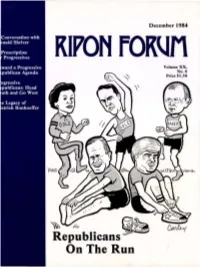
December 1984 Volume XX, No.6 Price $ 1.50 ~\- Republicans On The Run Editor's Column One of the first orders of business for RepUblicans on Capitol Hillfollowing the 1984 election was the selection of new Senate leaders. For moderates and progressives, the news was encouraging. Bob D ole was elected majon'ty leader. RIPON fORtJM John Heinz again heads the National Republican Senaton'al Commillee; John Chcifee is in charge ofth e Senate Republi can Conference; B ob Packwood is chairman of the Senate Editor's Column 2 Finance Commillee; a nd John Danforth is in charge of the Pronlu and Perspectivu: 3 Senate Commerce Commillee, They join other moderates A Conversation with andprogressives, such as Pete Domenici and M ark Haifield, Donald Shriver in key leadership positions. Our cover design points out that some moderates might, in A P~serlptlon (or Pro&resslves: 7 Dale Curt!, fact, seek the presidency in 1988. Ofcourse, it is too early, if not plain wrong, to start sen'ously hypothesizing about 1988. Editorial: LooklnaBeyond 1984 Yet it isn't too earlyfor GOP moderates and progressives to • begin organizing andfocusing on specific goals. This is the Toward A PrOltenive 12 Repubtlean Alenda: theme of several articles in this edilion oflhe Forum. Dale David L. S.lI acb CUrlis outlines several obstacles thaI must be overcome, but he also claims thatfivefavorable trends existfor moderates Proafuslve Republicans: IS and progressives, David Sallachpresenls theftrst in a sen'es Head Soutb and Go Wu t: William P. McKenzie ofprogressive R epublican "agendas, "focusing pn'man'ly on U. -

News from the Ripon Society May 19, 2010
News from The Ripon Society May 19, 2010 Ripon Society Hosts Roundtable Discussion with Senior Senate Staff Members The Ripon Society hosted its third roundtable discussion of the year on May 18, an event that focused on the Unit- ed States Senate and featured 11 key aides and senior staff members from that chamber. The event kicked off with remarks from Matt Zabel, the Chief of Staff for South Dakota Senator John Thune. Among other things, Zabel discussed the agenda in the Senate and the legislative items that could be considered as Congress approaches the Memorial Day recess. He also spoke of the work Thune is doing as Chairman of the Senate Republican Policy Committee, and the effort the South Dakota Senator is spearheading to develop new policy ideas and push new policy proposals into the market- Matt Zabel, Chief of Staff to South Dakota Senator John Thune, delivers place. These ideas and proposals, he noted, are available at opening remarks at The Ripon Society’s May 18th Roundtable. the Policy Committee’s website -- www.rpc.senate.gov. In addition to Zabel, the Roundtable also included: Bret Conzelman also noted that this was the third roundtable Bernhardt, Chief of Staff to Senator Jim DeMint (SC); Mary discussion The Ripon Society has hosted in 2010. In April, Beth Carozza, Deputy Staff Director of the Senate Home- the Society hosted Chiefs of Staff and Staff Directors from land Security Committee; Rob Epplin, Legislative Direc- the House of Representatives for a similar event, while in tor for Senator Susan Collins (ME); March the group played host to the Paul Fassbender, General Counsel, for Ranking Member and Republican Senator Bob Corker (TN); Nicole Foltz, Among other things, leadership of the Ways and Means Counsel for the Senate Budget Commit- Zabel discussed the Committee. -
Annual Report
COUNCIL ON FOREIGN RELATIONS ANNUAL REPORT July 1,1996-June 30,1997 Main Office Washington Office The Harold Pratt House 1779 Massachusetts Avenue, N.W. 58 East 68th Street, New York, NY 10021 Washington, DC 20036 Tel. (212) 434-9400; Fax (212) 861-1789 Tel. (202) 518-3400; Fax (202) 986-2984 Website www. foreignrela tions. org e-mail publicaffairs@email. cfr. org OFFICERS AND DIRECTORS, 1997-98 Officers Directors Charlayne Hunter-Gault Peter G. Peterson Term Expiring 1998 Frank Savage* Chairman of the Board Peggy Dulany Laura D'Andrea Tyson Maurice R. Greenberg Robert F Erburu Leslie H. Gelb Vice Chairman Karen Elliott House ex officio Leslie H. Gelb Joshua Lederberg President Vincent A. Mai Honorary Officers Michael P Peters Garrick Utley and Directors Emeriti Senior Vice President Term Expiring 1999 Douglas Dillon and Chief Operating Officer Carla A. Hills Caryl R Haskins Alton Frye Robert D. Hormats Grayson Kirk Senior Vice President William J. McDonough Charles McC. Mathias, Jr. Paula J. Dobriansky Theodore C. Sorensen James A. Perkins Vice President, Washington Program George Soros David Rockefeller Gary C. Hufbauer Paul A. Volcker Honorary Chairman Vice President, Director of Studies Robert A. Scalapino Term Expiring 2000 David Kellogg Cyrus R. Vance Jessica R Einhorn Vice President, Communications Glenn E. Watts and Corporate Affairs Louis V Gerstner, Jr. Abraham F. Lowenthal Hanna Holborn Gray Vice President and Maurice R. Greenberg Deputy National Director George J. Mitchell Janice L. Murray Warren B. Rudman Vice President and Treasurer Term Expiring 2001 Karen M. Sughrue Lee Cullum Vice President, Programs Mario L. Baeza and Media Projects Thomas R. -
Interview with Paul Findley # IS-A-L-2013-002 Interview # 1: January 15, 2013 Interviewer: Mark Depue
Interview with Paul Findley # IS-A-L-2013-002 Interview # 1: January 15, 2013 Interviewer: Mark DePue The following material can be used for educational and other non-commercial purposes without the written permission of the Abraham Lincoln Presidential Library. “Fair use” criteria of Section 107 of the Copyright Act of 1976 must be followed. These materials are not to be deposited in other repositories, nor used for resale or commercial purposes without the authorization from the Audio-Visual Curator at the Abraham Lincoln Presidential Library, 112 N. 6th Street, Springfield, Illinois 62701. Telephone (217) 785-7955 Note to the Reader: Readers of the oral history memoir should bear in mind that this is a transcript of the spoken word, and that the interviewer, interviewee and editor sought to preserve the informal, conversational style that is inherent in such historical sources. The Abraham Lincoln Presidential Library is not responsible for the factual accuracy of the memoir, nor for the views expressed therein. We leave these for the reader to judge. DePue: Today is Tuesday, January 15, 2013. My name is Mark DePue. I’m the Director of Oral History with the Abraham Lincoln Presidential Library. Today I’m in Jacksonville, Illinois, specifically, at Illinois College, Whipple Hall. I’m with Congressman Paul Findley. Good morning, sir. Findley: Good morning. DePue: I’ve been looking forward to this interview. I’ve started to read your autobiography. You’ve lived a fascinating life. Today I want to ask you quite a bit to get your story about growing up here in Jacksonville and your military experiences during World War II, and maybe a little bit beyond that, as well. -

CONGRESSIONAL RECORD—SENATE, Vol. 152, Pt. 7 May 25, 2006 EXECUTIVE SESSION NAYS—30 Mr
9602 CONGRESSIONAL RECORD—SENATE, Vol. 152, Pt. 7 May 25, 2006 EXECUTIVE SESSION NAYS—30 Mr. Kavanaugh was a deputy, with as Akaka Durbin Levin many as nine other such deputies on Baucus Feingold Menendez his level. Bayh Harkin Mikulski He was candid in some criticism of NOMINATION OF BRETT M. Bingaman Inouye Murray Boxer Jeffords Reed the handling of the matter; the public KAVANAUGH TO BE UNITED Cantwell Johnson Reid release of the report was not the choos- STATES CIRCUIT JUDGE FOR Clinton Kennedy Sarbanes ing of Independent Counsel. He testi- THE DISTRICT OF COLUMBIA Dayton Kerry Schumer Dodd Lautenberg Stabenow fied that he believed that the Inde- CIRCUIT—Resumed Dorgan Leahy Wyden pendent Counsel statute ought to be The PRESIDING OFFICER. Under NOT VOTING—3 changed materially if it was to be re- the previous order, the Chair lays be- vised and that having Mr. Starr both Conrad Rockefeller Salazar fore the Senate the pending cloture on Whitewater and the impeachment of motion, which the clerk will state. The PRESIDING OFFICER. On this the President was too much. The legislative clerk read as follows: vote, the ayes are 67, the nays are 30. He wrote a law review article on the Three-fifths of the Senators duly cho- CLOTURE MOTION issue of peremptory challenges for sen and sworn having voted in the af- Black jurors and took the position that We the undersigned Senators, in accord- firmative, the motion is agreed to. ance with the provisions of rule XXII of the it was inappropriate, should not be Standing Rules of the Senate, do hereby The PRESIDING OFFICER. -

The Trump-Russia Collusion Case
The Trump-Russia Collusion Case Updated to August 2020 Source: http://www.scaruffi.com/politics/trumptraitor.html For those who have been following this page for a while: my main target is not Trump, my target is Putin. Putin, not Trump, is the most dangerous person in the world. Trump is just a lackey, a small-time crook and bit-time liar whom Putin is using to attack the USA. The problem is not that there is no evidence of Trump-Putin collusion, the problem is that there is too much of it. I have added some background about the motive of Russia's interference in US politics. In my opinion, it was not only a general attempt at undermining US institutions (that came later) but originally it was a determined effort to make sure that Hillary Clinton did not become president. Putin feared her more than anyone else. For those who have NOT followed this page from the beginning: this website was one of the first to talk about the Trump-Russia collusion at a time when few dared mention the Steele dossier. Just to be very clear: this is not about whether Russia's interference changed the results of the election (i personally think that the FBI investigation into Clinton's email server had a much bigger impact). It is about Putin's strategy to attack the USA, and, secondly, it is about the extent of Trump's collaboration with Putin. And, just to be fair, Putin's Russia is not the only country that ever interfered in US politics. -

Wayne Hays Charles Carney James Stant
_ SWING CONGRESSMEN ON S. 1868 AND R.R. 8005 ON SANCTIO..NS AGAINST RHODESIA June 20, 1973 Member District Area _OiH-I-e------ - ------- Wayne Hays 18th Ru.ral and small town industrial area, including Steubenville Charles Carney 19th Steel towns of Youngstown and Warren James Stanton 20th Part of Cleveland and west ILLINOIS Frank Annunzio 11th Part of Chicago Morgan Murphy 2nd Far south side of Chicago Samuel Young 10th North shore suburbs of Chicago Ed Derwinski 4th Part of Chicago John Kluczynski 5th Chicago area Robert McClory 13th Chicago area Kenneth Gray 24th Chicago area George Shipley 22nd Chicago area Tom Railsback 19th Between Chicago and Omaha, including Democratic Rock Island and Republi can rural area MICHIGAN Guy Vander Jagt 9th Industrial Democratic Muskegon in Republican western. Michigan Martha Griffiths 17th Northwest white collar, Protestant Detroit William Broomfield 19th Northwest white-collar suburbs of Detroit Philip Ruppe llyh Upper Peninsula plus resort area of Lower Peninsula Gary Brown 3rd Outstate Michigan, including Kala mazoo and Battle Creek INDIANA Ray Madden 1st Northwestern Ind., inclr.~ing indust rial Gary and suburb J. Edward Roush 4th Fort Wayne, industrial town MISSOURI Bill Burlison 10th Southeast corner of state William Randall 4th Kansas City and Suburbs plus Demo cratic rural counties WISCONSIJ.II William Steiger 6th Small industrial cities north of Milwaukee MINNESOTA Joseph Karth 4th St. Paul and Northern Suburbs KANSAS William Roy 2nd Northeast corner of state, dominated by Topeka PENNSYLVANIA