Into Integrating Genetic Concepts Planning Rangeland Seedings
Total Page:16
File Type:pdf, Size:1020Kb
Load more
Recommended publications
-
Improved Conservation Plant Materials Released by NRCS and Cooperators Through December 2014
Natural Resources Conservation Service Improved Conservation Plant Materials Released by Plant Materials Program NRCS and Cooperators through December 2014 Page intentionally left blank. Natural Resources Conservation Service Plant Materials Program Improved Conservation Plant Materials Released by NRCS and Cooperators Through December 2014 Norman A. Berg Plant Materials Center 8791 Beaver Dam Road Building 509, BARC-East Beltsville, Maryland 20705 U.S.A. Phone: (301) 504-8175 prepared by: Julie A. DePue Data Manager/Secretary Julie.DePue@md.usda.gov John M. Englert Plant Materials Program Leader John.Englert@wdc.usda.gov January 2015 Visit our Website: http://Plant-Materials.nrcs.usda.gov TABLE OF CONTENTS Topics Page Introduction ...........................................................................................................................................................1 Types of Plant Materials Releases ........................................................................................................................2 Sources of Plant Materials ....................................................................................................................................3 NRCS Conservation Plants Released in 2013 and 2014 .......................................................................................4 Complete Listing of Conservation Plants Released through December 2014 ......................................................6 Grasses ......................................................................................................................................................8 -
Genetic Diversity and Phylogeny in Hystrix (Poaceae, Triticeae) and Related Genera Inferred from Giemsa C-Banded Karyotypes
Genetics and Molecular Biology, 32, 3, 521-527 (2009) Copyright © 2009, Sociedade Brasileira de Genética. Printed in Brazil www.sbg.org.br Research Article Genetic diversity and phylogeny in Hystrix (Poaceae, Triticeae) and related genera inferred from Giemsa C-banded karyotypes Hai-Qin Zhang1,2, Rui-Wu Yang3, Li Zhang3, Chun-Bang Ding3, Jian Zeng1 and Yong-Hong Zhou1,2 1Triticeae Research Institute, Sichuan Agricultural University, Sichuan, China. 2Key Laboratory of Crop Genetic Resources and Improvement, Ministry of Education, Sichuan Agricultural University, Sichuan, China. 3College of Biology and Science, Sichuan Agricultural University, Sichuan, China. Abstract The phylogenetic relationships of 15 taxa from Hystrix and the related genera Leymus (NsXm), Elymus (StH), Pseudoroegneria (St), Hordeum (H), Psathyrostachys (Ns), and Thinopyrum (E) were examined by using the Giemsa C-banded karyotype. The Hy. patula C-banding pattern was similar to those of Elymus species, whereas C-banding patterns of the other Hystrix species were similar to those of Leymus species. The results suggest high genetic diversity within Hystrix, and support treating Hy. patula as E. hystrix L., and transferring Hy. coreana, Hy. duthiei ssp. duthiei and Hy. duthiei ssp. longearistata to the genus Leymus. On comparing C-banding patterns of Elymus species with their diploid ancestors (Pseudoroegneria and Hordeum), there are indications that certain chro- mosomal re-arrangements had previously occurred in the St and H genomes. Furthermore, a comparison of the C-banding patterns of the Hystrix and Leymus species with the potential diploid progenitors (Psathyrostachys and Thinopyrum) suggests that Hy. coreana and some Leymus species are closely related to the Ns genome of Psathyrostachys, whereas Hy. -
Gene Flow in the Environment – Genetic Pollution? G.R
Gene flow in the environment Gene flow in the environment – genetic pollution? G.R. Squire, N. Augustin, J. Bown1, J.W. Crawford, G. Dunlop, J. Graham, J.R. Hillman, B. Marshall, D. Marshall, G. Ramsay, D.J. Robinson, J. Russell, C. Thompson & G. Wright iological invasions have had profound effects on affect plants and animals, injure us? Will crops in gen- Bhuman society from the earliest times. The spread eral, and GM ones in particular, reduce even more the of the black death in the Middle Ages, the devasta- biological diversity of arable farmland? Will they con- tions of potato blight, the effects on indigenous taminate other crops, cause more pesticide to be used, species by grey squirrels, dutch elm disease and flat- rather than less as some companies claim? worms have all been seen as detrimental to man or the environment. Others are seen as bringing benefits: An increasing number of people have a stake in the most of our crops evolved elsewhere in the world and debate - pressure groups, farmers, farm advisers, con- many culinary and medicinal herbs were brought to sumers, agrochemical companies and government. Britain by the Romans. Perhaps the greatest invasion Opinions are too often polarised. In this confronta- is the import of vast numbers of exotic plants to gar- tional atmosphere, the need is for clear, independent dens and greenhouses. Ecological invasions are an fact, answers and comment. A part of the debate is intrinsic part of ecology and evolution and we only ethical, but independent research is essential on ques- consider them bad if they impoverish our health, tions that science can legitimately address. -

The Role of Genetic Resources for Food and Agriculture in Climate Change Adaptation and Mitigation
March 2021 CGRFA/WG-AqGR-3/21/Inf.15 E COMMISSION ON GENETIC RESOURCES FOR FOOD AND AGRICULTURE Item 8 of the Provisional Agenda INTERGOVERNMENTAL TECHNICAL WORKING GROUP ON AQUATIC GENETIC RESOURCES FOR FOOD AND AGRICULTURE Third Session 1 - 3 June 2021 THE ROLE OF GENETIC RESOURCES FOR FOOD AND AGRICULTURE IN CLIMATE CHANGE ADAPTATION AND MITIGATION TABLE OF CONTENTS Paragraphs I. INTRODUCTION ................................................................................................... 1 – 2 II. SCOPING STUDY ON THE ROLE OF GENETIC RESOURCES FOR FOOD AND AGRICULTURE IN ADAPTATION TO AND MITIGATION OF CLIMATE CHANGE ....................................................................................................................... 3 Appendix: Scoping study on the role of genetic resources for food and agriculture in adaptation to and mitigation of climate change NF847 2 CGRFA/WG-AqGR-3/21/Inf.15 I. INTRODUCTION 1. The Commission on Genetic Resources for Food and Agriculture (Commission), at its last session, requested FAO to prepare a scoping study on the role of genetic resources for food and agriculture (GRFA) in adaptation to and mitigation of climate change, including knowledge gaps, taking into account the forthcoming special reports on terrestrial and marine systems by the Intergovernmental Panel on Climate Change (IPCC) and other available relevant sources, including examples from different regions and subsectors.1 2. The Commission further requested its Intergovernmental Technical Working Groups to review the study. II. SCOPING STUDY ON THE ROLE OF GENETIC RESOURCES FOR FOOD AND AGRICULTURE IN ADAPTATION TO AND MITIGATION OF CLIMATE CHANGE 3. The draft text of the scoping study on the role of genetic resources for food and agriculture in adaptation to and mitigation of climate change is presented in Appendix to this document. -

Bees, Beekeepers, and Bureaucrats: Parasitism and the Politics of Transgenic Life
EnvironmentandPlanningD:SocietyandSpaceadvance online publication doi:10.1068/d0510 Bees, beekeepers, and bureaucrats: parasitism and the politics of transgenic life Javier Lezaun Institute for Science, Innovation and Society, University of Oxford, Park End Street, Oxford OX1 1HP, England; e-mail: javier.lezaun@sbs.ox.ac.uk Received 5 January 2010; in revised form 26 September 2010; published online 3 June 2011 Abstract. Over the last decade the flying patterns and foraging behavior of bees have become a matter of public policy in the European Union. Determined to establish a system where transgenic crops can `coexist' with conventional and organic farming, the EU has begun to erect a system of demarcations and separations designed to minimize the extent of `gene flow' from genetically modified plants. As the European landscape is regimented through the introduction of isolation distances and buffer zones, bees and other pollinating insects have become vectors of `genetic pollution', disrupting the project of cohabitation and purification devised by European authorities. Drawing on the work of Michel Serres on parasitism, this paper traces the emergence of bees as an object of regulatory scrutiny and as an interruptor of the `coexistence' project. Along with bees, however, another uninvited guest arrived unexpectedly on the scene: the beekeeper, who came to see his traditional relationship to bees, crops, and consumers at risk. The figure of the parasite connects the two essential dynamics described in this paper: an escalation of research and the intensification of political attributes. ``The founding of the naked, empty field, virgin once more, is the oldest work of the human world.'' Michel Serres (2007 The Parasite) At the turn of this century bees became a preoccupation of European bureaucrats. -

The Cartagena Protocol and Biological Diversity; Biosafe Or Bio- Sorry
Case Western Reserve University School of Law Scholarly Commons Faculty Publications 2000 The Cartagena Protocol and Biological Diversity; Biosafe or Bio- sorry Jonathan H. Adler Case Western University School of Law, jonathan.adler@case.edu Follow this and additional works at: https://scholarlycommons.law.case.edu/faculty_publications Part of the Natural Resources Law Commons Repository Citation Adler, Jonathan H., "The Cartagena Protocol and Biological Diversity; Biosafe or Bio-sorry" (2000). Faculty Publications. 190. https://scholarlycommons.law.case.edu/faculty_publications/190 This Article is brought to you for free and open access by Case Western Reserve University School of Law Scholarly Commons. It has been accepted for inclusion in Faculty Publications by an authorized administrator of Case Western Reserve University School of Law Scholarly Commons. The Cartagena Protocol and Biological Diversity: Biosafe or Bio�Sorry? . JONATHAN H. ADLER* CONTENTS I. Introduction . 761 IT. TheThreat to Biodiversity. 764 ill. TheCartagena Protocol on Biosafety. 768 IV. Biosafety Versus Biodiversity. 772 V. Conclusion . 777 I. INTRODUCTION In February 1999, delegates from some 170 nations were summoned to Cartagena, Columbia to finalize an international protocol on the regulation of biotechnology. Under the auspices of the United Nations Convention on Biologi cal Diversity (CBD),1 national representatives and members of non-governmen tal organizations met to hammer out the details of a new regulatory regime for genetically modified organisms. "We need a widely accepted protocol that protects the environment, strengthens the capacity of developing countries to ensure biosafety, complements existing national regulations, and promotes public confidence in biotechnology and the benefits it can offer," proclaimed Klaus 2 Toepfer, executive director of the United Nations Environment Programme. -

A Call to Protect Food Systems from Genetic Extinction Technology: the Global Food and Agriculture Movement Says NO to Release of Gene Drives
A Call to Protect Food Systems from Genetic Extinction Technology: The Global Food and Agriculture Movement Says NO to Release of Gene Drives Gene drives are new tools that force genetically engineered traits through entire populations of insects, plants, animals and other organisms. This invasive technology represents a deliberate attempt to create a new form of genetic pollution. Gene Drives may drive species to extinction and undermine sustainable and equitable food and agriculture. Gene drives threaten natural systems. If released experimentally into the environment they may spread engineered genes uncontrollably through wild and domesticated species. This could alter ecological systems and food webs, harm biodiversity and eradicate beneficial organisms such as pollinators. Gene drives could disrupt lands, waters, food and fiber economies and harm Indigenous and peasant agroecological practices and cultures. Gene drives are being developed for use in agriculture. If applied, they may make farms even more genetically uniform and foreclose farmers’ rights, as enshrined, among others, in the International Treaty on Plant Genetic Resources for Food and Agriculture and in the UN Declaration on the Rights of Peasants and other People Working in Rural Areas. Use of gene drives may further entrench a system of genetically-engineered industrial agriculture, extend agro-toxin use and concentrate corporate control over global food systems, undermining the food sovereignty of farmers, food workers and consumers. Gene drives hinder the realization of human rights including rights to healthy, ecologically-produced and culturally appropriate food and nutrition. We, the undersigned, call for a global moratorium on any release of engineered gene drives. This moratorium is necessary to affirm the precautionary principle, which is enshrined in international law, and to protect life on Earth as well as our food supply. -
Genome Analysis of South American Elymus (Triticeae) and Leymus (Triticeae) Species Based on Variation in Repeated Nucleotide Sequences
UC Davis UC Davis Previously Published Works Title Genome analysis of South American Elymus (Triticeae) and Leymus (Triticeae) species based on variation in repeated nucleotide sequences. Permalink https://escholarship.org/uc/item/54w48156 Journal Genome, 40(4) ISSN 0831-2796 Authors Dubcovsky, J Schlatter, AR Echaide, M Publication Date 1997-08-01 DOI 10.1139/g97-067 Peer reviewed eScholarship.org Powered by the California Digital Library University of California Genome analysis of South American Elymus (Triticeae) and Leymus (Triticeae) species based on variation in repeated nucleotide sequences Jorge DU~COVS~~,A.R. Schlatter, and M. Echaide Abstract: Variation in repeated nucleotide sequences (RNSs) at the level of entire families assayed by Southern blot hybridization is remarkably low within species and is a powerful tool for scrutinizing the origin of allopolyploid taxa. Thirty-one clones from RNSs isolated from different Triticeae genera were used to investigate the genome constitution of South American Elymus. One of these clones, pHch2, preferentially hybridized with the diploid H genome Hordeum species. Hybridization of this clone with a worldwide collection of Elymus species with known genome formulas showed that pHch2 clearly discriminates Elymus species with the H genome (StH, StHH, StStH, and StHY) from those with other genome combinations (Sty, StStY, StPY, and StP). Hybridization with pHch2 indicates the presence of the H genome in all South American Elymus species except Elymus erianthus and Elymus mendocinus. Hybridization with additional clones that revealed differential restriction fragments (marker bands) for the H genome confirmed the absence of the H genome in these species. Differential restriction fragments for the NS genome of Psathyrostachys were detected in E. -
Ecology: Biodiversity and Natural Resources Part 1
CK-12 FOUNDATION Ecology: Biodiversity and Natural Resources Part 1 Akre CK-12 Foundation is a non-profit organization with a mission to reduce the cost of textbook materials for the K-12 market both in the U.S. and worldwide. Using an open-content, web-based collaborative model termed the “FlexBook,” CK-12 intends to pioneer the generation and distribution of high-quality educational content that will serve both as core text as well as provide an adaptive environment for learning. Copyright © 2010 CK-12 Foundation, www.ck12.org Except as otherwise noted, all CK-12 Content (including CK-12 Curriculum Material) is made available to Users in accordance with the Creative Commons Attribution/Non-Commercial/Share Alike 3.0 Un- ported (CC-by-NC-SA) License (http://creativecommons.org/licenses/by-nc-sa/3.0/), as amended and updated by Creative Commons from time to time (the “CC License”), which is incorporated herein by this reference. Specific details can be found at http://about.ck12.org/terms. Printed: October 11, 2010 Author Barbara Akre Contributor Jean Battinieri i www.ck12.org Contents 1 Ecology: Biodiversity and Natural Resources Part 1 1 1.1 Lesson 18.1: The Biodiversity Crisis ............................... 1 1.2 Lesson 18.2: Natural Resources .................................. 32 2 Ecology: Biodiversity and Natural Resources Part I 49 2.1 Chapter 18: Ecology and Human Actions ............................ 49 2.2 Lesson 18.1: The Biodiversity Crisis ............................... 49 2.3 Lesson 18.2: Natural Resources .................................. 53 www.ck12.org ii Chapter 1 Ecology: Biodiversity and Natural Resources Part 1 1.1 Lesson 18.1: The Biodiversity Crisis Lesson Objectives • Compare humans to other species in terms of resource needs and use, and ecosystem service benefits and effects. -

Beardless Wildrye (Leymus Triticoides) Plant Guide
Plant Guide reptiles, rodents and other small mammals (McAdoo et BEARDLESS WILDRYE al., 2006; Olson, 2001). Leymus triticoides (Buckl.) Pilger Ethnobotanical: Beardless wildrye seed was used Plant Symbol = LETR5 historically by Native Americans as meal, or pinole (Chesnut, 1902). Contributed by: USDA NRCS Lockeford Plant Materials Center, California & Bridger Plant Materials Center, Status Montana Please consult the PLANTS Web site and your State Department of Natural Resources for this plant’s current status (e.g., threatened or endangered species, state noxious status, and wetland indicator values). Description General: Grass Family (Poaceae). Beardless wildrye is a cool-season, perennial, sod-forming native grass. It grows 18 to 51 inches tall (45-130 cm) and is strongly rhizomatous (Hickman, 1993). Stems are usually smooth, but are occasionally hairy. Leaf blades are green to blue- green, stiff and flat early in the growth season, becoming rolled later in the year, and are 0.1 to 0.2 inch wide (2.5-4 mm). The spike is narrow and 2 to 7.9 inches long (5-20 cm), with typically two or more spikelets occurring per node, except for occasional single spikelets near the top. Photo by Anna Young-Mathews, Lockeford PMC Glumes and lemmas are sharp pointed, and lemmas are Alternate Names generally tipped with an approximately 0.1 inch (3 mm) Creeping wildrye, alkali ryegrass, valley wild rye, Elymus awn. triticoides Identification: Beardless wildrye hybridizes with Leymus Uses condensatus, L. mollis and L. cinereus. It may be Beardless wildrye is primarily used for soil stabilization, confused with western wheatgrass (Pascopyrum smithii) especially along channel or river banks, and for wildlife due to their similar habitat and growth habit (OSU habitat in wetland and riparian plantings. -

The Effects of Introduced Tilapias on Native Biodiversity
AQUATIC CONSERVATION: MARINE AND FRESHWATER ECOSYSTEMS Aquatic Conserv: Mar. Freshw. Ecosyst. 15: 463–483 (2005) Published online in Wiley InterScience (www.interscience.wiley.com). DOI: 10.1002/aqc.699 The effects of introduced tilapias on native biodiversity GABRIELLE C. CANONICOa,*, ANGELA ARTHINGTONb, JEFFREY K. MCCRARYc,d and MICHELE L. THIEMEe a Sustainable Development and Conservation Biology Program, University of Maryland, College Park, Maryland, USA b Centre for Riverine Landscapes, Faculty of Environmental Sciences, Griffith University, Australia c University of Central America, Managua, Nicaragua d Conservation Management Institute, College of Natural Resources, Virginia Tech, Blacksburg, Virginia, USA e Conservation Science Program, World Wildlife Fund, Washington, DC, USA ABSTRACT 1. The common name ‘tilapia’ refers to a group of tropical freshwater fish in the family Cichlidae (Oreochromis, Tilapia, and Sarotherodon spp.) that are indigenous to Africa and the southwestern Middle East. Since the 1930s, tilapias have been intentionally dispersed worldwide for the biological control of aquatic weeds and insects, as baitfish for certain capture fisheries, for aquaria, and as a food fish. They have most recently been promoted as an important source of protein that could provide food security for developing countries without the environmental problems associated with terrestrial agriculture. In addition, market demand for tilapia in developed countries such as the United States is growing rapidly. 2. Tilapias are well-suited to aquaculture because they are highly prolific and tolerant to a range of environmental conditions. They have come to be known as the ‘aquatic chicken’ because of their potential as an affordable, high-yield source of protein that can be easily raised in a range of environments } from subsistence or ‘backyard’ units to intensive fish hatcheries. -
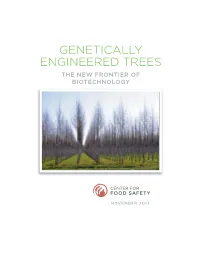
Genetically Engineered Trees the New Frontier of Biotechnology
GENETICALLY ENGINEERED TREES THE NEW FRONTIER OF BIOTECHNOLOGY NOVEMBER 2013 CENTER FOR FOOD SAFETY | GE TREES: THE NEW FRONTIER OF BIOTECHNOLOGY Editor and Executive Summary: DEBBIE BARKER Writers: DEBBIE BARKER, SAM COHEN, GEORGE KIMBRELL, SHARON PERRONE, AND ABIGAIL SEILER Contributing Writer: GABRIELA STEIER Copy Editing: SHARON PERRONE Additonal Copy Editors: SAM COHEN, ABIGAIL SEILER AND SARAH STEVENS Researchers: DEBBIE BARKER, SAM COHEN, GEORGE KIMBRELL, AND SHARON PERRONE Additional Research: ABIGAIL SEILER Science Consultant: MARTHA CROUCH Graphic Design: DANIELA SKLAN | HUMMINGBIRD DESIGN STUDIO Report Advisor: ANDREW KIMBRELL ACKNOWLEDGEMENTS We are grateful to Ceres Trust for its generous support of this publication and other project initiatives. ABOUT US THE CENTER FOR FOOD SAFETY (CFS) is a national non-profit organization working to protect human health and the environment by challenging the use of harmful food production technologies and by promoting organic and other forms of sustainable agriculture. CFS uses groundbreaking legal and policy initiatives, market pressure, and grassroots campaigns to protect our food, our farms, and our environment. CFS is the leading organization fighting genetically engineered (GE) crops in the US, and our successful legal chal - lenges and campaigns have halted or curbed numerous GE crops. CFS’s US Supreme Court successes include playing an historic role in the landmark US Supreme Court Massachusetts v. EPA decision mandating that the EPA reg - ulate greenhouse gases. In addition, in