United Kingdom 2019 International Religious Freedom Report
Total Page:16
File Type:pdf, Size:1020Kb
Load more
Recommended publications
-

January 2018 MANIFESTATIONS of ISLAMOPHO
DIALOGUE & OUTREACH Department OIC Islamophobia Observatory Monthly Bulletin – January 2018 MANIFESTATIONS OF ISLAMOPHOBIA: A. In the United States and Canada: US: Minnesota Republicans under fire for saying Muslims are infiltrating the party— Two Minnesota Republican state lawmakers and a local GOP official were facing scrutiny after they reportedly shared a Facebook post accusing Muslims of preparing to “infiltrate” the party’s caucuses this month. State Reps. Kathy Lohmer and Cindy Pugh, shared the post created by Dave Sina, chairman of the Fourth Congressional District GOP. In the post, Sina said a friend of his had attended a caucus training session held at a mosque by the Muslim American Society. MAS was a nonpartisan organization that promoted civic engagement among American Muslims with local chapters across the US. Sina claimed that Muslims were trying to “infiltrate our republican caucuses on Feb. 6” and that “they didn’t talk about the general election but I am sure they are ahead of us in that as well.” The local party chair played to a sense of hysteria that American Muslims were, and would always be, foreigners who want political influence only to harm the country. See: The Huffington Post News’ entry, in: https://www.huffingtonpost.com/entry/minnesota-republicans-muslims- caucuses_us_5a7217b9e4b05253b2752e90, retrieved on 3.1.2018 US: Steve Bannon steps down from Breitbart News— Stephen Bannon had stepped down as executive chairman of Breitbart News, the company announced in an online post and a source close to Bannon confirmed. The former White House chief strategist faced mounting pressure to resign from Breitbart after he was quoted disparaging President Donald Trump and his family in a new book “Fire and Fury: Inside the Trump White House” by Michael Wolff. -
Nolb Tender Process – Third Sector Register of Interest
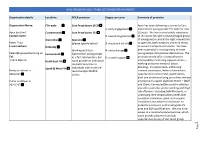
NOLB TENDER PROCESS – THIRD SECTOR REGISTER OF INTEREST Organisation details Localities NOLB provision Stages can cover Summary of provision Organisation Name: Fife-wide ☒ Core Practitioner 16-24☐ Apex has been delivering a service to Care 1. early engagement☒ Experienced young people Fife wide for over Apex Scotland Cowdenbeath☒ Core Practitioner 25+☐ 12 years. We have considerable experience Contact name: 2. overcoming barriers☒ of the issues facing this disadvantaged group Glenrothes☒ Specialist☒ of young people and all the right connections Helen Tripp (please specify below) 3. vocational activity☒ to agencies, both statutory and third sector, E-mail address: Kirkcaldy ☒ to ensure a wraparound service. We have Working with Care 4. job brokerage☒ been successful in moving many of these helent@apexscotland.org.uk Levenmouth ☒ Experienced young people young people into positive destinations. The Tel: as a first intervention, but 5. in work support☐ provision would offer a comprehensive 07973 986276 employability mentoring support service – North East Fife☐ could provide an additional working on barrier removal, action specialist provision to planning, CV preparation, addressing South & West Fife☐ individuals with a criminal Ready to deliver in record and/or MAPPA criminal convictions, letters of disclosure, 2021/22? ☒ clients. opportunity to access SQA qualifications, both one to one and using our online, remote Prefer to deliver in employment support platform STACC – (Staff 2022/23? ☒ and Clients Connected)We could in addition also offer specialist service working with high risk offenders, including MAPPA clients, in addressing their employability needs with conviction relevance, spent and unspent convictions and advice on disclosure to potential employers built in alongside CV prep and SQA qualifications. -

Tell MAMA Reporting 2013/14 Anti-Muslim Overview, Analysis and ‘Cumulative Extremism’ Dr Matthew Feldman Mark Littler Teesside University, July 2014
Inspiring success Centre for Fascist, Anti-Fascist and Post-Fascist Studies Tell MAMA Reporting 2013/14 Anti-Muslim Overview, Analysis and ‘Cumulative Extremism’ Dr Matthew Feldman Mark Littler Teesside University, July 2014 Tell MAMA Reporting 2013/14: Anti-Muslim Overview, Analysis and ‘Cumulative Extremism’ Dr Matthew Feldman Mark Littler Centre for Fascist, Anti-fascist and Post-fascist Studies Teesside University July 2014 Executive Summary 1. Introduction 2. Tell MAMA: Methodology and Data Collection 3. Hate Crimes: National Trends and Police Data 4. Tell MAMA reporting 1 May 2013 – 28 February 2014 5. ‘Cumulative extremism’ and the ‘spike’ in post-Woolwich incidents 6. Conclusions Appendices Executive Summary • The Centre for Fascist, Anti-fascist and Post-fascist Studies at Teesside University analysed anti-Muslim incidents recorded by Faith Matters’ Tell MAMA project over 2013/14. • There were 734 self-reported cases between 1 May 2013 and 28 February 2014; of these, there were 599 incidents of online abuse and 135 offline attacks, combining for an average of more than 2 cases per day. • Of the 18% of offline anti-Muslim attacks recorded by Tell MAMA; 23 cases involved assault and another 13 cases involved extreme violence. • Estimated age of perpetrators was between 10 and 30 in 60% of offline attacks. • Two-fifths of all anti-Muslim incidents recorded by Tell MAMA reported a link to far-right groups (e.g. BNP, EDL, etc.); including 45% of online abuse. • In the wake of Drummer Lee Rigby’s brutal murder, reported incidents to Tell MAMA skyrocketed – there were nearly four times more online and offline reports (373%) in the week after 22 May 2013 than in the week beforehand. -

Understanding Anti-Muslim Hate Crimes Addressing the Security Needs of Muslim Communities
Understanding Anti-Muslim Hate Crimes Addressing the Security Needs of Muslim Communities A Practical Guide Understanding Anti-Muslim Hate Crimes Addressing the Security Needs of Muslim Communities A Practical Guide Published by the OSCE Office for Democratic Institutions and Human Rights (ODIHR) Ul. Miodowa 10 00-251 Warsaw Poland www.osce.org/odihr © OSCE/ODIHR 2020 All rights reserved. The contents of this publication may be freely used and copied for educational and other non-commercial purposes, provided that any such reproduction is accompanied by an acknowledgement of the OSCE/ ODIHR as the source. ISBN 978-83-66089-93-8 Designed by Homework Printed in Poland by Centrum Poligrafii Contents Foreword v Executive Summary vii Introduction 1 PART ONE: Understanding the challenge 7 I. Hate crimes against Muslims in the OSCE region: context 8 II. Hate crimes against Muslims in the OSCE region: key features 12 III. Hate crimes against Muslims in the OSCE region: impact 21 PART TWO: International standards on intolerance against Muslims 29 I. Commitments and other international obligations 30 II. Key principles 37 1. Rights based 37 2. Victim focused 38 3. Non-discriminatory 41 4. Participatory 41 5. Shared 42 6. Collaborative 43 7. Empathetic 43 8. Gender sensitive 43 9. Transparent 44 10. Holistic 45 PART THREE: Responding to anti-Muslim hate crimes and the security challenges of Muslim communities 47 Practical steps 48 1. Acknowledging the problem 48 2. Raising awareness 51 3. Recognizing and recording the anti-Muslim bias motivation of hate crimes 53 4. Providing evidence of the security needs of Muslim communities by working with them to collect hate crime data 58 5. -

MIAMI UNIVERSITY the Graduate School
MIAMI UNIVERSITY The Graduate School Certificate for Approving the Dissertation We hereby approve the Dissertation of Bridget Christine Gelms Candidate for the Degree Doctor of Philosophy ______________________________________ Dr. Jason Palmeri, Director ______________________________________ Dr. Tim Lockridge, Reader ______________________________________ Dr. Michele Simmons, Reader ______________________________________ Dr. Lisa Weems, Graduate School Representative ABSTRACT VOLATILE VISIBILITY: THE EFFECTS OF ONLINE HARASSMENT ON FEMINIST CIRCULATION AND PUBLIC DISCOURSE by Bridget C. Gelms As our digital environments—in their inhabitants, communities, and cultures—have evolved, harassment, unfortunately, has become the status quo on the internet (Duggan, 2014 & 2017; Jane, 2014b). Harassment is an issue that disproportionately affects women, particularly women of color (Citron, 2014; Mantilla, 2015), LGBTQIA+ women (Herring et al., 2002; Warzel, 2016), and women who engage in social justice, civil rights, and feminist discourses (Cole, 2015; Davies, 2015; Jane, 2014a). Whitney Phillips (2015) notes that it’s politically significant to pay attention to issues of online harassment because this kind of invective calls “attention to dominant cultural mores” (p. 7). Keeping our finger on the pulse of such attitudes is imperative to understand who is excluded from digital publics and how these exclusions perpetuate racism and sexism to “preserve the internet as a space free of politics and thus free of challenge to white masculine heterosexual hegemony” (Higgin, 2013, n.p.). While rhetoric and writing as a field has a long history of examining myriad exclusionary practices that occur in public discourses, we still have much work to do in understanding how online harassment, particularly that which is gendered, manifests in digital publics and to what rhetorical effect. -

BAB IV Kesimpulan 4.1 Kesimpulan Berdasarkan Hasil Analisis Secara
BAB IV Kesimpulan 4.1 Kesimpulan Berdasarkan hasil analisis secara mendalam terhadap tindakan Donald Trump yang merespon aksi anti-Muslim melalui Twitter yang dilakukan oleh Jayda Fransen yang merupakan seorang wakil pemimpin partai sayap kanan Britain First, secara tidak langsung hal tersebut berdampak terhadap peningkatan Islamophobia di AS, di mana peningkatan Islamophobia tersebut termasuk ke dalam peningkatan pada klaster pertama, klaster kedua, klaster ketiga, klaster keempat, dan klaster kelima. Peningkatan dalam Islamophobia tersebut diukur dengan melihat dari jenis klaster yang dicetuskan oleh S. Sayyid: Klaster pertama, di mana ada manifestasi Islamophobia melalui serangan terhadap orang-orang Muslim yang mencakup melakukan pelecehan, mendorong, meneriaki, dan menarik jilbab dari wanita Muslim; Klaster kedua, terjadi serangan terhadap properti yang dianggap terkait dengan Muslim: masjid, kuburan, tempat bisnis; Klaster ketiga, ada Islamophobia yang diwakili oleh tindakan intimidasi seperti kampanye atau iklan yang memperingati akan bahayanya Islam; Klaster keempat, perilaku pelecehan, penindasan, lelucon yang melewati batas, dan penilaian kinerja di mana mereka yang dianggap Muslim dikenakan perlakuan atau komentar yang merugikan. Klaster kelima, bentuk Islamophobia ini dapat diartikulasikan di situs-situs kebencian internet, surat kabar, majalah, atau media lainnya. 79 Hal ini bisa terjadi karena Trump, menurut teori psikoanalisis, memiliki konflik internal di mana ia tidak bisa menyeimbangkan antara id, ego, dan superego-nya sehingga tindakan yang dilakukannya berdasarkan hanya dari keinginannya saja. Ia tidak mempertimbangkan konsekuensi baik yang positif atau pun negatif yang dapat terjadi. Oleh karena itu ia memiliki kepribadian yang tidak sehat, dan tergolong ekstrem. Selain itu, sebagai presiden, sudah seharusnya Trump dapat menempatkan diri sebagai tokoh yang baik bagi masyarakat, sebagai tokoh panutan, dan tidak memanipulasi masyarakatnya. -
A Critical Discourse Analysis
How Facebook Comments Reflect Certain Characteristics Of Islamophobia: A Critical Discourse Analysis By Annabell Curci-Wallis UPPSALA UNIVERSITY Department of Theology Master Programme in Religion in Peace and Conflict Master thesis 30 credits Spring 2019 Supervisor: Mia Lövheim Facebook Comments and the Reflection of Characteristics of Islamophobia 2 Thank you: I am extremely grateful to my supervisor, Mia Lövheim, who was patient with me, advised me, and send insightful comments and suggestions even when she had the flu, so I could finish on time. I could not have done it without you. Thank you. I also like to say thank you to my husband, and my sweet daughter, who both supported me by giving me enough time and space, to finish my work. Abstract: This study is a contribution to the limited knowledge of how different types of media content (about Muslims and extremism) posted and shared on Facebook might influence corresponding user comments. Through analyzing the discourse of user comments this study aims to identify how comments might reflect certain characteristics of Islamophobia, and to which themes in Facebook posts commentators relate to the most. The linguistic analysis is guided by the use of critical discourse analysis. For the purpose of this study, three different types of articles/video and the corresponding comments are analyzed. Two of the articles/video that I will analyze are from unreliable media sources, and one of the articles is from a credible media source. The linguistic analysis showed that the majority of commentators expressed that they believe the claims made in the articles/video about Muslims and extremism are true. -

Prepared by the European Jewish Congress, Secretariat and Member of the Advisory 2016 Board of the European Parliament Working Group on Antisemitism (WGAS)
Prepared by the European Jewish Congress, Secretariat and Member of the Advisory 2016 Board of the European Parliament Working Group on Antisemitism (WGAS). Page 1 of 40 TABLE OF CONTENT I. REPORTS & POLLS .......................................................................................................... 6 AUSTRIA................................................................................................................................ 6 Antisemitic incidents in Austria up by more than 80% ........................................................... 6 FRANCE ................................................................................................................................. 6 Large dip in French Jewish emigration to Israel ..................................................................... 6 Huge fall in number of antisemitic attacks in France .............................................................. 6 Hate crimes in France down 80% this year ............................................................................. 7 Most French believe Jews responsible for rise in antisemitism................................................ 7 SPCJ statistics and analyses on antisemitism in France in 2015 .............................................. 7 More than 40% of French Jews considering “Aliyah”............................................................. 7 GERMANY ............................................................................................................................. 8 Germany to force Facebook, -

Far-Right Extremism in the Populist Age
Far-Right Extremism in the Populist Age Briefing Paper Sophie Gaston 2017 ABOUT THIS PAPER This paper was prepared to facilitate discussion at the International Summit on Far-Right Extremism, held in central London in partnership between Friedrich-Ebert-Stiftung and Demos on 23 May 2017. The event was held against a backdrop of ‘shifting sands’ across Europe and the United States, with fundamental realignments in national political contexts, a broadly spread hardening of attitudes towards cultural and ethnic diversity, and a sense that the far-right – both through attitudes and expressions of violent extremism and populist political movements – has assumed a visible and influential role of historic proportions. Introduction and Definitions In tandem with, and partially as a result of national political and social differences, there is no clear definition of far-right extremism. In a fundamental sense, it refers to the opposition of the primary foundations of liberal democracy, which offers safeguards for minority groups, a civic-based conception of national identity and citizenship, and political pluralism1. Norris (2005) acknowledges the multitude of labels for far right political parties and social groups – ‘far’, ‘extreme’, ‘radical’, ‘new right’, ‘ultra- nationalist’ among many others – and consequently argues that these groups are best thought of a cluster or family of parties rather than a single category2. Similarly, Mudde (1995) notes the difficulty of producing a clear conceptual criteria of extreme right wing parties because of the varying ideological commitments of different parties. For instance, a contemporary contrast can be made between anti-federal groups in the US and authoritarian and strong-state parties in Central and Eastern Europe3. -
Violent Protest and Heterogeneous Diffusion
BRITAIN FIRST AND THE UK INDEPENDENCE PARTY: SOCIAL MEDIA AND MOVEMENT-PARTY DYNAMICS1 Thomas Davidson and Mabel Berezin2 FORTHCOMING IN DECEMBER 2018 ISSUE OF MOBILIZATION. PLEASE CITE THE PUBLISHED VERSION. Social movement scholars have recently turned their attention to the interactions between political parties and social movements, but little is known about how social media have impacted these relationships, despite widespread adoption of these technologies. We present a case study of the relationship between Britain First, a far-right anti-Muslim social movement, and the U.K. Independence Party, the Eurosceptic political party that spearheaded the Brexit campaign. The movement appeared marginal in the press but it dominated social media, using this presence to support to the party. We examine the dynamics of the relationship between these groups from 2013 until 2017, drawing upon data from social media, newspapers, and other online sources, and focusing on interactions between elites and rank-and-file supporters. Our findings illustrate how far-right groups have used new technologies to generate an unprecedented amount of popular support and to attempt to influence the political mainstream. A number of western democracies have recently experienced a resurgence of right-wing political activity in both the parliamentary and extra-parliamentary sphere (Akkerman, de Lange, and Rooduijn 2016; Mudde 2016; Muis and Immerzeel 2017). In Germany, the unprecedented electoral performance of the anti-immigrant Alternative for Germany (AfD) party -

Decision Case Study: United Kingdom, Mossmorran-Braefoot Bay
Decision Case Study: United Kingdom, Mossmorran-Braefoot Bay Macgill, S.M. IIASA Collaborative Paper July 1982 Macgill, S.M. (1982) Decision Case Study: United Kingdom, Mossmorran-Braefoot Bay. IIASA Collaborative Paper. Copyright © July 1982 by the author(s). http://pure.iiasa.ac.at/2078/ All rights reserved. Permission to make digital or hard copies of all or part of this work for personal or classroom use is granted without fee provided that copies are not made or distributed for profit or commercial advantage. All copies must bear this notice and the full citation on the first page. For other purposes, to republish, to post on servers or to redistribute to lists, permission must be sought by contacting repository@iiasa.ac.at NOT FOR QUOTATION WITHOUT PERMISSION OF THE AUTHOR DECISION CASE STUDY UNITED KINGDOM MOSSMORRAN-BWFOOT BAY Sally M. Macgill July 1982 CP-82- 4 0 Collaborative Papers report work which has not been performed solely at the International Institute for Applied Systems Analysis and which has received only limited review. Views or opinions expressed herein do not necessarily represent those of the Insti- tute, its National Member Organizations, or other organizations supporting the work. INTERNATIONAL INSTITUTE FOR APPLIED SYSTEMS ANALYSIS 2361 Laxenburg, Austria CONTENTS CHAPTER 1 : INTRODUCTION 1.1. Perspective 1.2. Status of Report 1.3. Outline CHAPTER 2 : THE DECISION STRUCTURE 2.1. Context for the Developments 2.2. Site Choice 2.3. The Main Parties to the Decision 2.4. The Main Events in the Decision Process CHAPTER 3: THE DIMENSIONS OF THE DECISION 3.1. -
BE6 Bus Time Schedule & Line Route
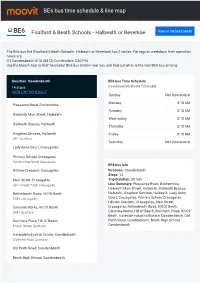
BE6 bus time schedule & line map BE6 Foulford & Beath Schools - Halbeath or Beverkae View In Website Mode The BE6 bus line (Foulford & Beath Schools - Halbeath or Beverkae) has 2 routes. For regular weekdays, their operation hours are: (1) Cowdenbeath: 8:10 AM (2) Dunfermline: 3:30 PM Use the Moovit App to ƒnd the closest BE6 bus station near you and ƒnd out when is the next BE6 bus arriving. Direction: Cowdenbeath BE6 bus Time Schedule 14 stops Cowdenbeath Route Timetable: VIEW LINE SCHEDULE Sunday Not Operational Monday 8:10 AM Pleasance Road, Dunfermline Tuesday 8:10 AM Halbeath Main Street, Halbeath Wednesday 8:10 AM Halbeath Bypass, Halbeath Thursday 8:10 AM Kingdom Services, Halbeath Friday 8:10 AM A92, Scotland Saturday Not Operational Lady Anne Court, Crossgates Primary School, Crossgates Dunfermline Road, Crossgates BE6 bus Info Hillview Crescent, Crossgates Direction: Cowdenbeath Stops: 14 Main Street, Crossgates Trip Duration: 20 min John Wood Place, Crossgates Line Summary: Pleasance Road, Dunfermline, Halbeath Main Street, Halbeath, Halbeath Bypass, Netherbeath Road, Hill Of Beath Halbeath, Kingdom Services, Halbeath, Lady Anne B981, Crossgates Court, Crossgates, Primary School, Crossgates, Hillview Crescent, Crossgates, Main Street, Concrete Works, Hill Of Beath Crossgates, Netherbeath Road, Hill Of Beath, B981, Scotland Concrete Works, Hill Of Beath, Swinton's Place, Hill Of Beath, Gateside Industrial Estate, Cowdenbeath, Old Swinton's Place, Hill Of Beath Perth Road, Cowdenbeath, Beath High School, 8 Main Street, Scotland