Rights Lawyering in Xi's China
Total Page:16
File Type:pdf, Size:1020Kb
Load more
Recommended publications
-

HRWF Human Rights in the World Newsletter Bulgaria Table Of
Table of Contents • EU votes for diplomats to boycott China Winter Olympics over rights abuses • CCP: 100th Anniversary of the party who killed 50 million • The CCP at 100: What next for human rights in EU-China relations? • Missing Tibetan monk was sentenced, sent to prison, family says • China occupies sacred land in Bhutan, threatens India • 900,000 Uyghur children: the saddest victims of genocide • EU suspends efforts to ratify controversial investment deal with China • Sanctions expose EU-China split • Recalling 10 March 1959 and origins of the CCP colonization in Tibet • Tibet: Repression increases before Tibetan Uprising Day • Uyghur Group Defends Detainee Database After Xinjiang Officials Allege ‘Fake Archive’ • Will the EU-China investment agreement survive Parliament’s scrutiny? • Experts demand suspension of EU-China Investment Deal • Sweden is about to deport activist to China—Torture and prison be damned • EU-CHINA: Advocacy for the Uyghur issue • Who are the Uyghurs? Canadian scholars give profound insights • Huawei enables China’s grave human rights violations • It's 'Captive Nations Week' — here's why we should care • EU-China relations under the German presidency: is this “Europe’s moment”? • If EU wants rule of law in China, it must help 'dissident' lawyers • Happening in Europe, too • U.N. experts call call for decisive measures to protect fundamental freedoms in China • EU-China Summit: Europe can, and should hold China to account • China is the world’s greatest threat to religious freedom and other basic human rights -
Culture Matters
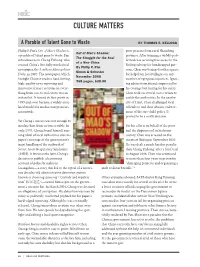
CRF-2008-04r-080-098.qxd:HRIC-Report 1/14/09 2:57 PM Page 82 CULTURE MATTERS A Parable of Talent Gone to Waste BY THOMAS E. KELLOGG Philip P. Pan’s Out of Mao’s Shadow is poor peasant from rural Shandong Out of Mao’s Shadow: a parable of talent gone to waste . Pan province. After winning a widely-pub - The Struggle for the Soul introduces us to Cheng Yizhong, who licized case securing free access to the of a New China created China’s first fully marketized Beijing subway for handicapped per - By Philip P. Pan newspaper, the Southern Metropolitan sons, Chen was besieged with requests Simon & Schuster Daily , in 1997 . The newspaper, which for help from local villagers on any November 2008 brought Chinese readers hard-hitting, number of egregious injustices . Ignor - 368 pages, $28.00 high-quality news reporting and ing advice from friends impressed by innovative feature sections on every - his courage but fearing for his safety, thing from cars to real estate, was an Chen took on several cases certain to instant hit. It turned its first profit in rankle the authorities. In the nearby 1999 and soon became a widely-emu - city of Linyi, Chen challenged local lated model for media entrepreneurs officials to end their abusive enforce - nationwide. ment of the one-child policy . It proved to be a costly decision. Yet Cheng’s success was not enough to insulate him from serious trouble. In For his efforts on behalf of the poor early 2003 , Cheng found himself run - and the dispossessed in his home ning afoul of local authorities over his county, Chen was arrested on the paper’s coverage of the government’s streets of Beijing in September 2005 . -

Digital Feminism in the Arab Gulf
MIT Center for Intnl Studies | Starr Forum: Digital Feminism in the Arab Gulf MICHELLE I'm Michelle English, and on behalf of the MIT Center for International Studies, welcome you to ENGLISH: today's Starr Forum. Before we get started, I'd like to mention that this is our last planned event for the fall. However, we do have many, many events planned for the spring. So if you haven't already, please take time to sign up to get our event notices. Today's talk on digital feminism in the Arab Gulf states is co-sponsored by the MIT Women's and Gender Studies program, the MIT History department, and the MIT Press bookstore. In typical fashion, our talk will conclude with Q&A with the audience. And for those asking questions, please line up behind the microphones. We ask that you to be considerate of time and others who want to ask questions. And please also identify yourself and your affiliation before asking your question. Our featured speaker is Mona Eltahawy, an award winning columnist and international public speaker on Arab and Muslim issues and global feminism. She is based in Cairo and New York City. Her commentaries have appeared in multiple publications and she is a regular guest analyst on television and radio shows. During the Egypt Revolution in 2011, she appeared on most major media outlets, leading the feminist website Jezebel to describe her as the woman explaining Egypt to the West. In November 2011, Egyptian riot police beat her, breaking her left arm and right hand, and sexually assaulted her, and she was detained for 12 hours by the Interior Ministry and Military Intelligence. -
R Stern Phd Diss 2009
UC Berkeley UC Berkeley Electronic Theses and Dissertations Title Navigating the Boundaries of Political Tolerance: Environmental Litigation in China Permalink https://escholarship.org/uc/item/3rc0h094 Author Stern, Rachel E. Publication Date 2009 Peer reviewed|Thesis/dissertation eScholarship.org Powered by the California Digital Library University of California Navigating the Boundaries of Political Tolerance: Environmental Litigation in China by Rachel E. Stern A dissertation submitted in partial satisfaction of the requirements for the degree of Doctor of Philosophy in Political Science in the Graduate Division of the University of California, Berkeley Committee in charge: Professor Kevin J. O’Brien, Chair Professor Robert Kagan Professor Katherine O’Neill Fall 2009 Navigating the Boundaries of Political Tolerance: Environmental Litigation in China © 2009 by Rachel E. Stern Abstract Navigating the Boundaries of Political Tolerance: Environmental Litigation in China by Rachel E. Stern Doctor of Philosophy in Political Science University of California, Berkeley Professor Kevin J. O’Brien, Chair This is a dissertation about lawyers, judges, international NGOs and legal action in an authoritarian state. The state is contemporary China. The type of legal action is civil environmental lawsuits, as when herdsmen from Inner Mongolia sue a local paper factory over poisoned groundwater and dead livestock or a Shandong villager demands compensation from a nearby factory for the noise that allegedly killed 26 foxes on his farm. Empirically, this is a close-to-the-ground account of everyday justice and the factors that shape it. Drawing on fifteen months of field research in China, along with in-depth exploration of four cases, legal documents, government reports, newspaper articles and blog archives, this dissertation unpacks how law as litigation works: how judges make decisions, why lawyers take cases and how international influence matters. -

Young Feminist Activists in Present-Day China: a New Feminist Generation?
China Perspectives 2018/3 | 2018 Twenty Years After: Hong Kong's Changes and Challenges under China's Rule Young Feminist Activists in Present-Day China: A New Feminist Generation? Qi Wang Electronic version URL: http://journals.openedition.org/chinaperspectives/8165 ISSN: 1996-4617 Publisher Centre d'étude français sur la Chine contemporaine Printed version Date of publication: 1 September 2018 Number of pages: 59-68 ISSN: 2070-3449 Electronic reference Qi Wang, « Young Feminist Activists in Present-Day China: A New Feminist Generation? », China Perspectives [Online], 2018/3 | 2018, Online since 01 September 2019, connection on 28 October 2019. URL : http://journals.openedition.org/chinaperspectives/8165 © All rights reserved Articles China perspectives Young Feminist Activists in Present-Day China A New Feminist Generation? QI WANG ABSTRACT: This article studies post-2000 Chinese feminist activism from a generational perspective. It operationalises three notions of gene- ration—generation as an age cohort, generation as a historical cohort, and “political generation”—to shed light on the question of generation and generational change in post-socialist Chinese feminism. The study shows how the younger generation of women have come to the forefront of feminist protest in China and how the historical conditions they live in have shaped their feminist outlook. In parallel, it examines how a “po- litical generation” emerges when feminists of different ages are drawn together by a shared political awakening and collaborate across age. KEYWORDS: -
The Broad and Sustained Offensive on Human Rights That Started After President Xi Jinping Took Power Five Years Ago Showed No Sign of Abating in 2017
JANUARY 2018 COUNTRY SUMMARY China The broad and sustained offensive on human rights that started after President Xi Jinping took power five years ago showed no sign of abating in 2017. The death of Nobel Peace Prize laureate Liu Xiaobo in a hospital under heavy guard in July highlighted the Chinese government’s deepening contempt for rights. The near future for human rights appears grim, especially as Xi is expected to remain in power at least until 2022. Foreign governments did little in 2017 to push back against China’s worsening rights record at home and abroad. The Chinese government, which already oversees one of the strictest online censorship regimes in the world, limited the provision of censorship circumvention tools and strengthened ideological control over education and mass media in 2017. Schools and state media incessantly tout the supremacy of the Chinese Communist Party, and, increasingly, of President Xi Jinping as “core” leader. Authorities subjected more human rights defenders—including foreigners—to show trials in 2017, airing excerpted forced confessions and court trials on state television and social media. Police ensured the detainees’ compliance by torturing some of them, denying them access to lawyers of their choice, and holding them incommunicado for months. In Xinjiang, a nominally autonomous region with 11 million Turkic Muslim Uyghurs, authorities stepped up mass surveillance and the security presence despite the lack of evidence demonstrating an organized threat. They also adopted new policies denying Uyghurs cultural and religious rights. Hong Kong’s human rights record took a dark turn. Hong Kong courts disqualified four pro-democracy lawmakers in July and jailed three prominent pro-democracy student leaders in August. -

Air Annual Issue, Vol. 1, 2017
Grasp the pattern, read the trend Asia in Review (AiR) Brought to you by CPG AiR Annual Issue, Vol. 1, 2017 Table of Contents I. Law and Politics in Asia ............................................................................................................................................................................3 1. Bangladesh ...................................................................................................................................................................................... 3 2. Cambodia ......................................................................................................................................................................................... 9 3. China .............................................................................................................................................................................................. 19 4. India ............................................................................................................................................................................................... 45 5. Indonesia ........................................................................................................................................................................................ 61 6. Japan .............................................................................................................................................................................................. 76 7. Laos ............................................................................................................................................................................................... -

LEGAL ADVOCACY and the 2011 CRACKDOWN in CHINA: ADVERSITY, REPRESSION, and RESILIENCE
1. All persons are entitled to call upon the assistance of a lawyer of their choice to protect and establish their rights and to defend them in all stages of criminal proceedings. 2. Governments co railtoroype and subject to their jurisdiction, tion rat erna ion without distinction of any kind, such as discrimination based on race, colour, ethnic origin, sex, language, religion, political or other opinion, nationalt or social origin, property, birth, economic or i in n yf , to other disadvanptaged persons. Professional o r t o associations of lawyers shall cooperate in the organization and provision of services, facilities and other resources. 4. Governments and profnessional associations ofm lawyers shall promote e o m t programmes to inform the public about their rights and duties under the law and the important role of lawyers in protecting their fundamene tal freedoms. Special attenintion should be given to ac v g and rld e h i e assisting the poor and other disadvantagedo a persons so as to enable them to assert their rights and where necessary call upon the assistanh ce of lawyers. 5. Governments shae ll ensure that all w t e r n c h m s t u c e t e r s p p f , p o o o s e persons are immediately informed by the competein t authority of their right to be assisted by a lawyer of their own choice upon arrest or detention or when charged with a crimu en r cef . 6. r r g agin o o t i pe p e r e s r e l h Any such persons who do not havee a lawyer shall, in a all cases in which the interests of justice so require, be entitled to have a lawyer of experience and competence commensurate with the h u t l i m s a t h nedn to them in order to prov ofo pay for such services. -
Chinese Government's Use of Enforced Disappearance As
Chinese Government’s Use of Enforced Disappearance as Political Persecution China has expanded its use of enforced disappearance in recent years, increasingly leveraging Article 73 of the Criminal Procedure Law (CPL) to present a veneer of legality for forcibly disappearing individuals. Article 73, which has been in effect since January 2013, allows police to put an individual under “residential surveillance at a (police-) designated location” (RSDL), whereby police can hold individuals in secret for up to six months, without access to lawyers or family members, if they are suspected of “endangering state security,” “terrorism,” or significant bribery crimes. The government has routinely disappeared human rights defenders (HRDs) by invoking Article 73. RSDL has even been applied to detain HRDs who have not been charged with offenses stipulated in Article 73, such as “picking quarrels and provoking trouble” and “disrupting court order.”1 This indicates that police may be exploiting legal loopholes which allow police to label any criminal act as a threat to “national security.”2 Some Data on Enforced Disappearances While the Chinese government does not provide statistics on the number of RSDL cases or the number of RSDL detainees granted a visit by their lawyer, we have documented 42 cases between 2015-2017 of HRDs forcibly disappeared in RSDL for up to six months.3 None of these individuals were granted a meeting with a lawyer of their or their families’ choosing. There is a significant risk of torture in RSDL; at least eight of these 42 individuals later alleged that police tortured and ill-treated them while they were under RSDL.4 Authorities have continued to use “black jails”—unlawful temporary detention facilities run by state agents or government-hired thugs—even as government officials have declared that such facilities do not exist in China. -
Measuring Decentralization of Chinese Keyword Censorship Via Mobile Games
Measuring Decentralization of Chinese Keyword Censorship via Mobile Games Jeffrey Knockel1,2, Lotus Ruan1, and Masashi Crete-Nishihata1 1Citizen Lab, Munk School of Global Affairs, University of Toronto 2Dept. of Computer Science, University of New Mexico Abstract collected from chat applications and social media plat- forms [19, 16, 31, 20] have consistently found limited China has the world’s largest mobile gaming market. Like overlap between keyword lists across companies suggest- other technology and Internet companies operating in the ing that Chinese authorities do not provide a centralized country, the gaming industry must follow strict content list of keywords to companies. What is the role of com- control policies including submitting lists of blacklisted panies and government authorities in the development of keywords to regulators. In this paper we provide a first blacklisted keyword lists? look at how content regulations over the gaming industry To further probe this question we analyzed the Chinese are implemented in practice by analyzing over 180,000 mobile gaming industry, which has recently come under unique blacklisted keywords collected across over 200 increased government pressure [15, 36]. We found a large games from app stores in China. number of games implement keyword censorship client- Internet censorship in China is often presented as a side, which provided the opportunity to collect hundreds uniformly enforced, top-down system. However, we find of keyword blacklists. Facilitated by the large number of content -

Women's Rights in China and Feminism on Chinese Social Media
Issue Brief June 14, 2021 Women’s Rights in China and Feminism on Chinese Social Media Frida Lindberg In recent years, women in China have to a greater extent than previously raised their voices about issues relating to women’s rights and gender equality. Social media has served as an important tool and venue for women to share their own experiences with sexual harassment, domestic violence, and gender discrimination in the labor market. Yet, while the feminist movement has been on the rise over the past ten years, feminists and women in China who speak up about gender-related issues nevertheless face threats, antagonism, and censorship online.1China has stated that it aims to empower women and protect their rights.2 However, activities and discourses that have the potential to disturb the existing social order or challenge the authorities are not tolerated by the government, as social stability is one of its top priorities.3,4 This paper addresses how women and feminists in China use social media to speak up, while at the same time having to cope with gender antagonism in Chinese society and monitoring efforts by the government. Oppression and Discrimination Against enshrined in the constitution, while initiatives that Women in China involved women in building the new communist China were introduced.8 Through posters and In ancient China, women were subordinate to first speeches, the party projected the image of female and foremost their fathers, secondly their husbands, socialist icons, so-called “iron women”, who were and lastly, as widows, their sons. At that time, depicted as labor heroes that also managed to religious and philosophical norms had been set up maintain a harmonious family. -
China's One-Child Policy: Population Control and Its Unintended
Volume 4, Issue No. 2. China’s One-Child Policy: Population Control and Its Unintended Consequences Kira Goeking Tulane University, New Orleans, Louisiana, USA ÒÏ Abstract: In 1979, the Chinese government established the one-child policy, the most severe state- mandated family planning policy in the world. This policy was intended to curb rapid population growth in China by prohibiting couples from having more than one child. The policy was implemented in varying degrees across provinces and affected urban and rural areas differently. China successfully lowered their total fertility rate and population growth but experienced significant unintended consequences, mainly an imbalance in the gender composition of the country. Families desired a son for labor, inheritance, and care in their old age, leading some parents to take extreme measures to ensure the birth of a son. The skewed sex ratio has affected all sectors of Chinese society, including marriage, the labor force, and educational opportunities for women. Today, China faces the aftermath of this birth quota that was in place for 35 years. China’s one-child policy demonstrates the difficulties countries face with population growth. With the unexpected effects of the one-child policy, it is still unclear how the Chinese government should have managed their population growth to ensure economic expansion and a good quality of life for their citizens. However, it is evident that the one-child policy sparked a new feminist movement to emerge as Chinese women began to speak out against the consequences of state birth planning on women’s lives and bodies. Evolution of the One-Child Policy Throughout China’s history, families have placed more value on having sons compared to daughters since sons were expected to take on the family name, inherit family wealth, and provide care for their parents in old age.