FAMILY HISTERIDAE (Hister Beetles)
Total Page:16
File Type:pdf, Size:1020Kb
Load more
Recommended publications
-
Beetle Appreciation Diversity and Classification of Common Beetle Families Christopher E
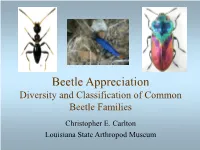
Beetle Appreciation Diversity and Classification of Common Beetle Families Christopher E. Carlton Louisiana State Arthropod Museum Coleoptera Families Everyone Should Know (Checklist) Suborder Adephaga Suborder Polyphaga, cont. •Carabidae Superfamily Scarabaeoidea •Dytiscidae •Lucanidae •Gyrinidae •Passalidae Suborder Polyphaga •Scarabaeidae Superfamily Staphylinoidea Superfamily Buprestoidea •Ptiliidae •Buprestidae •Silphidae Superfamily Byrroidea •Staphylinidae •Heteroceridae Superfamily Hydrophiloidea •Dryopidae •Hydrophilidae •Elmidae •Histeridae Superfamily Elateroidea •Elateridae Coleoptera Families Everyone Should Know (Checklist, cont.) Suborder Polyphaga, cont. Suborder Polyphaga, cont. Superfamily Cantharoidea Superfamily Cucujoidea •Lycidae •Nitidulidae •Cantharidae •Silvanidae •Lampyridae •Cucujidae Superfamily Bostrichoidea •Erotylidae •Dermestidae •Coccinellidae Bostrichidae Superfamily Tenebrionoidea •Anobiidae •Tenebrionidae Superfamily Cleroidea •Mordellidae •Cleridae •Meloidae •Anthicidae Coleoptera Families Everyone Should Know (Checklist, cont.) Suborder Polyphaga, cont. Superfamily Chrysomeloidea •Chrysomelidae •Cerambycidae Superfamily Curculionoidea •Brentidae •Curculionidae Total: 35 families of 131 in the U.S. Suborder Adephaga Family Carabidae “Ground and Tiger Beetles” Terrestrial predators or herbivores (few). 2600 N. A. spp. Suborder Adephaga Family Dytiscidae “Predacious diving beetles” Adults and larvae aquatic predators. 500 N. A. spp. Suborder Adephaga Family Gyrindae “Whirligig beetles” Aquatic, on water -

Succession of Coleoptera on Freshly Killed
Louisiana State University LSU Digital Commons LSU Master's Theses Graduate School 2008 Succession of Coleoptera on freshly killed loblolly pine (Pinus taeda L.) and southern red oak (Quercus falcata Michaux) in Louisiana Stephanie Gil Louisiana State University and Agricultural and Mechanical College, sgil1@lsu.edu Follow this and additional works at: https://digitalcommons.lsu.edu/gradschool_theses Part of the Entomology Commons Recommended Citation Gil, Stephanie, "Succession of Coleoptera on freshly killed loblolly pine (Pinus taeda L.) and southern red oak (Quercus falcata Michaux) in Louisiana" (2008). LSU Master's Theses. 1067. https://digitalcommons.lsu.edu/gradschool_theses/1067 This Thesis is brought to you for free and open access by the Graduate School at LSU Digital Commons. It has been accepted for inclusion in LSU Master's Theses by an authorized graduate school editor of LSU Digital Commons. For more information, please contact gradetd@lsu.edu. SUCCESSIO OF COLEOPTERA O FRESHLY KILLED LOBLOLLY PIE (PIUS TAEDA L.) AD SOUTHER RED OAK ( QUERCUS FALCATA MICHAUX) I LOUISIAA A Thesis Submitted to the Graduate Faculty of the Louisiana State University and Agricultural and Mechanical College in partial fulfillment of the requirements for the degree of Master of Science in The Department of Entomology by Stephanie Gil B. S. University of New Orleans, 2002 B. A. University of New Orleans, 2002 May 2008 DEDICATIO This thesis is dedicated to my parents who have sacrificed all to give me and my siblings a proper education. I am indebted to my entire family for the moral support and prayers throughout my years of education. My mother and Aunt Gloria will have several extra free hours a week now that I am graduating. -
Coleoptera Species of Forensic Importance from Brazil: an Updated List
G Model RBE-49; No. of Pages 11 ARTICLE IN PRESS Revista Brasileira de Entomologia xxx (2015) xxx–xxx REVISTA BRASILEIRA DE Entomologia A Journal on Insect Diversity and Evolution w ww.rbentomologia.com Systematics, Morphology and Biogeography Coleoptera species of forensic importance from Brazil: an updated list a,∗ a b Lúcia Massutti de Almeida , Rodrigo César Corrêa , Paschoal Coelho Grossi a Laboratório de Sistemática e Bioecologia de Coleoptera, Departamento de Zoologia, Universidade Federal do Paraná, Curitiba, PR, Brazil b Universidade Federal Rural de Pernambuco, Recife, PE, Brazil a b s t r a c t a r t i c l e i n f o Article history: A list of the Coleoptera of importance from Brazil, based on published records was compiled. The checklist Received 21 May 2015 contains 345 species of 16 families allocated to 16 states of the country. In addition, three species of two Accepted 14 August 2015 families are registered for the first time. The fauna of Coleoptera of forensic importance is still not entirely Available online xxx known and future collection efforts and taxonomic reviews could increase the number of known species Associate Editor: Rodrigo Krüger considerably in the near future. © 2015 Published by Elsevier Editora Ltda. on behalf of Sociedade Brasileira de Entomologia. This is an Keywords: Beetles open access article under the CC BY-NC-ND license Cleridae (http://creativecommons.org/licenses/by-nc-nd/4.0/). Dermestidae Forensic entomology Silphidae Introduction behaviour are needed before their importance can be fully under- stood (see Midgley et al., 2010). The diversity of Coleoptera and The development of forensic entomology in Brazil was well the lack of taxonomic studies have direct effect in how the beetles reported by Pujol-Luz et al. -

Integrated Pest Management: Current and Future Strategies
Integrated Pest Management: Current and Future Strategies Council for Agricultural Science and Technology, Ames, Iowa, USA Printed in the United States of America Cover design by Lynn Ekblad, Different Angles, Ames, Iowa Graphics and layout by Richard Beachler, Instructional Technology Center, Iowa State University, Ames ISBN 1-887383-23-9 ISSN 0194-4088 06 05 04 03 4 3 2 1 Library of Congress Cataloging–in–Publication Data Integrated Pest Management: Current and Future Strategies. p. cm. -- (Task force report, ISSN 0194-4088 ; no. 140) Includes bibliographical references and index. ISBN 1-887383-23-9 (alk. paper) 1. Pests--Integrated control. I. Council for Agricultural Science and Technology. II. Series: Task force report (Council for Agricultural Science and Technology) ; no. 140. SB950.I4573 2003 632'.9--dc21 2003006389 Task Force Report No. 140 June 2003 Council for Agricultural Science and Technology Ames, Iowa, USA Task Force Members Kenneth R. Barker (Chair), Department of Plant Pathology, North Carolina State University, Raleigh Esther Day, American Farmland Trust, DeKalb, Illinois Timothy J. Gibb, Department of Entomology, Purdue University, West Lafayette, Indiana Maud A. Hinchee, ArborGen, Summerville, South Carolina Nancy C. Hinkle, Department of Entomology, University of Georgia, Athens Barry J. Jacobsen, Department of Plant Sciences and Plant Pathology, Montana State University, Bozeman James Knight, Department of Animal and Range Science, Montana State University, Bozeman Kenneth A. Langeland, Department of Agronomy, University of Florida, Institute of Food and Agricultural Sciences, Gainesville Evan Nebeker, Department of Entomology and Plant Pathology, Mississippi State University, Mississippi State David A. Rosenberger, Plant Pathology Department, Cornell University–Hudson Valley Laboratory, High- land, New York Donald P. -

Coleoptera: Histeridae: Abraeinae) from Brazil
Zootaxa 3175: 63–68 (2012) ISSN 1175-5326 (print edition) www.mapress.com/zootaxa/ Article ZOOTAXA Copyright © 2012 · Magnolia Press ISSN 1175-5334 (online edition) New species and key of Aeletes Horn (Coleoptera: Histeridae: Abraeinae) from Brazil FERNANDO W. T. LEIVAS1,3, KLEBER M. MISE1, LÚCIA M. ALMEIDA1, BRUNA P. MACARI1 & YVES GOMY2 1Departamento de Zoologia, Universidade Federal do Paraná, Caixa-Postal 19020, 81531-980 Curitiba-PR, Brasil. E-mail: fwleivas@gmail.com; klebermise@yahoo.com.br; lalmeida@ufpr.br; bru_macari@yahoo.com.br 2Boulevard Victor Hugo, 58000, Nevers, France. E-mail: halacritus@neuf.fr 3Corresponding author. E-mail: fwleivas@gmail.com Abstract A new species of abraeine histerid, Aeletes (s. str.) nicolasi sp. nov. is described and illustrated from Paraná State, Brazil. An identification key is provided to the known Brazilian species of Aeletes. Ecological data are provided for the new spe- cies and for the genus, being the first record of Aeletes in carrion. Key words: Acritini, decaying organic matter, forensic entomology, histerid beetle, Paraná Resumo Uma nova espécie de Abraeinae, Aeletes (s. str.) nicolasi sp. nov. é descrita e ilustrada do Paraná, Brasil. Uma chave de identificação para as espécies brasileiras conhecidas de Aeletes é fornecida. São incluídos dados ecológicos para a espécie e o gênero, sendo o primeiro registro de Aeletes em carcaça. Palavras chave: Acritini, entomologia forense, histerídeo, matéria orgânica em decomposição, Paraná Introduction The species of the tribes Acritini and Abraeini (Abraeinae) are minute histerids with a wide geographic distribu- tion. They occur in decaying organic matter (such as plant detritus, litter, tree cavities, under bark, external debris of ants, in and under decaying seaweed, etc.) and usually prey on small invertebrates such as minute insects, mites and probably nematodes (Mazur 1997; 2005). -
The Evolution and Genomic Basis of Beetle Diversity
The evolution and genomic basis of beetle diversity Duane D. McKennaa,b,1,2, Seunggwan Shina,b,2, Dirk Ahrensc, Michael Balked, Cristian Beza-Bezaa,b, Dave J. Clarkea,b, Alexander Donathe, Hermes E. Escalonae,f,g, Frank Friedrichh, Harald Letschi, Shanlin Liuj, David Maddisonk, Christoph Mayere, Bernhard Misofe, Peyton J. Murina, Oliver Niehuisg, Ralph S. Petersc, Lars Podsiadlowskie, l m l,n o f l Hans Pohl , Erin D. Scully , Evgeny V. Yan , Xin Zhou , Adam Slipinski , and Rolf G. Beutel aDepartment of Biological Sciences, University of Memphis, Memphis, TN 38152; bCenter for Biodiversity Research, University of Memphis, Memphis, TN 38152; cCenter for Taxonomy and Evolutionary Research, Arthropoda Department, Zoologisches Forschungsmuseum Alexander Koenig, 53113 Bonn, Germany; dBavarian State Collection of Zoology, Bavarian Natural History Collections, 81247 Munich, Germany; eCenter for Molecular Biodiversity Research, Zoological Research Museum Alexander Koenig, 53113 Bonn, Germany; fAustralian National Insect Collection, Commonwealth Scientific and Industrial Research Organisation, Canberra, ACT 2601, Australia; gDepartment of Evolutionary Biology and Ecology, Institute for Biology I (Zoology), University of Freiburg, 79104 Freiburg, Germany; hInstitute of Zoology, University of Hamburg, D-20146 Hamburg, Germany; iDepartment of Botany and Biodiversity Research, University of Wien, Wien 1030, Austria; jChina National GeneBank, BGI-Shenzhen, 518083 Guangdong, People’s Republic of China; kDepartment of Integrative Biology, Oregon State -

Scarabaeidae) in Finland (Coleoptera)
© Entomologica Fennica. 27 .VIII.1991 Abundance and distribution of coprophilous Histerini (Histeridae) and Onthophagus and Aphodius (Scarabaeidae) in Finland (Coleoptera) Olof Bistrom, Hans Silfverberg & Ilpo Rutanen Bistrom, 0., Silfverberg, H. & Rutanen, I. 1991: Abundance and distribution of coprophilous Histerini (Histeridae) and Onthophagus and Aphodius (Scarabaeidae) in Finland (Coleoptera).- Entomol. Fennica 2:53-66. The distribution and occmTence, with the time-factor taken into consideration, were monitored in Finland for the mainly dung-living histerid genera Margarinotus, Hister, and Atholus (all predators), and for the Scarabaeidae genera Onthophagus and Aphodius, in which almost all species are dung-feeders. All available records from Finland of the 54 species studied were gathered and distribution maps based on the UTM grid are provided for each species with brief comments on the occmTence of the species today. Within the Histeridae the following species showed a decline in their occurrence: Margarinotus pwpurascens, M. neglectus, Hister funestus, H. bissexstriatus and Atholus bimaculatus, and within the Scarabaeidae: Onthophagus nuchicornis, 0. gibbulus, O.fracticornis, 0 . similis , Aphodius subterraneus, A. sphacelatus and A. merdarius. The four Onthophagus species and A. sphacelatus disappeared in the 1950s and 1960s and are at present probably extinct in Finland. Changes in the agricultural ecosystems, caused by different kinds of changes in the traditional husbandry, are suggested as a reason for the decline in the occuJTence of certain vulnerable species. Olof Bistrom & Hans Si!fverberg, Finnish Museum of Natural Hist01y, Zoo logical Museum, Entomology Division, N. Jarnviigsg. 13 , SF-00100 Helsingfors, Finland llpo Rutanen, Water and Environment Research Institute, P.O. Box 250, SF- 00101 Helsinki, Finland 1. -

Ecological Coassociations Influence Species Responses To
Molecular Ecology (2013) 22, 3345–3361 doi: 10.1111/mec.12318 Ecological coassociations influence species’ responses to past climatic change: an example from a Sonoran Desert bark beetle RYAN C. GARRICK,* JOHN D. NASON,† JUAN F. FERNANDEZ-MANJARRES‡ and RODNEY J. DYER§ *Department of Biology, University of Mississippi, Oxford, MS 38677, USA, †Department of Ecology, Evolution and Organismal Biology, Iowa State University, Ames, IA 50011, USA, ‡Laboratoire d’Ecologie, Systematique et Evolution, UMR CNRS 8079, B^at 360, Universite Paris-Sud 11, 91405, Orsay Cedex, France, §Department of Biology, Virginia Commonwealth University, Richmond, VA 23284, USA Abstract Ecologically interacting species may have phylogeographical histories that are shaped both by features of their abiotic landscape and by biotic constraints imposed by their coassociation. The Baja California peninsula provides an excellent opportunity to exam- ine the influence of abiotic vs. biotic factors on patterns of diversity in plant-insect spe- cies. This is because past climatic and geological changes impacted the genetic structure of plants quite differently to that of codistributed free-living animals (e.g. herpetofauna and small mammals). Thus, ‘plant-like’ patterns should be discernible in host-specific insect herbivores. Here, we investigate the population history of a monophagous bark beetle, Araptus attenuatus, and consider drivers of phylogeographical patterns in the light of previous work on its host plant, Euphorbia lomelii. Using a combination of phylogenetic, coalescent-simulation-based and exploratory analyses of mitochondrial DNA sequences and nuclear genotypic data, we found that the evolutionary history of A. attenuatus exhibits similarities to its host plant that are attributable to both biotic and abiotic processes. -
A Revision of the Genus Mecistostethus Marseul (Histeridae, Histerinae, Exosternini)
A peer-reviewed open-access journal ZooKeys 213:A 63–78revision (2012) of the genus Mecistostethus Marseul (Histeridae, Histerinae, Exosternini) 63 doi: 10.3897/zookeys.213.3552 RESEARCH ARTICLE www.zookeys.org Launched to accelerate biodiversity research A revision of the genus Mecistostethus Marseul (Histeridae, Histerinae, Exosternini) Michael S. Caterino1,†, Alexey K. Tishechkin1,‡, Nicolas Dégallier2,§ 1 Department of Invertebrate Zoology, Santa Barbara Museum of Natural History, 2559 Puesta del Sol, Santa Barbara, CA 93105 USA 2 120 rue de Charonne, 75011 Paris France † urn:lsid:zoobank.org:author:F687B1E2-A07D-4F28-B1F5-4A0DD17B6490 ‡ urn:lsid:zoobank.org:author:341C5592-E307-43B4-978C-066999A6C8B5 § urn:lsid:zoobank.org:author:FD511028-C092-41C6-AF8C-08F32FADD16B Corresponding author: Michael S. Caterino (mcaterino@sbnature2.org) Academic editor: C. Majka | Received 19 June 2012 | Accepted 20 July 2012 | Published 1 August 2012 rn:lsid:zoobank.org:pub:FF382AE2-6CAD-4399-99E6-D5539C10F83E Citation: Caterino MS, Tishechkin AK, Dégallier N (2012) A revision of the genus Mecistostethus Marseul (Histeridae, Histerinae, Exosternini). ZooKeys 213: 63–78. doi: 10.3897/zookeys.213.3552 Abstract We revise the genus Mecistostethus Marseul, sinking the monotypic genus Tarsilister Bruch as a junior syno- nym. Mecistostethus contains six valid species: M. pilifer Marseul, M. loretoensis (Bruch), comb. n., M. seago- rum sp. n., M. carltoni sp. n., M. marseuli sp. n., and M. flechtmanni sp. n. The few existing records show the genus to be widespread in tropical and subtropical South America, from northern Argentina to western Amazonian Ecuador and French Guiana. Only a single host record associates one species with the ant Pachycondyla striata Smith (Formicidae: Ponerinae), but it is possible that related ants host all the species. -
An Annotated Bibliography of Archaeoentomology
University of Nebraska - Lincoln DigitalCommons@University of Nebraska - Lincoln Distance Master of Science in Entomology Projects Entomology, Department of 4-2020 An Annotated Bibliography of Archaeoentomology Diana Gallagher Follow this and additional works at: https://digitalcommons.unl.edu/entodistmasters Part of the Entomology Commons This Thesis is brought to you for free and open access by the Entomology, Department of at DigitalCommons@University of Nebraska - Lincoln. It has been accepted for inclusion in Distance Master of Science in Entomology Projects by an authorized administrator of DigitalCommons@University of Nebraska - Lincoln. Diana Gallagher Master’s Project for the M.S. in Entomology An Annotated Bibliography of Archaeoentomology April 2020 Introduction For my Master’s Degree Project, I have undertaken to compile an annotated bibliography of a selection of the current literature on archaeoentomology. While not exhaustive by any means, it is designed to cover the main topics of interest to entomologists and archaeologists working in this odd, dark corner at the intersection of these two disciplines. I have found many obscure works but some publications are not available without a trip to the Royal Society’s library in London or the expenditure of far more funds than I can justify. Still, the goal is to provide in one place, a list, as comprehensive as possible, of the scholarly literature available to a researcher in this area. The main categories are broad but cover the most important subareas of the discipline. Full books are far out-numbered by book chapters and journal articles, although Harry Kenward, well represented here, will be publishing a book in June of 2020 on archaeoentomology. -

Epuraeosoma, a New Genus of Histerinae and Phylogeny of the Family Histeridae (Coleoptera, Histeroidea)
ANNALES ZOOLOGIO (Warszawa), 1999, 49(3): 209-230 EPURAEOSOMA, A NEW GENUS OF HISTERINAE AND PHYLOGENY OF THE FAMILY HISTERIDAE (COLEOPTERA, HISTEROIDEA) Stan isław A dam Śl ip iń s k i 1 a n d S ław om ir Ma zu r 2 1Muzeum i Instytut Zoologii PAN, ul. Wilcza 64, 00-679 Warszawa, Poland e-mail: adamsli@robal.miiz.waw.pl 2Katedra Ochrony Lasu i Ekologii, SGGW, ul. Rakowiecka 26/30, 02-528 Warszawa, Poland e-mail: mazur@delta.sggw.waw.pl Abstract. — Epuraeosoma gen. nov. (type species: E. kapleri sp. nov.) from Malaysia, Sabah is described, and its taxonomic placement is discussed. The current concept of the phylogeny and classification of Histeridae is critically examined. Based on cladistic analysis of 50 taxa and 29 characters of adult Histeridae a new hypothesis of phylogeny of the family is presented. In the concordance with the proposed phylogeny, the family is divided into three groups: Niponiomorphae (incl. Niponiinae), Abraeomorphae and Histeromorphae. The Abraeomorphae includes: Abraeinae, Saprininae, Dendrophilinae and Trypanaeinae. The Histeromorphae is divided into 4 subfamilies: Histerinae, Onthophilinae, Chlamydopsinae and Hetaeriinae. Key words. — Coleoptera, Histeroidea, Histeridae, new genus, phylogeny, classification. Introduction subfamily level taxa. Óhara provided cladogram which in his opinion presented the most parsimonious solution to the Members of the family Histeridae are small or moderately given data set. large beetles which due to their rigid and compact body, 2 Biology and the immature stages of Histeridae are poorly abdominal tergites exposed and the geniculate, clubbed known. In the most recent treatment of immatures by antennae are generally well recognized by most of entomolo Newton (1991), there is a brief diagnosis and description of gists. -
Contribution to the Knowledge of the Clown Beetle Fauna of Lebanon, with a Key to All Species (Coleoptera, Histeridae)
ZooKeys 960: 79–123 (2020) A peer-reviewed open-access journal doi: 10.3897/zookeys.960.50186 RESEARCH ARTICLE https://zookeys.pensoft.net Launched to accelerate biodiversity research Contribution to the knowledge of the clown beetle fauna of Lebanon, with a key to all species (Coleoptera, Histeridae) Salman Shayya1, Tomáš Lackner2 1 Faculty of Health Sciences, American University of Science and Technology, Beirut, Lebanon 2 Bavarian State Collection of Zoology, Münchhausenstraße 21, 81247 Munich, Germany Corresponding author: Tomáš Lackner (tomaslackner@me.com) Academic editor: M. Caterino | Received 16 January 2020 | Accepted 22 June 2020 | Published 17 August 2020 http://zoobank.org/D4217686-3489-4E84-A391-1AC470D9875E Citation: Shayya S, Lackner T (2020) Contribution to the knowledge of the clown beetle fauna of Lebanon, with a key to all species (Coleoptera, Histeridae). ZooKeys 960: 79–123. https://doi.org/10.3897/zookeys.960.50186 Abstract The occurrence of histerids in Lebanon has received little specific attention. Hence, an aim to enrich the knowledge of this coleopteran family through a survey across different Lebanese regions in this work. Sev- enteen species belonging to the genera Atholus Thomson, 1859,Hemisaprinus Kryzhanovskij, 1976, Hister Linnaeus, 1758, Hypocacculus Bickhardt, 1914, Margarinotus Marseul, 1853, Saprinus Erichson, 1834, Tribalus Erichson, 1834, and Xenonychus Wollaston, 1864 were recorded. Specimens were sampled mainly with pitfall traps baited with ephemeral materials like pig dung, decayed fish, and pig carcasses. Several species were collected by sifting soil detritus, sand cascading, and other specialized techniques. Six newly recorded species for the Lebanese fauna are the necrophilous Hister sepulchralis Erichson, 1834, Hemisap- rinus subvirescens (Ménétriés, 1832), Saprinus (Saprinus) externus (Fischer von Waldheim, 1823), Saprinus (Saprinus) figuratus Marseul, 1855, and Saprinus (Saprinus) niger (Motschulsky, 1849) all associated with rotting fish and dung, and the psammophilousXenonychus tridens (Jacquelin du Val, 1853).