Cucumaria Frondosa) Fishery
Total Page:16
File Type:pdf, Size:1020Kb
Load more
Recommended publications
-
Educators' Resource Guide
EDUCATORS' RESOURCE GUIDE Produced and published by 3D Entertainment Distribution Written by Dr. Elisabeth Mantello In collaboration with Jean-Michel Cousteau’s Ocean Futures Society TABLE OF CONTENTS TO EDUCATORS .................................................................................................p 3 III. PART 3. ACTIVITIES FOR STUDENTS INTRODUCTION .................................................................................................p 4 ACTIVITY 1. DO YOU Know ME? ................................................................. p 20 PLANKton, SOURCE OF LIFE .....................................................................p 4 ACTIVITY 2. discoVER THE ANIMALS OF "SECRET OCEAN" ......... p 21-24 ACTIVITY 3. A. SECRET OCEAN word FIND ......................................... p 25 PART 1. SCENES FROM "SECRET OCEAN" ACTIVITY 3. B. ADD color to THE octoPUS! .................................... p 25 1. CHristmas TREE WORMS .........................................................................p 5 ACTIVITY 4. A. WHERE IS MY MOUTH? ..................................................... p 26 2. GIANT BasKET Star ..................................................................................p 6 ACTIVITY 4. B. WHat DO I USE to eat? .................................................. p 26 3. SEA ANEMONE AND Clown FISH ......................................................p 6 ACTIVITY 5. A. WHO eats WHat? .............................................................. p 27 4. GIANT CLAM AND ZOOXANTHELLAE ................................................p -

Petition to List the Black Teatfish, Holothuria Nobilis, Under the U.S. Endangered Species Act
Before the Secretary of Commerce Petition to List the Black Teatfish, Holothuria nobilis, under the U.S. Endangered Species Act Photo Credit: © Philippe Bourjon (with permission) Center for Biological Diversity 14 May 2020 Notice of Petition Wilbur Ross, Secretary of Commerce U.S. Department of Commerce 1401 Constitution Ave. NW Washington, D.C. 20230 Email: WLRoss@doc.gov, TheSec@doc.gov Dr. Neil Jacobs, Acting Under Secretary of Commerce for Oceans and Atmosphere U.S. Department of Commerce 1401 Constitution Ave. NW Washington, D.C. 20230 Email: neil.jacobs@noaa.gov Petitioner: Kristin Carden, Oceans Program Scientist Sarah Uhlemann, Senior Att’y & Int’l Program Director Center for Biological Diversity Center for Biological Diversity 1212 Broadway #800 2400 NW 80th Street, #146 Oakland, CA 94612 Seattle,WA98117 Phone: (510) 844‐7100 x327 Phone: (206) 324‐2344 Email: kcarden@biologicaldiversity.org Email: suhlemann@biologicaldiversity.org The Center for Biological Diversity (Center, Petitioner) submits to the Secretary of Commerce and the National Oceanographic and Atmospheric Administration (NOAA) through the National Marine Fisheries Service (NMFS) a petition to list the black teatfish, Holothuria nobilis, as threatened or endangered under the U.S. Endangered Species Act (ESA), 16 U.S.C. § 1531 et seq. Alternatively, the Service should list the black teatfish as threatened or endangered throughout a significant portion of its range. This species is found exclusively in foreign waters, thus 30‐days’ notice to affected U.S. states and/or territories was not required. The Center is a non‐profit, public interest environmental organization dedicated to the protection of native species and their habitats. -

Psolus Phantapus
Maine 2015 Wildlife Action Plan Revision Report Date: January 13, 2016 Psolus phantapus (Psolus) Priority 2 Species of Greatest Conservation Need (SGCN) Class: Holothuroidea (Sea Cucumbers) Order: Dendrochirotida (Sea Cucumbers) Family: Psolidae (Sea Cucumbers) General comments: none No Species Conservation Range Maps Available for Psolus SGCN Priority Ranking - Designation Criteria: Risk of Extirpation: NA State Special Concern or NMFS Species of Concern: NA Recent Significant Declines: Psolus is currently undergoing steep population declines, which has already led to, or if unchecked is likely to lead to, local extinction and/or range contraction. Notes: recent decline - Trott, in review; last record in Cobscook Bay 1973; subjected to targeted collections for public aquaria display; climate change - Arctic Province Species; understudied as dredge by-catch, professional judgement Regional Endemic: NA High Regional Conservation Priority: NA High Climate Change Vulnerability: Psolus phantapus is highly vulnerable to climate change. Understudied rare taxa: Recently documented or poorly surveyed rare species for which risk of extirpation is potentially high (e.g. few known occurrences) but insufficient data exist to conclusively assess distribution and status. *criteria only qualifies for Priority 3 level SGCN* Notes: recent decline - Trott, in review; last record in Cobscook Bay 1973; subjected to targeted collections for public aquaria display; climate change - Arctic Province Species; understudied as dredge by-catch, professional judgement -

Traditional Ecological Knowledge in Andavadoaka, Southwest Madagascar
BLUE VENTURES CONSERVATION REPORT Josephine M. Langley Vezo Knowledge: Traditional Ecological Knowledge in Andavadoaka, southwest Madagascar 52 Avenue Road, London N6 5DR research@blueventures.org Tel: +44 (0) 208 341 9819 Fax: +44 (0) 208 341 4821 BLUE VENTURES CONSERVATION REPORT Andavadoaka, 2006 © Blue Ventures 2006 Copyright in this publication and in all text, data and images contained herein, except as otherwise indicated, rests with Blue Ventures. Recommended citation: Langley, J. (2006). Vezo Knowledge: Traditional Ecological Knowledge in Andavadoaka, southwest Madagascar. BLUE VENTURES CONSERVATION REPORT Summary Many fisheries and marine conservation management (ii) Knowledge of marine resources is passed orally from projects throughout the world have been dogged by generation to generation failure as a result of a lack of acceptance of (iii) Traditional laws, taboos and ceremonies are commonly management interventions by local communities. used in natural resource management Evaluation of these failed studies has produced (iv) Lifestyle, food security and housing are all dependent extensive guidelines, manuals and new fields of study on natural resources and the use of coastal and marine (Bunce and Pomeroy, 2004). Community engagement, resources form an essential part of this participatory research, and promoting the use of local (v) The arrival of the Catholic Mission has reduced the knowledge have repeatedly emerged as steps necessary proportion of villagers adhering to traditional ancestor to address the problem of managing the development of worship people and their economies while simultaneously (vi) There has been a change in recent years from a barter protecting the environment (Berkes et al, 2001; Bunce and subsistence economy to a market-driven cash- based economy and Pomeroy, 2004; Wibera et al, 2004; Scholz et al, (vii) Increased income for some members of the 2004). -

Fishes of Terengganu East Coast of Malay Peninsula, Malaysia Ii Iii
i Fishes of Terengganu East coast of Malay Peninsula, Malaysia ii iii Edited by Mizuki Matsunuma, Hiroyuki Motomura, Keiichi Matsuura, Noor Azhar M. Shazili and Mohd Azmi Ambak Photographed by Masatoshi Meguro and Mizuki Matsunuma iv Copy Right © 2011 by the National Museum of Nature and Science, Universiti Malaysia Terengganu and Kagoshima University Museum All rights reserved. No part of this publication may be reproduced or transmitted in any form or by any means without prior written permission from the publisher. Copyrights of the specimen photographs are held by the Kagoshima Uni- versity Museum. For bibliographic purposes this book should be cited as follows: Matsunuma, M., H. Motomura, K. Matsuura, N. A. M. Shazili and M. A. Ambak (eds.). 2011 (Nov.). Fishes of Terengganu – east coast of Malay Peninsula, Malaysia. National Museum of Nature and Science, Universiti Malaysia Terengganu and Kagoshima University Museum, ix + 251 pages. ISBN 978-4-87803-036-9 Corresponding editor: Hiroyuki Motomura (e-mail: motomura@kaum.kagoshima-u.ac.jp) v Preface Tropical seas in Southeast Asian countries are well known for their rich fish diversity found in various environments such as beautiful coral reefs, mud flats, sandy beaches, mangroves, and estuaries around river mouths. The South China Sea is a major water body containing a large and diverse fish fauna. However, many areas of the South China Sea, particularly in Malaysia and Vietnam, have been poorly studied in terms of fish taxonomy and diversity. Local fish scientists and students have frequently faced difficulty when try- ing to identify fishes in their home countries. During the International Training Program of the Japan Society for Promotion of Science (ITP of JSPS), two graduate students of Kagoshima University, Mr. -
Biology of Echinoderms
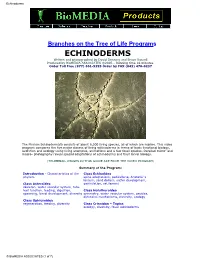
Echinoderms Branches on the Tree of Life Programs ECHINODERMS Written and photographed by David Denning and Bruce Russell Produced by BioMEDIA ASSOCIATES ©2005 - Running time 16 minutes. Order Toll Free (877) 661-5355 Order by FAX (843) 470-0237 The Phylum Echinodermata consists of about 6,000 living species, all of which are marine. This video program compares the five major classes of living echinoderms in terms of basic functional biology, evolution and ecology using living examples, animations and a few fossil species. Detailed micro- and macro- photography reveal special adaptations of echinoderms and their larval biology. (THUMBNAIL IMAGES IN THIS GUIDE ARE FROM THE VIDEO PROGRAM) Summary of the Program: Introduction - Characteristics of the Class Echinoidea phylum. spine adaptations, pedicellaria, Aristotle‘s lantern, sand dollars, urchin development, Class Asteroidea gastrulation, settlement skeleton, water vascular system, tube feet function, feeding, digestion, Class Holuthuroidea spawning, larval development, diversity symmetry, water vascular system, ossicles, defensive mechanisms, diversity, ecology Class Ophiuroidea regeneration, feeding, diversity Class Crinoidea – Topics ecology, diversity, fossil echinoderms © BioMEDIA ASSOCIATES (1 of 7) Echinoderms ... ... The characteristics that distinguish Phylum Echinodermata are: radial symmetry, internal skeleton, and water-vascular system. Echinoderms appear to be quite different than other ‘advanced’ animal phyla, having radial (spokes of a wheel) symmetry as adults, rather than bilateral (worm-like) symmetry as in other triploblastic (three cell-layer) animals. Viewers of this program will observe that echinoderm radial symmetry is secondary; echinoderms begin as bilateral free-swimming larvae and become radial at the time of metamorphosis. Also, in one echinoderm group, the sea cucumbers, partial bilateral symmetry is retained in the adult stages -- sea cucumbers are somewhat worm–like. -

Profiles and Biological Values of Sea Cucumbers: a Mini Review Siti Fathiah Masre
Life Sciences, Medicine and Biomedicine, Vol 2 No 4 (2018) 25 Review Article Profiles and Biological Values of Sea Cucumbers: A Mini Review Siti Fathiah Masre Biomedical Science Programme, Faculty of Health Sciences, Universiti Kebangsaan Malaysia (UKM), 50300 Kuala Lumpur, Malaysia. https://doi.org/10.28916/lsmb.2.4.2018.25 Received 8 October 2018, Revisions received 19 November 2018, Accepted 23 November 2018, Available online 31 December 2018 Abstract Sea cucumbers, blind cylindrical marine invertebrates that live in the ocean intertidal beds have more than thousand species available of varying morphology and colours throughout the world. Sea cucumbers have long been exploited in traditional treatment as a source of natural medicinal compounds. Various nutritional and therapeutic values have been linked to this invertebrate. These creatures have been eaten since ancient times and purported as the most commonly consumed echinoderms. Some important biological activities of sea cucumbers including anti-hypertension, anti-inflammatory, anti-cancer, anti-asthmatic, anti-bacterial and wound healing. Thus, this short review comes with the principal aim to cover the profile, taxonomy, together with nutritional and medicinal properties of sea cucumbers. Keywords: sea cucumber; invertebrate; echinoderm; therapeutic; taxonomy. 1.0 Introduction Sea cucumbers are marine invertebrate under phylum Echinodermata (Kamarudin et al., 2017). This cylindrical invertebrate that lives throughout the worlds’ oceans bed is known as sea cucumber or ‘gamat’ in Malaysia (Kamarudin et al., 2017). There are more than 1200 sea cucumber species available of varying morphology and colours throughout the world (Oh et al., 2017). Within the coastal areas of Malaysia, sea cucumbers can be located in Semporna Island, Pangkor Island, Tioman Island, Langkawi Island and coastal areas within Terengganu. -
ASMI Monthly Marketing Update December 2020
Email not displaying properly? View as webpage now >> ALASKA SEAFOOD MONTHLY UPDATE | DEC 2020 ALASKASEAFOOD.ORG | WILDALASKASEAFOOD.COM Foodservice Retail International Nutrition Resources Happy Holidays From the ASMI Team! Thank you, from all of us, for your shared commitment to increasing the value of Alaska's seafood resource. We look forward to continuing our mission on behalf of our state and our industry in the next year! Announcements A Successful Virtual All Hands On Deck! Thank you for joining ASMI for the 2020 All Hands on Deck Virtual Conference. Recordings and materials from of all committee and board meetings can be found found at www.alaskaseafood.org/all-hands-on-deck/. Extended: USDA Seafood Trade Relief Program The USDA has extended its deadline for its Seafood Trade Relief Program. Fishermen can now sign up for the program through Jan. 15, 2021. More details can be found online. Extended: Alaska Direct Marketers Survey ASMI is looking to better understand the needs of Alaska's direct marketers through a short online survey. If you are a direct marketer, take the survey before Jan. 1, 2021 for a chance to win $100. ASMI appreciates your thoughtful answers to help guide our strategy. TAKE THE SURVEY NOW ASMI Technical Program Update Michael Kohan recently departed ASMI to pursue a new opportunity within the industry. We are grateful for Michael's five years of dedication to the Alaska seafood industry in her role as Seafood Technical Director and wish her all the best in her future endeavors! For all technical or seafood quality questions, please contact ASMI Seafood Technical Coordinator, John Burrows. -

Sea Cucumber Trade from Africa to Asia
September 2020 A RAPID ASSESSMENT OF THE SEA CUCUMBER TRADE FROM AFRICA TO ASIA Simone Louw Markus Bűrgener SEA CUCUMBER TRADE DYNAMICS FROM AFRICA TO ASIA 1 SHORT REPORT TRAFFIC is a leading non-governmental organisation working globally on trade in wild animals and plants in the context of both biodiversity conservation and sustainable development. Reproduction of material appearing in this report requires written permission from the publisher. The designations of geographical entities in this publication, and the presentation of the material, do not imply the expression of any opinion whatsoever on the part of TRAFFIC or its supporting organisations concerning the legal status of any country, territory, or area, or of its authorities, or concerning the delimitation of its frontiers or boundaries. AuthorS Simone Louw Markus Bűrgener PROJECT Supervisor Camilla Floros Published by: TRAFFIC International, Cambridge, United Kingdom. Dried sea cucumbers destined for export, confiscated by the South African Postal Service in 2016 SUGGESTED CITATION Louw, S., Bűrgener, M., (2020). A Rapid Assessment of the Sea Cucumber trade from Africa to Asia. © TRAFFIC 2020. Copyright of material published in this report is vested in TRAFFIC. ACKNOWLEDGEMENTS ISBN: 978-1-911646-27-3 UK Registered Charity No. 1076722 The authors thank Camilla Floros, Glenn Sant, Nicola Okes, David Newton, Julie Thomson, Martin Andimile, Linah Clifford, Design Thomasina Oldfield, and Stephanie Pendry for their valued inputs Marcus Cornthwaite and helpful review of this document. The study was undertaken through the ReTTA (Reducing Trade Threats to Africa’s wild species and ecosystems) project, which is funded by Arcadia—a charitable fund of Lisbet Rausing and Peter Baldwin. -

Brooding in Psolus Patagonicus (Echinodermata: Holothuroidea) from Argentina, SW Atlantic Ocean
Helgol Mar Res (2010) 64:21–26 DOI 10.1007/s10152-009-0161-z ORIGINAL ARTICLE Brooding in Psolus patagonicus (Echinodermata: Holothuroidea) from Argentina, SW Atlantic Ocean Juliana Giménez · Pablo E. Penchaszadeh Received: 11 August 2008 / Revised: 21 April 2009 / Accepted: 28 April 2009 / Published online: 15 May 2009 © Springer-Verlag and AWI 2009 Abstract The mode, season, and time of brooding, egg diVerent substrata in a variety of habitats from southern diameter, egg number per brood, and the characteristics of Patagonia, including intertidal rocky shores and fronds and newly released juveniles of Psolus patagonicus were inves- holdfasts of Macrocystis pyrifera (Bernasconi 1941; Her- tigated oV Mar del Plata, Buenos Aires, Argentina, between nández 1981). Moreover, it is found as epizoic on the shells October 1999 and February 2001. Individuals were of live scallops of economic importance (Zygochlamys pat- attached to the Patagonian scallop, Zygochlamys patago- agonica) on the continental shelf oV Buenos Aires prov- nica. Spawning occurs between February and March. The ince, Argentina (Bremec and Lasta 2002). Like many other mean egg diameter, 887 § 26 m, is the highest reported benthic invertebrates in the region, P. patagonicus is dis- for the family Psolidae. Eggs are brooded under the tributed in shallow waters at high latitudes (Patagonian and mother’s sole until they develop into crawling juveniles subantarctic area), and in deeper, colder waters at low lati- within 7 months. The largest embryos reached a length of tudes (oV the Rio de la Plata estuary). 1,941 § 228 m in September. During the brooding period Brooding behaviour in holothurians has been observed (February–September) the number of brooded embryos in at least 41 species (Smiley et al. -
High-Value Components and Bioactives from Sea Cucumbers for Functional Foods—A Review
Mar. Drugs 2011, 9, 1761-1805; doi:10.3390/md9101761 OPEN ACCESS Marine Drugs ISSN 1660-3397 www.mdpi.com/journal/marinedrugs Review High-Value Components and Bioactives from Sea Cucumbers for Functional Foods—A Review Sara Bordbar 1, Farooq Anwar 1,2 and Nazamid Saari 1,* 1 Faculty of Food Science and Technology, Universiti Putra Malaysia, Serdang, Selangor 43400, Malaysia; E-Mails: sara_bordbar@ymail.com (S.B.); fqanwar@yahoo.com (F.A.) 2 Department of Chemistry and Biochemistry, University of Agriculture, Faisalabad 38040, Pakistan * Author to whom correspondence should be addressed; E-Mail: nazamid@putra.ump.edu.my; Tel.: +60-389-468-385; Fax: +60-389-423-552. Received: 3 August 2011; in revised form: 30 August 2011 / Accepted: 8 September 2011 / Published: 10 October 2011 Abstract: Sea cucumbers, belonging to the class Holothuroidea, are marine invertebrates, habitually found in the benthic areas and deep seas across the world. They have high commercial value coupled with increasing global production and trade. Sea cucumbers, informally named as bêche-de-mer, or gamat, have long been used for food and folk medicine in the communities of Asia and Middle East. Nutritionally, sea cucumbers have an impressive profile of valuable nutrients such as Vitamin A, Vitamin B1 (thiamine), Vitamin B2 (riboflavin), Vitamin B3 (niacin), and minerals, especially calcium, magnesium, iron and zinc. A number of unique biological and pharmacological activities including anti-angiogenic, anticancer, anticoagulant, anti-hypertension, anti-inflammatory, antimicrobial, antioxidant, antithrombotic, antitumor and wound healing have been ascribed to various species of sea cucumbers. Therapeutic properties and medicinal benefits of sea cucumbers can be linked to the presence of a wide array of bioactives especially triterpene glycosides (saponins), chondroitin sulfates, glycosaminoglycan (GAGs), sulfated polysaccharides, sterols (glycosides and sulfates), phenolics, cerberosides, lectins, peptides, glycoprotein, glycosphingolipids and essential fatty acids. -

Echinodermata) De Águas Rasas Da Costa Brasileira
Programa de Pós-graduação em Diversidade Animal Universidade Federal da Bahia Luciana Ribeiro Martins Estudo Taxonômico dos Holothuroidea (Echinodermata) de águas rasas da costa Brasileira Salvador 2012 2 Luciana Ribeiro Martins Estudo Taxonômico dos Holothuroidea (Echinodermata) de águas rasas da costa Brasileira Dissertação apresentada ao Instituto de Biologia da Universidade Federal da Bahia para a obtenção do Título de Mestre em Zoologia pelo Programa de Pós-graduação em Diversidade Animal. Orientador (a): Carla M. Menegola Salvador 2012 3 Ficha catalográfica Martins, Luciana “Estudo Taxonômico dos Holothuroidea (Echinodermata) de águas rasas da costa Brasileira”. 134 páginas. Dissertação (Mestrado) - Instituto de Biologia da Universidade Federal da Bahia. Departamento de Zoologia. Programa de Pós- graduação em Diversidade Animal. 1. Taxonomia 2. Holotúria. I. Universidade Federal da Bahia. Instituto de Biologia. Departamento de Zoologia. Programa de Pós- graduação em Diversidade Animal. 5 Epígrafe O princípio da sabedoria é chamar as coisas pelos seus nomes corretos. Provérbio Chinês. 6 Agradecimentos Ao Programa de Pós Graduaçao em Diversidade Animal (PPGDA-UFBA). À Coordenação de Aperfeiçoamento de Pessoal de Nível Superior (CAPES) pela concessão da bolsa durante o mestrado e (PROAP-PPGDA) pelo auxílio financeiro. À Drª. Carla Menegola pela orientação e oportunidade. Aos Drs. Ahmed Thandar (University of KwaZulu-Natal), David Pawson (USNM), Francisco Solís-Marín (UNAM) e Gustav Paulay (FLMNH) por todas as sugestões. Aos Drs. David Pawson (USNM), Rich Mooi (CAS), Carstern Lueter (ZMB), Martin Lindsey Christoffersen & Carmem Alonso (UFPB), Walter Cerqueira (MZUEFS) e César Carqueja (MZFTC) pelo empréstimo de espécimes. Aos Drs. Aline Benetti (MZUSP), Lucia Campos (UFRJ) e Renato Ventura (MNRJ) pela visita as suas respectivas coleções.