Two New Trap-Door Spiders from Thailand Araneae Mygalomorphae
Total Page:16
File Type:pdf, Size:1020Kb
Load more
Recommended publications
-

Archiv Für Naturgeschichte
ZOBODAT - www.zobodat.at Zoologisch-Botanische Datenbank/Zoological-Botanical Database Digitale Literatur/Digital Literature Zeitschrift/Journal: Archiv für Naturgeschichte Jahr/Year: 1905 Band/Volume: 71-2_2 Autor(en)/Author(s): Lucas Robert Artikel/Article: Arachnida für 1904. 925-993 © Biodiversity Heritage Library, http://www.biodiversitylibrary.org/; www.zobodat.at Arachnida fiir 1904. Bearbeitet von Dr. Robert Lucas. A. Publikationen (Autoren alphabetisch). d'Agostino, A. P. Prima nota dei Ragni deU'Avelliiiese. Avellino 1/8 4 pp. Banks, Nathan (1). Some spiders and mites from Bermuda Islands. Trans. Connect. Acad. vol. XI, 1903 p. 267—275. — {%), The Arachnida of Florida. Proc. Acad. Philad. Jan. 1904 p. 120—147, 2 pls. (VII u. VIII). — (3). Some Arachnida from CaUfornia. Proc. Californ. Acad. III No. 13. p. 331—374, pls. 38—41. — (4). Arachnida (in) Alaska; from the Harriman Alaska Ex- pedition vol. VIII p. 37—45, 11 pls. — Abdruck der Publikation von 1900 aus d. Proc. Washington Acad. vol. II p. 477—486. Berthoumieu, L' Abbe. Revision de l'entomologie dans 1' Antiquite. Arachnides p. 197—200 (Chelifer, Scorpiones, Galeodes, Aranea, Ixodes, Tyroglyphus et Cheyletus). Eev. Sei. Bourbonnais 1904, p. 167. Bolton, H. The Palaeontology of the Lancashire Goal Measures. Manchester. Mus. Owens Coli. Publ. 50. Mus. Handb. p. 378—415. — Abdruck aus Trans. Manchester geol. min. Soc. vol. 28. Brown, Rob. (I). Rectifications tardives mais necessaires. Proc- verb. Soc. Linn. Bordeaux, vol. 59 p. LXVIII—LXX. — Auch über Arachniden. Calman, W. T. Arachnida in Zool. Record for 1903 vol. XL. XI 47 pp. Cambridge, F. 0. Pickard. 1901. Further Contributions towards the Knowledge of the Arachnida of Epping Forest. -
Project Name
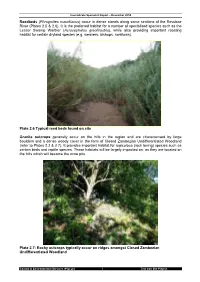
Invertebrate Specialist Report – December 2014 Reedbeds (Phragmites mauritianus) occur in dense stands along some sections of the Revuboe River (Plates 2.5 & 2.6). It is the preferred habitat for a number of specialised species such as the Lesser Swamp Warbler (Acrocephalus gracilirostris), while also providing important roosting habitat for certain dryland species (e.g. weavers, bishops, swallows). Plate 2.6 Typical reed beds found on site Granite outcrops generally occur on the hills in the region and are characterised by large boulders and a dense woody cover in the form of Closed Zambezian Undifferentiated Woodland (refer to Plates 2.2 & 2.7). It provides important habitat for rupiculous (rock loving) species such as certain birds and reptile species. These habitats will be largely impacted on, as they are located on the hills which will become the mine pits Plate 2.7: Rocky outcrops typically occur on ridges amongst Closed Zambezian Undifferentiated Woodland Coastal & Environmental Services (Pty) Ltd 3 Tete Iron Ore Project Invertebrate Specialist Report – December 2014 Dambos occur as linear open areas of hydrophilic grasslands with rushes and sedges, which contrast with surrounding woodland, in this case the mopane woodlands (Figure 2.1 and Plate 2.8). A Dambo is essentially is a plateau wetland, which is “a seasonally waterlogged, predominantly grass-covered, depression (i.e. vlei)”. They may be substantially dry at the end of the dry season, revealing grey soils or black clays, but unlike flooded grassland, they retain wet lines of drainage through the dry season. They are inundated (waterlogged) in the wet season but not generally above the height of the vegetation and any open water surface is usually confined to streams, rivers and small ponds or lagoons at the lowest point, generally near the centre. -
Final Project Completion Report
CEPF SMALL GRANT FINAL PROJECT COMPLETION REPORT Organization Legal Name: - Tarantula (Araneae: Theraphosidae) spider diversity, distribution and habitat-use: A study on Protected Area adequacy and Project Title: conservation planning at a landscape level in the Western Ghats of Uttara Kannada district, Karnataka Date of Report: 18 August 2011 Dr. Manju Siliwal Wildlife Information Liaison Development Society Report Author and Contact 9-A, Lal Bahadur Colony, Near Bharathi Colony Information Peelamedu Coimbatore 641004 Tamil Nadu, India CEPF Region: The Western Ghats Region (Sahyadri-Konkan and Malnad-Kodugu Corridors). 2. Strategic Direction: To improve the conservation of globally threatened species of the Western Ghats through systematic conservation planning and action. The present project aimed to improve the conservation status of two globally threatened (Molur et al. 2008b, Siliwal et al., 2008b) ground dwelling theraphosid species, Thrigmopoeus insignis and T. truculentus endemic to the Western Ghats through systematic conservation planning and action. Investment Priority 2.1 Monitor and assess the conservation status of globally threatened species with an emphasis on lesser-known organisms such as reptiles and fish. The present project was focused on an ignored or lesser-known group of spiders called Tarantulas/ Theraphosid spiders and provided valuable information on population status and potential conservation sites in Uttara Kannada district, which will help in future monitoring and assessment of conservation status of the two globally threatened theraphosid species T. insignis and Near Threatened T. truculentus. Investment Priority 2.3. Evaluate the existing protected area network for adequate globally threatened species representation and assess effectiveness of protected area types in biodiversity conservation. -

SA Spider Checklist
REVIEW ZOOS' PRINT JOURNAL 22(2): 2551-2597 CHECKLIST OF SPIDERS (ARACHNIDA: ARANEAE) OF SOUTH ASIA INCLUDING THE 2006 UPDATE OF INDIAN SPIDER CHECKLIST Manju Siliwal 1 and Sanjay Molur 2,3 1,2 Wildlife Information & Liaison Development (WILD) Society, 3 Zoo Outreach Organisation (ZOO) 29-1, Bharathi Colony, Peelamedu, Coimbatore, Tamil Nadu 641004, India Email: 1 manjusiliwal@rediffmail.com; 3 herpinvert@vsnl.com ABSTRACT Thesaurus, (Vol. 1) in 1734 (Smith, 2001). Most of the spiders After one year since publication of the Indian Checklist, this is described during the British period from South Asia were by an attempt to provide a comprehensive checklist of spiders of foreigners based on the specimens deposited in different South Asia with eight countries - Afghanistan, Bangladesh, Bhutan, India, Maldives, Nepal, Pakistan and Sri Lanka. The European Museums. Indian checklist is also updated for 2006. The South Asian While the Indian checklist (Siliwal et al., 2005) is more spider list is also compiled following The World Spider Catalog accurate, the South Asian spider checklist is not critically by Platnick and other peer-reviewed publications since the last scrutinized due to lack of complete literature, but it gives an update. In total, 2299 species of spiders in 67 families have overview of species found in various South Asian countries, been reported from South Asia. There are 39 species included in this regions checklist that are not listed in the World Catalog gives the endemism of species and forms a basis for careful of Spiders. Taxonomic verification is recommended for 51 species. and participatory work by arachnologists in the region. -
WO 2017/035099 Al 2 March 2017 (02.03.2017) P O P C T
(12) INTERNATIONAL APPLICATION PUBLISHED UNDER THE PATENT COOPERATION TREATY (PCT) (19) World Intellectual Property Organization International Bureau (10) International Publication Number (43) International Publication Date WO 2017/035099 Al 2 March 2017 (02.03.2017) P O P C T (51) International Patent Classification: BZ, CA, CH, CL, CN, CO, CR, CU, CZ, DE, DK, DM, C07C 39/00 (2006.01) C07D 303/32 (2006.01) DO, DZ, EC, EE, EG, ES, FI, GB, GD, GE, GH, GM, GT, C07C 49/242 (2006.01) HN, HR, HU, ID, IL, IN, IR, IS, JP, KE, KG, KN, KP, KR, KZ, LA, LC, LK, LR, LS, LU, LY, MA, MD, ME, MG, (21) International Application Number: MK, MN, MW, MX, MY, MZ, NA, NG, NI, NO, NZ, OM, PCT/US20 16/048092 PA, PE, PG, PH, PL, PT, QA, RO, RS, RU, RW, SA, SC, (22) International Filing Date: SD, SE, SG, SK, SL, SM, ST, SV, SY, TH, TJ, TM, TN, 22 August 2016 (22.08.2016) TR, TT, TZ, UA, UG, US, UZ, VC, VN, ZA, ZM, ZW. (25) Filing Language: English (84) Designated States (unless otherwise indicated, for every kind of regional protection available): ARIPO (BW, GH, (26) Publication Language: English GM, KE, LR, LS, MW, MZ, NA, RW, SD, SL, ST, SZ, (30) Priority Data: TZ, UG, ZM, ZW), Eurasian (AM, AZ, BY, KG, KZ, RU, 62/208,662 22 August 2015 (22.08.2015) US TJ, TM), European (AL, AT, BE, BG, CH, CY, CZ, DE, DK, EE, ES, FI, FR, GB, GR, HR, HU, IE, IS, IT, LT, LU, (71) Applicant: NEOZYME INTERNATIONAL, INC. -

Biogeografía Histórica Y Diversidad De Arañas Mygalomorphae De Argentina, Uruguay Y Brasil: Énfasis En El Arco Peripampásico
i UNIVERSIDAD NACIONAL DE LA PLATA FACULTAD DE CIENCIAS NATURALES Y MUSEO Biogeografía histórica y diversidad de arañas Mygalomorphae de Argentina, Uruguay y Brasil: énfasis en el arco peripampásico Trabajo de tesis doctoral TOMO I Lic. Nelson E. Ferretti Centro de Estudios Parasitológicos y de Vectores CEPAVE (CCT- CONICET- La Plata) (UNLP) Directora: Dra. Alda González Codirector: Dr. Fernando Pérez-Miles Argentina Año 2012 “La tierra y la vida evolucionan juntas”… León Croizat (Botánico y Biogeógrafo italiano) “Hora tras hora… otra de forma de vida desaparecerá para siempre de la faz del planeta… y la tasa se está acelerando” Dave Mustaine (Músico Estadounidense) A la memoria de mi padre, Edgardo Ferretti ÍNDICE DE CONTENIDOS TOMO I Agradecimientos v Resumen vii Abstract xi Capítulo I: Introducción general. I. Biogeografía. 2 II. Biogeografía histórica. 5 III. Áreas de endemismo. 11 IV. Marco geológico. 14 IV.1- Evolución geológica de América del Sur. 15 IV.2- Arco peripampásico. 23 V. Arañas Mygalomorphae. 30 VI. Objetivos generales. 34 Capítulo II: Diversidad, abundancia, distribución espacial y fenología de la comunidad de Mygalomorphae de Isla Martín García, Ventania y Tandilia. I. INTRODUCCIÓN. 36 I.1- Isla Martín García. 36 I.2- El sistema serrano de Ventania. 37 I.3- El sistema serrano de Tandilia. 38 I.4- Las comunidades de arañas en áreas naturales. 39 I.5- ¿Porqué estudiar las comunidades de arañas migalomorfas? 40 II. OBJETIVOS. 42 II.1- Objetivos específicos. 42 III. MATERIALES Y MÉTODOS. 43 III.1- Áreas de estudio. 43 III.1.1- Isla Martín García. 43 III.1.2- Sistema de Ventania. -

Royal Society of Western Australia, 97: 57–64, 2014
WA Science—Journal of the Royal Society of Western Australia, 97: 57–64, 2014 Arachnida (Arthropoda: Chelicerata) of Western Australia: overview and prospects M S HARVEY * Department of Terrestrial Zoology, Western Australian Museum, Locked Bag 49, Welshpool DC, WA 6986, Australia. mark.harvey@museum.wa.gov.au. The history of the study of arachnids (spiders, scorpions, ticks, mites and their relatives) in Western Australia is briefly reviewed, and the main periods of activity are documented: 1860s–1910s, between the wars, after World War II, and the modern era. The fauna consists of at least 1400 named species (but the mite fauna is imperfectly documented), and it is estimated that ~6000 species exist, the majority of which are currently undescribed KEYWORDS: history, pseudoscorpions, scorpions, spiders, taxonomy. INTRODUCTION nowadays known as Missulena granulosum (Cambridge). This species is quite common throughout southwestern The arachnid fauna of Western Australia represents a Australia where it persists in woodland habitats. The fascinating tableau of ancient relictual species and more next arachnid to be described was Idiops blackwalli recently arrived invaders. While the spiders (order Cambridge (1870) based on an adult male collected from Araneae) and mites (superorder Acari) are numerically Swan River. The species was quickly transferred to a new dominant, representatives of six other orders— genus by Ausserer (1871). Idiommata blackwalli is a large, Scorpiones, Pseudoscorpiones, Opiliones, Schizomida, impressive species still common in the Perth region. The Amblypygi and Palpigradi (Figure 1)—have been found trapdoor spiders Aganippe latior (based on a female from in the state. The size of the fauna is unknown, but ‘West Australia’), Eriodon insignis (based on a male from certainly comprises several thousand species, the Swan River), and E. -

A New Species of the Trapdoor Spiders Genus Idiops Perty, 1833 (Araneae: Idiopidae) from the Western Ghats, with a Key to the Idiops of India
Revista Ibérica de Aracnología, nº 21 (31/12/2012): 9‒14. ARTÍCULO Grupo Ibérico de Aracnología (S.E.A.). ISSN: 1576 - 9518. http://www.sea-entomologia.org/ A NEW SPECIES OF THE TRAPDOOR SPIDERS GENUS IDIOPS PERTY, 1833 (ARANEAE: IDIOPIDAE) FROM THE WESTERN GHATS, WITH A KEY TO THE IDIOPS OF INDIA Zeeshan A. Mirza1, Varun V. Vaze2 & Rajesh V. Sanap3 1 Post-Graduate Program in Wildlife Biology & Conservation, WCS-India Program, F-21, National Centre for Biological Sciences, Tata Institute of Fundamental Research, GKVK, Bellary Road, Bangalore 560065, India ‒ snakeszeeshan@gmail.com 2 Biospheres, Eshwari, 52/403, Lakshminagar, Paravati, Pune 411 009, Maharashtra, India ‒ varunvaze@gmail.com 3 D-5/2, Marol Police Camp, M. M. Road, Andheri (East), Mumbai, 400059, Maharashtra, India. ‒ rajeshvsanap@gmail.com Abstract: A new species of the trapdoor spider genus Idiops Perty, Idiops kaasensis sp. n., is described from Kaas Plateau in the Satara District (Western Ghats, Maharashtra, India). A key to the known Indian species of the genus is presented. Key words: Araneae, Idiopidae, new species, Kaas Plateau, Satara, Maharashtra, India. Una especie nueva de araña del género Idiops Perty, 1833 (Araneae: Idiopidae) de los Ghats Occidentales, con una clave para los Idiops de la India Resumen: Se describe una nueva especie de araña de trampilla del género Idiops Perty, Idiops kaasensis sp. n., procedente de la meseta de Kaas, en el distrito de Satara (Ghats Occidentales, Maharashtra, India). Se presenta una clave para las especies conoci- das del género de la India. Palabras clave: Araneae, Idiopidae, especie nueva, meseta de Kaas, Satara, Maharashtra, India. -

New Records of 43 Spider Species from the Mountain Zebra National Park, South Africa (Arachnida: Araneae)
New records of 43 spider species from the Mountain Zebra National Park, South Africa (Arachnida: Araneae) A.S. DIPPENAAR-SCHOEMAN Dippenaar-Schoeman, A.S. 2006. New records of 43 spider species from the Mountain Zebra National Park, South Africa (Arachnida: Araneae). Koedoe 49(2): 23–28. Pretoria. ISSN 0075-6458. Forty-three new spider species records have been added to the check list of spiders pub- lished in 1988 on the spiders of the Mountain Zebra National Park. An updated check list with information on the guilds, habitat preferences and web types are provided for the 34 families, 66 genera and 76 species presently known from the park. A total of 3.8 % of the spiders known from South Africa are presently protected in the park. Fourteen of the 34 families representing 35 species (46.1 %) are web builders and twenty-one families represented by 41 species (53.9 %) are wanderers. The Thomisidae are the most diverse family represented by 11 species. This is an inventory project of the South African National Survey of Arachnida (SANSA) for spiders in the Nama Karoo and conserved areas. Key words: Araneae, check list, Mountain Zebra National Park, Nama Karoo, spiders, South African National Survey of Arachnida. A.S. Dippenaar-Schoeman, Agricultural Research Council, Plant Protection Research Institute, Biosystematics Division, Private Bag X134, Queenswood, 0121 Republic of South Africa/ Department of Zoology and Entomology, University of Pretoria, Pretoria, 0002 Republic of South Africa. Introduction and the Soutpansberg Conservancy (Foord et al. 2002). This study forms part of the South African National Survey of Arachnida (SANSA), The Mountain Zebra National Park (MZNP) initiated in 1997 with the main aim to is 24 km west of Cradock in the Eastern Cape create an inventory of the arachnid fauna Province and was proclaimed as a protected of South Africa (Dippenaar-Schoeman & area in 1937. -

Arachnida, Araneae) of the Savanna Biome in South Africa
The faunistic diversity of spiders (Arachnida, Araneae) of the Savanna Biome in South Africa S.H. Foord1, A.S. Dippenaar-Schoeman2& C.R Haddad3 1Department of Zoology, Centre for Invasion Biology, University of Venda, Private Bag X5050, Thohoyandou, 0950, South Africa 2 ARC-Plant Protection Research Institute, Private Bag X134, Queenswood 0121/Department of Zoology &Entomology, University of Pretoria, Pretoria 0001, South Africa 3Department of Zoology & Entomology, University of the Free State, P.O. Box 339, Bloemfontein 9300, South Africa Invertebrates include more than 80% of all animals, yet they are severely under-represented in studies of southern African diversity. Site biodiversity estimates that do not consider invertebrates, not only omit the greatest part of what they are attempting to measure, but also ignore major contributors to essential ecosystem processes. All available information on spider species distribution in the South African Savanna Biome was compiled. This is the largest biome in the country,occupying over one third of the surface area.A total of 1230 species represented by 381genera and 62 families are known from the biome. The last decade has seen an exponential growth in the knowledge of the group in South Africa, but there certainly are several more species that have to be discovered, and the distribution patterns of those listed are partly unknown. Information is summarized for all quarter degree squares of the biome and reveals considerable inequalities in knowledge. At a large scale the eastern region is much better surveyed than the western parts, but at smaller scales throughout the region, several areas have little information. -

(Araneae, Mygalomorphae, Idiopidae) from Western Ghats, India
Journal of Asia-Pacific Biodiversity 8 (2015) 242e246 HOSTED BY Contents lists available at ScienceDirect Journal of Asia-Pacific Biodiversity journal homepage: http://www.elsevier.com/locate/japb Short communication A new large trapdoor spider species of the genus Heligmomerus Simon 1892 (Araneae, Mygalomorphae, Idiopidae) from Western Ghats, India Rajesh V. Sanap, Zeeshan A. Mirza* Biodiversity Laboratory, National Centre for Biological Sciences, Tata Institute of Fundamental Research, Bangalore, India article info abstract Article history: A new species of trapdoor spider, Heligmomerus maximus sp. nov. is described from southern Western Received 11 April 2015 Ghats of Kerala state, India. The new species differs from known species of the genus from India and Sri Received in revised form Lanka in possessing a band of thorn-like spinules on coxa IV. Moreover it is the largest species of the 30 July 2015 genus with adult females reaching a length up to 32 mm and the burrows are shallow compared with Accepted 31 July 2015 other species of the genus. Available online 18 August 2015 Copyright Ó 2015, National Science Museum of Korea (NSMK) and Korea National Arboretum (KNA). Production and hosting by Elsevier. This is an open access article under the CC BY-NC-ND license (http:// Keywords: burrows creativecommons.org/licenses/by-nc-nd/4.0/). Idiopidae Mygalomorphae natural history Introduction present communication provides a description of the new species as a contribution towards Indian arachnology. The trap door spider family Idiopidae is represented by 22 genera and 319 species in the world (Platnick 2015). India is host to three genera namely: Heligmomerus Simon 1892, Idiops Perty, 1833, Materials and methods and Scalidognathus Karsch, 1891 and eleven species (Sanap and Mirza 2011; Mirza et al 2012; Mirza and Sanap 2012). -
Checklist of Spiders (Arachnida: Araneae) from India-2012
© Indian Society of Arachnology ISSN 2278 - 1587(Online) CHECKLIST OF SPIDERS (ARACHNIDA: ARANEAE) FROM INDIA-2012 Keswani, S.; P. Hadole and A. Rajoria* SGB Amravati University, Amravati-444602 keswaniseema10@gmail.com; priya.hadole@gmail.com *Indraprastha University, Delhi; anuradha.rajoria8@gmail.com ABSTRACT Spiders comprise one of the largest (5-6th) orders of animals. The spider fauna of India has never been studied in its entirety despite of contributions by many arachnologists since Stoliczka (1869). In the present paper, we provide an updated checklist of spiders from India based on published records and on the collections of the Arachnology Museum, SGB Amravati University. A total of 1686 species of spiders are now recorded from India. They belong to two infraorders, Mygalomorphae and Araneomorphae, 60 families and 438 genera. The list also includes 70 species from Karakorum. The spider diversity in India is dominated by Saltisids followed by Thomisids and then Araneids, Gnaphosids and Lycosids. Key words: India, Araneae, spider fauna, checklist. INTRODUCTION The pioneering contribution on the taxonomy of Indian spiders is that of European arachnologist Stoliczka (1869). Review of available literature reveals that the earliest contribution by Blackwall (1867); Karsch (1873); Simon (1887); Thorell (1895) and Pocock (1900) were the pioneer workers of Indian spiders. They described many species from India. Tikader (1980, 1982), Tikader, and Malhotra (1980) described spiders from India. Tikader (1980) compiled a book on Thomisid spiders of India, comprising two subfamilies, 25 genera and 115 species. Of these, 23 species were new to science. Descriptions, illustrations and distributions of all species were given. Keys to the subfamilies, genera, and species were provided.