EXCALIBUR MINERAL CORPORATION – CATALOG 20701, Vol
Total Page:16
File Type:pdf, Size:1020Kb
Load more
Recommended publications
-
Download PDF About Minerals Sorted by Mineral Name
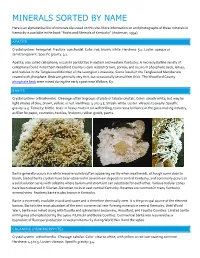
MINERALS SORTED BY NAME Here is an alphabetical list of minerals discussed on this site. More information on and photographs of these minerals in Kentucky is available in the book “Rocks and Minerals of Kentucky” (Anderson, 1994). APATITE Crystal system: hexagonal. Fracture: conchoidal. Color: red, brown, white. Hardness: 5.0. Luster: opaque or semitransparent. Specific gravity: 3.1. Apatite, also called cellophane, occurs in peridotites in eastern and western Kentucky. A microcrystalline variety of collophane found in northern Woodford County is dark reddish brown, porous, and occurs in phosphatic beds, lenses, and nodules in the Tanglewood Member of the Lexington Limestone. Some fossils in the Tanglewood Member are coated with phosphate. Beds are generally very thin, but occasionally several feet thick. The Woodford County phosphate beds were mined during the early 1900s near Wallace, Ky. BARITE Crystal system: orthorhombic. Cleavage: often in groups of platy or tabular crystals. Color: usually white, but may be light shades of blue, brown, yellow, or red. Hardness: 3.0 to 3.5. Streak: white. Luster: vitreous to pearly. Specific gravity: 4.5. Tenacity: brittle. Uses: in heavy muds in oil-well drilling, to increase brilliance in the glass-making industry, as filler for paper, cosmetics, textiles, linoleum, rubber goods, paints. Barite generally occurs in a white massive variety (often appearing earthy when weathered), although some clear to bluish, bladed barite crystals have been observed in several vein deposits in central Kentucky, and commonly occurs as a solid solution series with celestite where barium and strontium can substitute for each other. Various nodular zones have been observed in Silurian–Devonian rocks in east-central Kentucky. -

Washington State Minerals Checklist
Division of Geology and Earth Resources MS 47007; Olympia, WA 98504-7007 Washington State 360-902-1450; 360-902-1785 fax E-mail: geology@dnr.wa.gov Website: http://www.dnr.wa.gov/geology Minerals Checklist Note: Mineral names in parentheses are the preferred species names. Compiled by Raymond Lasmanis o Acanthite o Arsenopalladinite o Bustamite o Clinohumite o Enstatite o Harmotome o Actinolite o Arsenopyrite o Bytownite o Clinoptilolite o Epidesmine (Stilbite) o Hastingsite o Adularia o Arsenosulvanite (Plagioclase) o Clinozoisite o Epidote o Hausmannite (Orthoclase) o Arsenpolybasite o Cairngorm (Quartz) o Cobaltite o Epistilbite o Hedenbergite o Aegirine o Astrophyllite o Calamine o Cochromite o Epsomite o Hedleyite o Aenigmatite o Atacamite (Hemimorphite) o Coffinite o Erionite o Hematite o Aeschynite o Atokite o Calaverite o Columbite o Erythrite o Hemimorphite o Agardite-Y o Augite o Calciohilairite (Ferrocolumbite) o Euchroite o Hercynite o Agate (Quartz) o Aurostibite o Calcite, see also o Conichalcite o Euxenite o Hessite o Aguilarite o Austinite Manganocalcite o Connellite o Euxenite-Y o Heulandite o Aktashite o Onyx o Copiapite o o Autunite o Fairchildite Hexahydrite o Alabandite o Caledonite o Copper o o Awaruite o Famatinite Hibschite o Albite o Cancrinite o Copper-zinc o o Axinite group o Fayalite Hillebrandite o Algodonite o Carnelian (Quartz) o Coquandite o o Azurite o Feldspar group Hisingerite o Allanite o Cassiterite o Cordierite o o Barite o Ferberite Hongshiite o Allanite-Ce o Catapleiite o Corrensite o o Bastnäsite -
Mineral Processing
Mineral Processing Foundations of theory and practice of minerallurgy 1st English edition JAN DRZYMALA, C. Eng., Ph.D., D.Sc. Member of the Polish Mineral Processing Society Wroclaw University of Technology 2007 Translation: J. Drzymala, A. Swatek Reviewer: A. Luszczkiewicz Published as supplied by the author ©Copyright by Jan Drzymala, Wroclaw 2007 Computer typesetting: Danuta Szyszka Cover design: Danuta Szyszka Cover photo: Sebastian Bożek Oficyna Wydawnicza Politechniki Wrocławskiej Wybrzeze Wyspianskiego 27 50-370 Wroclaw Any part of this publication can be used in any form by any means provided that the usage is acknowledged by the citation: Drzymala, J., Mineral Processing, Foundations of theory and practice of minerallurgy, Oficyna Wydawnicza PWr., 2007, www.ig.pwr.wroc.pl/minproc ISBN 978-83-7493-362-9 Contents Introduction ....................................................................................................................9 Part I Introduction to mineral processing .....................................................................13 1. From the Big Bang to mineral processing................................................................14 1.1. The formation of matter ...................................................................................14 1.2. Elementary particles.........................................................................................16 1.3. Molecules .........................................................................................................18 1.4. Solids................................................................................................................19 -
Compilation of Reported Sapphire Occurrences in Montana
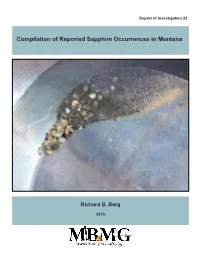
Report of Investigation 23 Compilation of Reported Sapphire Occurrences in Montana Richard B. Berg 2015 Cover photo by Richard Berg. Sapphires (very pale green and colorless) concentrated by panning. The small red grains are garnets, commonly found with sapphires in western Montana, and the black sand is mainly magnetite. Compilation of Reported Sapphire Occurrences, RI 23 Compilation of Reported Sapphire Occurrences in Montana Richard B. Berg Montana Bureau of Mines and Geology MBMG Report of Investigation 23 2015 i Compilation of Reported Sapphire Occurrences, RI 23 TABLE OF CONTENTS Introduction ............................................................................................................................1 Descriptions of Occurrences ..................................................................................................7 Selected Bibliography of Articles on Montana Sapphires ................................................... 75 General Montana ............................................................................................................75 Yogo ................................................................................................................................ 75 Southwestern Montana Alluvial Deposits........................................................................ 76 Specifi cally Rock Creek sapphire district ........................................................................ 76 Specifi cally Dry Cottonwood Creek deposit and the Butte area .................................... -

MAMMOTHITE: a Pb-Sb-Cu-Al OXY-HYDROXIDE-SULFATE — HYDROGEN ATOM DETERMINATION LOWERS SPACE GROUP SYMMETRY
canmin.52.4.00048 04-03-15 10:50 687 The Canadian Mineralogist Vol. 52, pp. 687-698 (2014) DOI: 10.3749/canmin.1400048 MAMMOTHITE: A Pb-Sb-Cu-Al OXY-HYDROXIDE-SULFATE — HYDROGEN ATOM DETERMINATION LOWERS SPACE GROUP SYMMETRY § JOEL D. GRICE Canadian Museum of Nature, PO Box 3443, Stn D, Ottawa, ON, K1P 6P4, Canada MARK A. COOPER Department of Geological Sciences, University of Manitoba, 125 Dysart Road, Winnipeg, MB, R3T 2N2, Canada ABSTRACT The crystal structure of mammothite, Pb6Cu4AlSbO2(SO4)2Cl4(OH)16, is monoclinic in acentric space group C2, with a 18.959(4), b 7.3398(19), c 11.363(3) Å, β 112.428(9)˚, V 1461.6(1.0) Å3, and Z = 2. It has been refined to an R index of 0.019 on the basis of 3878 observed reflections. There are three crystallographically distinct Pb sites with two different co-ordinations: [Pb1O8Cl1] is a mono-capped square antiprism polyhedron, while [Pb21O7Cl2] and [Pb22O7Cl2] are tri- capped trigonal prisms. Both Cu2+ sites have distorted [4 + 2] octahedral coordination due to the Jahn-Teller effect. The Al and Sb sites are regular-octahedral co-ordination with oxygen atoms. The [SO4] tetrahedron is quite distorted, with S–O bond lengths varying from 1.45 to 1.52 Å and subtended O–S–O angles varying from 106 to 113˚. In the structure there are eight (OH)– anions. All eight H atoms pfu were located, and it is these structure sites that reduce the symmetry from centric to acentric. Although mammothite is classified as a framework structure, it has a distinct layering. -
Alamosite Pbsio3 C 2001 Mineral Data Publishing, Version 1.2 ° Crystal Data: Monoclinic
Alamosite PbSiO3 c 2001 Mineral Data Publishing, version 1.2 ° Crystal Data: Monoclinic. Point Group: 2=m: Crystals ¯brous [010]; as radiating aggregates and balls, to 7.5 cm. k Physical Properties: Cleavage: Perfect on 010 . Hardness = 4.5 D(meas.) = 6.488(3) D(calc.) = [6.30] f g Optical Properties: Transparent to translucent. Color: Colorless to white, cream, or light gray. Luster: Adamantine. Optical Class: Biaxial ({). Orientation: Y = b. Dispersion: r < v; strong, weak inclined. ® = 1.945{1.947 ¯ = 1.955{1.961 ° = 1.959{1.968 2V(meas.) = 65± Cell Data: Space Group: P 2=n: a = 12.247 b = 7.059 c = 11.236 ¯ = 113:12± Z = 12 X-ray Powder Pattern: Tsumeb, Namibia. 3.34 (100), 3.56 (95), 3.53 (75), 2.300 (75), 3.23 (70), 2.987 (70), 3.25 (60) Chemistry: (1) (2) (3) SiO2 21.11 20.01 21.21 Al2O3 0.09 FeO 0.09 0.18 MnO 0.02 PbO 78.13 78.95 78.79 CaO trace 0.09 insol: 0.61 Total 99.94 99.34 100.00 (1) Alamos, Mexico. (2) Tsumeb, Namibia; by electron microprobe. (3) PbSiO3: Occurrence: As a rare secondary mineral in the oxidized zone of lead-bearing base metal deposits. Association: Wulfenite, leadhillite, cerussite (Alamos, Mexico); leadhillite, anglesite, melanotekite, °eischerite, kegelite, hematite (Tsumeb, Namibia); diaboleite, phosgenite, cerussite, wulfenite, willemite (Tiger, Arizona, USA); melanotekite, shattuckite, wickenburgite (Rawhide mine, Arizona, USA). Distribution: From Mexico, in Sonora, at Alamos, and the San Pascual mine, near Zimap¶an, Hidalgo. In the USA, from Arizona, in the Mammoth-St. -
The Picking Table Volume 27, No. 1 – Spring 1986
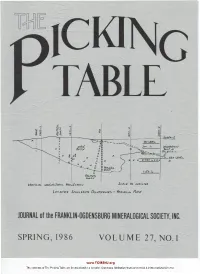
TABLE JOURNAL of the FRANKLIN-OGDENSBURG MINERALOGICAL SOCIETY, INC. SPRING. 1986 VOLUME 27, NO.l The contents of The Picking Table are licensed under a Creative Commons Attribution-NonCommercial 4.0 International License. F.QM.S. Notes prise a spectacular fluorescent display. For PRESIDENT'S MESSAGE years the Gerstmann Mineral Museum has displayed the collection for the delight and With the melting of the snow, the rocks of education of amateur and professional mineralo- the Buckwheat Dump emerge from their white gists alike. The Franklin Mineral Museum mantle, and the seismic tremors rumble through is most grateful to Arthur and Harriet Mitteldorf the souls of the collector community. Whatever for this most generous donation and to Ewald Spring may mean to the average mortal, to Gerstmann for its accumulation and for his FOMS members it brings a special appeal to sponsorship of the Franklin Mineral Museum dig in the dirt, not to plant, but to explore as the recipient. Transfer of the collection again the crystalline mysteries of Nature. will be effected as soon as suitable space is available to house it. Let us not lose sight of the fact that we are a community, however widespread, dedicated JLB to a great common interest and purpose: the expansion and preservation of knowledge about the world's most remarkable mineral location. ABOUT THE COVER SKETCH Like all great enterprises, this demands the efforts and participation of many. To the Located Sphalerite Occurrences—Franklin Mine extent that we share our knowledge, our time, and our interest with each other and the world, It is suggested that you refer to this hand Franklin lives. -

MINERALS and MINERAL VARIETIES from METAMORPHOSED Mn DEPOSITS of BISTRITA MOUNTAINS, ROMANIA
Acta Mineralogica-Petrographica, Abstract Series 1, Szeged, 2003 MINERALS AND MINERAL VARIETIES FROM METAMORPHOSED Mn DEPOSITS OF BISTRITA MOUNTAINS, ROMANIA HÎRTOPANU, P.1 & SCOTT, P.2 1 Geological Institute of Romania, Caransebeş 1, RO-78344 Bucharest, Romania. E-mail: paulina.hirtopanu@igr.ro 2 Camborne School of Mines, Redruth, Cornwall, United Kingdom. The Bistrita Mountains belong to the Crystalline Meso- mation of some amphiboles and some pyroxenes into other zoic Zone of the East Carpathians, which consists of super- phases, there are drastical transformations of pyroxenes into posed Variscan and Alpine Nappes, overthrusted eastwards pyroxenoids (johannsenite into rhodonite), pyroxenoids into over the Flysch Zone. The manganese ore is contained by pyroxenoids (pyroxmangite into rhodonite), pyroxmangite Tulghes Group (Tg2 level) of the Variscan Putna Nappe, into manganogrunerite, garnets into garnets (spessartine- situated over the Pietrosu Bistritei Nappe and supporting the calderite into spessartine, spessartine into anisotropic spes- thrusting of the Rebra Nappe. All these Variscan nappes sartine-andradite-grossular), calderite into pyroxmangite- constitute the Alpine Sub-Bucovinian Nappe localised be- magnetite, etc. are the best evidences of continuous variation tween Alpine Infrabucovinian Nappe in the East and the of formation conditions. Alpine Bucovinian Nappe in the West. The Mn ore have a predominant carbonate rather than The mineralogy of Mn metamorphosed deposits from silicate mineralogical composition, which means a great CO2 Bistrita Mts. includes 328 minerals and mineral varieties. fluid control in the carbonation and dehydration processes They may count among the mineralogically the most com- along the many stages of the whole history of the ore and the plex deposits of the world. -

Infrare D Transmission Spectra of Carbonate Minerals
Infrare d Transmission Spectra of Carbonate Mineral s THE NATURAL HISTORY MUSEUM Infrare d Transmission Spectra of Carbonate Mineral s G. C. Jones Department of Mineralogy The Natural History Museum London, UK and B. Jackson Department of Geology Royal Museum of Scotland Edinburgh, UK A collaborative project of The Natural History Museum and National Museums of Scotland E3 SPRINGER-SCIENCE+BUSINESS MEDIA, B.V. Firs t editio n 1 993 © 1993 Springer Science+Business Media Dordrecht Originally published by Chapman & Hall in 1993 Softcover reprint of the hardcover 1st edition 1993 Typese t at the Natura l Histor y Museu m ISBN 978-94-010-4940-5 ISBN 978-94-011-2120-0 (eBook) DOI 10.1007/978-94-011-2120-0 Apar t fro m any fair dealin g for the purpose s of researc h or privat e study , or criticis m or review , as permitte d unde r the UK Copyrigh t Design s and Patent s Act , 1988, thi s publicatio n may not be reproduced , stored , or transmitted , in any for m or by any means , withou t the prio r permissio n in writin g of the publishers , or in the case of reprographi c reproductio n onl y in accordanc e wit h the term s of the licence s issue d by the Copyrigh t Licensin g Agenc y in the UK, or in accordanc e wit h the term s of licence s issue d by the appropriat e Reproductio n Right s Organizatio n outsid e the UK. Enquirie s concernin g reproductio n outsid e the term s state d here shoul d be sent to the publisher s at the Londo n addres s printe d on thi s page. -
Mineral Collecting Sites in North Carolina by W
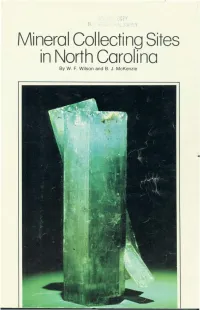
.'.' .., Mineral Collecting Sites in North Carolina By W. F. Wilson and B. J. McKenzie RUTILE GUMMITE IN GARNET RUBY CORUNDUM GOLD TORBERNITE GARNET IN MICA ANATASE RUTILE AJTUNITE AND TORBERNITE THULITE AND PYRITE MONAZITE EMERALD CUPRITE SMOKY QUARTZ ZIRCON TORBERNITE ~/ UBRAR'l USE ONLV ,~O NOT REMOVE. fROM LIBRARY N. C. GEOLOGICAL SUHVEY Information Circular 24 Mineral Collecting Sites in North Carolina By W. F. Wilson and B. J. McKenzie Raleigh 1978 Second Printing 1980. Additional copies of this publication may be obtained from: North CarOlina Department of Natural Resources and Community Development Geological Survey Section P. O. Box 27687 ~ Raleigh. N. C. 27611 1823 --~- GEOLOGICAL SURVEY SECTION The Geological Survey Section shall, by law"...make such exami nation, survey, and mapping of the geology, mineralogy, and topo graphy of the state, including their industrial and economic utilization as it may consider necessary." In carrying out its duties under this law, the section promotes the wise conservation and use of mineral resources by industry, commerce, agriculture, and other governmental agencies for the general welfare of the citizens of North Carolina. The Section conducts a number of basic and applied research projects in environmental resource planning, mineral resource explora tion, mineral statistics, and systematic geologic mapping. Services constitute a major portion ofthe Sections's activities and include identi fying rock and mineral samples submitted by the citizens of the state and providing consulting services and specially prepared reports to other agencies that require geological information. The Geological Survey Section publishes results of research in a series of Bulletins, Economic Papers, Information Circulars, Educa tional Series, Geologic Maps, and Special Publications. -
Thirty-Fourth List of New Mineral Names
MINERALOGICAL MAGAZINE, DECEMBER 1986, VOL. 50, PP. 741-61 Thirty-fourth list of new mineral names E. E. FEJER Department of Mineralogy, British Museum (Natural History), Cromwell Road, London SW7 5BD THE present list contains 181 entries. Of these 148 are Alacranite. V. I. Popova, V. A. Popov, A. Clark, valid species, most of which have been approved by the V. O. Polyakov, and S. E. Borisovskii, 1986. Zap. IMA Commission on New Minerals and Mineral Names, 115, 360. First found at Alacran, Pampa Larga, 17 are misspellings or erroneous transliterations, 9 are Chile by A. H. Clark in 1970 (rejected by IMA names published without IMA approval, 4 are variety because of insufficient data), then in 1980 at the names, 2 are spelling corrections, and one is a name applied to gem material. As in previous lists, contractions caldera of Uzon volcano, Kamchatka, USSR, as are used for the names of frequently cited journals and yellowish orange equant crystals up to 0.5 ram, other publications are abbreviated in italic. sometimes flattened on {100} with {100}, {111}, {ill}, and {110} faces, adamantine to greasy Abhurite. J. J. Matzko, H. T. Evans Jr., M. E. Mrose, lustre, poor {100} cleavage, brittle, H 1 Mono- and P. Aruscavage, 1985. C.M. 23, 233. At a clinic, P2/c, a 9.89(2), b 9.73(2), c 9.13(1) A, depth c.35 m, in an arm of the Red Sea, known as fl 101.84(5) ~ Z = 2; Dobs. 3.43(5), D~alr 3.43; Sharm Abhur, c.30 km north of Jiddah, Saudi reflectances and microhardness given. -

Kinoshitalite (Ba,K)(Mg,Mn,Al)3Si2al2o10(OH)2
Kinoshitalite (Ba; K)(Mg; Mn; Al)3Si2Al2O10(OH)2 c 2001 Mineral Data Publishing, version 1.2 ° Crystal Data: Monoclinic. Point Group: 2=m: Forms small scales, < 1 mm. Physical Properties: Cleavage: 001 , perfect. Tenacity: Brittle. Hardness = 2.5{3 D(meas.) = 3.30 D(calc.) = 3.33 f g Optical Properties: Semitransparent. Color: Yellow-brown to colorless; light yellow to colorless in thin section. Luster: Vitreous. Optical Class: Biaxial ({). Pleochroism: X = very light yellow to light yellow; Y = Z = light yellow with brownish tinge. Absorption: Y Z > X. ® = 1.619 ¯ = 1.628{1.633 ° = 1.635 ' 2V(meas.) = 23± Cell Data: Space Group: C2=m: a = 5.345(3) b = 9.250(4) c = 10.256(8) ¯ = 99:99(6)± Z = 2 X-ray Powder Pattern: Noda-Tamagawa mine, Japan. 3.37 (100), 2.52 (55), 2.020 (55), 5.05 (50), 10.1 (45), 1.684 (15), 3.16 (5) Chemistry: (1) (2) (1) (2) SiO2 24.58 23.43 BaO 17.85 27.60 TiO2 0.16 Na2O 0.68 0.11 Al2O3 22.06 19.25 K2O 3.30 0.24 Fe2O3 0.71 1.87 F 0.21 + Mn2O3 3.24 H2O 2.90 FeO 0.04 H2O¡ 0.20 MnO 7.38 2.62 H2O 3.50 MgO 16.60 21.95 O = F 0.09 ¡ 2 CaO 0.05 0.05 Total 99.87 100.62 2+ (1) Noda-Tamagawa mine, Japan; corresponds to (Ba0:58K0:35Na0:11Ca0:01)§=1:05(Mg2:06Mn0:52 3+ 3+ Al0:22Mn0:21Fe0:04Ti0:01)§=3:06Si2:05Al1:94O10[(OH)1:62O0:33F0:06]§=2:01: (2) Netra, India; by electron microprobe, total Fe as Fe2O3; corresponding to (Ba0:93K0:03Na0:02Ca0:01)§=0:99 (Mg2:80Mn0:19Fe0:08)§=3:07Si2:01(Al1:94Fe0:05)§=1:99O10(OH)2: Polymorphism & Series: 1M, 2M1 polytypes.