Mothers of the Believers
Total Page:16
File Type:pdf, Size:1020Kb
Load more
Recommended publications
-

Download Download
© 2020 Authors. Center for Study of Religion and Religious Tolerance, Belgrade, Serbia.This article is an open access article distributed under the terms and conditions of the Creative Commons Attribution-NonCommercial-ShareAlike 4.0 International License Labeeb A. Bsoul1 Overview paper Khalifa University UDC 28:341 United Arab Emirates THE ISLAMIC EPISTEME OF POLITIES DEVELOPMENT IN INTERNATIONAL AFFAIRS Abstract This paper illustrates the contributions of Islamic law to the development of transnational socio-political organisations that transcend racial and geopolitical fixations. Those are best enshrined in the premise of the unity of believing com- munity and humanity led to the Shari‘ah/Islamic law. Islam advocates the devel- opment and consolidation of communities. This study discusses the concept of ‘ummah’ (community of believers) according to the tradition of Prophet Muham- mad and surveys its development throughout the Islamic caliphates, sultanates, and imamates up until colonialism and modern ‘nation-state’ system. The article argues that there are ontological, epistemological, and normative differences spanning the divide between Muslim and Western worldviews especially con- cerning the development and management of their polities. Keywords: Islamic International Law/Siyar, Legal provisions, Politics, Muslim Jurists, Justice, State Introduction The Islamic religion should enhance people’s lives, while defining the limits of ‘free-living’ according to the Shari‘ah/Islamic law.2 This is derived from several aspects. The first is the origin or theoretical foundation of religion from which the conduct, behaviour, and purpose of existence are related to God and crea- tion. This is known as ‘ilm al-‘aqidah or usul al-din. The second pertains to the system, which defines the conduct of man in accordance with this ‘ilm in terms of social relations, finance and human interaction. -

Gce 'O' Level Islamiyat : Paper 01
GCE ‘O’ LEVEL ISLAMIYAT : PAPER 01 Topical Questions and Mark Scheme Compiled By : Syed Ruman Wajih Topical Past papers &Marking Schemes 2004------------ ------------ Islamiyat 2058/1 | 1 Topical Past papers &Marking Schemes 2004----------------- Islamiyat 2058/1 (PaperI) History and Importance of Quran Q1. (a) Briefly describe the four main sources of legal thinking in Islam. [12] (b) Give one example each to show how the third and fourth of these legal sources are used. [4] {November-05} (a) [Give up to 3 marks for each description.] • The Qur’an is the major source of instruction and thinking. • Its clear teachings are never questioned. • It is always referred to since no legal teaching ever contradicts it. • The Sunna of the Prophet is an authority next to the Qur’an. • It gives fuller teachings of what the Qur’an states in brief. • It and the Qur’an always agree. • It is taken as an authority where the Qur’an is silent. • The consensus of the community, ijma’, is referred to when the previous sources do not offer clear guidance. • It is understood as the agreement of believers on a point of faith or action. • Some take it as the consensus of the first generation of Muslims, others as the consensus of legal experts. • It never disagrees with the previous sources. • The Prophet said, ‘My community will never agree on error.’ • Analogy, qiyas, is employed when the previous sources do not offer clear guidance. • It involves an individual expert making a new decision on the basis of known teachings. • He compares the unknown with the known and identifies the common points between them. -

Marriage to Umm Habiba Tension in Mecca Had Reached Its Peak
limited the number of women a man could marry - the customary practice in pre-Islamic Arabia - and encouraged monogamy, allowed for God’s Messenger to marry several women in order for him to reach all his addressees in their entirety within as short a time as twenty-three years. The Messenger of God made use of this means in loosening such closely knit ties at a time when all the doors on which he knocked were slammed shut in his face. Moreover, it is not possible to suppose that the marriages of God’s Messenger, who stated, “God has assuredly willed that I marry only those who are of Paradise,”339 and who took his each and every step in line with the Divine injunctions, could be realized except by God's permission. Within this context, he states: “Each of my marriages and those of my daughters was conducted as a result of Divine permission conveyed to me through Gabriel.”340 In this way was he able to come together, on the basis of kinship, with those people who were not capable of being approached, and it was in these assemblies that the hearts of those who were consumed with hatred and enmity were softened. The marriages of God’s Messenger functioned as a bridge in his communication with them, and served to relax the atmosphere as well as legitimize his steps in their regard. He extended hospitality towards them, invited them to his wedding feasts using his marriages as a means to come together, and sent them gifts, drawing attention to their affinity. -
List of Sahaba
List of Sahaba A Abu Bakr As-Siddiq Abdullah ibn Abi Bakr Abdullah ibn Ja'far Abdu'l-Rahman ibn Abu Bakr Abdur Rahman ibn Sakran 'Abd al-Rahman ibn 'Awf Abdullah ibn Abbas Abd-Allah ibn Abd-Allah ibn Ubayy 'Abd Allah ibn 'Amr ibn al-'As Abdallah ibn Amir Abdullah ibn al-Zubayr Abdullah ibn Hudhafah as-Sahmi Abdullah ibn Jahsh Abdullah ibn Masud Abdullah ibn Suhayl Abd Allah ibn Hanzala Abd Allah ibn Mas'ada al-Fazari 'Abd Allah ibn Rawahah Abdullah ibn Salam Abdullah ibn Unais Yonis Aden Abdullah ibn Amr ibn Haram Abdullah ibn Zayd Abdullah ibn Umar Abd-Allah ibn Umm-Maktum Abdullah ibn Atik Abbad ibn Bishr Abu Basir Abu Darda Abū l-Ṭufayl ʿĀmir b. Wāthila al-Kinānī Abîd ibn Hamal Abîd ibn Hunay Abjr al-Muzni [ar] Abu al-Aas ibn al-Rabiah Abu Ayyub al-Ansari ‘Abbas ibn ‘Abd al-Muttalib Abu Dardaa Abû Dhar al-Ghifârî Abu Dujana Abu Fuhayra Abu Hudhaifah ibn Mughirah Abu-Hudhayfah ibn Utbah Abu Hurairah Abu Jandal ibn Suhail Abu Lubaba ibn Abd al-Mundhir Abu Musa al-Ashari Abu Sa`id al-Khudri Abu Salama `Abd Allah ibn `Abd al-Asad Abu Sufyan ibn al-Harith Abu Sufyan ibn Harb Abu Ubaidah ibn al-Jarrah Abu Zama' al-Balaui Abzâ al-Khuzâ`î [ar] Adhayna ibn al-Hârith [ar] Adî ibn Hâtim at-Tâî Aflah ibn Abî Qays [ar] Ahmad ibn Hafs [ar] Ahmar Abu `Usayb [ar] Ahmar ibn Jazi [ar][1] Ahmar ibn Mazan ibn Aws [ar] Ahmar ibn Mu`awiya ibn Salim [ar] Ahmar ibn Qatan al-Hamdani [ar] Ahmar ibn Salim [ar] Ahmar ibn Suwa'i ibn `Adi [ar] Ahmar Mawla Umm Salama [ar] Ahnaf ibn Qais Ahyah ibn -

Islamic Law and Social Change
ISLAMIC LAW AND SOCIAL CHANGE: A COMPARATIVE STUDY OF THE INSTITUTIONALIZATION AND CODIFICATION OF ISLAMIC FAMILY LAW IN THE NATION-STATES EGYPT AND INDONESIA (1950-1995) Dissertation zur Erlangung der Würde des Doktors der Philosophie der Universität Hamburg vorgelegt von Joko Mirwan Muslimin aus Bojonegoro (Indonesien) Hamburg 2005 1. Gutachter: Prof. Dr. Rainer Carle 2. Gutachter: Prof. Dr. Olaf Schumann Datum der Disputation: 2. Februar 2005 ii TABLE OF RESEARCH CONTENTS Title Islamic Law and Social Change: A Comparative Study of the Institutionalization and Codification of Islamic Family Law in the Nation-States Egypt and Indonesia (1950-1995) Introduction Concepts, Outline and Background (3) Chapter I Islam in the Egyptian Social Context A. State and Islamic Political Activism: Before and After Independence (p. 49) B. Social Challenge, Public Discourse and Islamic Intellectualism (p. 58) C. The History of Islamic Law in Egypt (p. 75) D. The Politics of Law in Egypt (p. 82) Chapter II Islam in the Indonesian Social Context A. Towards Islamization: Process of Syncretism and Acculturation (p. 97) B. The Roots of Modern Islamic Thought (p. 102) C. State and Islamic Political Activism: the Formation of the National Ideology (p. 110) D. The History of Islamic Law in Indonesia (p. 123) E. The Politics of Law in Indonesia (p. 126) Comparative Analysis on Islam in the Egyptian and Indonesian Social Context: Differences and Similarities (p. 132) iii Chapter III Institutionalization of Islamic Family Law: Egyptian Civil Court and Indonesian Islamic Court A. The History and Development of Egyptian Civil Court (p. 151) B. Basic Principles and Operational System of Egyptian Civil Court (p. -

Pilgrimage Sites
Category: General [3] Have they not travelled in the land so that they should have hearts with which to understand, or ears with which to hear? (Qur'an, 22:46) Planning a pilgrimage (ziyarat) to one of the places below? Click on a country to see important places you shouldn't miss visiting and taking note of. Places to Visit: Makkah Madina Jeddah Taif Abwa Badr Uhud Arafat Mina Makkah al-Mukarramah 1. Masjid al-Haraam • The Holy Ka'aba. The House of Allah and the birth place of Imam Ali b. Abi Taalib [a] • Hajar al-Aswad (The Black Stone) • Maqam Ibrahim • Hijr Ismail. This was the location of the house of Prophet Ismael [a]. He and his mother are buried here. He denied access to anyone because he did not like it to be walked on. Other prophets are buried in this place also. According to Imam Baqir [a], the place between Rukn and Maqam is full of graves of the Prophets. According to Imam Sadiq [a], seventy prophets are buried between Rukn al-Aiman and Hajar al-Aswad • Well of Zamzam • Mizabe Rahmah: the golden trough (water channel) between Rukn Iraqi and Rukn Shami • Shadharwan • Mustajar: This is just before Rukn Yamani whilst walking from Rukn Shami to Rukn Yamani. It has also been defined as the area between the Black Stone (hajar al-aswad) and the door of the Ka'aba • Mutaawadh or Multazam: The place between Rukn Yamani and the Black Stone (hajar al-aswad) • Hatwim. According to the book "Adabul Haramain", this is the place between the door of the Ka'aba and Hajar al-Aswad. -
Questions and Answers About Islam Vol
QUESTIONS AND ANSWERS ABOUT ISLAM VOL. 1 QUESTIONS & ANSWERS about ISLAM VOL. 1 Translated by Muhammed Çetin New Jersey 2006 Copyright © 2006 by The Light, Inc. First published 2000 Revised edition 2006 Originally published in Turkish as Asrýn Getirdiði Tereddütler (1-4) 09 08 07 06 2 3 4 5 All rights reserved. No part of this book may be reproduced or transmitted in any form or by any means, electronic or mechanical, including photocopying, recording or by any information storage and retrieval system without permission in writing from the Publisher. Published by The Light, Inc. 26 Worlds Fair Dr. Unit C Somerset, New Jersey, 08873, USA www.thelightpublishing.com http://fgulen.org Library of Congress Cataloging-in-Publication Data Gülen, Fethullah. [Asrin getirdigi tereddütler. English.] Questions & answers about Islam / by M. Fethullah Gülen ; translated by Muhammed Çetin. -- Rev. ed. p. cm. "Originally published in Turkish as Asrin getirdigi tereddütler." Includes bibliographical references and index. ISBN 1-59784-064-5 (v. 1 : pbk.) -- ISBN 1-59784-065-3 (v. 1 : hardcover) -- ISBN 1-932099-25-5 (v. 2 : pbk.) 1. Islam--Theology--Miscellanea. 2. Islam-- Doctrines--Miscellanea. I. Title. II. Title: Questions and answers about Islam. BP166.G8513 2006 297.2--dc22 2006026406 Printed by Çaðlayan A.Þ. Izmir, Turkey August 2006 TABLE OF CONTENTS Publisher’s Note........................................................................................vii About the Author.......................................................................................xi -
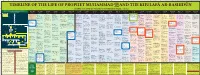
Umm Kulthum Bint ‘Ali Zaynab Bint ‘Ali the Shape That We See in the Present Prophet
TIMELINE OF THE LIFE OF PROPHET MUHAMMAD AND THE KHULAFĀ AR-RASHIDŪN “...SO ADHERE TO MY SUNNAH AND THE SUNNAH OF THE RIGHTLY-GUIDED KHULAFA...”(ABU DAWUD) SUMMARIZED LINEAGE OF THE PROPHET AND HIS RELATIONSHIP WITH THE KHULAFA AR-RASHIDUN 53-37 BH 28-13 BH 13-8 BH 8-4 BH 4-2 BH 1 BH-1 AH 1-2 AH 2-4 AH 4-6 AH 6-7 AH 7-8 AH 8-9 AH 9-11 AH 11 AH 11-13 AH 13-14 AH 15-17 AH 18-23 AH 23-31 AH 33-36 AH 36-37 AH 38-50 AH 570 CE 594 CE 608 CE 613 CE 617 CE 620 CE 622 CE 623 CE 625 CE 626 CE 628 CE 629 CE 630 CE 632 CE 632 CE 634 CE 636 CE 639 CE 643 CE 653 CE 656 CE 660 CE Indicates multiple generations in between Adam 12 Rabi’ al-Awal, 11 AH 11 AH 28 BH Sha’ban 4 AH Sha’ban, 6 AH Muharram, 7 AH Jumada al-Awal, 8 AH Rajab, 9 AH Jumada al-Thani, 13 AH Sha’ban 15 AH 18 AH Dhul Hijjah, 23 AH 33 AH Rabi’ al-Thani, 36 AH 9 Safar, 38 AH Indicates direct descendant 13 BH – 10 BH Dhul Hijjah, 8 BH Shawwal, 4 BH 1 BH Rabi’ al-Awal, 1 AH 17th Ramadan, 2 AH Nuh DEATH OF PROPHET DEATH OF FATIMAH MARRIAGE TO SECRET PREACHING ‘UMAR IBN AL- PROPHET’S JOURNEY MUS’AB IBN UMAIR BUILDING OF MASJID BATTLE OF BADR BIRTH OF AL-HUSAYN SLANDER OF Ā’ISHA EXPEDITION TO BATTLE OF MU’TAH EXPEDITION TO TABUK As foretold by the Prophet , BATTLE OF YARMOUK BATTLE OF QADISIYYAH GREAT FAMINE DEATH AND BURIAL OF RISE OF ABDULLAH IBN ‘ALI LEAVES BATTLE OF NAHRAWAN The Prophet secretly preaches his A group of 313 Muslims face off While the army and its caravan was The envoy the Prophet sends The Expedition to Tabuk takes MUHAMMAD Another major battle between the Under the command of Sa’ad ibn A severe drought causes famine The Khawarij are dealt a huge blow Indicate relations by marriage/concubinage KHADIJAH KHATTAB ACCEPTS TO AT-TA’IF SENT TO YATHRIB AN-NABAWI IBN ‘ALI KHAYBAR Fatimah is the first of his family to ‘UMAR SABA MADINAH FOR KUFA returning from the expedition of to the ruler of Busra in al-Sham is place, in which the Prophet The Prophet dies while lying on the Byzantine forces and the Muslims Abi Waqqas , the Muslims win the in Arabia. -
Demystifying Islam.Pdf
Demystifying Islam Your Guide to the Most Misunderstood Religion of the 21st. Century By Dr. Ali Shehata Edited by Julie Samia Mair. JD MPH 2019 Contents Author’s Introduction Important Terms Evidences for God Allah—His Very Name Means Love Monotheism—the Bedrock of Islam The Quran – the Spoken Word of God Modern Science and the Quran The Preservation of the Quran Hadith and the Sunnah of Muhammad —the Second Divine Revelation Can Hadith be Trusted as Authentic? A Sampling of Hadith of the Prophet Muhammad Muhammad —the Messenger of God The Character and Teachings of the Prophet Muhammad Was Muhammad Prophesied In Other Scriptures? Prophet or Liar? Looking Into the Matter of Prophecy Relevance of the Prophet Muhammad Today Jesus Christ—the Revered Son of Mary in the Islamic Scriptures Why Don't Muslims believe that Jesus is God? Why Don't Muslims believe that Jesus is the Son of God? How do Muslims view Salvation? Blind Faith? Jesus in Islam The Shariah of Islam—an Often Misunderstood Complete Way of Life Distinctive Features of Islamic Law The Islamic Criminal Punishment System The Issue of “Honor Killings” Islamic State or Muslim Country – Is there a Difference? The Islamic Stance on Terrorism and War - Direct from the Sources What are the Verses from the Quran that Mention Violence and War? Is Islam the Only Religion that Sanctions War and Fighting? Does Islam Condemn Terrorism Scripturally? Is Islam a Religion of Tolerance? A Brief Word on 9/11 Women in Islam: Hidden and Glorious Past, Uncertain Present Women in Modern Day Secular -

Islam Is the Religion of Lust. the Prophet of Islam Married Many Women
Islam is the religion of lust. The Prophet of Islam married many women. Answer The claim that Islam is a religion of lust is not true and this is an accusation that has always been raised by the enemies of Islam. According to the Qur'an, the Prophet ᴾᴮᵁᴴ is a prophet of mercy and piety, and his behavior confirms this. Numerous books and articles have been written about the marriages of the Prophet ᴾᴮᵁᴴ. Indeed, if the aim of the Prophet ᴾᴮᵁᴴ was to satisfy his lustful wishes, then why he did not accept the offer of the infidels to marry the best and most beautiful daughters of the Quraysh in order to stop propagating Islam?! In all civilized and non-civilized societies, in the past, there were numerous types of marriages without borders and Islam has adjusted it. The other thing is that if any one of these types got banned in any, only the name remained in the law and replaced by secret relations, prostitution, betrayal or, ultimately, absolute freedom of relationship. According to the verses of the Qur'an and the Sunnah of the Imams, the result was that polygamy is only a matter of religious recommendation and not advisable for everyone, but a ruling for exceptional circumstances and salvation from crisis and deadlocks. According to a verse in the Qur'an, the principle in Islam is monogamy, and those who want to marry a second wife must constantly practice justice, and also permission from the first wife is necessary. Therefore, the most obvious point is that the only person who can dare to comment on a man's justice is his partner, his most confident intimate, and his constant companion, the man’s first spouse. -
Hist. Coll. Summary
Islamic Manuscripts at the University of Michigan Summary of collection history The University of Michigan's first Islamic manuscript–a small nineteenth-century Koran (later numbered as Michigan Islamic Manuscript 837)–arrived in its collections in 1914, the gift of David Emil Heineman.1 No overt agenda for the acquisition of Islamic manuscripts existed at the University of Michigan before 1924. William Warner Bishop, University Librarian, discussing the library's needs in a memorandum submitted to President M. L. Burton in 1923, had noted that the university's holdings were weak in Orientalia, particularly in the Arabic language.2 In the 1920s the University of Michigan's manuscript collecting activities were particularly focused on the acquisition of Greek and Coptic manuscripts. The individual primarily responsible for this was Francis Willey Kelsey, professor of classics at the university. At this period manuscripts were being acquired in large lots from various dealers in antiquities, who encouraged peasants working in their fields or digging for fertilizer in archaeological sites in the countryside to bring them anything of interest that was found. In Cairo one of Kelsey's main contacts for the purchase of old manuscripts was Maurice Nahman,3 cashier at the Crédit Foncier Égyptien (a bank specializing in the loaning of money on Egyptian improved real estate). Nahman's antiquities business was an important sideline to his work at the bank, which brought him into contact with people from all over the country who might have access to antiquities. Kelsey had been introduced to Nahman by Charles L. Freer of Detroit, whose collection of Oriental art was to become the nucleus of the Freer Collection in Washington, D.C. -

Verses of Ghadir.Pdf
Verses of Ghadir Author : Al‐Mustafa Center for Islamic Researches Introduction Chapter 1 : The Three Verses Of Ghadir Chapter 2 : The Holy Prophet (S)’s Succession Was Raised During His Lifetime Chapter 3 : The Prophet (S) Foretells About The Twelve Imams (a.s.) (C) The Imams are from Quraysh, but from the Ahl al‐Bayt Wahhabism and the Condition of Belonging to Quraysh Scholars’ Involvement in Safinah’s Narration Chapter 4 : The Humanitarian Equity First Basis The Prophets’ Need For People’s Protection During Conveying The Missions Conquest of Makkah Bewilders the Jurisprudents Chapter 5 : The Verse of Ismah Indirect Reports Turn into Reliable Opinions The Opinion Agreeing the Ahl al‐Bayt’s Interpretation General Remarks Regarding the Other Opinions The Story Of Ghadir Presented by http://www.alhassanain.com & http://www.islamicblessings.com Chapter 6 : The Verse of Ikmal al‐Din (The Final Verse) The Ahl al‐Bayt and the Verse of Ikmal al‐Din Chapter 7 : The Verse of Sa`il Chapter 8 : References Introduction ﱠالر ِح ِيم ﱠالر ْح َم ِن ﱠﷲ ِ بِ ْس ِم In the Name of Allah, the Beneficent, the Merciful All Praise belongs to Allah alone, and honorable and perfect blessings be upon Muhammad and his infallible, immaculate Progeny. Unfortunately, scholars have not regarded adequately three questions concerning the The linked image cannot be displayed. The file may have been moved, renamed, or deleted. Verify that the link points to the correct file and location. Prophets’ missions. The first question is the conveyance of the Lord’s message being the original mission of the Prophets.