New Republic Briefing ECONOMIC SECURITY
Total Page:16
File Type:pdf, Size:1020Kb
Load more
Recommended publications
-

Annual Report 2015 COMMITTEE to PROTECT JOURNALISTS ANNUAL REPORT 2015 | 1 Annual Report 2015
ANNUAL REPORT 2015 COMMITTEE TO PROTECT JOURNALISTS ANNUAL REPORT 2015 | 1 Annual REPORT 2015 DEAR CPJ SUPPORTER, threat. By mid-year 2015, imprisoned there. In October, after 18 journalists were behind bars an international campaign, members The January 7 attack on the office in Egypt. of Ethiopia’s Zone 9 blogging of Charlie Hebdo left 12 dead This terror dynamic—in which collective were cleared of trumped- and served as a chilling reminder journalists are caught between the up terrorism charges. that in the global struggle for free violence of militant and criminal We challenged other countries expression, there is no safe haven. groups and the repressive policies that, while not the worst abusers, Days after the attack, millions came of governments—presents a unique were failing to live up to their own together in Paris to express their challenge for press freedom. CPJ standards. In Nairobi, we took the horror and defend their rights. has responded by deepening its Kenyan government to task for At the front of the march, political research, expanding its assistance weakening media protections. In leaders from around the world and security support, and Brussels, we called on the European marched shoulder to shoulder. confronting governments at Union to strengthen press freedom But free expression wasn’t what every turn. protections within its borders in united them. Instead, many leaders CPJ’s research is systematic and order to exercise greater influence exploited the Charlie Hebdo tragedy sustained, and our database of outside them. In Washington, to give their domestic anti-terror journalists killed since 1992 is the we urged the White House to policies a patina of international world’s most comprehensive. -
Framing Faith: Religion Coverage in Time and Newsweek, 2004-2008
FRAMING FAITH: RELIGION COVERAGE IN TIME AND NEWSWEEK, 2004-2008 by KIMBERLY D. DAVIS (Under the Direction of LEARA D. RHODES) ABSTRACT Open any newsmagazine and you’re likely to see some type of religion or faith coverage. The role of the media, particularly magazines, in shaping how we view religion and faith issues has been somewhat understudied. This study used framing theory and textual analysis to examine faith and religion coverage in Time and Newsweek from 2004-2008, and how journalists make meaning of these issues for an audience, whether it is a part of a specific story about religion or faith, or a story that includes some aspect of religion or faith. The analysis yielded four major frames: culture, politics, religion vs. science and personality. This study adds to the already growing field of study in the framing of religion and mass media, and lays the groundwork for future analysis of the representation of faith or religion in mass media, particularly mass- circulating magazines. INDEX WORDS: religion, media, magazines, culture, politics, mass communication, Time, Newsweek, textual analysis, framing theory FRAMING FAITH: RELIGION COVERAGE IN TIME AND NEWSWEEK, 2004-2008 by KIMBERLY D. DAVIS B.S., Journalism, Northwestern University, 1996 A Thesis Submitted to the Graduate Faculty of The University of Georgia in Partial Fulfillment of the Requirements for the Degree MASTER OF ARTS ATHENS, GEORGIA 2008 © 2008 Kimberly D. Davis All Rights Reserved FRAMING FAITH: RELIGION COVERAGE IN TIME AND NEWSWEEK, 2004-2008 by KIMBERLY D. DAVIS Major Professor: Leara D. Rhodes Committee: Barry Hollander Janice Hume Electronic Version Approved: Maureen Grasso Dean of the Graduate School The University of Georgia August 2008 iv DEDICATION I dedicate this thesis to my mother, Linda E. -
Deception, Disinformation, and Strategic Communications: How One Interagency Group Made a Major Difference by Fletcher Schoen and Christopher J
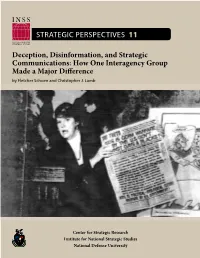
STRATEGIC PERSPECTIVES 11 Deception, Disinformation, and Strategic Communications: How One Interagency Group Made a Major Difference by Fletcher Schoen and Christopher J. Lamb Center for Strategic Research Institute for National Strategic Studies National Defense University Institute for National Strategic Studies National Defense University The Institute for National Strategic Studies (INSS) is National Defense University’s (NDU’s) dedicated research arm. INSS includes the Center for Strategic Research, Center for Complex Operations, Center for the Study of Chinese Military Affairs, Center for Technology and National Security Policy, Center for Transatlantic Security Studies, and Conflict Records Research Center. The military and civilian analysts and staff who comprise INSS and its subcomponents execute their mission by conducting research and analysis, publishing, and participating in conferences, policy support, and outreach. The mission of INSS is to conduct strategic studies for the Secretary of Defense, Chairman of the Joint Chiefs of Staff, and the Unified Combatant Commands in support of the academic programs at NDU and to perform outreach to other U.S. Government agencies and the broader national security community. Cover: Kathleen Bailey presents evidence of forgeries to the press corps. Credit: The Washington Times Deception, Disinformation, and Strategic Communications: How One Interagency Group Made a Major Difference Deception, Disinformation, and Strategic Communications: How One Interagency Group Made a Major Difference By Fletcher Schoen and Christopher J. Lamb Institute for National Strategic Studies Strategic Perspectives, No. 11 Series Editor: Nicholas Rostow National Defense University Press Washington, D.C. June 2012 Opinions, conclusions, and recommendations expressed or implied within are solely those of the contributors and do not necessarily represent the views of the Defense Department or any other agency of the Federal Government. -

English Edition: ISSN 2519-8688
GLOBAL 10.3 DIALOGUE MAGAZINE 3 issues a year in multiple languages Talking Sociology with Robert Kuttner Johanna Grubner Md. Rezwan Siddiqui Markus Wissen Vishwas Satgar Climate and Change Joan Fitzgerald Mahmudul Hasan Laskar Attila Melegh Iliana Olivié and Manuel Gracia COVID-19: Brigitte Aulenbacher, Petra Ezzeddine, Dóra Gábriel, Michael Leiblfinger, Pandemic Kinga Milankovics, and Veronika Prieler Dev Nath Pathak and Crisis Michele Grigolo and Craig Lundy Theoretical Perspectives Syed Farid Alatas In Memoriam: Yogendra Singh Mir Suheel Rasool S.A. Hamed Hosseini Barry Gills Scott Timcke Re-Imagining Society Shelene Gomes Siri Hettige Subhangi M.K. Herath Sociology from Kalinga Tudor Silva Farzana Haniffa Sri Lanka Premakumara de Silva VOLUME 10 / ISSUE VOLUME 3 / DECEMBER 2020 https://globaldialogue.isa-sociology.org/ Open Section > The Plastic Waste Issue in China GD > Editorial he section ‘Talking Sociology’ features an inter- The COVID-19 crisis is also the starting point for Syed view with the most renowned journalist Robert Farid Alatas’ profound reflection on the role and impact of Kuttner, who reads Karl Polanyi’s work for to- sociological thought and theory in the broader society. Tday. Starting from the political and economic situation at the beginning of the twentieth century the in- This issue features a tribute to Yogendra Singh, a pio- terview discusses current trends in globalization, the need neer of Indian sociology who passed away this year. His for strong national economies to strengthen democratic research on modernization and tradition in post-colonial decision making, and issues of inclusion and exclusion in India was groundbreaking. times of increasing international migration. -

Thomas Byrne Edsall Papers
http://oac.cdlib.org/findaid/ark:/13030/kt4d5nd2zb No online items Inventory of the Thomas Byrne Edsall papers Finding aid prepared by Aparna Mukherjee Hoover Institution Library and Archives © 2015 434 Galvez Mall Stanford University Stanford, CA 94305-6003 hoover-library-archives@stanford.edu URL: http://www.hoover.org/library-and-archives Inventory of the Thomas Byrne 88024 1 Edsall papers Title: Thomas Byrne Edsall papers Date (inclusive): 1965-2014 Collection Number: 88024 Contributing Institution: Hoover Institution Library and Archives Language of Material: English Physical Description: 259 manuscript boxes, 8 oversize boxes.(113.0 Linear Feet) Abstract: Writings, correspondence, notes, memoranda, poll data, statistics, printed matter, and photographs relating to American politics during the presidential administration of Ronald Reagan, especially with regard to campaign contributions and effects on income distribution; and to the gubernatorial administration of Michael Dukakis in Massachusetts, especially with regard to state economic policy, and the campaign of Michael Dukakis as the Democratic candidate for president of the United States in 1988; and to social conditions in the United States. Creator: Edsall, Thomas Byrne Hoover Institution Library & Archives Access The collection is open for research; materials must be requested at least two business days in advance of intended use. Publication Rights For copyright status, please contact the Hoover Institution Library & Archives. Acquisition Information Acquired by the Hoover -
The Challenging Future of Strategic Planning in Foreign Policy
01-0306-8 ch1.qxd 3/26/09 2:44 PM Page 3 daniel w. drezner 1 The Challenging Future of Strategic Planning in Foreign Policy “Avoid trivia.” —Secretary of State George Marshall’s advice to George Kennan, the first director of policy planning Strategic planning for American foreign policy is dead, dying, or moribund. This, at least, has been the assessment of several commentators and policy- makers in recent years.1 Michèle Flournoy and Shawn Brimley observed in 2006, “For a country that continues to enjoy an unrivaled global position, it is both remarkable and disturbing that the United States has no truly effective strategic planning process for national security.”2 At an academic conference in 2007, a former director of the State Department’s policy planning staff complained that, “six years after 9/11, we still don’t have a grand strategy.” Aaron Friedberg, who was director of policy planning for Vice President Richard Cheney, writes in this volume, “The U.S. government has lost the capacity to conduct serious, sustained national strategic planning.” Admiral William Fallon, the CENTCOM commander until the spring of 2008, told the New York Times that the United States would need to focus more on policy planning: “We need to have a well-thought-out game plan for engagement in the world that we adjust regularly and that has some system of checks and bal- ances built into it.”3 In this volume, Council on Foreign Relations president Richard Haass argues that the United States has “squandered” its post–cold war opportunity, concluding, “Historians will not judge the United States well for how it has used these twenty years.” These sorts of laments have become common in the past decade, in no small part because of the foreign policy planning of the administrations of Bill 3 01-0306-8 ch1.qxd 3/26/09 2:44 PM Page 4 4 The Challenging Future of Strategic Planning Clinton and George W. -

True Conservative Or Enemy of the Base?
Paul Ryan: True Conservative or Enemy of the Base? An analysis of the Relationship between the Tea Party and the GOP Elmar Frederik van Holten (s0951269) Master Thesis: North American Studies Supervisor: Dr. E.F. van de Bilt Word Count: 53.529 September January 31, 2017. 1 You created this PDF from an application that is not licensed to print to novaPDF printer (http://www.novapdf.com) Page intentionally left blank 2 You created this PDF from an application that is not licensed to print to novaPDF printer (http://www.novapdf.com) Table of Content Table of Content ………………………………………………………………………... p. 3 List of Abbreviations……………………………………………………………………. p. 5 Chapter 1: Introduction…………………………………………………………..... p. 6 Chapter 2: The Rise of the Conservative Movement……………………….. p. 16 Introduction……………………………………………………………………… p. 16 Ayn Rand, William F. Buckley and Barry Goldwater: The Reinvention of Conservatism…………………………………………….... p. 17 Nixon and the Silent Majority………………………………………………….. p. 21 Reagan’s Conservative Coalition………………………………………………. p. 22 Post-Reagan Reaganism: The Presidency of George H.W. Bush……………. p. 25 Clinton and the Gingrich Revolutionaries…………………………………….. p. 28 Chapter 3: The Early Years of a Rising Star..................................................... p. 34 Introduction……………………………………………………………………… p. 34 A Moderate District Electing a True Conservative…………………………… p. 35 Ryan’s First Year in Congress…………………………………………………. p. 38 The Rise of Compassionate Conservatism…………………………………….. p. 41 Domestic Politics under a Foreign Policy Administration……………………. p. 45 The Conservative Dream of a Tax Code Overhaul…………………………… p. 46 Privatizing Entitlements: The Fight over Welfare Reform…………………... p. 52 Leaving Office…………………………………………………………………… p. 57 Chapter 4: Understanding the Tea Party……………………………………… p. 58 Introduction……………………………………………………………………… p. 58 A three legged movement: Grassroots Tea Party organizations……………... p. 59 The Movement’s Deep Story…………………………………………………… p. -

The Filibuster and Reconciliation: the Future of Majoritarian Lawmaking in the U.S
The Filibuster and Reconciliation: The Future of Majoritarian Lawmaking in the U.S. Senate Tonja Jacobi†* & Jeff VanDam** “If this precedent is pushed to its logical conclusion, I suspect there will come a day when all legislation will be done through reconciliation.” — Senator Tom Daschle, on the prospect of using budget reconciliation procedures to pass tax cuts in 19961 Passing legislation in the United States Senate has become a de facto super-majoritarian undertaking, due to the gradual institutionalization of the filibuster — the practice of unending debate in the Senate. The filibuster is responsible for stymieing many legislative policies, and was the cause of decades of delay in the development of civil rights protection. Attempts at reforming the filibuster have only exacerbated the problem. However, reconciliation, a once obscure budgetary procedure, has created a mechanism of avoiding filibusters. Consequently, reconciliation is one of the primary means by which significant controversial legislation has been passed in recent years — including the Bush tax cuts and much of Obamacare. This has led to minoritarian attempts to reform reconciliation, particularly through the Byrd Rule, as well as constitutional challenges to proposed filibuster reforms. We argue that the success of the various mechanisms of constraining either the filibuster or reconciliation will rest not with interpretation by † Copyright © 2013 Tonja Jacobi and Jeff VanDam. * Professor of Law, Northwestern University School of Law, t-jacobi@ law.northwestern.edu. Our thanks to John McGinnis, Nancy Harper, Adrienne Stone, and participants of the University of Melbourne School of Law’s Centre for Comparative Constitutional Studies speaker series. ** J.D., Northwestern University School of Law (2013), vandam@nlaw.northwestern. -
Curriculum Vitae (Updated August 1, 2021)
DAVID A. BELL SIDNEY AND RUTH LAPIDUS PROFESSOR IN THE ERA OF NORTH ATLANTIC REVOLUTIONS PRINCETON UNIVERSITY Curriculum Vitae (updated August 1, 2021) Department of History Phone: (609) 258-4159 129 Dickinson Hall dabell@princeton.edu Princeton University www.davidavrombell.com Princeton, NJ 08544-1017 @DavidAvromBell EMPLOYMENT Princeton University, Director, Shelby Cullom Davis Center for Historical Studies (2020-24). Princeton University, Sidney and Ruth Lapidus Professor in the Era of North Atlantic Revolutions, Department of History (2010- ). Associated appointment in the Department of French and Italian. Johns Hopkins University, Dean of Faculty, School of Arts & Sciences (2007-10). Responsibilities included: Oversight of faculty hiring, promotion, and other employment matters; initiatives related to faculty development, and to teaching and research in the humanities and social sciences; chairing a university-wide working group for the Johns Hopkins 2008 Strategic Plan. Johns Hopkins University, Andrew W. Mellon Professor in the Humanities (2005-10). Principal appointment in Department of History, with joint appointment in German and Romance Languages and Literatures. Johns Hopkins University. Professor of History (2000-5). Johns Hopkins University. Associate Professor of History (1996-2000). Yale University. Assistant Professor of History (1991-96). Yale University. Lecturer in History (1990-91). The New Republic (Washington, DC). Magazine reporter (1984-85). VISITING POSITIONS École des Hautes Études en Sciences Sociales, Visiting Professor (June, 2018) Tokyo University, Visiting Fellow (June, 2017). École Normale Supérieure (Paris), Visiting Professor (March, 2005). David A. Bell, page 1 EDUCATION Princeton University. Ph.D. in History, 1991. Thesis advisor: Prof. Robert Darnton. Thesis title: "Lawyers and Politics in Eighteenth-Century Paris (1700-1790)." Princeton University. -
The Copenhagen Consensus Reading Adam Smith in Denmark by Robert Kuttner
The Copenhagen Consensus Reading Adam Smith in Denmark By Robert Kuttner From Foreign Affairs , March/April 2008 Summary: Denmark has forged a social and economic model that couples the best of the free market with the best of the welfare state, transcending tradeoffs between dynamism and security, efficiency and equality. Other countries may not be able to simply copy the Danish model of social democracy, but it nonetheless offers important lessons for governments confronting the dilemmas of globalization. ROBERT KUTTNER is Co-Editor of The American Prospect, a Senior Fellow at the think tank Demos, and the author of The Squandering of America: How the Failure of Our Politics Undermines Our Prosperity. He conducted the research for this article as a German Marshall Fund Journalism Fellow. Adam Smith observed in 1776 that economies work best when governments keep their clumsy thumbs off the free market's "invisible hand." Two generations later, in 1817, the British economist David Ricardo extended Smith's insights to global trade. Just as market forces lead to the right price and quantity of products domestically, Ricardo argued, free foreign trade optimizes economic outcomes internationally. Reading Adam Smith in Copenhagen -- the center of the small, open, and highly successful Danish economy -- is a kind of out-of-body experience. On the one hand, the Danes are passionate free traders. They score well in the ratings constructed by pro-market organizations. The World Economic Forum's Global Competitiveness Index ranks Denmark third, just behind the United States and Switzerland. Denmark's financial markets are clean and transparent, its barriers to imports minimal, its labor markets the most flexible in Europe, its multinational corporations dynamic and largely unmolested by industrial policies, and its unemployment rate of 2.8 percent the second lowest in the OECD (the Organization for Economic Cooperation and Development). -

Avery Leiserson Papers
AVERY LEISERSON PAPERS MSS # 256 Arranged and described by Molly Dohrmann February 2008 SPECIAL COLLECTIONS Jean and Alexander Heard Library Vanderbilt University 419 21st Avenue South Nashville, Tennessee 37240 Telephone: (615) 322-2807 © Vanderbilt University Special Collections Biographical Note Avery Leiserson was born in 1913 and died February 14, 2004 at the age of 90. He was a native of Madison, Wisconsin. He graduated from the University of Illinois in 1934 with a B.A. degree and in 1941 from the University of Chicago with a Ph.D in Political Science. Early in his career and before the second World War he taught briefly at Princeton University. Then from 1946 until he came to Vanderbilt University in 1952, he taught at the University of Chicago. He was at Vanderbilt until his retirement as Professor Emeritus in 1978. He was a nationally known scholar of American politics who was instrumental in building Vanderbilt’s Political Science department to a position of national prominence. Professor Leiserson’s great mentor and influence was Charles E. Merriam. In an introduction to a program in 1975 of the American Political Science Asssociation of which Professor Leiserson was president at the time, Samuel Patterson introduced Avery Leiserson as one of the most important leaders in the field of Political Science and noted especially his seminal work “Problems of Methodology in Political Research.” Avery Leiserson is known in addition to his work on methodology in political science “for his concern about values, his devotion to scientific inquiry, and his emphasis on realism all of which were guided by his sense of the value of democracy.” In the 1960’s Professor Leiserson was active in Civil Rights work, and he was one of a group of Vanderbilt professors who first proposed a Black Studies Program in the College of Arts and Science, which later became the African American Studies Program. -

Starting Over: the Center-Right After Trump a Niskanen Center Conference on December 11, 2018
1 Starting Over: The Center-Right After Trump A Niskanen Center Conference on December 11, 2018 PANEL 3: POLITICAL PROSPECTS FOR A NEW CENTER-RIGHT Moderator: Geoff Kabaservice Panelists: Whit Ayres, Juleanna Glover, Mike Murphy Geoff Kabaservice: As some of you know, I was in Germany over the weekend, trying to do what I could to help plan this conference remotely. I couldn’t even begin to tell you what time my body thinks it is right now. Every time I go to Germany, it seems that I pick up a new word that has some relevance to my life or what’s about to follow. Last time I was there, I learned the term kummerspeck, which is literally “bacon grief.” It’s the food you eat and the weight you put on in the wake of some traumatic event, like a disappointing romantic episode. This time the term I learned was suppenkoma — “soup coma” — which is the stuporous state you find yourself falling into when you are at the first session after lunch of a conference. But fortunately we have the perfect antidote here to the soup coma, which is three of the best Republican political consultants, operatives, gurus that there are anywhere on the face of the Earth. Juleanna Glover: But I don’t consider myself a Republican anymore. [laughter] Geoff Kabaservice: Former, present, and possibly future Republican gurus, then. So this is Juleanna Glover to my left, Whit Ayres to my right, and Mike Murphy on the far right. Okay, so the subject of this panel is “Political Prospects for a New Center-Right.” This is where we descend from the somewhat empyrean realms of theory and philosophy into the more practical, Lenin-like question: What is to be done? Geoff Kabaservice: Those of us on the center-right have not had a pleasant time of it for the last several years — decades, perhaps.