Download Campaign
Total Page:16
File Type:pdf, Size:1020Kb
Load more
Recommended publications
-

Introduction Ronald Reagan’S Defining Vision for the 1980S— - and America
© Copyright, Princeton University Press. No part of this book may be distributed, posted, or reproduced in any form by digital or mechanical means without prior written permission of the publisher. Introduction Ronald Reagan’s Defining Vision for the 1980s— -_and America There are no easy answers, but there are simple answers. We must have the courage to do what we know is morally right. ronald reagan, “the speech,” 1964 Your first point, however, about making them love you, not just believe you, believe me—I agree with that. ronald reagan, october 16, 1979 One day in 1924, a thirteen-year-old boy joined his parents and older brother for a leisurely Sunday drive roaming the lush Illinois country- side. Trying on eyeglasses his mother had misplaced in the backseat, he discovered that he had lived life thus far in a “haze” filled with “colored blobs that became distinct” when he approached them. Recalling the “miracle” of corrected vision, he would write: “I suddenly saw a glori- ous, sharply outlined world jump into focus and shouted with delight.” Six decades later, as president of the United States of America, that extremely nearsighted boy had become a contact lens–wearing, fa- mously farsighted leader. On June 12, 1987, standing 4,476 miles away from his boyhood hometown of Dixon, Illinois, speaking to the world from the Berlin Wall’s Brandenburg Gate, Ronald Wilson Reagan em- braced the “one great and inescapable conclusion” that seemed to emerge after forty years of Communist domination of Eastern Eu- rope. “Freedom leads to prosperity,” Reagan declared in his signature For general queries, contact webmaster@press.princeton.edu © Copyright, Princeton University Press. -

Reagan's Victory
Reagan’s ictory How HeV Built His Winning Coalition By Robert G. Morrison Foreword by William J. Bennett Reagan’s Victory: How He Built His Winning Coalition By Robert G. Morrison 1 FOREWORD By William J. Bennett Ronald Reagan always called me on my birthday. Even after he had left the White House, he continued to call me on my birthday. He called all his Cabinet members and close asso- ciates on their birthdays. I’ve never known another man in public life who did that. I could tell that Alzheimer’s had laid its firm grip on his mind when those calls stopped coming. The President would have agreed with the sign borne by hundreds of pro-life marchers each January 22nd: “Doesn’t Everyone Deserve a Birth Day?” Reagan’s pro-life convic- tions were an integral part of who he was. All of us who served him knew that. Many of my colleagues in the Reagan administration were pro-choice. Reagan never treat- ed any of his team with less than full respect and full loyalty for that. But as for the Reagan administration, it was a pro-life administration. I was the second choice of Reagan’s to head the National Endowment for the Humanities (NEH). It was my first appointment in a Republican administration. I was a Democrat. Reagan had chosen me after a well-known Southern historian and literary critic hurt his candidacy by criticizing Abraham Lincoln. My appointment became controversial within the Reagan ranks because the Gipper was highly popular in the South, where residual animosities toward Lincoln could still be found. -

Ridley Scott's Dystopia Meets Ronald Reagan's America
RIDLEY SCOTT’S DYSTOPIA MEETS RONALD REAGAN’S AMERICA: CLASS CONFLICT AND POLITICAL DISCLOSURE IN BLADE RUNNER: THE FINAL CUT Fabián Orán Llarena Universidad de La Laguna “The great owners ignored the three cries of history. The land fell into fewer hands, the number of dispossessed increased, and every effort of the great own- ers was directed at repression.” (John Steinbeck, The Grapes of Wrath) Abstract Blade Runner has been the object of multiple inquiries over the last three decades. However, this essay analyzes the socio-political discourse of the text, one aspect yet to be elucidated. Taking as basis the 1992 re-edited version (Blade Runner: The Final Cut), the essay studies the film as a critical and contextualized response to Ronald Reagan’s presidency (1981-1989). The essay scrutinizes how the materiality of the socio-economic system presented in the film, and the discourses that revolve around it, embody a critical representation of the policy-making and cultural discourse of Reaganism. Thus, the ensuing text characterizes the film as a (counter) 155 narrative that deconstructs the conservative ideology of the 1980s. Keywords: Reaganism, supply-side theory, hegemony, underclass, Off World. Resumen Blade Runner ha sido objeto de múltiples consideraciones durante las últimas tres décadas. No obstante, este ensayo analiza el discurso político-cultural del film, un aspecto aún por dilucidar. Tomando como base el remontaje de 1992 (Blade Runner: The Final Cut), se estudia el film como una respuesta crítica y contextualizada a la presidencia de Ronald Reagan (1981-1989). El ensayo escruta cómo la materialidad del sistema socio-económico presentado en el film, y los discursos que se construyen en torno al mismo, son una representación crítica de las políticas y el discurso cultural del Reaganismo. -

Ronald Reagan and Executive Power” Examines the Use and EXECUTIVE POWER of Presidential Powers by Ronald Reagan, the Fortieth President of the United States
We the People: The Citizen and the Constitution is a nationally acclaimed civic education program for upper elementary, secondary, and post-secondary school students that focuses on the history and principles of the U.S. Constitution and Bill of Rights. We the People is a program of the Center for Civic Education, whose mission is to promote an enlightened and responsible citizenry committed to democratic principles and actively engaged in the practice of democracy in the United States and other countries. February 6, 2011, marks the one-hundredth anniversary of Ronald Reagan’s birth, providing an occasion for teaching and learning about President Reagan’s contributions to American constitutionalism and citizenship. To this end, the Center for Civic Education and the Ronald Reagan Presidential Foundation have collaborated to produce this lesson. The lesson and materials to enhance this curriculum can be found at www.civiced.org/reagan. RONALD REAGAN PURPOSE OF THE LESSON “Ronald Reagan and Executive Power” examines the use AND EXECUTIVE POWER of presidential powers by Ronald Reagan, the fortieth president of the United States. It explores Article II of the Constitution, which grants the president executive pow - ers. When you have completed this lesson, you should be able to explain and discuss how President Reagan exer - cised his authority under Article II of the Constitution concerning war powers, domestic policy, and foreign pol - icy. You should be able to explain how the brevity and ambiguity of Article II allows presidents to interpret these powers, especially in relation to Congress. You should be able to evaluate and take positions on the constitutional issues raised by the exercise of these powers, drawing on specific examples from Ronald Reagan’s presidency. -

Six Months to Go: Where the Presidential Contest Stands As the General Election Begins
May 10, 2012 Six Months To Go: Where the Presidential Contest Stands as the General Election Begins William A. Galston Table of Contents Summary 1 Where We Are Now and How We Got There 1 The Mood of the Country 3 The Issues 5 Ideology 7 What Kind of Election Will 2012 Be? 9 Referendum or Choice? 9 Persuasion or Mobilization? 13 It’s the Electoral College, Stupid 16 Conclusion: The Known Unknowns 22 Endnotes 23 SUMMARY arack Obama’s standing with the American people hit bottom in the late Bsummer and early fall of 2011. Since then, the president has recovered the political ground he lost during the debt ceiling fiasco and now enjoys a narrow edge over Mitt Romney, the presumptive Republican nominee. The standard political and economic indicators suggest that the 2012 election will be close. And the historic level of partisan polarization ensures that it will be hard-fought and divisive. William A. Galston is the Ezra K. Zilkha Since Vietnam and the Iranian hostage crisis, Republicans have effectively used the Chair in Governance issue of national security against Democrats. Barring unforeseen events, Romney Studies and senior will not be able to do so this year. Nor will a focus on hot-button social issues yield fellow at Brookings. significant gains for the challenger. Instead, to an extent that Americans have not seen for at least two decades, the election of 2012 will revolve around a single defining issue—the condition of the economy. In 2008, Barack Obama defeated John McCain in large measure because the people saw him as more able to manage the economy at a moment of frightening crisis. -
Using Youtube to Teach Presidential Election Propaganda: Twelve Representative Videos
·~'ocial l:'ducatton 13r7), pp 3 .25 _3 .3 9, 3 6.2 •.rJ20()9 National Council £or the Social Swdics Using YouTube to Teach Presidential Election Propaganda: Twelve Representative Videos Wayne Journell ne of the primary goals of social studies education in the United States is many schools block access to YouTube to prepare students for civically active, politically informed, and socially on school property. Certainly, many 0 engaged democratic citizenship. Too often, however, the curricula fall short of the advertisements described in this of this goal. Textbooks and state curriculum standards tend to portray citizenship article can be found on other websites as a static concept rather than an active process that involves awareness of, and or through a savvy Google search.5 participation within, a democratic political system.1 However, YouTube has the advantage of an easy-to-use search engine and a This is best illustrated by the way many students are to make informed political name brand that middle and high school teachers approach presidential elections decisions as adults, then they must learn students recognize. At the conclusion in their classrooms, a topic Haas and to decipher ways politicians manipulate of this article, I offer suggestions for Laughlin argue should be "the quintessen media. minimizing any risks associated with tial example of teaching social studies."2 The good news is that access to presi using YouTube in the classroom. Yet teachers often fail to adequately pre dential propaganda has never been easier. pare students to understand the nuances The Internet, in particular, is a wonderful Twelve Representative Videos of presidential politics, particularly with repository for examples of both historic respect to political propaganda. -
Ronald Reagan in Memoriam
Grand Valley State University ScholarWorks@GVSU Features Hauenstein Center for Presidential Studies 6-6-2004 Ronald Reagan in Memoriam Follow this and additional works at: http://scholarworks.gvsu.edu/features Recommended Citation "Ronald Reagan in Memoriam" (2004). Features. Paper 91. http://scholarworks.gvsu.edu/features/91 This Article is brought to you for free and open access by the Hauenstein Center for Presidential Studies at ScholarWorks@GVSU. It has been accepted for inclusion in Features by an authorized administrator of ScholarWorks@GVSU. For more information, please contact scholarworks@gvsu.edu. Ronald Reagan In Memoriam - Hauenstein Center for Presidential Studies - Grand Valley... Page 1 of 32 Ronald Reagan In Memoriam Ronald Reagan In Memoriam Our 40th president's life, career, death, and funeral are recalled in this Hauenstein Center focus. Detroit Free Press A Milliken Republican was driven to honor Reagan Column By Dawson Bell - Detroit Free Press (June 14, 2004) "The Michigan Republican Party Jerry Roe served as executive director in the 1970s wasn't exactly ground zero in the Reagan Revolution." FULL TEXT One thing's for sure, he kept to the script Column By Rochelle Riley - Detroit Free Press (June 11, 2004) "He took on his greatest acting role, as president of the United States, in a sweeping epic drama about one national superpower making itself stronger while growing tired of a second nipping at its heels with waning threats of nuclear annihilation." FULL TEXT Media do not tell the truth about Reagan Column By Leonard Pitts Jr. - Detroit Free Press (June 11, 2004) "Philadelphia, a speck of a town north and east of Jackson, is infamous as the place three young civil rights workers were murdered in 1964 for registering black people to vote. -
Examining the Changing Use of the Bear As a Symbol of Russia
UC Santa Barbara UC Santa Barbara Previously Published Works Title The “Forward Russia” Flag: Examining the Changing Use of the Bear as a Symbol of Russia Permalink https://escholarship.org/uc/item/5xz8x2zc Journal Raven: A Journal of Vexillology, 19 ISSN 1071-0043 Author Platoff, Anne M. Publication Date 2012 License https://creativecommons.org/licenses/by-nc-nd/4.0/ 4.0 Peer reviewed eScholarship.org Powered by the California Digital Library University of California The “Forward Russia” Flag 99 The “Forward Russia” Flag: Examining the Changing Use of the Bear as a Symbol of Russia Anne M. Platoff Introduction Viewers of international sporting events have become accustomed to seeing informal sporting flags waved by citizens of various countries. The most famil- iar of these flags, of course, are the “Boxing Kangaroo” flag used to represent Australia and the “Fighting Kiwi” flag used by fans from New Zealand. Both of these flags have become common at the Olympic Games when athletes from those nations compete. Recently a new flag of this type has been displayed at international soccer matches and the 2010 Vancouver Winter Olympics. Unlike the Kangaroo and Kiwi flags, this new flag has been constructed using a defaced national flag, the Russian tricolor flag of white, blue, and red horizontal stripes, readopted as the flag of the Russian Federation after the breakup of the Soviet Union. A number of variations of the flag design have been used, but all of them contain two elements: the Russian text Vperëd Rossiia, which means “Forward Russia”, and a bear which appears to be break- ing its way out of the flag. -
Fessler Interpretive Essay [PDF]
Voices of Democracy 2 (2007): 26‐49 Fessler 26 RONALD REAGAN, ADDRESS TO THE NATIONAL ASSOCIATION OF EVANGELICALS ("EVIL EMPIRE SPEECH") (8 MARCH 1983) Paul Fessler Dordt College Abstract: This essay argues that Ronald Reagan's "Evil Empire" speech helped transform presidential discourse with its explicitly religious language and imagery. Credited with helping to bring about an end to the Cold War, the speech was widely criticized at the time for its religious and moral absolutism but later celebrated for reflecting a rhetorical blueprint that helped bring an end to the Cold War. Key Words: Ronald Reagan, "Evil Empire," Cold War, Détente, Religion, Evangelical When Ronald Reagan took office in early 1981, the United States appeared weak and faltering. In foreign affairs, the United States, still reeling from defeat in Vietnam, faced not only a Soviet Union expanding into Afghanistan but also a major hostage crisis in Iran that had crippled the outgoing president, Jimmy Carter. It seemed as if America's self‐image as a confident and strong international superpower was fading into a distant memory. Indeed, Carter's speeches and public pronouncements as president seemed to contribute to this growing public perception. As a conservative and as an outspoken anti‐communist, President Ronald Reagan not only brought about a shift in presidential policy but also in presidential rhetoric. Known as the "Great Communicator," Reagan's powerful oratory, liberally peppered with anecdotes and humor, helped gain public support for his two main issues—anti‐ communism and reducing the size of the federal government. Reagan's speech to the National Association of Evangelicals (NAE) on March 8, 1983, was arguably his most significant and memorable speech on international affairs. -

“It's Morning Again in America”: How the Tuesday Team Revolutionized
“It’s Morning Again in America”: How the Tuesday Team Revolutionized the Use of Music in Political Ads1 PAUL CHRISTIANSEN Television Commercials and Their Music in 1984 The year 1984 introduced many memorable ads and ad campaigns that remain well known. These include ads for Apple Macintosh (“1984”), McDonald’s (“It’s a Good Time for the Great Taste of McDonald’s),” Burger King (“The Midnight Zone,” which riffed on The Twilight Zone series), Wendy’s (“Where’s the Beef?” and Kool and the Gang singing “Celebrate” with new lyrics to peddle Wendy’s new product Crispy Chicken Nuggets), Coors Light (“The Silver Bullet”), Folgers (“The Best Part of Wakin’ Up is Folger’s in Your Cup!”), Coke (“Coke is it”), and Pepsi (Michael Jackson’s Pepsi Generation ads). Advertising was ever-present at this time. Ad agencies and the clients they served in early 1984 sought to connect their products to the approaching Los Angeles Summer Olympics through cross- marketing campaigns, though not always with great success. (Most disastrous was the McDonald’s idea to give away free food and drink for every medal U.S. athletes earned; the Soviet Union’s decision to boycott these games led to the U.S winning by far the most medals, almost three times more than second-place West Germany.)2 Perhaps the most powerful connection to the Olympics that year was “1984,” the Apple Macintosh ad directed by Ridley Scott. This ad seems to have transformed the landscape of television advertising by introducing an authentically cinematic aesthetic. (It should be noted that the actual product is never shown in “1984,” and this comports with the increasing association of companies with lifestyle and the concomitant abstraction of advertising from the actual benefits of the products being pitched.) I discuss this ad briefly below. -

Antinuclear Politics, Atomic Culture, and Reagan Era Foreign Policy
Selling the Second Cold War: Antinuclear Cultural Activism and Reagan Era Foreign Policy A dissertation presented to the faculty of the College of Arts and Sciences of Ohio University In partial fulfillment of the requirements for the degree Doctor of Philosophy William M. Knoblauch March 2012 © 2012 William M. Knoblauch. All Rights Reserved. 2 This dissertation titled Selling the Second Cold War: Antinuclear Cultural Activism and Reagan Era Foreign Policy by WILLIAM M. KNOBLAUCH has been approved for the Department of History and the College of Arts and Sciences by __________________________________ Chester J. Pach Associate Professor of History __________________________________ Howard Dewald Dean, College of Arts and Sciences 3 ABSTRACT KNOBLAUCH, WILLIAM M., Ph.D., March 2012, History Selling the Second Cold War: Antinuclear Cultural Activism and Reagan Era Foreign Policy Director of Dissertation: Chester J. Pach This dissertation examines how 1980s antinuclear activists utilized popular culture to criticize the Reagan administration’s arms buildup. The 1970s and the era of détente marked a decade-long nadir for American antinuclear activism. Ronald Reagan’s rise to the presidency in 1981 helped to usher in the “Second Cold War,” a period of reignited Cold War animosities that rekindled atomic anxiety. As the arms race escalated, antinuclear activism surged. Alongside grassroots movements, such as the nuclear freeze campaign, a unique group of antinuclear activists—including publishers, authors, directors, musicians, scientists, and celebrities—challenged Reagan’s military buildup in American mass media and popular culture. These activists included Fate of the Earth author Jonathan Schell, Day After director Nicholas Meyer, and “nuclear winter” scientific-spokesperson Carl Sagan. -
Orchestrating Public Opinion
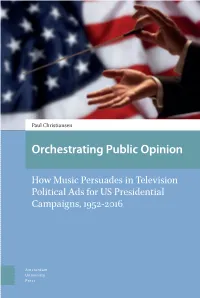
Paul ChristiansenPaul Orchestrating Public Opinion Paul Christiansen Orchestrating Public Opinion How Music Persuades in Television Political Ads for US Presidential Campaigns, 1952-2016 Orchestrating Public Opinion Orchestrating Public Opinion How Music Persuades in Television Political Ads for US Presidential Campaigns, 1952-2016 Paul Christiansen Amsterdam University Press Cover design: Coördesign, Leiden Lay-out: Crius Group, Hulshout Amsterdam University Press English-language titles are distributed in the US and Canada by the University of Chicago Press. isbn 978 94 6298 188 1 e-isbn 978 90 4853 167 7 doi 10.5117/9789462981881 nur 670 © P. Christiansen / Amsterdam University Press B.V., Amsterdam 2018 All rights reserved. Without limiting the rights under copyright reserved above, no part of this book may be reproduced, stored in or introduced into a retrieval system, or transmitted, in any form or by any means (electronic, mechanical, photocopying, recording or otherwise) without the written permission of both the copyright owner and the author of the book. Every effort has been made to obtain permission to use all copyrighted illustrations reproduced in this book. Nonetheless, whosoever believes to have rights to this material is advised to contact the publisher. Table of Contents Acknowledgments 7 Introduction 10 1. The Age of Innocence: 1952 31 2. Still Liking Ike: 1956 42 3. The New Frontier: 1960 47 4. Daisies for Peace: 1964 56 5. This Time Vote Like Your Whole World Depended On It: 1968 63 6. Nixon Now! 1972 73 7. A Leader, For a Change: 1976 90 8. The Ayatollah Casts a Vote: 1980 95 9. Morning in America: 1984 101 10.