Acta Botánica Mexicana
Total Page:16
File Type:pdf, Size:1020Kb
Load more
Recommended publications
-

A Taxonomic Revision of Hymenophyllaceae
BLUMEA 51: 221–280 Published on 27 July 2006 http://dx.doi.org/10.3767/000651906X622210 A TAXONOMIC REVISION OF HYMENOPHYLLACEAE ATSUSHI EBIHARA1, 2, JEAN-YVES DUBUISSON3, KUNIO IWATSUKI4, SABINE HENNEQUIN3 & MOTOMI ITO1 SUMMARY A new classification of Hymenophyllaceae, consisting of nine genera (Hymenophyllum, Didymoglos- sum, Crepidomanes, Polyphlebium, Vandenboschia, Abrodictyum, Trichomanes, Cephalomanes and Callistopteris) is proposed. Every genus, subgenus and section chiefly corresponds to the mono- phyletic group elucidated in molecular phylogenetic analyses based on chloroplast sequences. Brief descriptions and keys to the higher taxa are given, and their representative members are enumerated, including some new combinations. Key words: filmy ferns, Hymenophyllaceae, Hymenophyllum, Trichomanes. INTRODUCTION The Hymenophyllaceae, or ‘filmy ferns’, is the largest basal family of leptosporangiate ferns and comprises around 600 species (Iwatsuki, 1990). Members are easily distin- guished by their usually single-cell-thick laminae, and the monophyly of the family has not been questioned. The intrafamilial classification of the family, on the other hand, is highly controversial – several fundamentally different classifications are used by indi- vidual researchers and/or areas. Traditionally, only two genera – Hymenophyllum with bivalved involucres and Trichomanes with tubular involucres – have been recognized in this family. This scheme was expanded by Morton (1968) who hierarchically placed many subgenera, sections and subsections under -

Instituto De Botânica
MAIRA CORTELLINI ABRAHÃO Diversidade e ecologia de Agaricomycetes lignolíticos do Cerrado da Reserva Biológica de Mogi-Guaçu, estado de São Paulo, Brasil (exceto Agaricales e Corticiales) Tese apresentada ao Instituto de Botânica da Secretaria do Meio Ambiente, como parte dos requisitos exigidos para a obtenção do título de DOUTORA em BIODIVERSIDADE VEGETAL E MEIO AMBIENTE, na Área de Concentração de Plantas Avasculares e Fungos em Análises Ambientais. SÃO PAULO 2012 MAIRA CORTELLINI ABRAHÃO Diversidade e ecologia de Agaricomycetes lignolíticos do Cerrado da Reserva Biológica de Mogi-Guaçu, estado de São Paulo, Brasil (exceto Agaricales e Corticiales) Tese apresentada ao Instituto de Botânica da Secretaria do Meio Ambiente, como parte dos requisitos exigidos para a obtenção do título de DOUTORA em BIODIVERSIDADE VEGETAL E MEIO AMBIENTE, na Área de Concentração de Plantas Avasculares e Fungos em Análises Ambientais. ORIENTADORA: DRA. VERA LÚCIA RAMOS BONONI Ficha Catalográfica elaborada pelo NÚCLEO DE BIBLIOTECA E MEMÓRIA Abrahão, Maira Cortelellini A159d Diversidade e ecologia de Agaricomycetes lignolíticos do cerrado da Reserva Biológica de Mogi-Guaçu, estado de São Paulo, Brasil (exceto Agaricales e Corticiales) / Maira Cortellini Abrahão -- São Paulo, 2012. 132 p. il. Tese (Doutorado) -- Instituto de Botânica da Secretaria de Estado do Meio Ambiente, 2012 Bibliografia. 1. Basidiomicetos. 2. Basidiomycota. 3. Unidade de Conservação. I. Título CDU: 582.284 AGRADECIMENTOS Agradeço a Deus por mais uma oportunidade de estudar, crescer e amadurecer profissionalmente. Por colocar pessoas tão maravilhosas em minha vida durante esses anos de convívio e permitir que tudo ocorresse da melhor maneira possível. À Fundação de Amparo à Pesquisa do Estado de São Paulo (FAPESP), pela bolsa de doutorado (processo 2009/01403-6) e por todo apoio financeiro que me foi oferecido, desde os anos iniciais de minha carreira acadêmica (processos 2005/55136-8 e 2006/5878-6). -

Review of Selected Literature and Epiphyte Classification
--------- -- ---------· 4 CHAPTER 1 REVIEW OF SELECTED LITERATURE AND EPIPHYTE CLASSIFICATION 1.1 Review of Selected, Relevant Literature (p. 5) Several important aspects of epiphyte biology and ecology that are not investigated as part of this work, are reviewed, particularly those published on more. recently. 1.2 Epiphyte Classification and Terminology (p.11) is reviewed and the system used here is outlined and defined. A glossary of terms, as used here, is given. 5 1.1 Review of Selected, Relevant Li.terature Since the main works of Schimper were published (1884, 1888, 1898), particularly Die Epiphytische Vegetation Amerikas (1888), many workers have written on many aspects of epiphyte biology and ecology. Most of these will not be reviewed here because they are not directly relevant to the present study or have been effectively reviewed by others. A few papers that are keys to the earlier literature will be mentioned but most of the review will deal with topics that have not been reviewed separately within the chapters of this project where relevant (i.e. epiphyte classification and terminology, aspects of epiphyte synecology and CAM in the epiphyt~s). Reviewed here are some special problems of epiphytes, particularly water and mineral availability, uptake and cycling, general nutritional strategies and matters related to these. Also, all Australian works of any substance on vascular epiphytes are briefly discussed. some key earlier papers include that of Pessin (1925), an autecology of an epiphytic fern, which investigated a number of factors specifically related to epiphytism; he also reviewed more than 20 papers written from the early 1880 1 s onwards. -

Sayı Tam Dosyası
']FHhQLYHUVLWHVL2UPDQFÕOÕN'HUJLVL&LOW166D\Õ2 )DNOWH$GÕQD6DKLEL : 3URI'U+DOGXQ0h'(55ø62ö/8 %Dú(GLW|U : 'Ro'U(QJLQ(52ö/8 Editör Kurulu Alan Editörleri Prof. Dr. Oktay YILDIZ 3URI'U'HU\D(ù(1 Prof. Dr. Kermit CROMAC Jr. (Oregon State University) Prof. Dr. Rimvydas VASAITIS (Swedish University of Agricultural Sciences) 3URI'U-LĜt5(0(â &]HFK8QLYHUVLW\RI/LIH6FLHQFHV3UDJXH Prof. Dr. Marc J. LINIT (University of Missouri) 3URI'U=HNL'(0ø5 Prof. Dr. (PUDKdød(. Prof. 'U'U'HU\D6(9ø0.25.87 Prof. 'U$\ELNH$\IHU.$5$'$ö Doç'U0.ÕYDQo$. Doç'U7DUÕN*('ø. Doç. Dr. Akif KETEN Doç. Dr. Ali Kemal ÖZBAYRAM 'UgJUh3ÕQDU.g</h 'UgJUh'U+DVDQg='(0ø5 Dr. Ögr. Ü. Dr. Hüseyin AMBARLI Dr. gJUh'UøGULV'85862< 'UgJUh'U%LODOd(7ø1 Teknik Editörler $Uú*|U6HUWDo.$<$ $Uú*|U0XKDPPHWdø/ $Uú*|U'UdD÷ODU$.d$< $Uú*|U'U7DUÕNdø7*(= Dr. Ögr. Ü. Ömer ÖZYÜREK $Uú*|U1XUD\g=7h5. $Uú*|U<ÕOGÕ]%$+d(&ø $Uú*|UAbdullah Hüseyin DÖNMEZ Dil Editörleri gJU*|U'UøVPDLO.2d Ögr. Gör. Dr. Zennure UÇAR zĂnjŦƔŵĂĚƌĞƐŝ ŽƌƌĞƐƉŽŶĚŝŶŐĚĚƌĞƐƐ Düzce Üniversitesi Duzce University Orman Fakültesi Faculty of Forestry ϴϭϲϮϬ<ŽŶƵƌĂůƉzĞƌůĞƔŬĞƐŝͬƺnjĐĞ-dmZ<7z ϴϭϲϮϬ<ŽŶƵƌĂůƉĂŵƉƵƐͬƺnjĐĞ-dhZ<z 'HUJL\ÕOGDLNLVD\ÕRODUDN\D\ÕQODQÕU 7KLVMRXUQDOLVSXEOLVKHGVHPLDQQXDOO\ http://www.duzce.edu.tr/of/ DGUHVLQGHQGHUJL\HLOLúNLQELOJLOHUHYHPDNDOH|]HWOHULQHXODúÕODELOLU (Instructions to Authors" and "Abstracts" can be found at this address). ødø1'(.ø/(5 +X]XUHYL%DKoHOHULQLQ<Dú'RVWX7DVDUÕP$oÕVÕQGDQøQFHOHQPHVLAntalya-7UNL\HgUQH÷L«««««1 Tahsin YILMAZ, Bensu YÜCE .HQWVHO5HNUHDV\RQHO$ODQODUGDNL%LWNL9DUOÕ÷Õ5L]HgUQH÷L«««««««««««««««««16 Ömer Lütfü ÇORBACI, *|NKDQ$%$<7UNHU2ö8=7h5.0HUYHhd2. <Õ÷ÕOFD ']FH %DON|\ %DO2UPDQÕ)ORUDVÕ««««««««««««««««««««««««45 (OLI$\úH<,/',5,01HYDO*h1(ùg=.$11XUJO.$5/,2ö/8.,/,d Assessment of Basic Green Infrastructure Components as Part of Landscape Structure for Siirt……...70 Huriye Simten SÜTÜNÇ, Ömer Lütfü ÇORBACI Cephalaria duzceënsis N. -

Download Download
LITERATURE UPDATE FOR TEXAS FLESHY BASIDIOMYCOTA WITH NEW VOUCHERED RECORDS FOR SOUTHEAST TEXAS David P. Lewis Clark L. Ovrebo N. Jay Justice 262 CR 3062 Department of Biology 16055 Michelle Drive Newton, Texas 75966, U.S.A. University of Central Oklahoma Alexander, Arkansas 72002, U.S.A. dandplewis@gmail.com Edmond, Oklahoma 73034, U.S.A. justice@aristotle.net covrebo@uco.edu ABSTRACT This is a second paper documenting the literature records for Texas fleshy basidiomycetous fungi and includes both older literature and recently published papers. We report 80 literature articles which include 14 new taxa described from Texas. We also report on 120 new records of fleshy basdiomycetous fungi collected primarily from southeast Texas. RESUMEN Este es un segundo artículo que documenta el registro de nuevas especies de hongos carnosos basidiomicetos, incluyendo artículos antiguos y recientes. Reportamos 80 artículos científicamente relacionados con estas especies que incluyen 14 taxones con holotipos en Texas. Así mismo, reportamos unos 120 nuevos registros de hongos carnosos basidiomicetos recolectados primordialmente en al sureste de Texas. PART I—MYCOLOGICAL LITERATURE ON TEXAS FLESHY BASIDIOMYCOTA Lewis and Ovrebo (2009) previously reported on literature for Texas fleshy Basidiomycota and also listed new vouchered records for Texas of that group. Presented here is an update to the listing which includes literature published since 2009 and also includes older references that we previously had not uncovered. The authors’ primary research interests center around gilled mushrooms and boletes so perhaps the list that follows is most complete for the fungi of these groups. We have, however, attempted to locate references for all fleshy basidio- mycetous fungi. -

Biodiversity of Wood-Decay Fungi in Italy
AperTO - Archivio Istituzionale Open Access dell'Università di Torino Biodiversity of wood-decay fungi in Italy This is the author's manuscript Original Citation: Availability: This version is available http://hdl.handle.net/2318/88396 since 2016-10-06T16:54:39Z Published version: DOI:10.1080/11263504.2011.633114 Terms of use: Open Access Anyone can freely access the full text of works made available as "Open Access". Works made available under a Creative Commons license can be used according to the terms and conditions of said license. Use of all other works requires consent of the right holder (author or publisher) if not exempted from copyright protection by the applicable law. (Article begins on next page) 28 September 2021 This is the author's final version of the contribution published as: A. Saitta; A. Bernicchia; S.P. Gorjón; E. Altobelli; V.M. Granito; C. Losi; D. Lunghini; O. Maggi; G. Medardi; F. Padovan; L. Pecoraro; A. Vizzini; A.M. Persiani. Biodiversity of wood-decay fungi in Italy. PLANT BIOSYSTEMS. 145(4) pp: 958-968. DOI: 10.1080/11263504.2011.633114 The publisher's version is available at: http://www.tandfonline.com/doi/abs/10.1080/11263504.2011.633114 When citing, please refer to the published version. Link to this full text: http://hdl.handle.net/2318/88396 This full text was downloaded from iris - AperTO: https://iris.unito.it/ iris - AperTO University of Turin’s Institutional Research Information System and Open Access Institutional Repository Biodiversity of wood-decay fungi in Italy A. Saitta , A. Bernicchia , S. P. Gorjón , E. -
Identification and Tracking Activity of Fungus from the Antarctic Pole on Antagonistic of Aquatic Pathogenic Bacteria
INTERNATIONAL JOURNAL OF AGRICULTURE & BIOLOGY ISSN Print: 1560–8530; ISSN Online: 1814–9596 19F–079/2019/22–6–1311–1319 DOI: 10.17957/IJAB/15.1203 http://www.fspublishers.org Full Length Article Identification and Tracking Activity of Fungus from the Antarctic Pole on Antagonistic of Aquatic Pathogenic Bacteria Chuner Cai1,2,3, Haobing Yu1, Huibin Zhao2, Xiaoyu Liu1*, Binghua Jiao1 and Bo Chen4 1Department of Biochemistry and Molecular Biology, College of Basic Medicine, Naval Medical University, Shanghai, 200433, China 2College of Marine Ecology and Environment, Shanghai Ocean University, Shanghai, 201306, China 3Co-Innovation Center of Jiangsu Marine Bio-industry Technology, Lianyungang, Jiangsu, 222005, China 4Polar Research Institute of China, Shanghai, 200136, China *For correspondence: biolxy@163.com Abstract To seek the lead compound with the activity of antagonistic aquatic pathogenic bacteria in Antarctica fungi, the work identified species of a previously collected fungus with high sensitivity to Aeromonas hydrophila ATCC7966 and Streptococcus agalactiae. Potential active compounds were separated from fermentation broth by activity tracking and identified in structure by spectrum. The results showed that this fungus had common characteristics as Basidiomycota in morphology. According to 18S rDNA and internal transcribed space (ITS) DNA sequencing, this fungus was identified as Bjerkandera adusta in family Meruliaceae. Two active compounds viz., veratric acid and erythro-1-(3, 5-dichlone-4- methoxyphenyl)-1, 2-propylene glycol were identified by nuclear magnetic resonance spectrum and mass spectrum. Veratric acid was separated for the first time from any fungus, while erythro-1-(3, 5-dichlone-4-methoxyphenyl)-1, 2-propylene glycol was once reported in Bjerkandera. -

Universidade Federal Do Paraná Frederico
UNIVERSIDADE FEDERAL DO PARANÁ FREDERICO FREGOLENTE FARACCO MAZZIERO DISTRIBUIÇÃO E DIVERSIDADE DE SAMAMBAIAS E LICÓFITAS EM FORMAÇÕES GEOLÓGICAS DISTINTAS (CALCÁRIO E FILITO), NO PARQUE ESTADUAL TURÍSTICO DO ALTO RIBEIRA, IPORANGA, SÃO PAULO CURITIBA 2013 FREDERICO FREGOLENTE FARACCO MAZZIERO DISTRIBUIÇÃO E DIVERSIDADE DE SAMAMBAIAS E LICÓFITAS EM FORMAÇÕES GEOLÓGICAS DISTINTAS (CALCÁRIO E FILITO), NO PARQUE ESTADUAL TURÍSTICO DO ALTO RIBEIRA, IPORANGA, SÃO PAULO Dissertação apresentada como requisito parcial para obtenção do título de mestre, pelo Programa de Pós-graduação em Botânica do Setor de Ciências Biológicas da Universidade Federal do Paraná. Orientador: Prof. Dr. Paulo H. Labiak CURITIBA 2013 AGRADECIMENTOS Ao Dr. Paulo H. Labiak pela orientação durante estes dois anos. A minha família, sobretudo minha mãe, pelo apoio incondicional. Ao Dr. Mateus L. B. Paciencia por toda ajuda dispendida na elaboração e análises deste trabalho. A Drª. Claudine M. Mynssen pelo auxílio com as espécies de Diplazium. A Drª. Luciana Melo pela ajuda na determinação de algumas espécies do gênero Elaphoglossum. Ao doutorando Fernando Matos pelo auxílio na identificação de espécies de Elaphoglossum. Ao Dr. Pedro B. Schwartsburd pelo auxílio quanto aos gêneros Hypolepis e Saccoloma. Pelo auxílio e companhia em campo: André Soller, Alci Albiero Junior, Mathias Engels, Priscila Tremarin e Eduardo Freire. A Cassio Michelon, Bianca Canestraro e Jovani Pereira pelas proveitosas discussões sobre o fascinante mundo das samambaias e licófitas. Aos colegas de mestrado e laboratório: Alice Gerlach, Alci Abiero Junior, Ana Marcia Charnei, Ana Paula Cardozo, André Soller, Bianca Canestraro, Camila Alves, Carla Royer, Cassio Michelon, Daniela Imig, Duane Fernandes, Emanuela Castro, Fabiano Maia, Jovani Pereira, Lilien Rocha, Luiz Antônio Acra, Márcia Teixeira-Silva, Mathias Engels, Patrícia Luz, Shirley Feuerstein e Suelen Silva. -
A Preliminary Checklist of Arizona Macrofungi
A PRELIMINARY CHECKLIST OF ARIZONA MACROFUNGI Scott T. Bates School of Life Sciences Arizona State University PO Box 874601 Tempe, AZ 85287-4601 ABSTRACT A checklist of 1290 species of nonlichenized ascomycetaceous, basidiomycetaceous, and zygomycetaceous macrofungi is presented for the state of Arizona. The checklist was compiled from records of Arizona fungi in scientific publications or herbarium databases. Additional records were obtained from a physical search of herbarium specimens in the University of Arizona’s Robert L. Gilbertson Mycological Herbarium and of the author’s personal herbarium. This publication represents the first comprehensive checklist of macrofungi for Arizona. In all probability, the checklist is far from complete as new species await discovery and some of the species listed are in need of taxonomic revision. The data presented here serve as a baseline for future studies related to fungal biodiversity in Arizona and can contribute to state or national inventories of biota. INTRODUCTION Arizona is a state noted for the diversity of its biotic communities (Brown 1994). Boreal forests found at high altitudes, the ‘Sky Islands’ prevalent in the southern parts of the state, and ponderosa pine (Pinus ponderosa P.& C. Lawson) forests that are widespread in Arizona, all provide rich habitats that sustain numerous species of macrofungi. Even xeric biomes, such as desertscrub and semidesert- grasslands, support a unique mycota, which include rare species such as Itajahya galericulata A. Møller (Long & Stouffer 1943b, Fig. 2c). Although checklists for some groups of fungi present in the state have been published previously (e.g., Gilbertson & Budington 1970, Gilbertson et al. 1974, Gilbertson & Bigelow 1998, Fogel & States 2002), this checklist represents the first comprehensive listing of all macrofungi in the kingdom Eumycota (Fungi) that are known from Arizona. -
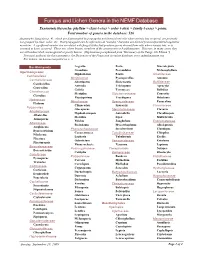
9B Taxonomy to Genus
Fungus and Lichen Genera in the NEMF Database Taxonomic hierarchy: phyllum > class (-etes) > order (-ales) > family (-ceae) > genus. Total number of genera in the database: 526 Anamorphic fungi (see p. 4), which are disseminated by propagules not formed from cells where meiosis has occurred, are presently not grouped by class, order, etc. Most propagules can be referred to as "conidia," but some are derived from unspecialized vegetative mycelium. A significant number are correlated with fungal states that produce spores derived from cells where meiosis has, or is assumed to have, occurred. These are, where known, members of the ascomycetes or basidiomycetes. However, in many cases, they are still undescribed, unrecognized or poorly known. (Explanation paraphrased from "Dictionary of the Fungi, 9th Edition.") Principal authority for this taxonomy is the Dictionary of the Fungi and its online database, www.indexfungorum.org. For lichens, see Lecanoromycetes on p. 3. Basidiomycota Aegerita Poria Macrolepiota Grandinia Poronidulus Melanophyllum Agaricomycetes Hyphoderma Postia Amanitaceae Cantharellales Meripilaceae Pycnoporellus Amanita Cantharellaceae Abortiporus Skeletocutis Bolbitiaceae Cantharellus Antrodia Trichaptum Agrocybe Craterellus Grifola Tyromyces Bolbitius Clavulinaceae Meripilus Sistotremataceae Conocybe Clavulina Physisporinus Trechispora Hebeloma Hydnaceae Meruliaceae Sparassidaceae Panaeolina Hydnum Climacodon Sparassis Clavariaceae Polyporales Gloeoporus Steccherinaceae Clavaria Albatrellaceae Hyphodermopsis Antrodiella -
Re-Thinking the Classification of Corticioid Fungi
mycological research 111 (2007) 1040–1063 journal homepage: www.elsevier.com/locate/mycres Re-thinking the classification of corticioid fungi Karl-Henrik LARSSON Go¨teborg University, Department of Plant and Environmental Sciences, Box 461, SE 405 30 Go¨teborg, Sweden article info abstract Article history: Corticioid fungi are basidiomycetes with effused basidiomata, a smooth, merulioid or Received 30 November 2005 hydnoid hymenophore, and holobasidia. These fungi used to be classified as a single Received in revised form family, Corticiaceae, but molecular phylogenetic analyses have shown that corticioid fungi 29 June 2007 are distributed among all major clades within Agaricomycetes. There is a relative consensus Accepted 7 August 2007 concerning the higher order classification of basidiomycetes down to order. This paper Published online 16 August 2007 presents a phylogenetic classification for corticioid fungi at the family level. Fifty putative Corresponding Editor: families were identified from published phylogenies and preliminary analyses of unpub- Scott LaGreca lished sequence data. A dataset with 178 terminal taxa was compiled and subjected to phy- logenetic analyses using MP and Bayesian inference. From the analyses, 41 strongly Keywords: supported and three unsupported clades were identified. These clades are treated as fam- Agaricomycetes ilies in a Linnean hierarchical classification and each family is briefly described. Three ad- Basidiomycota ditional families not covered by the phylogenetic analyses are also included in the Molecular systematics classification. All accepted corticioid genera are either referred to one of the families or Phylogeny listed as incertae sedis. Taxonomy ª 2007 The British Mycological Society. Published by Elsevier Ltd. All rights reserved. Introduction develop a downward-facing basidioma. -
Polypore Diversity in North America with an Annotated Checklist
Mycol Progress (2016) 15:771–790 DOI 10.1007/s11557-016-1207-7 ORIGINAL ARTICLE Polypore diversity in North America with an annotated checklist Li-Wei Zhou1 & Karen K. Nakasone2 & Harold H. Burdsall Jr.2 & James Ginns3 & Josef Vlasák4 & Otto Miettinen5 & Viacheslav Spirin5 & Tuomo Niemelä 5 & Hai-Sheng Yuan1 & Shuang-Hui He6 & Bao-Kai Cui6 & Jia-Hui Xing6 & Yu-Cheng Dai6 Received: 20 May 2016 /Accepted: 9 June 2016 /Published online: 30 June 2016 # German Mycological Society and Springer-Verlag Berlin Heidelberg 2016 Abstract Profound changes to the taxonomy and classifica- 11 orders, while six other species from three genera have tion of polypores have occurred since the advent of molecular uncertain taxonomic position at the order level. Three orders, phylogenetics in the 1990s. The last major monograph of viz. Polyporales, Hymenochaetales and Russulales, accom- North American polypores was published by Gilbertson and modate most of polypore species (93.7 %) and genera Ryvarden in 1986–1987. In the intervening 30 years, new (88.8 %). We hope that this updated checklist will inspire species, new combinations, and new records of polypores future studies in the polypore mycota of North America and were reported from North America. As a result, an updated contribute to the diversity and systematics of polypores checklist of North American polypores is needed to reflect the worldwide. polypore diversity in there. We recognize 492 species of polypores from 146 genera in North America. Of these, 232 Keywords Basidiomycota . Phylogeny . Taxonomy . species are unchanged from Gilbertson and Ryvarden’smono- Wood-decaying fungus graph, and 175 species required name or authority changes.