A Multi-Method Approach to Understanding Repression of Irish Republicans1
Total Page:16
File Type:pdf, Size:1020Kb
Load more
Recommended publications
-
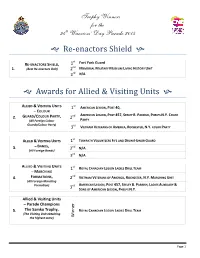
Re-Enactors Shield Awards for Allied & Visiting Units
Trophy Winners for the 94th Warriors’ Day Parade 2015 Re-enactors Shield st Fort York Guard RE-ENACTORS SHIELD, 1 nd 1. (Best Re-enactors Unit) 2 MEMORIAL MILITARY MUSEUM LIVING HISTORY UNIT 3rd N/A Awards for Allied & Visiting Units ALLIED & VISITING UNITS st 1 AMERICAN LEGION, POST 40, – COLOUR AMERICAN LEGION, POST 457, SEELEY B. PARRISH, PHELPS N.Y. COLOR 2. GUARD/COLOUR PARTY, 2nd (All Foreign Colour PARTY Guards/Colour Party) rd VIETNAM VETERANS OF AMERICA, ROCHESTER, N.Y. COLOR PARTY 3 st ALLIED & VISITING UNITS 1 TOWPATH VOLUNTEERS FIFE AND DRUM HONOR GUARD – BANDS, nd 3. 2 N/A (All Foreign Bands) 3rd N/A ALLIED & VISITING UNITS st 1 ROYAL CANADIAN LEGION LADIES DRILL TEAM – MARCHING nd 4. FORMATIONS, 2 VIETNAM VETERANS OF AMERICA, ROCHESTER, N.Y. MARCHING UNIT (All Foreign Marching AMERICAN LEGION, POST 457, SEELEY B. PARRISH, LADIES AUXILIARY & Formation) 3rd SONS OF AMERICAN LEGION, PHELPS N.Y. Allied & Visiting Units – Parade Champions 5. The Samko Trophy, ROYAL CANADIAN LEGION LADIES DRILL TEAM (The Visiting Unit obtaining the highest score) Winner Page 1 Trophy Winners for the 94th Warriors’ Day Parade 2015 Awards for Non-Veteran Units in Canada st The Molson Trophy, 1 DERRY FLUTE BAND (Flute, Fife, Accordion & Drum nd ULSTER ACCORDION BAND 6. Band) 2 rd 3 N/A The LCol, The st 1 32 CANADIAN BRIGADE GROUP Honourable J. Keiller MacKay Memorial nd 7. Trophy and Plaque 2 N/A (CAF Regular & Reserve Marching Formations) 3rd N/A Awards for Canadian Veteran Units st The Canon Scott 1 ROYAL REGIMENT OF CANADA ASSOCIATION Trophy, ROYAL CANADIAN LEGION, DISTRICT E, ONTARIO COMMAND, MARCHING 8. -

King's Research Portal
View metadata, citation and similar papers at core.ac.uk brought to you by CORE provided by King's Research Portal King’s Research Portal DOI: 10.1080/1057610X.2017.1283195 Document Version Peer reviewed version Link to publication record in King's Research Portal Citation for published version (APA): Woodford, I., & Smith, M. L. R. (2017). The Political Economy of the Provos: Inside the Finances of the Provisional IRA – A Revision. STUDIES IN CONFLICT AND TERRORISM. https://doi.org/10.1080/1057610X.2017.1283195 Citing this paper Please note that where the full-text provided on King's Research Portal is the Author Accepted Manuscript or Post-Print version this may differ from the final Published version. If citing, it is advised that you check and use the publisher's definitive version for pagination, volume/issue, and date of publication details. And where the final published version is provided on the Research Portal, if citing you are again advised to check the publisher's website for any subsequent corrections. General rights Copyright and moral rights for the publications made accessible in the Research Portal are retained by the authors and/or other copyright owners and it is a condition of accessing publications that users recognize and abide by the legal requirements associated with these rights. •Users may download and print one copy of any publication from the Research Portal for the purpose of private study or research. •You may not further distribute the material or use it for any profit-making activity or commercial gain •You may freely distribute the URL identifying the publication in the Research Portal Take down policy If you believe that this document breaches copyright please contact librarypure@kcl.ac.uk providing details, and we will remove access to the work immediately and investigate your claim. -
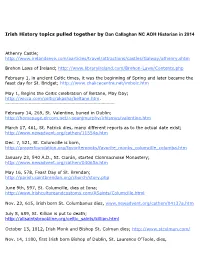
Irish History Links
Irish History topics pulled together by Dan Callaghan NC AOH Historian in 2014 Athenry Castle; http://www.irelandseye.com/aarticles/travel/attractions/castles/Galway/athenry.shtm Brehon Laws of Ireland; http://www.libraryireland.com/Brehon-Laws/Contents.php February 1, in ancient Celtic times, it was the beginning of Spring and later became the feast day for St. Bridget; http://www.chalicecentre.net/imbolc.htm May 1, Begins the Celtic celebration of Beltane, May Day; http://wicca.com/celtic/akasha/beltane.htm. ------------------------------------------------------------------------------------ February 14, 269, St. Valentine, buried in Dublin; http://homepage.eircom.net/~seanjmurphy/irhismys/valentine.htm March 17, 461, St. Patrick dies, many different reports as to the actual date exist; http://www.newadvent.org/cathen/11554a.htm Dec. 7, 521, St. Columcille is born, http://prayerfoundation.org/favoritemonks/favorite_monks_columcille_columba.htm January 23, 540 A.D., St. Ciarán, started Clonmacnoise Monastery; http://www.newadvent.org/cathen/04065a.htm May 16, 578, Feast Day of St. Brendan; http://parish.saintbrendan.org/church/story.php June 9th, 597, St. Columcille, dies at Iona; http://www.irishcultureandcustoms.com/ASaints/Columcille.html Nov. 23, 615, Irish born St. Columbanus dies, www.newadvent.org/cathen/04137a.htm July 8, 689, St. Killian is put to death; http://allsaintsbrookline.org/celtic_saints/killian.html October 13, 1012, Irish Monk and Bishop St. Colman dies; http://www.stcolman.com/ Nov. 14, 1180, first Irish born Bishop of Dublin, St. Laurence O'Toole, dies, www.newadvent.org/cathen/09091b.htm June 7, 1584, Arch Bishop Dermot O'Hurley is hung by the British for being Catholic; http://www.exclassics.com/foxe/dermot.htm 1600 Sept. -
Identity, Authority and Myth-Making: Politically-Motivated Prisoners and the Use of Music During the Northern Irish Conflict, 1962 - 2000
View metadata, citation and similar papers at core.ac.uk brought to you by CORE provided by Queen Mary Research Online Identity, authority and myth-making: Politically-motivated prisoners and the use of music during the Northern Irish conflict, 1962 - 2000 Claire Alexandra Green Submitted in partial fulfillment of the requirements of the Degree of Doctor of Philosophy 1 I, Claire Alexandra Green, confirm that the research included within this thesis is my own work or that where it has been carried out in collaboration with, or supported by others, that this is duly acknowledged below and my contribution indicated. Previously published material is also acknowledged below. I attest that I have exercised reasonable care to ensure that the work is original, and does not to the best of my knowledge break any UK law, infringe any third party’s copyright or other Intellectual Property Right, or contain any confidential material. I accept that the College has the right to use plagiarism detection software to check the electronic version of the thesis. I confirm that this thesis has not been previously submitted for the award of a degree by this or any other university. The copyright of this thesis rests with the author and no quotation from it or information derived from it may be published without the prior written consent of the author. Signature: Date: 29/04/19 Details of collaboration and publications: ‘It’s All Over: Romantic Relationships, Endurance and Loyalty in the Songs of Northern Irish Politically-Motivated Prisoners’, Estudios Irlandeses, 14, 70-82. 2 Abstract. In this study I examine the use of music by and in relation to politically-motivated prisoners in Northern Ireland, from the mid-1960s until 2000. -

BUZZ Newsletter January
January 2015 ANAF Unit #68 “The Friendly Club” Volume 206 THE BUZZ and liberated our country. My father was then sent to Indonesia, a Dutch colony at YOUR the time, who were fighting for PRESIDENT’S their Independence, and he did not return REPORT for 4 years. I was 5 years old when we were finally re-united. "HAPPY 2015" Comrades! After the war ended my dad said "Canada is where we are going" so in 1951 we arrived in Quebec City and moved to It is no coincidence that when you get this Niagara Falls, Ontario, where my 93 year month’s Buzz I will have celebrated my old mother still resides. 70th birthday. It has also been 70 years since World War II. Therefore I thought I Today in Holland, school children age 6, would share a true personal story. I was are assigned a gravestone at a Canadian born, January 7, 1945 in Holland. I was Cemetery. They must learn all they can born 6 weeks pre-mature, weighing only 2 about the soldiers name on the grave and lbs 8 ozs. Since it was only 6 months after clean and look after their soldier's grave D-Day, a lot of people think that the war until they leave elementary school ended in 1945 but believe me it did not. and then another 6 year old is given the task. This remembrance and respect will As the Germans knew they were losing the go on forever. war in Europe they were extremely cruel; there was no food, water or any utilities The Dutch people will never forget the and my father, who was a Lieutenant in the contribution and sacrifices made by our Dutch army, had to go underground. -
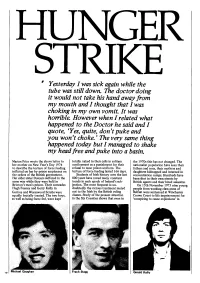
Article on Hungerstrike
" Yesterday I was sick again while the tube was still down. The doctor doing it would not take his hand away [rom my mouth and I thought that I was choking in my own vomit. It was homble. However when I related what happened to the Doctor he said and I quote, 'Yes, quite, don'tpuke and you won't choke. ' The very same thing happened today but I managed to shake my head [ree and puke into a basin. Marian Price wrote the above letter to totaHy naked in their ceHs in solitary the 1970s this has not changed. The her mother on New Year's Day 1974 confinement as a punishment for their nationalist population have seen their to describe the torture of force feeding refusal to wear prison uniform. The fathers and sons, their mothers and inflicted on her by prison employees on torture of force feeding lasted 166 days. daughters kidnapped and interned in the orders of the British government. Students of Irish history over the last concentration camps. Hundreds have Her eIder sister Dolours suffered in the 800 years have noted many constant been shot in their own streets by same way while they were held in trends in each epoch of Ireland's sub• British agents and their hired assassins. Brixton's men's prison. Their comrades jection. The most frequent is un• On 15th November 1973 nine young Hugh Feeney and Gerry KeHy in doubtedly the vicious treatment meted people from working class areas of Gartree and Wormwood Scrubs were out to the Irish by the British ruling Belfast were sentenced at Winchester equally brutally treated. -

Thatcher, Northern Ireland and Anglo-Irish Relations, 1979-1990
From ‘as British as Finchley’ to ‘no selfish strategic interest’: Thatcher, Northern Ireland and Anglo-Irish Relations, 1979-1990 Fiona Diane McKelvey, BA (Hons), MRes Faculty of Arts, Humanities and Social Sciences of Ulster University A thesis submitted in partial fulfilment of the requirements of the Ulster University for the degree of Doctor of Philosophy August 2018 I confirm that the word count of this thesis is less than 100,000 words excluding the title page, contents, acknowledgements, summary or abstract, abbreviations, footnotes, diagrams, maps, illustrations, tables, appendices, and references or bibliography Contents Acknowledgements i Abstract ii Abbreviations iii List of Tables v Introduction An Unrequited Love Affair? Unionism and Conservatism, 1885-1979 1 Research Questions, Contribution to Knowledge, Research Methods, Methodology and Structure of Thesis 1 Playing the Orange Card: Westminster and the Home Rule Crises, 1885-1921 10 The Realm of ‘old unhappy far-off things and battles long ago’: Ulster Unionists at Westminster after 1921 18 ‘For God's sake bring me a large Scotch. What a bloody awful country’: 1950-1974 22 Thatcher on the Road to Number Ten, 1975-1979 26 Conclusion 28 Chapter 1 Jack Lynch, Charles J. Haughey and Margaret Thatcher, 1979-1981 31 'Rise and Follow Charlie': Haughey's Journey from the Backbenches to the Taoiseach's Office 34 The Atkins Talks 40 Haughey’s Search for the ‘glittering prize’ 45 The Haughey-Thatcher Meetings 49 Conclusion 65 Chapter 2 Crisis in Ireland: The Hunger Strikes, 1980-1981 -
A Short History of Irish Memory in the Long Twentieth Century
Thomas Bartlett (ed.), The Cambridge History of Ireland Irish Memory in the Long Twentieth Century (Cambridge, 2018), vol. IV: 1800 to Present would later be developed by his disciple Maurice Halbwachs, who coined the term collective memory ('la memoire collective'). By calling attention to the social frameworks in which memory is framed ('les cadres sociaux de la 23 · memoire'), Halbwachs presented a sound theoretical model for understand ing how individual members of a society collectively remember their past. 3 A Short History of Irish Memory in The impression that modernisation had uprooted people from tradition and the Long Twentieth Century that mass society suffered from atomised impersonality gave birth to a vogue GUY BEINER for commemoration, which was seen as a fundamental act of communal soli darity, in that it projected an illusion of continuity with the past.4 Ireland, outside of Belfast, did not undergo industrialisation on a scale comparable with England, and yet Irish society was not spared the upheaval On the cusp of the twentieth century; Ireland was obsessed with memoriali of modernity. The Great Famine had decimated vernacular Gaelic culture sation. This condition reflected a transnational zeitgeist that was indicative of and resulted in massive emigration. An Irish variant of fin de siecle angst over a crisis of memory throughout Europe. The outcome of rapid modernisa degeneration fed on apprehensions that British rule would ultimately result tion, manifested through changes ushered in by such far-reaching processes in the loss of 'native' identity. The perceived threat to national culture, artic as industrialisation, urbanisation, commercialisation and migration, raised ulated in Douglas Hyde's manifesto on 'The Necessity for De-Anglicising fears that the rituals and customs through which the past had been habitually Ireland' (1892), stimulated a vigorous response in the form of the Irish Revival remembered in the countryside were destined to be swept away. -
Module 2 Questions & Answers
QUESTIONS & ANSWERS LESSON 1 // CIVIL RIGHTS IN NORTHERN IRELAND 1. Which group were formed on 29th January 1967? Northern Ireland Civil Rights Association (NICRA). 2. Which group formed as a result of an incident on 5th October 1968? People’s Democracy. 3. a) Which act established the Northern Ireland Housing Executive and when was it passed? ry The Housing Executive Act, 25th February 1971. ra Lib ills (c) RTÉ St 3. b) Which act appointed a Boundaries Commissioner and what was their job? The Local Government Boundaries Act. The job of the Boundaries Commissioner was to recommend the boundaries and names of new district councils and ward areas. 4. Why may some members of the Catholic community have been outraged by the incident which resulted in a protest at Caledon on 20th June 1968? Student’s answers should highlight the allocation of a house to a young, single Protestant female ahead of older Catholic families. EXTENSION ACTIVITY 1 The Cameron Report was set up in January 1969 to look into civil disturbances in Northern Ireland. Looking at the key events, which events may have lead to the establishment of the report? Student’s answers should make mention of disturbances which followed the events of the 5th October 1968 and 1st January 1969. EXTENSION ACTIVITY 2 Below is a table which lists the demands of NICRA. Read through the list of reforms/acts and write down the name of the reform/act which addressed each demand. NICRA DEMANDS REFORM / ACT One man, one vote Electoral Law Act An end to gerrymandering – an end to the setting of -
The Path to Revolutionary Violence Within the Weather Underground and Provisional IRA
The Path to Revolutionary Violence within the Weather Underground and Provisional IRA Edward Moran HIS 492: Seminar in History December 17, 2019 Moran 1 The 1960’s was a decade defined by a spirit of activism and advocacy for change among oppressed populations worldwide. While the methods for enacting change varied across nations and peoples, early movements such as that for civil rights in America were often committed to peaceful modes of protest and passive resistance. However, the closing years of the decade and the dawn of the 1970’s saw the patterned global spread of increasingly militant tactics used in situations of political and social unrest. The Weather Underground Organization (WUO) in America and the Provisional Irish Republican Army (PIRA) in Ireland, two such paramilitaries, comprised young activists previously involved in the Students for a Democratic Society (SDS) and the Northern Irish Civil Rights Association (NICRA) respectively. What caused them to renounce the non-violent methods of the Students for a Democratic Society and the Northern Irish Civil Rights Association for the militant tactics of the Weather Underground and Irish Republican Army, respectively? An analysis of contemporary source materials, along with more recent scholarly works, reveals that violent state reactions to more passive forms of demonstration in the United States and Northern Ireland drove peaceful activists toward militancy. In the case of both the Weather Underground and the Provisional Irish Republican Army in the closing years of the 1960s and early years of the 1970s, the bulk of combatants were young people with previous experience in more peaceful campaigns for civil rights and social justice. -

Dziadok Mikalai 1'St Year Student
EUROPEAN HUMANITIES UNIVERSITY Program «World Politics and economics» Dziadok Mikalai 1'st year student Essay Written assignment Course «International relations and governances» Course instructor Andrey Stiapanau Vilnius, 2016 The Troubles (Northern Ireland conflict 1969-1998) Plan Introduction 1. General outline of a conflict. 2. Approach, theory, level of analysis (providing framework). Providing the hypothesis 3. Major actors involved, definition of their priorities, preferences and interests. 4. Origins of the conflict (historical perspective), major actions timeline 5. Models of conflicts, explanations of its reasons 6. Proving the hypothesis 7. Conclusion Bibliography Introduction Northern Ireland conflict, called “the Troubles” was the most durable conflict in the Europe since WW2. Before War in Donbass (2014-present), which lead to 9,371 death up to June 3, 20161 it also can be called the bloodiest conflict, but unfortunately The Donbass War snatched from The Troubles “the victory palm” of this dreadful competition. The importance of this issue, however, is still essential and vital because of challenges Europe experience now. Both proxy war on Donbass and recent terrorist attacks had strained significantly the political atmosphere in Europe, showing that Europe is not safe anymore. In this conditions, it is necessary for us to try to assume, how far this insecurity and tensions might go and will the circumstances and the challenges of a international relations ignite the conflict in Northern Ireland again. It also makes sense for us to recognize that the Troubles was also a proxy war to a certain degree 23 Sources, used in this essay are mostly mass-media articles, human rights observers’ and international organizations reports, and surveys made by political scientists on this issue. -

Honour Guard Free
FREE HONOUR GUARD PDF Dan Abnett | 416 pages | 20 Oct 2015 | GAMES WORKSHOP | 9781784960049 | English | United States Honor Guard | Definition of Honor Guard by Merriam-Webster A guard of honour GBalso honor Honour Guard USalso ceremonial guardis a guard, usually military in nature, appointed to receive or guard a head of state or other dignitaries, the fallen in war, or to attend at state ceremonials, especially funerals. In military weddings, especially those of commissioned officers, a guard, composed usually of service members of the same branch, form the Saber arch. In principle any military unit could act as a guard of honour. However, in some countries certain units are specially designated to serve as a guard of honour, as well as other public duties. Guards of Honour also serve in the civilian world for fallen police officers and other civil servants. Certain religious bodies, especially Churches of Honour Guard Anglican Communion and the Methodist movement, have the tradition of an Honour Guard Honour Guard the funeral of an ordained elder, in which all other ordained elders present "guard the line" between the door of the church and the grave, or hearse if the deceased is to be buried elsewhere or cremated. Guards of honour have been mounted by a number of military forces, uniformed paramilitary organizations, and civilian emergency services. Composed of Honour Guard, troops, it is very similar in its formation style to equivalent units in the French Army. The Republican Guard includes a military band and a cavalry unit, the uniform and traditions of which Honour Guard based on those of the famous Berber cavalry, the Numidian cavalrythe French cavalry, and the Arab cavalry, as well as infantry.